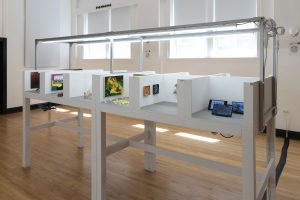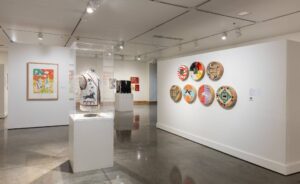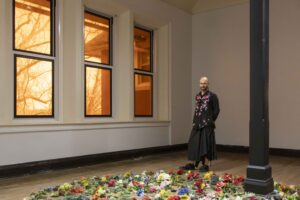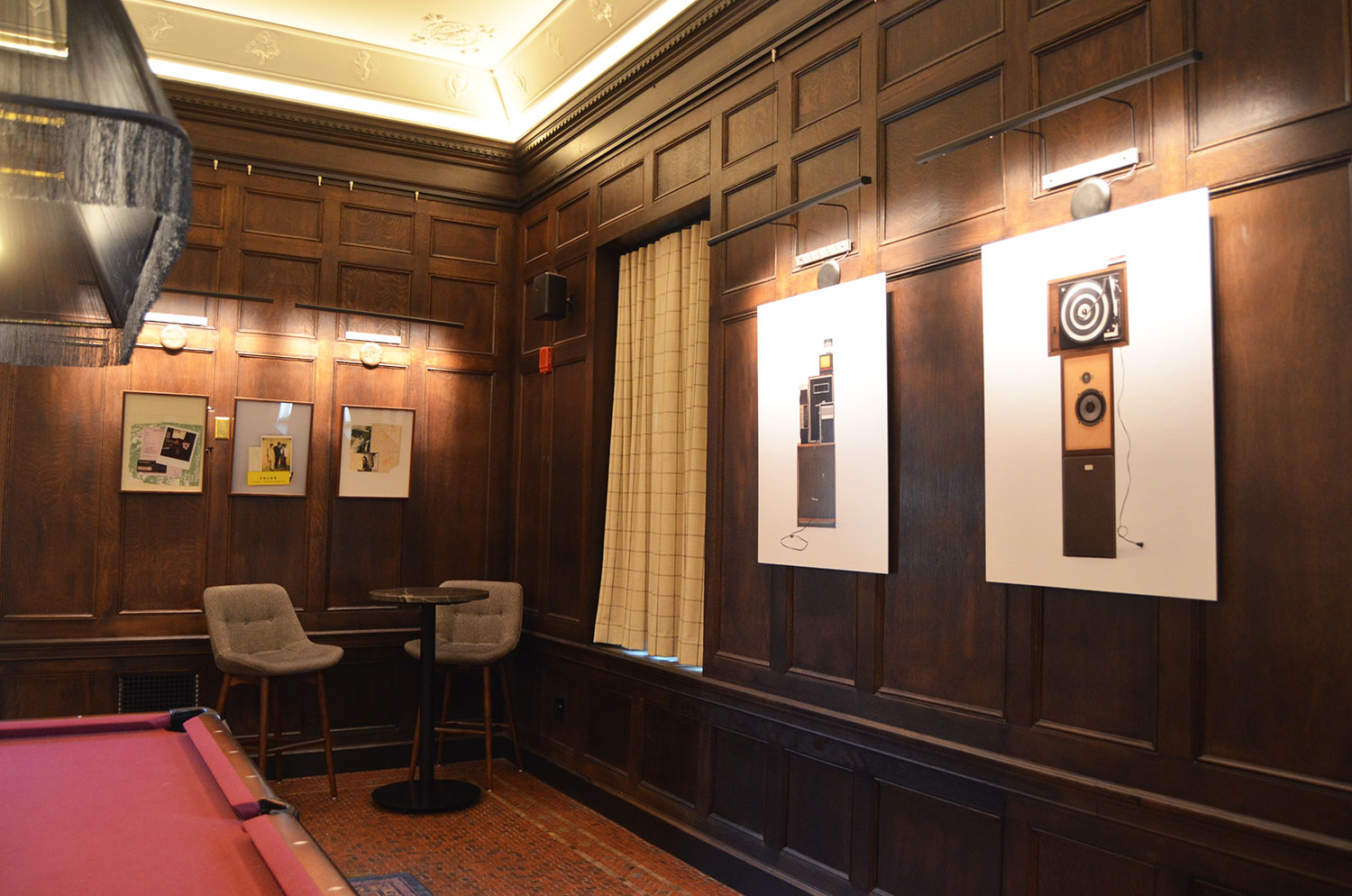
At the 21c Museum Hotel in St. Louis, Jen Everett’s lens-based works adorn the dark-wood walls in the billiards room. Although she is originally from Detroit with firm roots in the city, she has a clear place in St. Louis’s art scene as not only a participant of various exhibitions and the city-wide art intervention Counterpublic back in 2023, but also previously as an adjunct professor at Washington University. During my stay in St. Louis, I was able to see her work on view at the museum as well as in the exhibition Beneath the City, A World at The Luminary.
I’ve always been interested in family archives. As a twin, seeing photos of myself as a child has always elicited strange feelings. Is that really me? Who took this photo? What happens when the context around the photo changes as I grow up and learn more about my family and about who we are as individuals? Similar questions are probed in the work of Jen Everett, although through a different lens. In her recent work, time folds in on itself through the way she layers photos from family archives—sometimes from her family, sometimes not. Photos, stickers, and collected ephemera are collected and arranged, forming a complicated picture that is perhaps more akin to reality, or what we remember to be reality. Like the act of remembering, Everett’s imagery is offered in beautiful pieces—a fragmentation that compels a type of recounting that is both imperfect and complete.
While viewing her work, the artist and I discuss the way family albums become curated timelines, a kind of intentional sequencing whose intent may not make sense to the viewer, but contain their own truth and logic passed on through the hands that arranged them.
Through sonic memory, nostalgia, and strategic nods to Black interiority, Everett beautifully investigates not only the ways in which she can create a continuity and clarity within her lineage, family history, and individual story, but also offers a path for viewers to do the same.
Christina Nafziger (CN): I’m really interested in family albums and archives. I would love to talk to you about the place archives have in your practice. I’m really Interested in hearing what a photo album means to you and the importance the archive—and specifically family archives—has in your work and your life.
Jen Everett (JE): That’s a great question. I’m from Detroit and my family, specifically my grandmother and my father, were furious picture takers. My grandmother wasn’t the best photographer, but it was more about making a record and documenting her life and her children’s lives. My father had a knack for and was a photographer, even though I don’t think he saw himself in that way. So there were lots of pictures displayed on the mantle and in the photo albums, and so I didn’t see or even think about photography as an art form. It was more just what families do. There are so many photographs of us looking at pictures. To me, an album is almost its own kind of technology and organizing mechanism. They allow you to touch history in a particular way. I’m very attracted to [albums] for their haptics and tactility, and I think that is somewhat common for people of a certain age because that’s where the technology was.
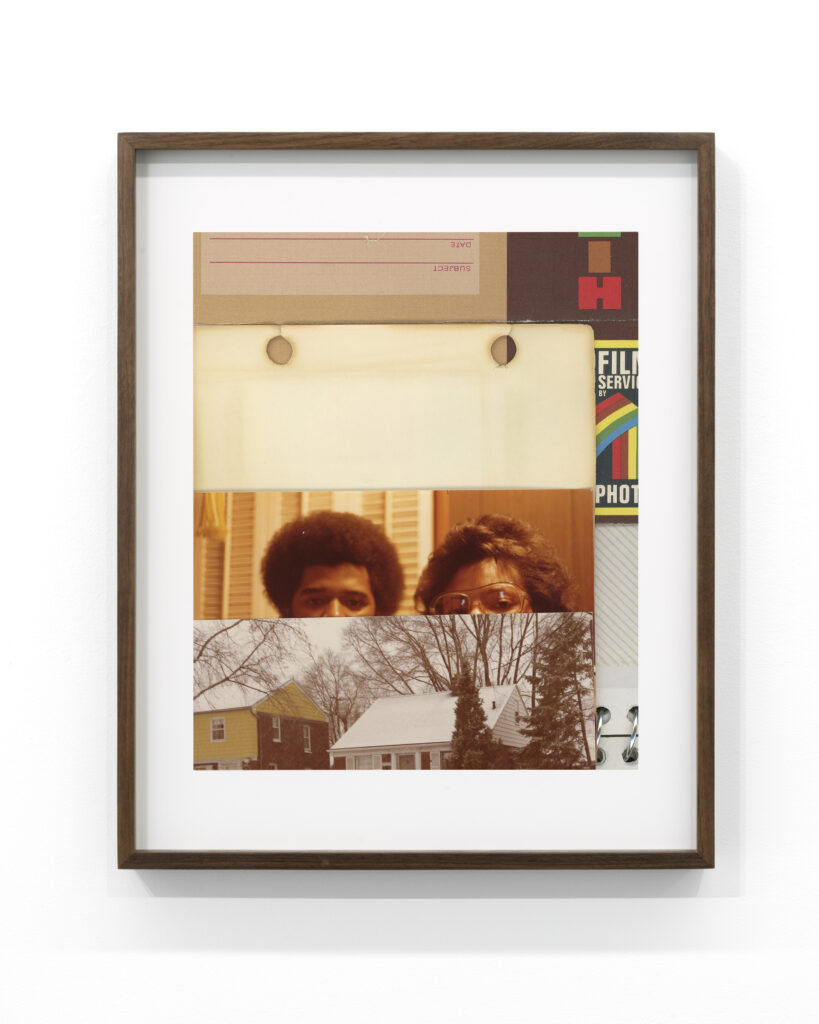
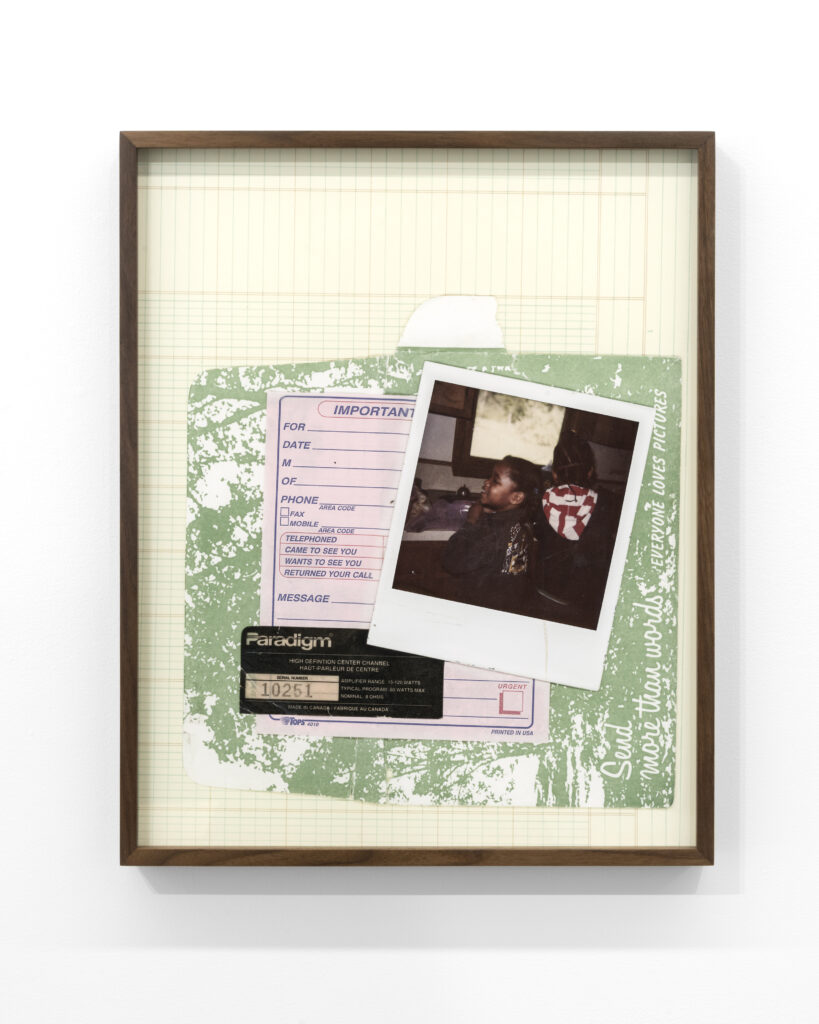
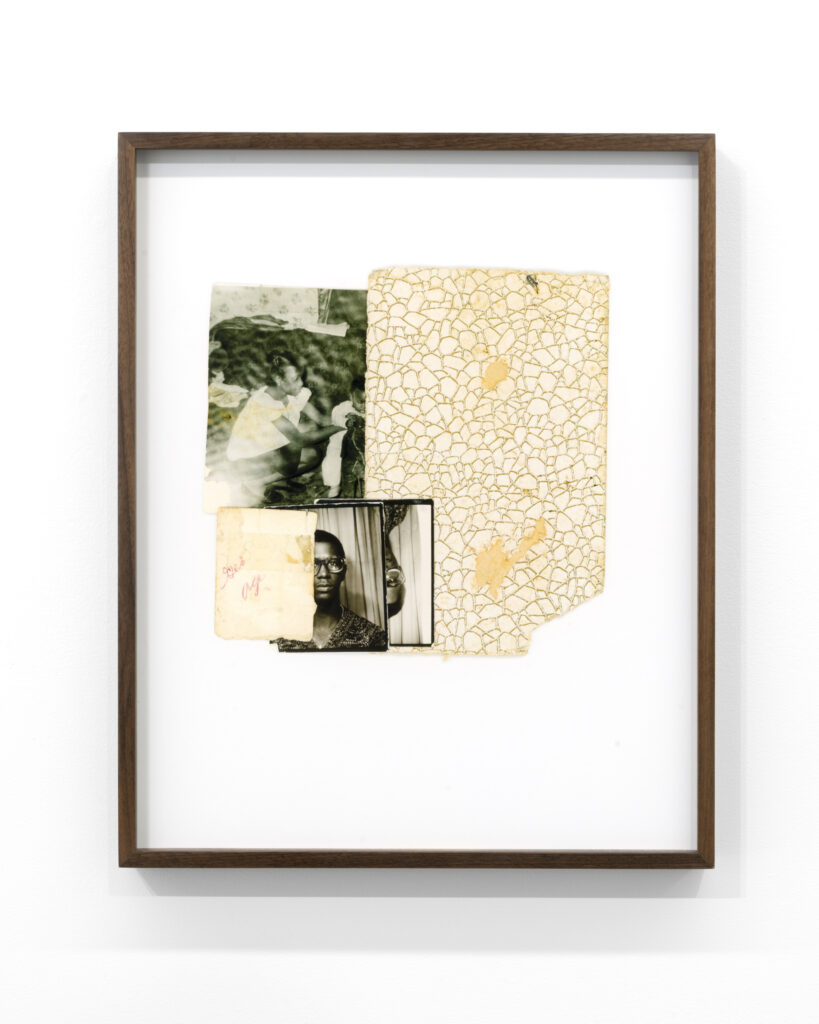
In this Polaroid—this is a picture of me [Everett points to the piece Untitled, 2024 hanging on the wall of the billiards room at 21c Museum Hotel]. This was the technology. On the last day of school in sixth or seventh grade, there’s a picture of me with a big Polaroid [camera] around my neck. That’s how we were documenting each other and making our own records. That’s such a significant thing to me. Most of my memories are in that format up until I’m in undergrad. So I have a lot of physical images and film of me as a young person. I also just encounter and collect physical images. So out of these images here, only this one is from my family. The rest of these figures are unknown to me.
CN: Did you get them from other people, you know, or do you find them at secondhand shops in those bins they have?
JE: Yeah, I do collect from bins. I even have some family photographs of people I don’t know, and whoever could explain [their histories] has passed away. I’m pretty sure someone gave this one to me, which is something that friends will do or people who know my work. Sometimes people who are non-Black will find images of Black people and love them, but know that they aren’t for them to keep or work with, and so they’ll give them to me, and sometimes I work with them and other times I just hang on to them.
CN: What’s in the back of the photo?
JE: That’s from a photo box. I find a lot of little weird pieces of paper…just those strange things you find when you go to thrift stores tucked into a book. I use a lot of speakers [in my work] as well. This is from a label on the speaker that fell off. I’m often taking little bits and trying to build them up. This work was a bit different and I was using this layering effect. Oftentimes I’ll scan and then crop [the images] digitally, but for these I was [using] an additive process rather than a subtractive one.
CN: The adding, subtracting, and layering makes me think of physical photo albums. Sometimes I’ll take a photo out of an album and keep it, but the empty space where it was remains…like a gap in a timeline. When you do this layering, there’s almost a collapsing of time or a remixing of time.
JE: Oh, for sure. I have this photo album that’s like a rolodex that was my grandmother’s, and what you said about order made me think of how I don’t ever want to disturb her order. I’m very careful about, oh, I took this photo out here, so let me make sure I put it back, because that was her organizing principle. And she’s gone. She’s an ancestor and I want to hold onto whatever her thought process was when she was making these selections and the sequencing of the album.
CN: I think that’s really important. It’s not just about who took the photos, but also the physical aspect of arranging.
JE: It’s significant.
CN: Yes, and even if you don’t know why something is arranged the way it is, it made sense to that person.
JE: Even if it was completely random, I still want to preserve it.
CN: Yes! Because that collecting and arranging is part of the archive.
JE: Absolutely. I agree.
CN: So you said your dad was a photographer. Are you the record keeper in your family?
JE: I think I am in a sense because I have a lot of physical material, but everyone in my family plays a role, which is kind of interesting. My father made a lot of pictures, he was the one who had the cameras, even when they weren’t convenient and small. He also took a lot of video, and that was a feat, especially in the early eighties when cameras weren’t accessible in terms of price.
I have a memory…there was a tape, maybe it was my second birthday, so like 1983. My father had rented a video camera and he set it up on the tripod. Then he had the feed running on our floor model TV. So imagine a house party and a bunch of adults and kids are running around in the back room, and everybody’s having their turn cutting up because it’s like, oh, I do this and then I see myself.
CN: That’s so cool.
JE: Now I recognize that [this was] directing, you’re making films. Now that I have this formal training and an understanding of this continuum and history of art making, I recognize that he was doing something broader than making memories. He would set up a camera sometimes and we would just be raking leaves, but he’d film us.
CN: This is so interesting! It really sounds like so many people in your family, like your dad and grandmother, had this urge to not just document it, but like, make this arrangement and make sense of your past and yourself.
JE: Absolutely. I know so much of that is because of the time period. My father’s deceased, but he would be, like, 70 if he were alive. My mother’s about to turn 70. Their parents were the silent generation, and they were part of the great migration. My maternal grandparents are from Mississippi. So when I think about people who grew up in the depression era South…what kind of images of themselves did they see that were representative of who they were? Probably not much. So, of course, that technology of the camera [is] now [much more] accessible. You can create your own image.
CN: There’s such an importance in the point you’re making about representation. Not only that, but thinking about the great migration, going North you’re sort of starting a new life in a sense, and so you can build that new life through physical images. It’s interesting to me because sometimes when folks move to a new place and they’re starting a new life, they’re like, ‘I wanna document all this part of my life’ [but] I’m only revealing this part of my life because this is what I want to show you.
JE: It’s very curated.
CN: Exactly. But this documenting is an important tool to understand yourself and also to create a continuity between your past, present, and future.
JE: Continuity is such an important concept. I love that you use continuity as a term. There’s this woman who’s a public theologian, who I’ve learned about through the work of Adam Pendleton actually. He did the portrait of activist Ruby Sales, and her life is really fascinating. She talks about this term called “generational continuity,” specifically about Black people and the segregated South. When Black people were segregated, there was a kind of continuity because you could not be dispersed. You had to live in a certain area within your community. So within families, that structure was not displaced. It couldn’t be. People typically stayed in close proximity.
As time has moved on, of course things have changed. The Civil Rights Act and other laws have been passed, and people can move freely, which of course is a wonderful thing, but that continuity, as time moves on, is lost. There’s something gained, but there’s also something that’s lost. I don’t gather with my family in the way that I saw my parents’ generation do and I’m sure the next generation won’t gather as much as I did. It’s a continual dispersion. Everybody’s living their own lives and making their own families, but there’s less of that connection to the past or where you came from.
CN: My dad’s side of the family is from Appalachia and the folks who left have very different accents. My dad’s accent was different from his mom’s accent, and then my accent, or maybe dialect, is slightly different from his. So when part of the family leaves, even their ways of speaking disconnects them in a way from the rest of their family.
JE: My grandparents didn’t lose their deep southern accents, and I’m so glad that they didn’t. Certainly there is probably a desire to want to change it depending on circumstances, but I love it when people retain it. Maybe my grandparents’ accent softened a bit or wasn’t as intense, but it was there.
Those are things that make us unique. I think the more we’re online…
CN: It’s making everything homogenized.
JE: I agree, especially when it comes to how people speak, and I can’t stand that. Also the pace! Everyone is trying to talk as if there’s a countdown, like you have to get your point across within 20 seconds. I learned this word “co-evolving,” in the sense of how we’re co-evolving with technologies.
CN: That sounds scary.
JE: We think we’re like telling technology everything, like we’re inputting everything, but it’s also working on us. I think we’re changing cognitively. I think our attention is changing.
CN: Yeah, I totally agree. I wanted to ask you about the emotional toll of going through your family archives. Is it an emotional experience of you, going through your family archives or other people’s archival photos?
JE: The emotion is there. I will say I do think that my practice helps me contend with that. Rupture is a framework that I use in my practice in general, but it also leads me to different bodies of work. So what even got me working with images was the divorce of my parents and that grief. They divorced when I was 35. That kind of blowing up our family structure pushed me to do a project and contend with our family archives, which is something I always wanted to do. You always think you have time, but all of a sudden we’re selling our family home, and we’re all dividing photos, ephemera, video tapes, all of that. So it’s been a way for me to deal with that. Since my father’s passing, I’ve even begun to see his work in a different light, specifically because of the divorce.
CN: It totally makes sense to me when you said the word rupture. When I was refamiliarizing myself with your work, that term really stuck in my brain. When I think about your previous work and I hear the word rupture, it brings to mind the concept of a glitch in term of a split. I also think of rupture in terms of fragmentation. I feel like you’re playing with these fragments and deconstructing and reconstructing them. To me, that fragmentation mirrors the process of remembering. The process of [remembering] is never linear. It is always in fragments. There’s something about these ‘pieces’ that you work with and the way you arrange them that are so much like the way we process memory and remember things.
JE: Yeah. And sometimes it’s not even right, the way you remember things.
CN: Oh, for sure…
JE: …like, misremembering. This is what I love about family and talking about things, because I might remember something one way, and then I talk to my mother and she says, no, it was this way. Then I talk to my brother and he’s like, ‘well, what about this part?’ And somewhere between us, we have a version of what it actually was. That ability [we have] to fill in certain parts or to misremember…you’re so right. It’s not linear. I hadn’t thought about it in that way: rupture in terms of memory. I think about it in terms of time. I appreciate you bringing that up because my graduate thesis that I had to write for my MFA was called “The Rupture Repeats,” and it always comes back around.
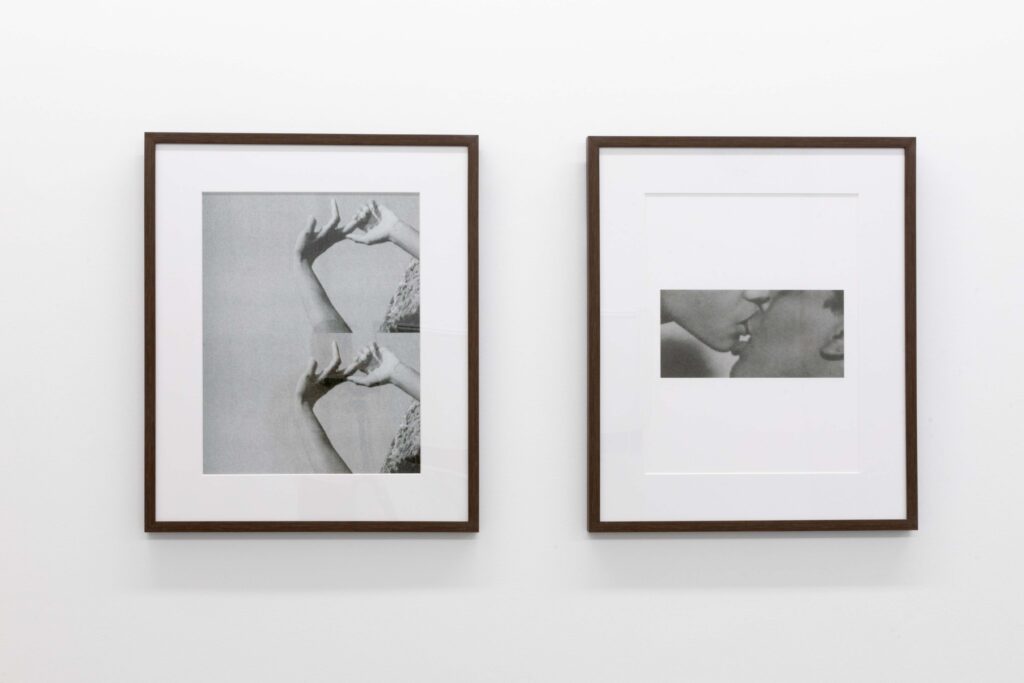
JE: I think of a rupture as anything that forces you to reorient yourself to the world in a broad way. So of course the pandemic is a rupture, but also having a baby is a rupture, getting married as a rupture, a job change. It’s not bad or good. All of that blows your world up and you’ve gotta figure out where you fit in again. That’s how I think about it conceptually, and that concept came from this book by Dionne Brand—a brilliant poet and theorist— called A Map to the Door of No Return. She’s from the Caribbean, and in the book she talks about this experience when she was a child talking to her grandfather and him saying he knew where they were from on the continent of Africa, where their people were from. And she kept asking him, and he was avoiding the question because he couldn’t quite remember. She talked about how it created a rupture between them, a space—because she wanted to know. But he couldn’t tell her. There was this grieving on both of their sides, so I kept that in my mind. I’m always thinking about that space that rupture creates: What can you fill it with? What goes there? What happens? That’s one thing I’m always thinking about, and it does tie in formally to how I’m dealing with different kinds of material.
CN: Wow. I love what you said about the ways rupture requires you to orient and reorient yourself. When I think of orientation I also think of perspective, and when you take a photograph, that perspective there. The viewer is seeing your perspective in a sense, through the photographer’s eyes. I’m thinking about that in relation to your world specifically.
JE: Oh, yeah.
CN: I also think about what the subject of the photos sees when the photo is taken. For example, in the photo of you, you’re seeing your mom take the photo…
JE: …or whoever took it. That’s what I think about more now. The longer you have pictures and the more you look at them, you begin to wonder, well, who took this one? Because that changes the whole thing.
CN: The context!
JE: Yeah, or even the vantage point. There’s this picture of my grandparents and it just dawned on me—I probably took this picture because of the way they’re looking. They look really happy. They’re like looking down, the picture is taken from a lower level. They’re all posing and cheesing, but this is not how they normally would be in a photograph.
CN: But for the grandkid…
JE: Yeah, they’re doing it. I looked at that picture a hundred times and never thought about that. But as an adult I’m like, oh, wow, I was really loved.
CN: That’s so special.
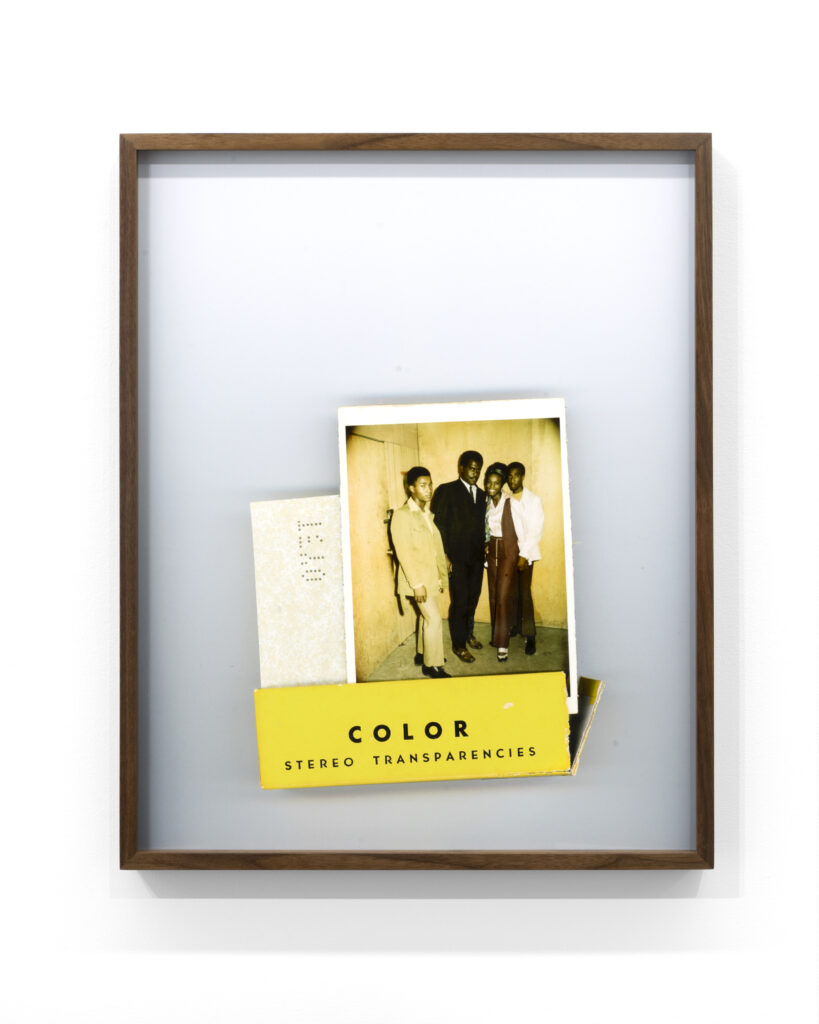
JE: Back to my dad being an artist…my parents met when they were, like, 19 and got married around 24 or 23, and then they had me very soon after they were married. They met because my dad saw my mother in a photograph, which is now so significant to me because I’m like, y’all met because of a picture in the early seventies! I’m actually working on a project about my father.
CN: Is that in relation to the Modern Ancient Brown Fellowship? Congratulations on that by the way!
JE: Thank you. That’s a good segue. I was in Detroit for the entire month of October working on this project about my father. It’s called I Have My Father’s Eyes, and it basically puts his practice as an artist, which we kind of talked about, in conversation with my own. I’ve been looking and listening and just being in Detroit, which was really good. I’ve also been talking to my mother and having conversations. She has an impeccable memory, and so she was telling me about some of the first cars my dad had and how he would always put a new sound system in. He did not want the stock speakers, right? He would always put his own radio in there.
CN: Were they big music people?
JE: Yeah, absolutely. They’re big music people. I mean, being in Detroit in that time and era, how could you not be? My mother has really amazing stories. I didn’t talk to my dad a lot about that, but I did raid his CD case as, like, a tween and a teen and he always had good music. They both did. I have memories of being in the car with them and riding around and just listening. It was all good music, and it was varied. It wasn’t just Motown stuff. My mom talks about listening to rock, you know—just stuff that was around.
“Magic Man” by Heart I think came out the year that my parents started dating, so my mom played that record. I know that whole song front to back because it just reminds me of my mom. So yeah, they’re big music people.
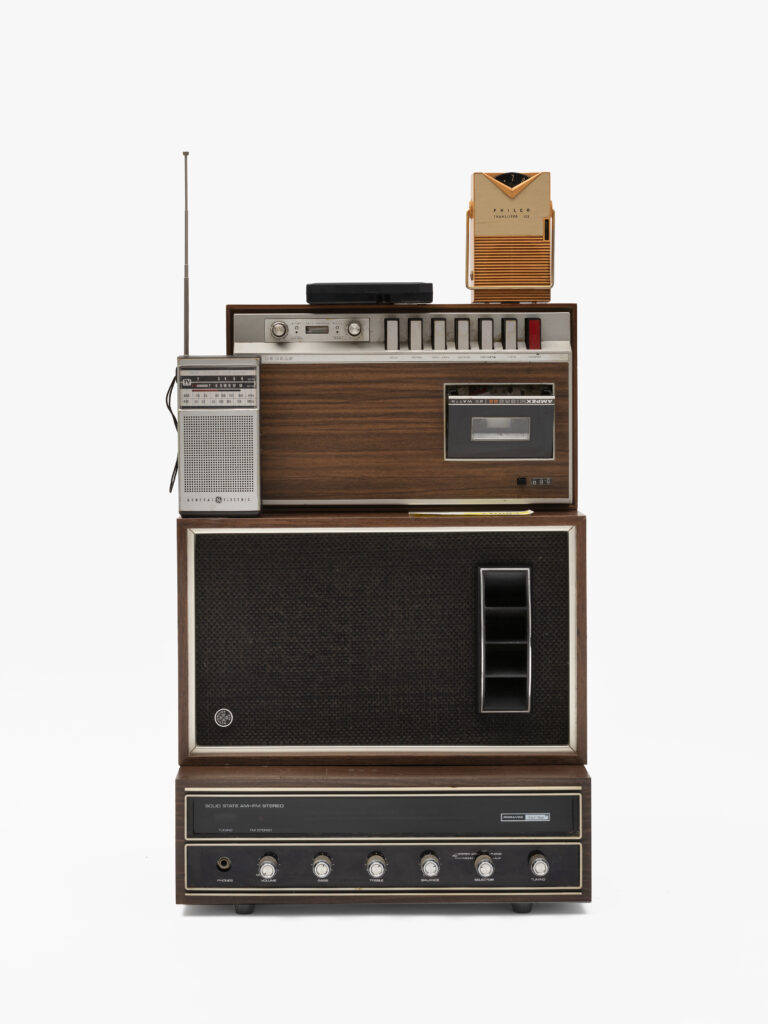
CN: That totally makes sense just thinking about your works on view on the first floor of the stacked vintage speakers. Are sculptures that live in real life that you then photograph?
JE: Yeah.
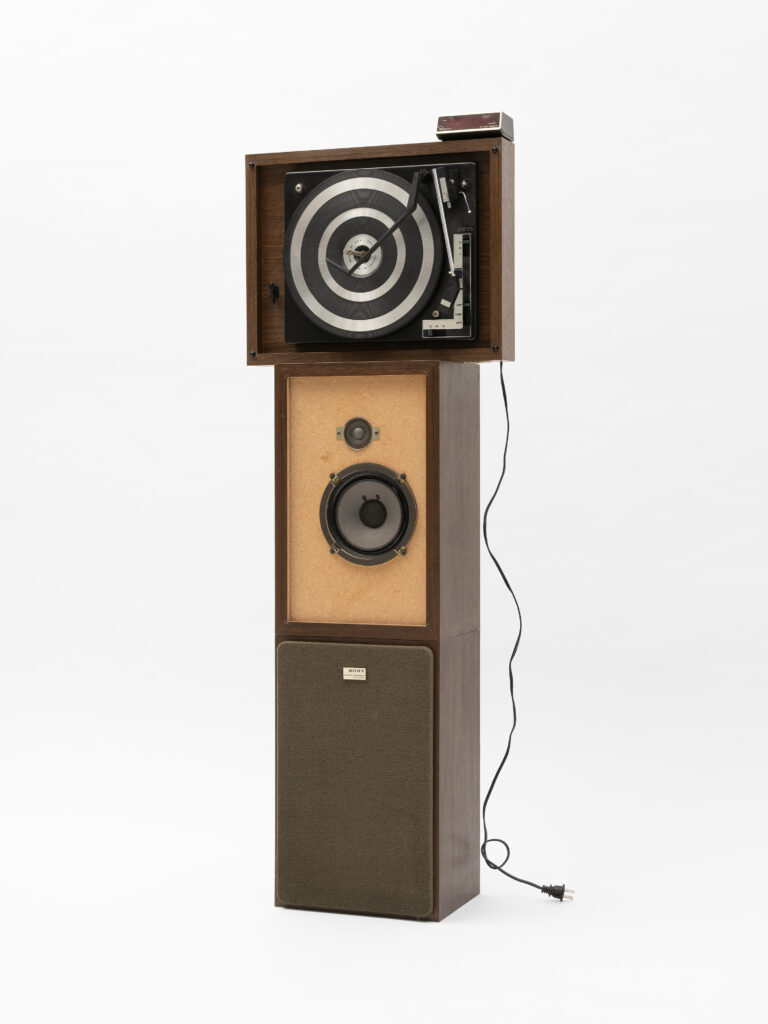
CN: Do you ever display the photographs of the speakers with the speaker sculptures?
JE: No. So this was a unique thing. Ideally you want the actual sculptures, but for that context, I mean, you see, you can’t have the sculptures in [such a public space].
CN: Oh, yeah—next to a pool table in the room.
JE: Yeah, people would be knocking over stuff and picking things up. So that was a unique circumstance where we chose to display them that way. Typically, and you’ll see at The Luminary, they exist as objects.
CN: Thinking about the sculptures vs. the photographs of the sculpture, seeing the physical sculptures in real life, they still feel like collages—sculptural collage. You have all these pieces, and there’s this fragmentation, which relates it back to memory for me. I think it’s interesting to think about visual memory versus sonic memory.
JE: Oh, wow. Yeah.
CN: We have all these different senses that bring back memories and allow you to recall memories in different ways. It’s so interesting how, when you’re seeing these speakers, these cassette tapes in your work, your mind starts filling in the sonic gaps. The music starts playing in your head…
JE: That’s so true.
CN: …but only if you have those memories to begin with. I mean, only if you are familiar with them. When I look at them, I might not hear any music, but if someone else who grew up at home with these objects, they would. If you experienced it, then you’ve experienced it.
JE: That’s such a good point because this actually came up in grad school when I first started making these arrangements in that way—these sculptures. You know, in grad school [students] have to theorize and justify every move [they] make. I remember discussions around if I’m going to activate these works with sound. I thought about it, but the only sound I could kind of think coming from this would be just like a low static—something that you almost don’t even perceive. Then I came to the awareness that nothing that I, nothing that I could activate these with or assign to them would be better than what people’s imagination would conjure for them.
CN: I think that was a good move.
JE: Yeah. I would be open to collaborating and it being something more performance based or, you know, making an installation of objects and then there’s a DJ [performing]. But the sculptures themselves? I’m not interested in them having sound come from them that’s artificial or that’s not actually coming from the components themselves.
CN: I think that totally makes sense. The implied sound is more powerful.
JE: Yep. I agree.
CN: Then what is unheard becomes louder in a sense. To me, what is removed or left blank—visually or sonically—a lot of times is thrown into higher contrast.
JE: Oh, that’s so true.
CN: The fact that there’s no sound makes you hyper aware of the sound in your head.
JE: And that’s different for everyone.
CN: Yeah, totally.
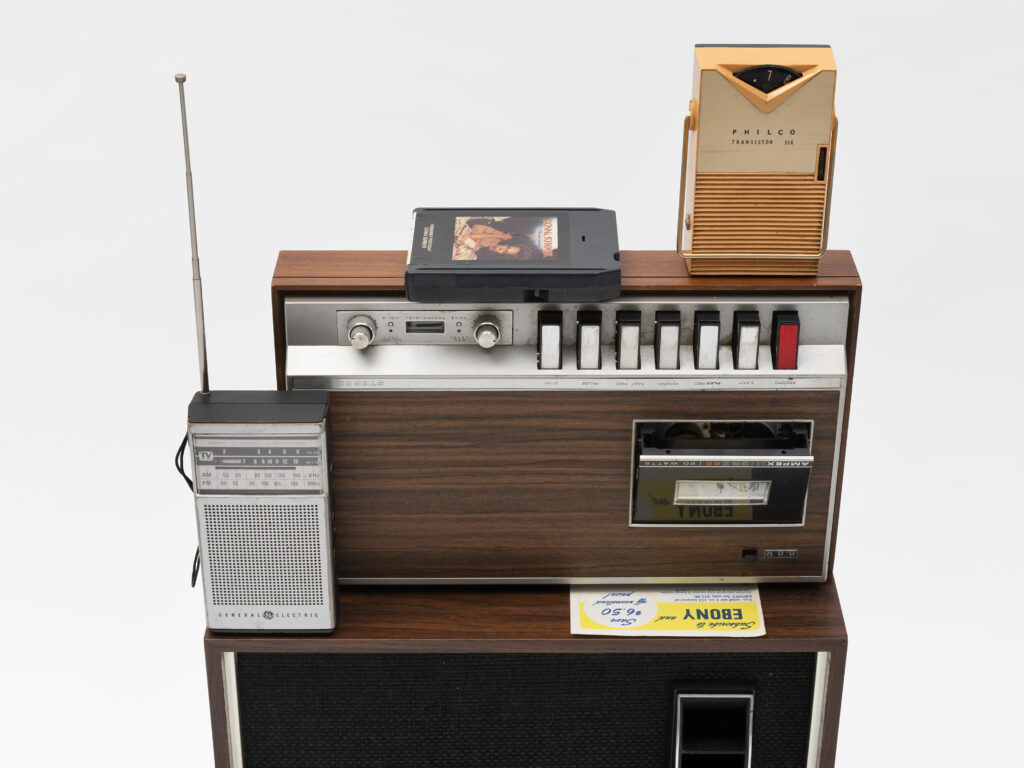
JE: People really react to those for a number of reasons. I think a lot of it is nostalgia. I think some of it too is just that those are beautiful objects. A lot of the things that I come across in thrift stores, they still work. And so I think about that. In some ways it can be hard to part with them because I am a collector, too, so then I began to have an affinity for them. But then, you gotta let it go. I can’t keep everything.
CN: Yeah. I think this too, going back to fragmentation, there’s a connection between this revealing and removal; you’re revealing what you wanna reveal. Is there a strategy there?
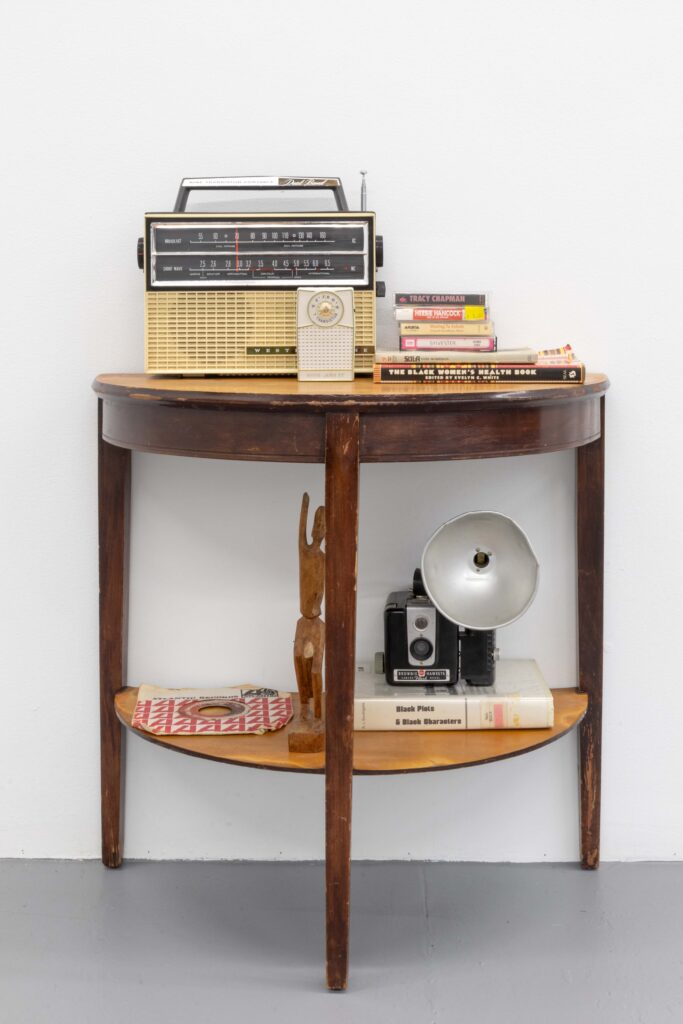
JE: Oh, yeah. I mean, the title of those sculptures is Unheard Sounds, Come Through. It’s inspired of course by what I encounter in thrift stores, but also the rooms that I remember in my home. In the nineties, those big sound systems were becoming obsolete, but we still had them around. They weren’t in use, but I remember in the family room there were speakers like this high.
CN: They were just fixtures of the room.
JE: Yeah. So then it becomes, oh, you’re gonna put a plant on them or whatever. At one point somebody invested in these speakers, and so you don’t want to just throw them away. These big elaborate sound systems or things now that are not of use become interesting objects for me.
They become things that I arrange and work with, and sometimes they’re turned around. I think that gets at what you’re talking about, about what’s being hidden or what’s being revealed. There’s also a conversation about Black interiority. I think about the burden of representation that Black people have—especially American Black people—as being this stand in for a community. When you see someone Black, it’s like they have to be a representative for the race. It’s a flattening of a whole people who are varied and exist in many different ways.
I think about my interior life and your interior world being apart from representation and without that, it’s a free space. I think about your backyard or your basement, or a place where you don’t have to do your code switching—I won’t say everybody Black code switches per se, but there is a way that you move that’s different when you step out into the world rather than when you are with your folks. There’s something that you can drop when you’re with people who are like you and who know you deeply. That’s your interior world.
At The Luminary, there’s an image on the wall that explains what that means visually. If I had to pick an image of Black interiority there’s an image on the wall that speaks to that.
CN: I’m really excited to see your work at The Luminary.
About the author: Christina Nafziger is a writer, editor, critic, and curator based in the occupied lands of so-called Chicago. Earning an M.A. in Contemporary Art Theory from Goldsmiths University of London, her research focuses on the effect photo collections and archiving have on memory and identity and the potential capacity these collections have in altering and editing our current futures. Within her writing practice, she is interested in the intersection of art, labor, and power as well as the ways in which location affects identity and art making in the Midwest. www.christinanafziger.com