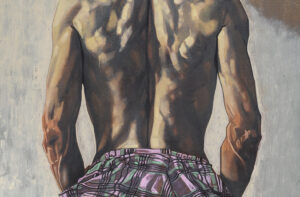
The first time I encountered work by the artist Magicfeifei was less than a year ago, in May 2025. Her work was included in the somewhat discordant MFA group show at the University of Chicago, Substitute Equal Amounts (an experience I wrote about here). Of the odd array of artworks presented by the cohort, Magicfeifei’s anime-influenced pieces had their own gravitational pull. One of the standout pieces was Magicfeifei’s incredible mechanical contraption: In The Name Of Parody, I’ll Punish You!, a rotating mounted sculpture of an open mouth. Held between the large stuffed, felted lips was an equally oversized Hello Kitty bow made entirely of stuffed Hello Kitty heads. It was funny, puzzling, and a little ridiculous. Even though I was quite impressed by the piece and its accompanying artworks, I was initially reticent to engage. My perception of the work at the time was that it was distinctly Asian, articulating an experience very different from my own. However, I did my due diligence as a critic. I researched her work as thoroughly as I did the other artists in the show. I came away feeling that Magicfeifei’s work needs space to breathe so it can be seen and understood on its own terms. Little did I know that opportunity would arise sooner rather than later with Emancipation Park
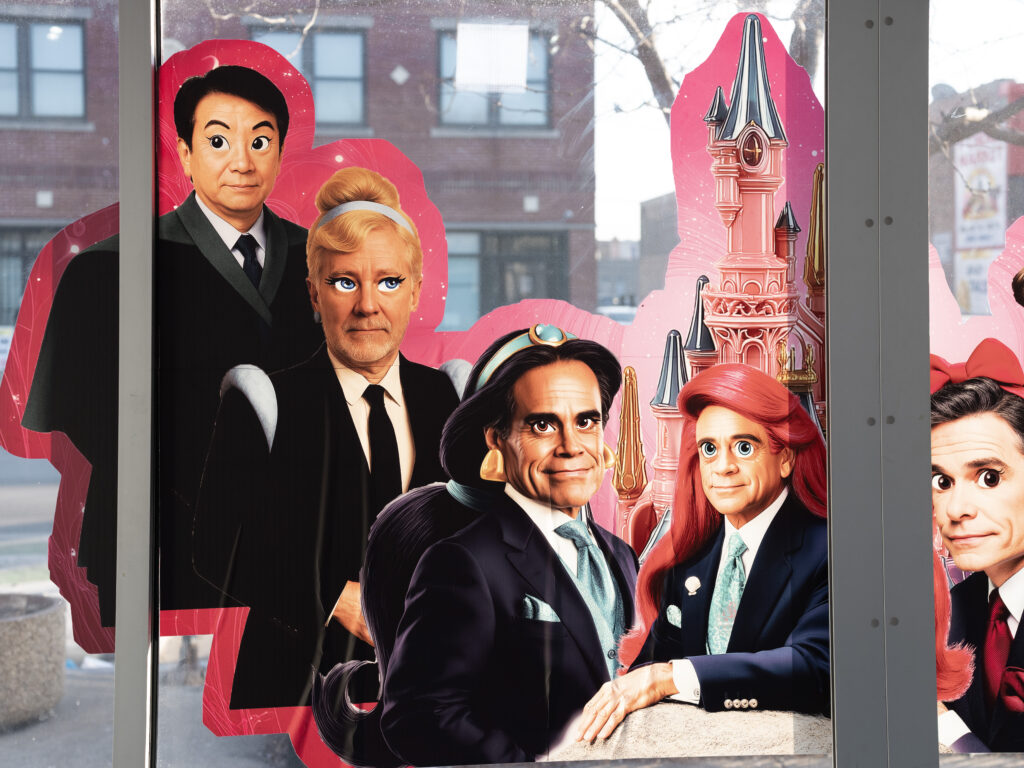
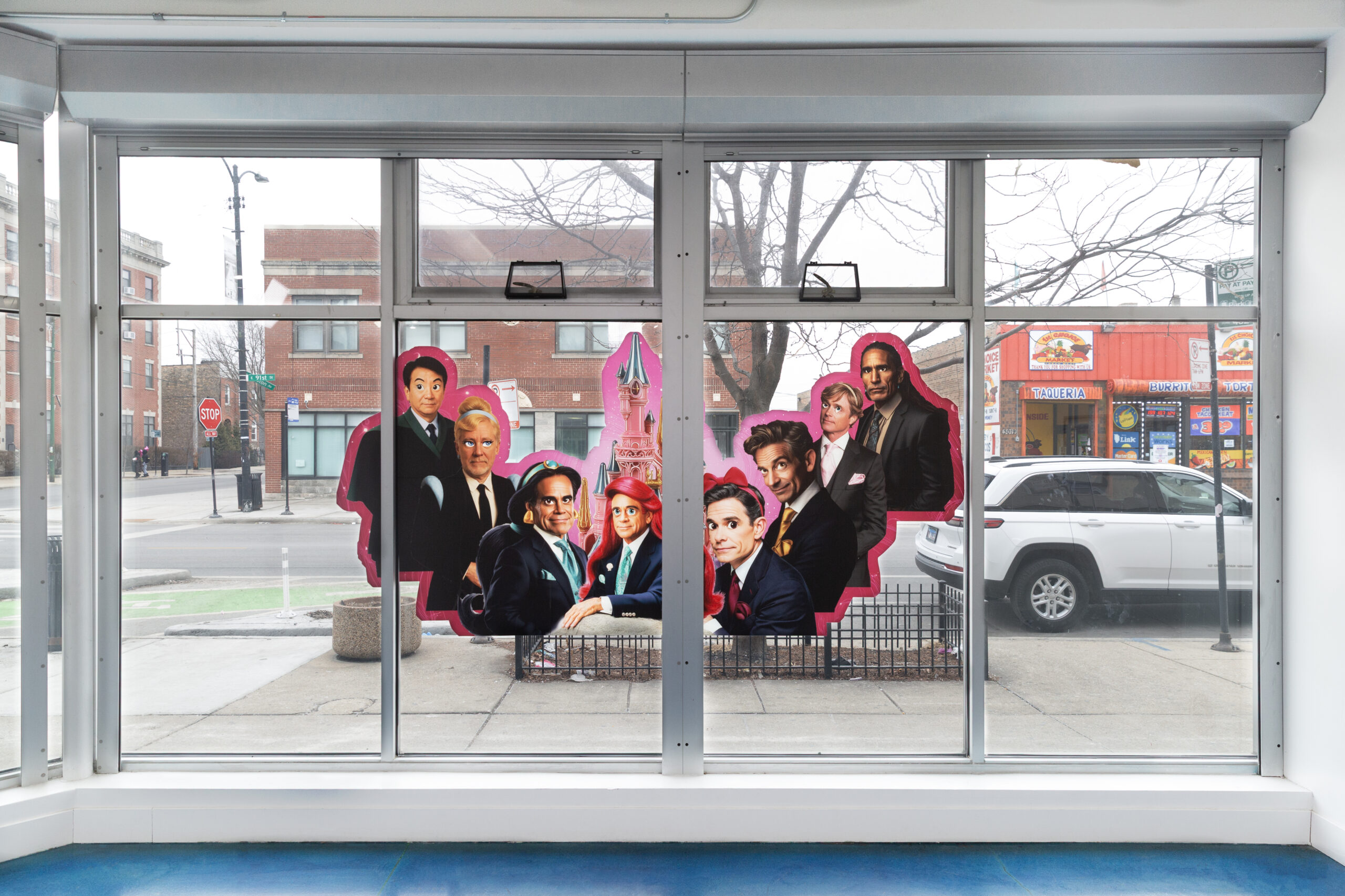
Emancipation Park is a solo exhibition featuring artwork by Magicfeifei on view at SkyART in South Chicago. Named after a park where the artist grew up in Wuhan, China, at first glance, it’s cute and sweet, but it contains a depth worth exploring. The exhibition invites you in to sit and contemplate, under the watchful eye of cutesy commercialism. It’s a short show—fewer than five pieces—but Magicfeifei’s artworks play with scale to make an impact. Most notably in the piece Monopoly, a massive vinyl installation across four floor-to-ceiling windows, depicting eight older men, political figures presented like the Disney Princesses. Photo-realistic images of men with large, illustrated doe eyes with princess hair and accessories, an image of a pink plastic-looking castle looms artificially in the background. At first, it’s funny, until discomfort sets in. The male subjects who lack the charm possessed by real Disney Princesses look suspicious, untrustworthy. The cuteness of these images of part-real, part-illustrated men is transformed into something more sinister and uncanny. Lawyers, senators, judges—even after their disneification—radiate a power that’s more concerning than reassuring.
In a small room with blue floors and a wall of windows that look out onto the street, Magicfeifei is exploring childhood memories, power, and entertainment. Emancipation Park takes place not in a gallery but at SkyART, a nonprofit arts organization with locations on the South and West sides of Chicago. Staging an exhibition here at a children’s art center is an interesting choice; it’s certainly an unfamiliar context. The organization’s mission is to provide art experiences to children and youth from underserved communities. In hosting Magicfeifei, the attempt is to merge contemporary art with mission-driven work. Typical, staid, and sterile art spaces might provide the most visually pleasing way to present art, but they can also create barriers. The people who are going to see this artwork extend far beyond the typical gallery-going public: the parents who pick their kids up from programming, the person who drops off the mail, the family that runs the elote stand on the corner. But most importantly, the young artists in the program.
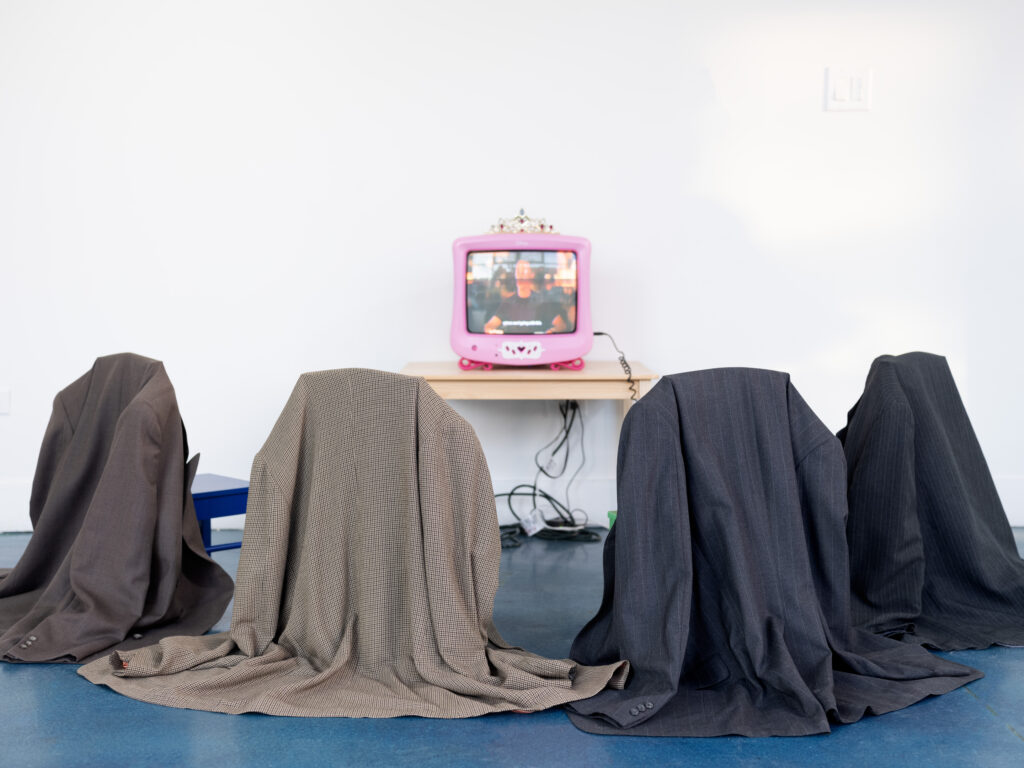
Magicfeifei’s themes expand into the space with two video installations that create an additional layer of discomfort and uncertainty. Suck It Up! Buttercup! is a tiara-clad vintage Pink Disney CRT television, showing a pivotal, if not disturbing scene from HBO’s The White Lotus (a perfect encapsulation of a recently agreed-upon bundle partnership between the streaming competitors), “On the inside, could I be an Asian girl?” Sam Rockwell asks a dumbfounded Walton Goggins for an audience of children’s chairs draped with adult-sized blazers. A separate video installation follows a Chinese dentist in his home, toying with a similar question of identity. He wonders, almost melancholically, if perhaps his love of Western culture makes him somehow more Western than Chinese. These depictions of unsettling men straining with identity raise a question: What is the media teaching us—and teaching our children? Or maybe it’s a reflection of how we have more in common than we thought—the universal sensation of feeling out of place, of not belonging. Magicfeifei’s artwork thrives in that space, the tension between normal and abnormal, sweetness and sour.
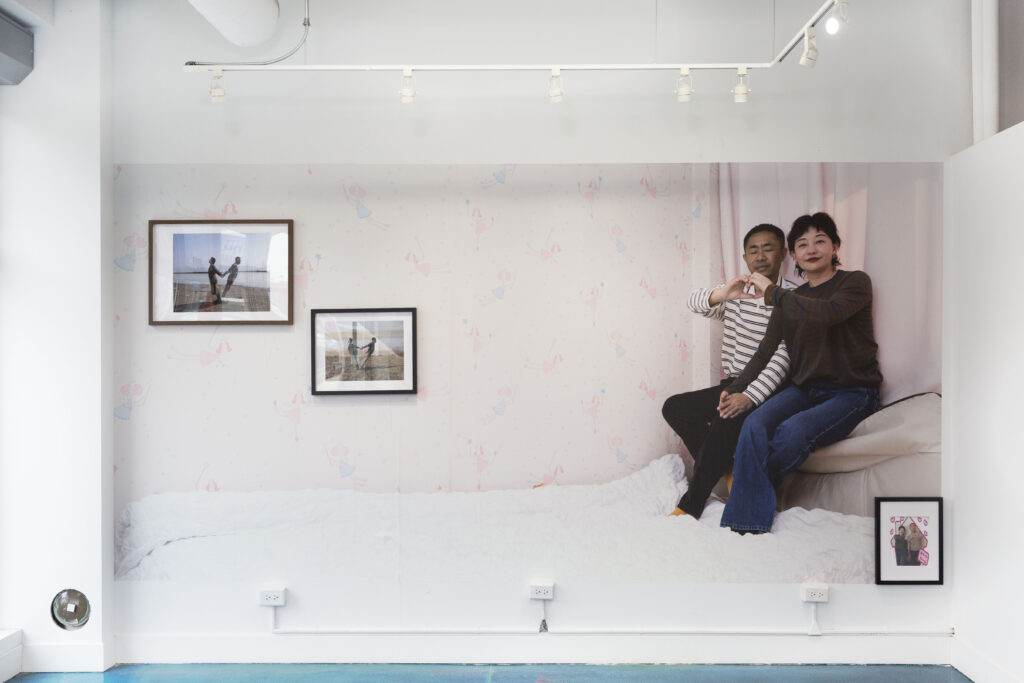
Even when the cuteness, heart motifs, and childlike imagery toe the line of naivety, the artist doesn’t lose sight of the audience. Yangtze Love depicts repeated images of a couple using their bodies to make hearts. It feels simple, about love and connection. Perhaps it is Pollyanna-ish to linger on love. But also, it might be the only thing that keeps us together. It seems almost radical to fixate on love when the world is finding new ways to end every day. Magicfeifei clearly has a vision they’re working to articulate in Emancipation Park—a reminder of the universality of art and the global culture we contribute to. We may look different and come from different places, but in a hyper-strange world of global extreme power disparity, commercialism, and consumerism, we all feel the same.
About the author: Jen Torwudzo-Stroh is an arts and culture professional and freelance writer based in Chicago, IL.