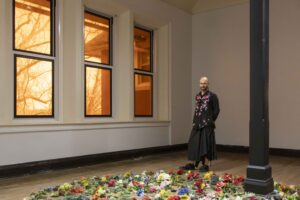
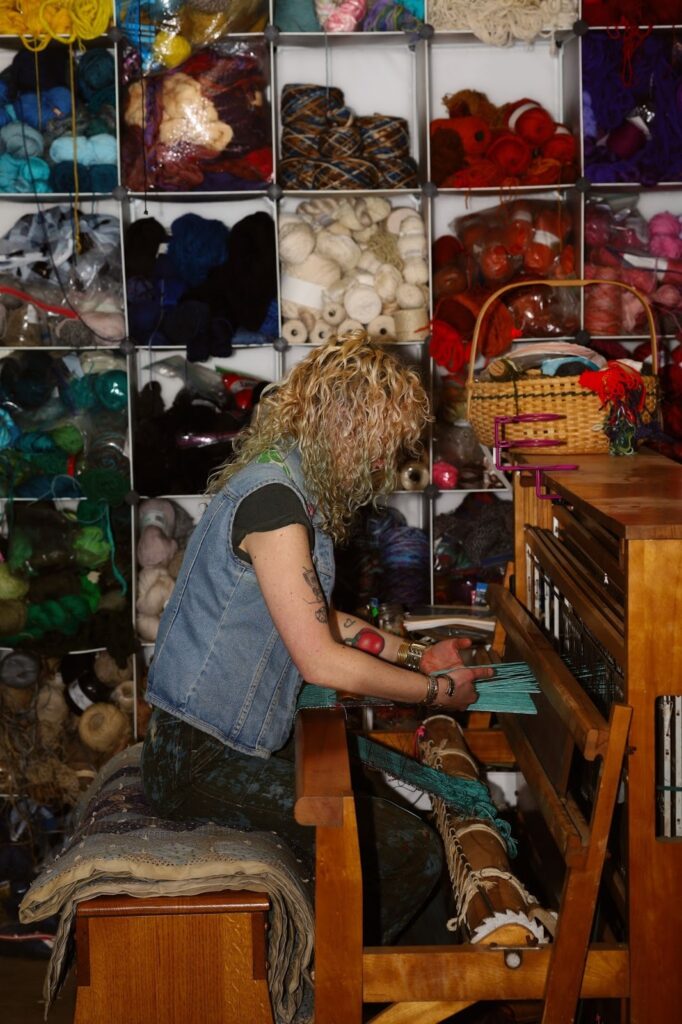
![Rachel sitting in the studio while showing off her piece “[Saccharomyces]”, the largest of the pellicle weavings. The piece includes cool-toned reds and blues, as well as yellows, teals, and creams and is a 83” x 16’8” handwoven Jacquard. The pellicle weavings use blending of color and patterns and shapes to illustrate the way yeast (or communities of yeast, i.e. pellicles) recycle physical materials in our world. They are flat and sometimes intentionally confusing, textural abstractions. To the right is the yarn shelving wall and their 16 Shaft Leclerc Loom. To the left are additional supplies resting on a shelving unit, filled with cones, skeins, and more. Photo by Viki Stark.](https://sixtyinchesfromcenter.org/wp-content/uploads/2026/04/22-scaled.jpg)
Fennville, Michigan-based artist Rachel Meyers Hefferan (she/they) is a self-described “homesteader, fermentation nerd, and hopeful environmentalist,” and one swift look around their studio reveals as much.
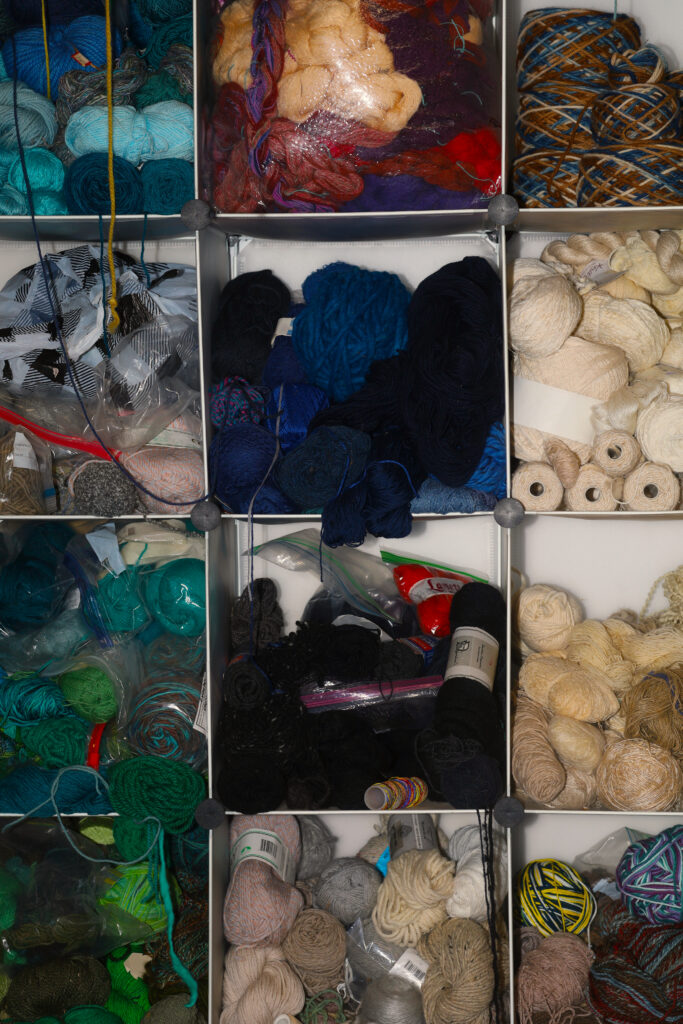
From my narrow vantage point via our video interview, I catch glimpses of this: a pellicle weaving hangs on the wall perpendicular to Rachel’s desk; buckets of raw wool sit patiently in corners; and a massive arrangement of shelving holds hundreds of skeins of secondhand materials that Rachel incorporates as an homage to the weavers who came before—i.e., “re-choosing what somebody else chose.”
Even an eight-year supply of hay-baling twine—often bound for the bin at many farms—has found a place in her studio, where it is currently being worked into a sculpturally woven piece.
In conversation, Rachel recounts how they began their weaving practice, describes moments of unexpected inspiration, and displays immense devotion towards their animals (sheep, goats, chickens, rabbits, ducks, dogs, a donkey named Puzzle…) through in-process artworks—proof that she doesn’t merely tend to these creatures but she dearly immortalizes them in her work.
The following interview, which took place on February 17th, 2026, has been edited for clarity and brevity.
Jamie Yonker: What do you believe to be the beginning of your weaving practice? Could you start there for me?
Rachel Meyers Hefferan: I didn’t know that textiles were considered an art form growing up. I always wanted to be two things: either an artist or a veterinarian.
I do have a very early memory of touching a loom at a Ren Faire. I was ten, and very enamored with this lady in costume, and she let me weave a few rows. I was like, what is this? It’s a very funny, formative memory for me.
Then when I was in college at the University of Michigan doing my undergrad I was studying ceramics and sculpture pretty heavily and my really good friend was like, you need to take a textiles class, and I was like, no. And she was like, yeah, you’re gonna love it. Sherri Smith is still teaching here. She’s famous. She’s weird. You need to meet her.
So, I took that class, and it really changed my trajectory.
Sherri Smith taught me how to weave and was like: you must dye your own materials. You don’t just pick things because it works. And I think her point in retrospect was about being thoughtful [concerning] color choice and not just like, it’s pretty or it’s whatever. It’s about finding a source of intentionality as a beginner.
JY: From there, when did you start spinning?
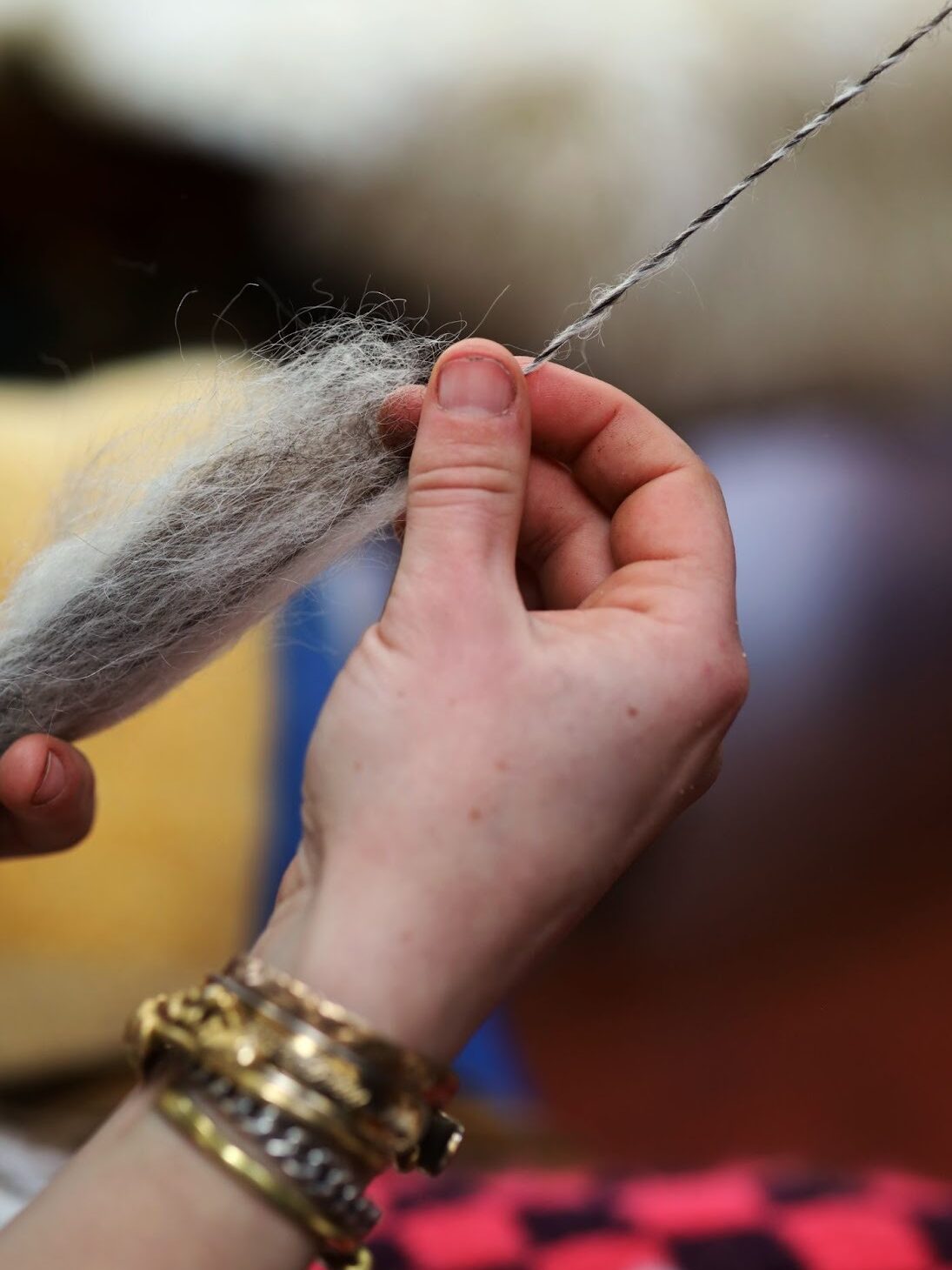
RMH: I’ve been spinning since 2013. I learned to drop spindle before that when I was in college. My mentor, Joe [Trumpey], gave me a drop spindle when he was my advisor. I was trying to do it and kind of failing epically, and I brought it back to him, and I was like, do you even know how to do this? And he was like, hell no.
JY: Did anyone teach you how to spin on a wheel?
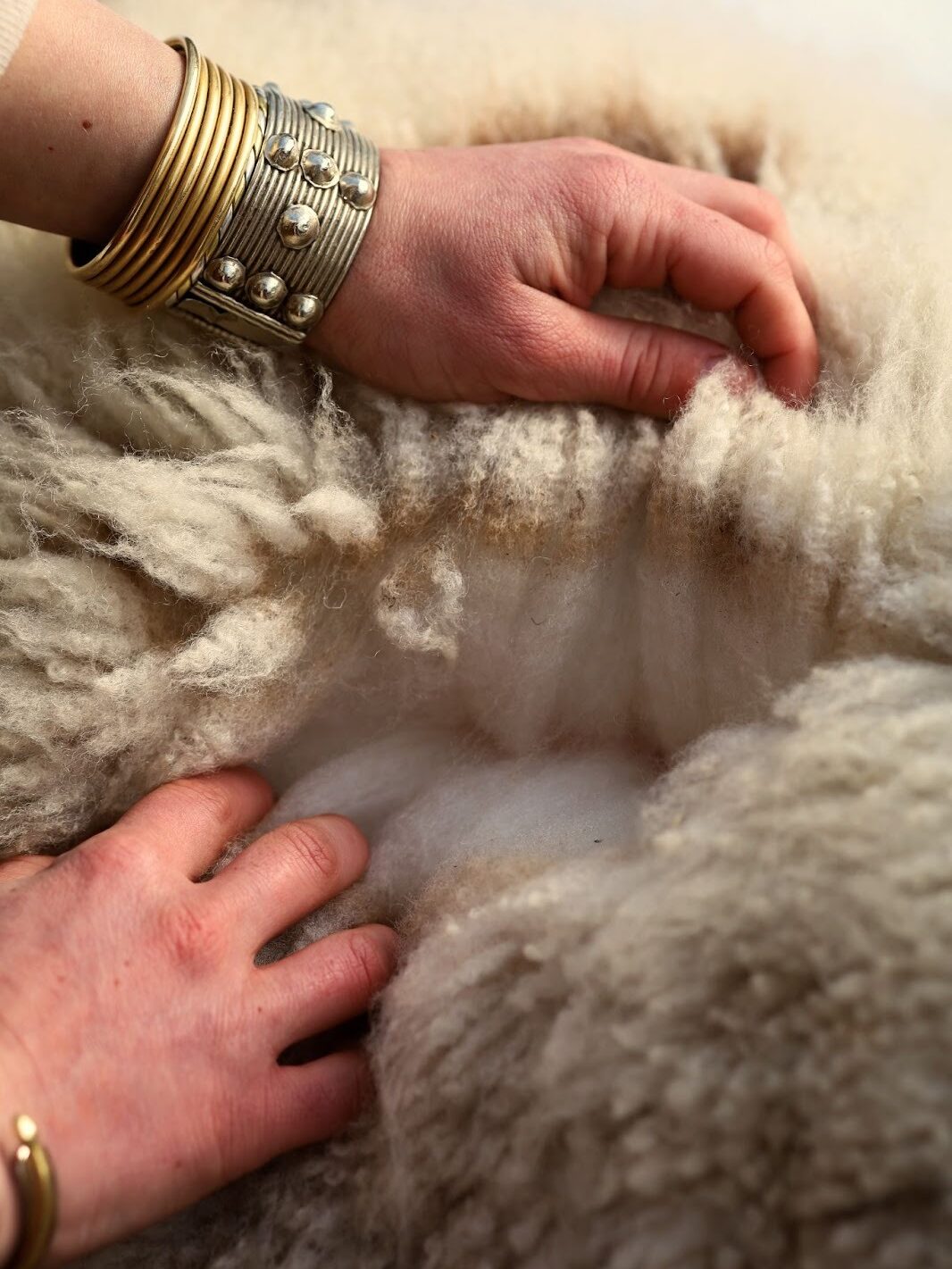
RMH: I’m self-taught. When I farm-sat for Joe and his wife, she left her spinning wheel prepped for me to use it and they gave me a bag of raw wool, and they were gone for two weeks. They did not have internet and they were like… yeah, you can learn to spin.
JY: How long did it take for you to buy your first spinning wheel?
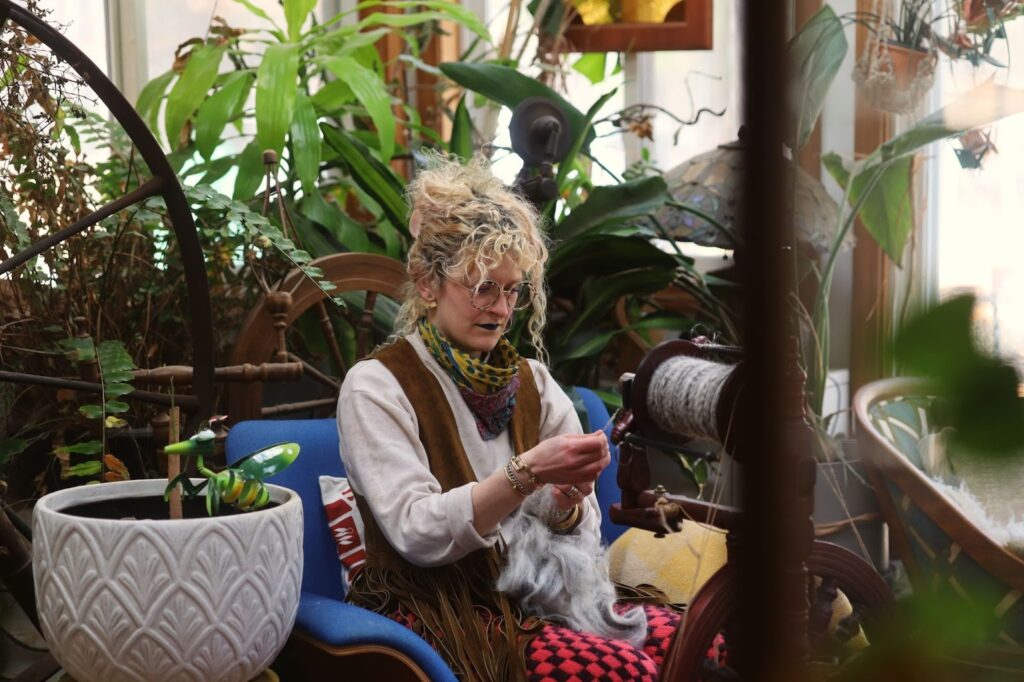
RMH: I bought my spinning wheel in 2017, not knowing it was the day that a very close friend of mine passed away. I found out the next day that he had passed, and I was very, very depressed, and I sat, and I spun for like two weeks, and that’s when I really started spinning. I think it was why I associated it with a calming, like, dissociative action. That’s like my marker of how long I have had my wheel and what day I bought it because of that memory.
JY: Do you remember your first woven piece?
RMH: My first weaving was a Leno technique, which is an open handwork piece. It’s very tedious, and I wove, like, four by six feet. My parents still have that hanging in their stairwell.
JY: The first woven work of yours that I encountered was at Virtue Cider, and I remember thinking, “This is inspired by yeast in a petri dish?!” It was a gift brought in for [fellow shepherd and Fiber Fleet co-owner] Johanna Bystrom, and it had such great texture and abstraction. It was this large, circularly framed piece that I couldn’t totally discern, and I’m still curious where you draw inspiration from for those pellicle pieces. Can you talk to me about that?
RMH: So, when I was learning [to use a digital loom at the School of the Art Institute of Chicago], I did all sorts of different, weird, quirky things in the first month or so, and then I realized that I had been taking photos of yeast pellicles and fermentations on the farm and at Virtue [Cider]. Nick had been taking lots of photos of them because he’s a microbiologist. He’s interested in that, and there were so many fermentations in my house because Nick and I were in a beer league and brewing beer for competitions.
He would save things and grow things on purpose. We had a whole refrigerator that was full of yeast and cultures. I always wanted to touch them like a weirdo.
I’m just like, you can’t fucking touch them because you’ll ruin them.
I was like, it’s so cool. I want to touch. I want to know what they feel like.
I started photographing them.
So fast forward, I’m in grad school (at the School of the Art Institute of Chicago). I need photos, and I have this body of yeast pellicles, and the reason I wanted to touch them is because they look like fabric. They’re pretty and crumpled. They always look different. They bubble. So the first one that I wove was purely so that I could metaphorically touch it.
JY: Wow, because now you can’t ruin it?
RMH: Yeah, so I’m like making this thing, this ephemeral object that I can’t have so I can have it. Then, through the process of doing that, I realized that there’s a link between what the function of a yeast pellicle is and what I was doing with the fabric.
The function of fungus in bacterial culture is to break down sugars and other structures in nature, so that all of those little building blocks become available to become new things. So, metaphorically speaking, in a textile, when I’m plugging in different structures, because the excitement about using that specific loom is that you have infinite mathematical matrices to make patterns. So I can put literally twenty different patterns next to each other, and you can’t do that on a traditional loom because there are not enough physical mechanisms to make it work.
The metaphor became the thread that travels from left to right goes through a metamorphosis and it becomes part of these different systems, and [that] it’s the beauty of those systems working together that creates the whole, so that abstraction is both a representation, in metaphor and in action, of the thing it represents.
JY: Jeez, that is so cool. I am so glad you told me that. Being like, I made this thing because I couldn’t touch it in real life is giving me goosebumps. It feels like a children’s story. You know what I mean? Like living in a house of glass and then you’re like, I’m going to make this thing that I can actually touch or break.
RMH: Nick and I also have a double-lens microscope, so we can look at the same sample at the same time—he literally purchased it so that I could look and he could look.
JY: Ok, that’s so cute.
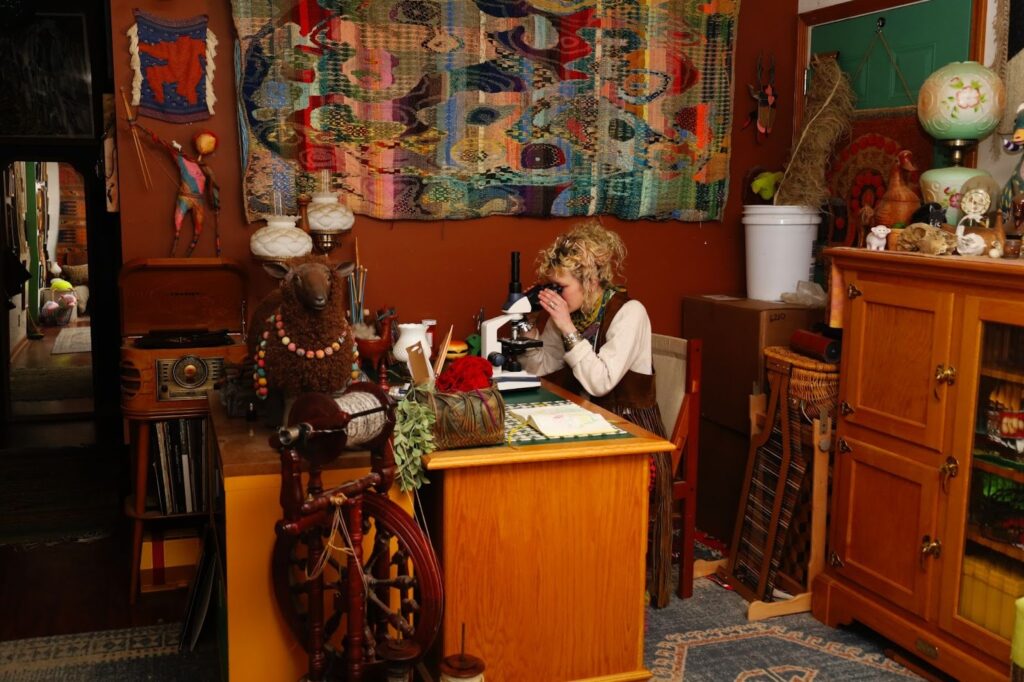
RMH: Then as I sort of deep-dove in, I started using that second spot where Nick would show-and-tell things to me and just whomp my phone camera on it and take pictures through that second [lens].
As it developed too, I also started intentionally sampling things and growing things in agar powder or on a plate with the intention of letting it overgrow or mold or sort of like be exposed, have a double exposure, and then you’re mixing things that don’t belong.
JY: What were a few intentional cultures you wanted to sample?
RMH: Some of them started with little bits of wool from the animals or I’ve had a whole series of them where I prepped a petri dish and then we would go outside. Which is the same practice if you’re doing a wild yeast capture, where you would just go swab something. [You’d] go take a swab on, like, the tip of a sheep’s nose.
JY: Can you tell me more about your farm?
RMH: We bought the house in Fennville in 2014 and we got the goats in 2016. We still have one of them—our old boy, Hooch. The first we got were Pygmy Angora goats—bottle babies—they were two weeks old.
JY: Oh my gosh, teeny little babies!
RMH: Yeah, and not super long after we got them, my mentor, Joe [Trumpy], called me and was like, hey, a former student had a not-zoned-legally farm in the city of Detroit, and their farm got busted or something, and that former student was like, I need you to take all my animals. I’ll take them back.
And he was like, it was a long time ago, I don’t think they’re coming back and they dumped this little goat, and she’s too small to be out with the cattle. So can you come get her? And that’s Cammie, the little superstar of the farm. She’s a Detroit girl.
All of the rabbits are previously loved beings. I never chose to get rabbits. The first rabbits we had, somebody dumped on our property just after Easter a few years ago.
Nick and I had come home late, and it was dark, and I thought it was our barn cat in the yard. And then, because it was a shadow, and then the shadow split in two. And I was like, Oh my god. What is that? Am I on drugs? What the hell is that?!
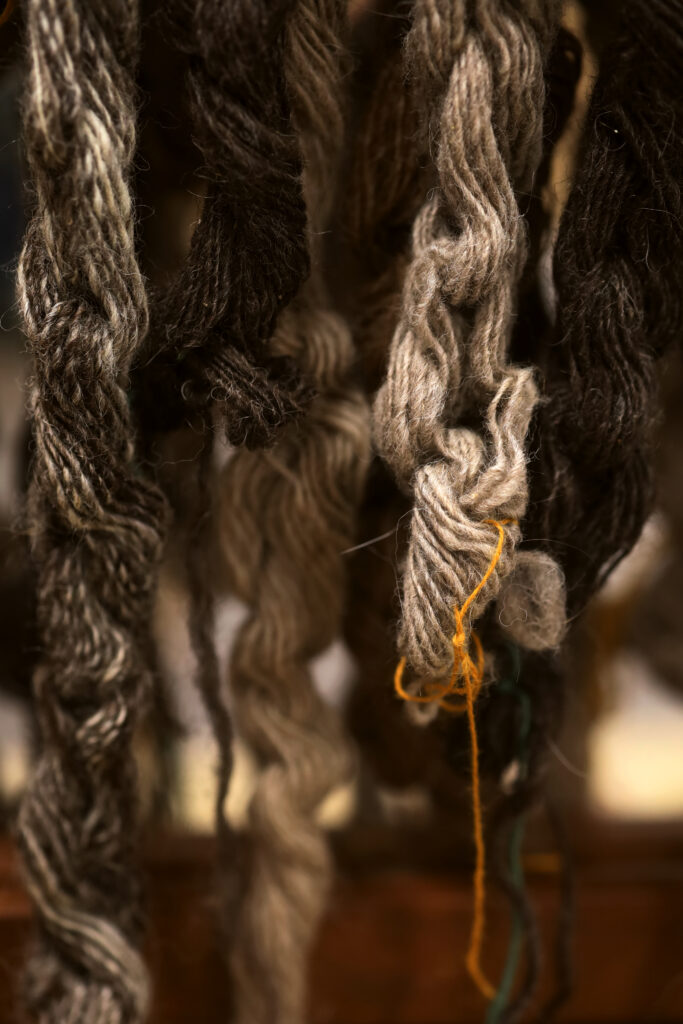
JY: Can you talk to me about some recently completed projects you’ve done and where they might be living now?
RMH: I finished a big commission for a client last summer. That was my dream commission. It took me two years. What they wanted was the aesthetic of a piece that I had done and shown (“Local Cultures”), and that was a case I was making when I was in grad school (at the School of the Art Institute of Chicago) and sort of living a funny dual life—here in Fennville and in Chicago.
I’ve done a lot of writing on that piece, but it was a mix between a food diary and a daily practice. It grows and changes, and every time I display it, it looks different. They liked the aesthetic, but they wanted me to make a piece for their home, and they were kind of like, do whatever you want and on whatever timeline, right? So, I ended up making a piece that represented my community and my animals through color and texture. It was sixteen feet by ten feet, wrinkled, sort of beautiful, magical, sculptural work.
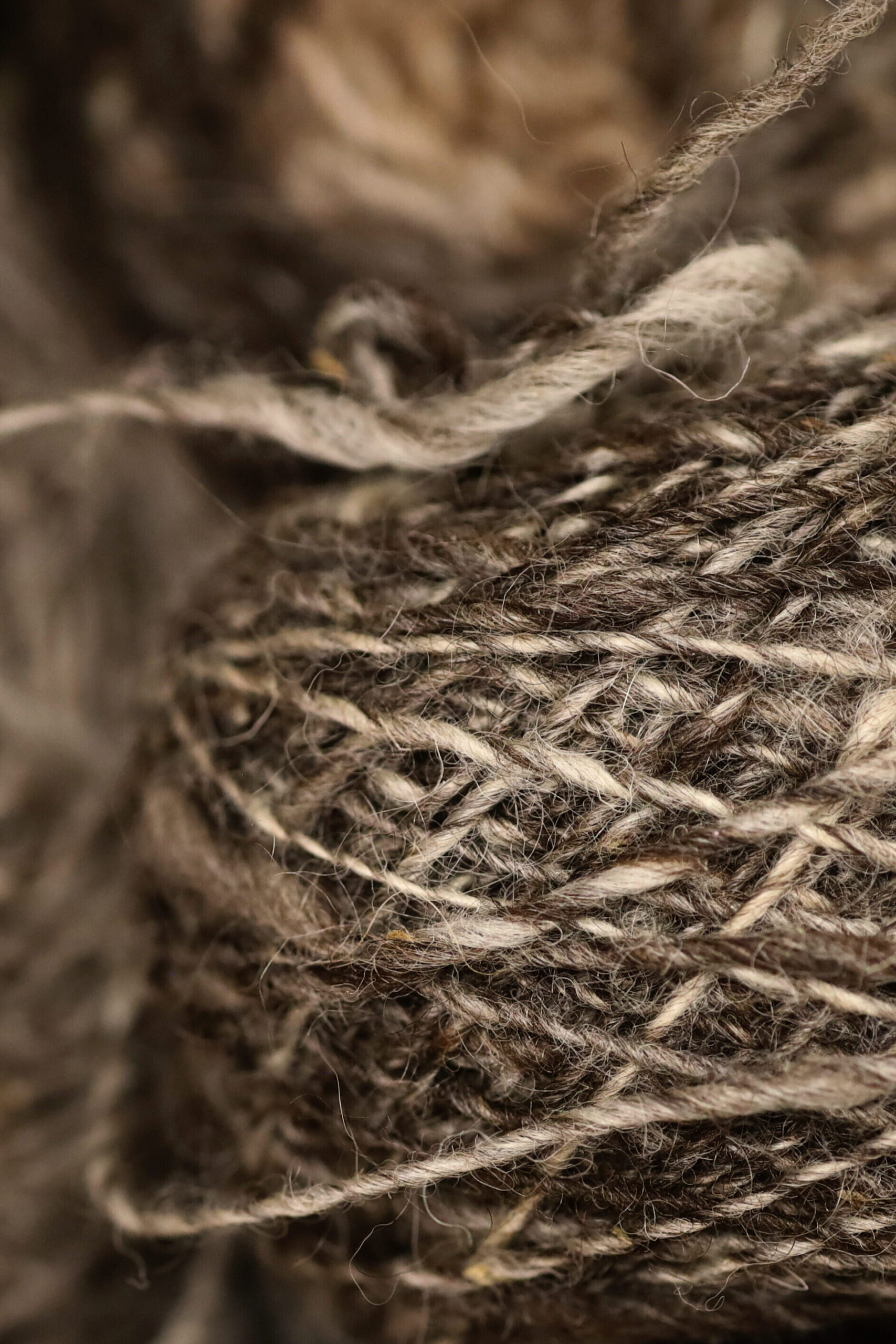
There were five farms represented [in the piece]: my own, Johanna Bystrom’s, my mentor’s farm, a Shetland farm, and a lady who has some alpaca that donates her alpaca [fiber] to Oxbow every year, and somehow I keep getting it. I think a lot of my work is about bringing material through its whole life cycle. So the piece sort of embodies, you know, the start to finish of that.
I started growing indigo for the project. I had a greenhouse full of indigo and I was fermenting it and dyeing it. So it was all the natural colors of the different breeds. And blue. Which was a through line for the work, right? I think I have some statistics, but I handspun… I need to look it up, it was in the thousands…
JY: Thousands of miles?! What?!
RMH: Miles of yarn.
JY: Holy shit.
RMH: That was woven. And I also used each loom that I own, so there was a panel from each loom that I know how to use. Which was important because, you know, you can do different things with different looms, just like you can make different yarns with different breeds of sheep’s wool.
So there’s a nice tie-in there for me and why I went to the Art Institute of Chicago, I really wanted to learn to program a digital loom, which is kind of what they’re known for. I think a lot of programs have those looms now, but a digital Jacquard loom is like the highest form of wild thinking. They teach a method where you program individual thread control pixel by pixel.
It was very celebratory to have a client that wanted to give me the time and space to make that kind of work. It’s such a dream. The other kind-of nice thing is it’s in their house on the [Michigan] lakeshore, so it lives nearby too, which is, like, just cool, even though it’s privately owned, it’s in the area that it represents.
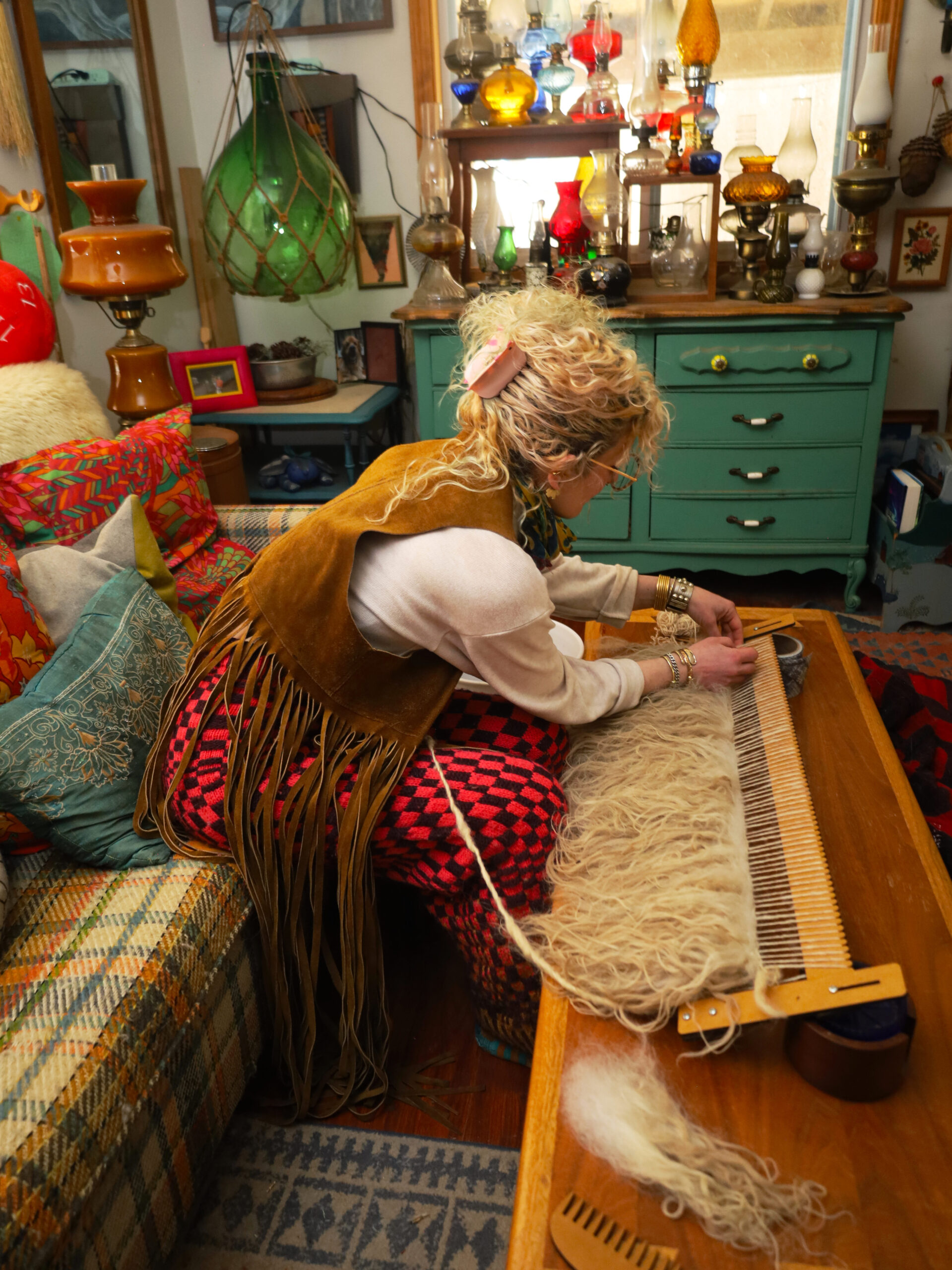
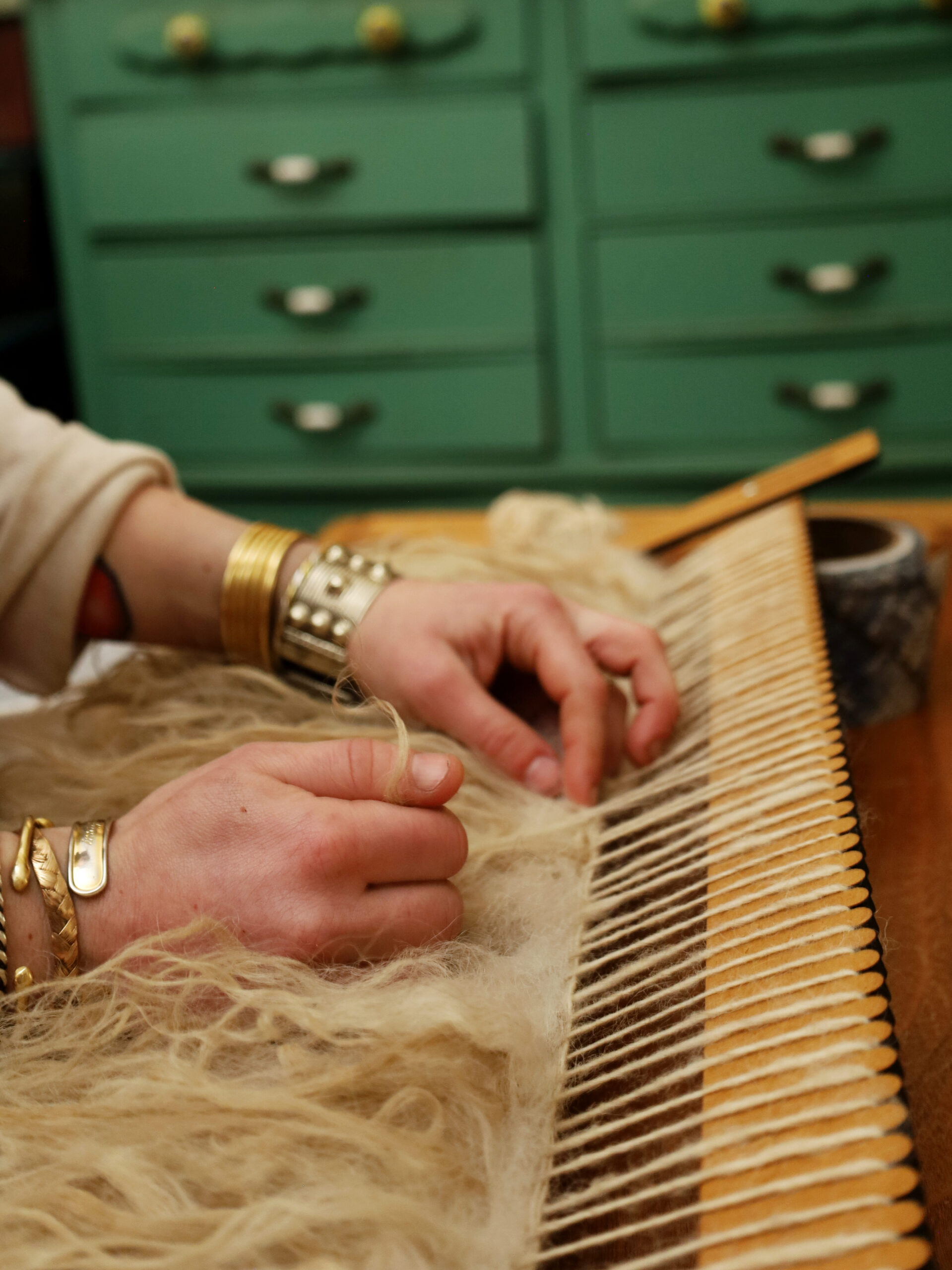
JY: How did that large, longform project inform what you took on next?
RMH: I did that and I was like, great, felt good, now what do I do? That was kind of a rare place. The rest of the work I made was about my sheep, which is something that I previously hadn’t so pointedly done, because so much of my work is about microbiology and place and, you know, the specificity of connection and interconnection and all of that on a micro scale.
I think that the work I’m making now is echoing that really similarly, but instead of it being about this unseen world that connects us all, right? It’s more about what is physically seen in front of me, which is my animals, and that’s the most grounding thing in my life. I think it’s also something that I was resistant to putting into my work because I think it’s really easy to get in your own head about what’s a cliche and what’s not. I think it took me awhile to get there to be like, it’s not. It’s not a cliché.
It is important to talk about, and it’s definitely something that people are interested in and want me to talk about. We all have to get past our own insecurities.
JY: I totally agree. I feel in a way, too, it’s almost evolutionary, like, you’re starting from the cell and you’re building up. Are you already working on something with your animals at the center of it?
RMH: I’m working on, sort of slowly, a breed-specific tactile journal. I am including one-off bunny samples in there because I’m weaving four-by-four-inch squares. And I do have the dogs in there.
Our puppy, Pattern, has a really unique coat. It’s very woolly, so I’m definitely gonna spin that, and I do have a plan to make an artwork, actually. We have a big laundry basket in the house where I just put the dog’s hair when I brush it, and I am going to spin all of that and make a weaving.
I’m on the edge of making a body of work that’s about honoring the bodies of the animals that I coexist with.
I know a piece that I want to make is for my first dog, Pepper, who died a few years ago, and because she was my bestie, and she was also the queen of the farm, and she did chores every morning, right up until the end of her life. She walked the whole property with me every single morning.
I think making a piece for her, even if it’s not something that I wanna exhibit in a gallery, I think it’s something that I need to make for myself.
JY: What’s your next hope for the farm?
RMH: I had a living indigo vat last year, and the chickens got into my indigo…but I would really like to have a living vat on the farm. I’m hoping to expand the physical footprint of the studio so that I can have a heated area to do dyes and wet work, as opposed to just rolling around and doing it outside. So that’s a major goal. I also really want to get some Icelandic goats, but that’s like a whole ‘nother…
JY: Icelandic goats?! What! I’ve never heard of those. Are they mostly in Iceland still?
RMH: Yeah, so the Icelandic goat was brought over just like the Icelandic sheep with the Vikings. They were harder to manage and became like a pest on the island, because they don’t have predation, [so] the goats were like wild animals, like giant squirrels. They’re actually a fiber breed—they have these really cool, beautiful coats. They’re genetically unique because they’ve been on the island for so long. There’s one woman that decided she was gonna save the Icelandic goat. She is very, very cool.
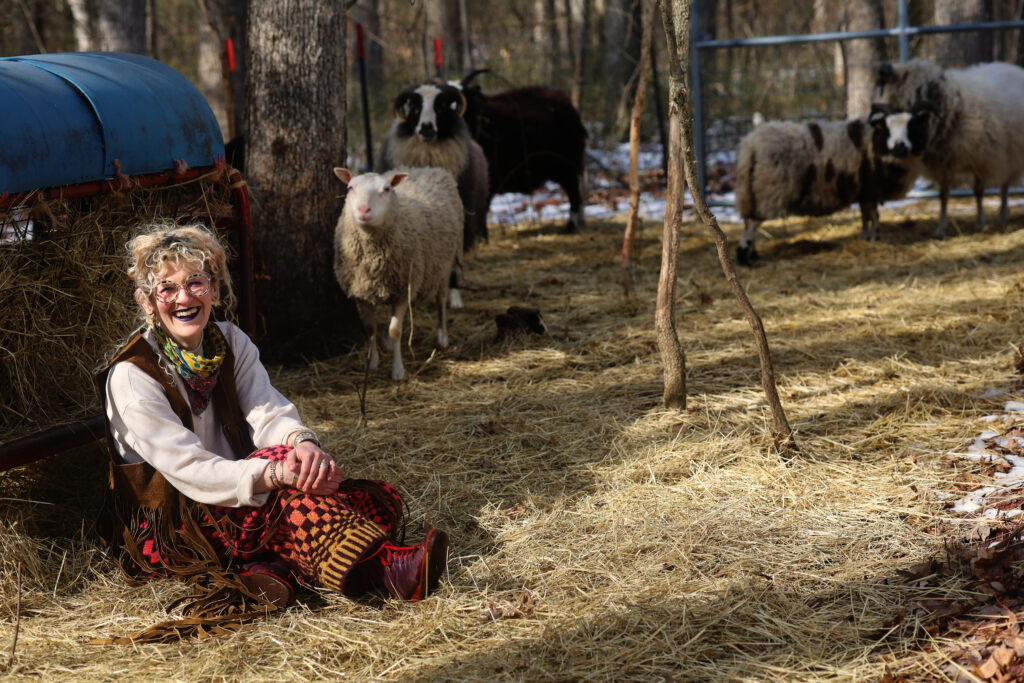
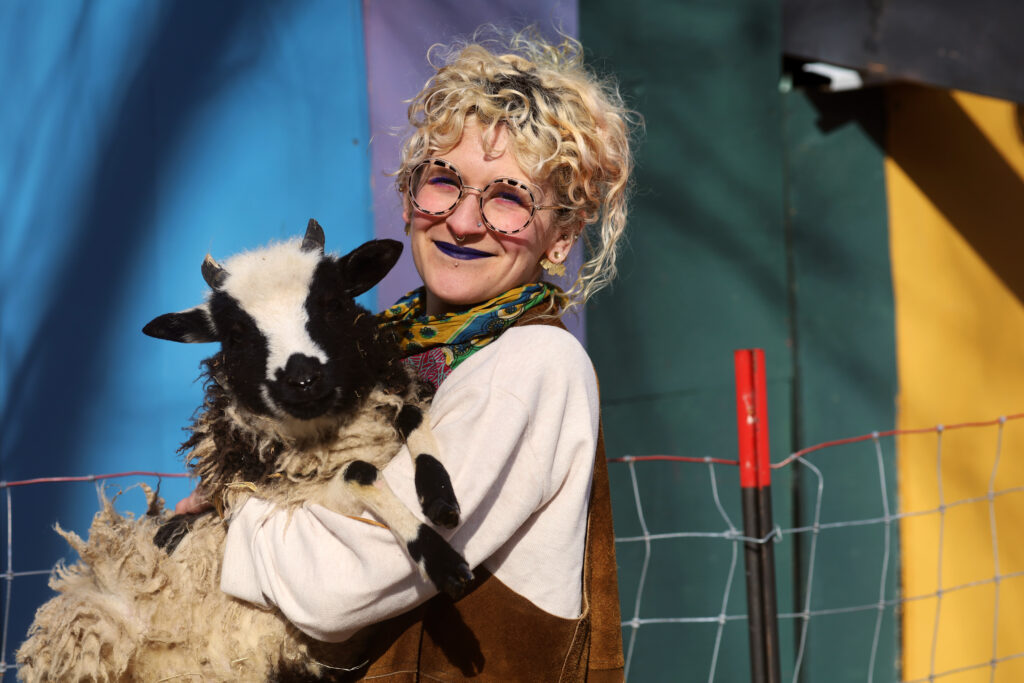
Rachel lifts me from the position in her home studio and carries the phone out towards the yard, panning past the trio of Great Pyrenees as they spill out onto the five-acre wooded farm. Long-rested snow piles on top of the raised garden beds, the sheep in the distance are on alert next to an abundant heap of sage green hay, and the rabbits are not resigned to their hutches but instead tanning on mounds of straw in the sun.
A turkey hustles across Rachel’s path as we head towards the outdoor studio which shares a sixteen-foot barn wall and is steps away from their beloved goats: Cammie and Hooch.
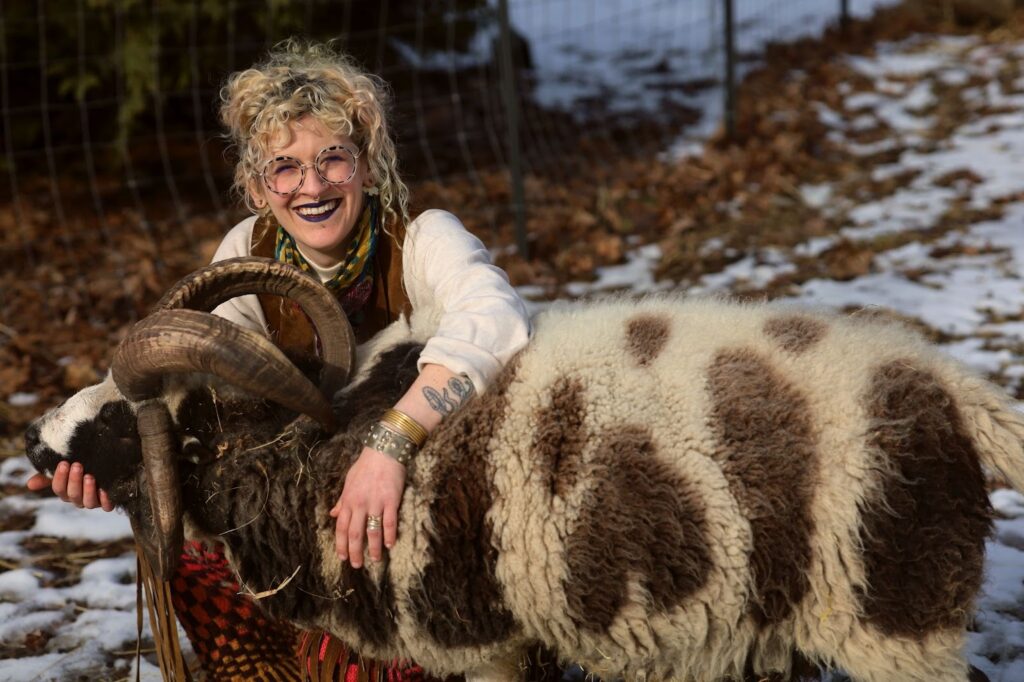
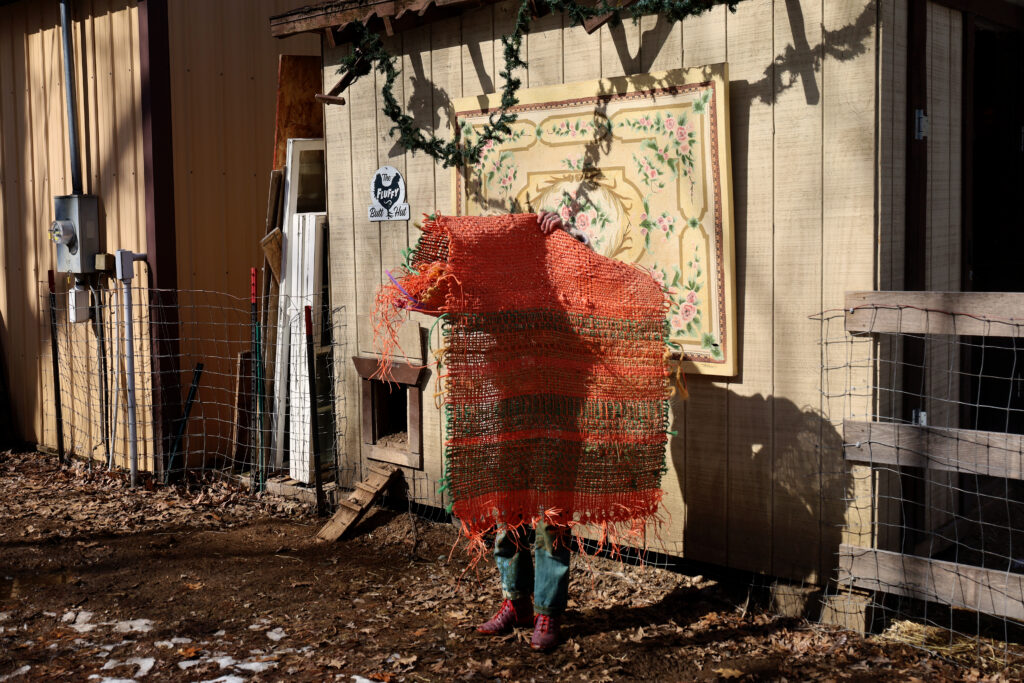
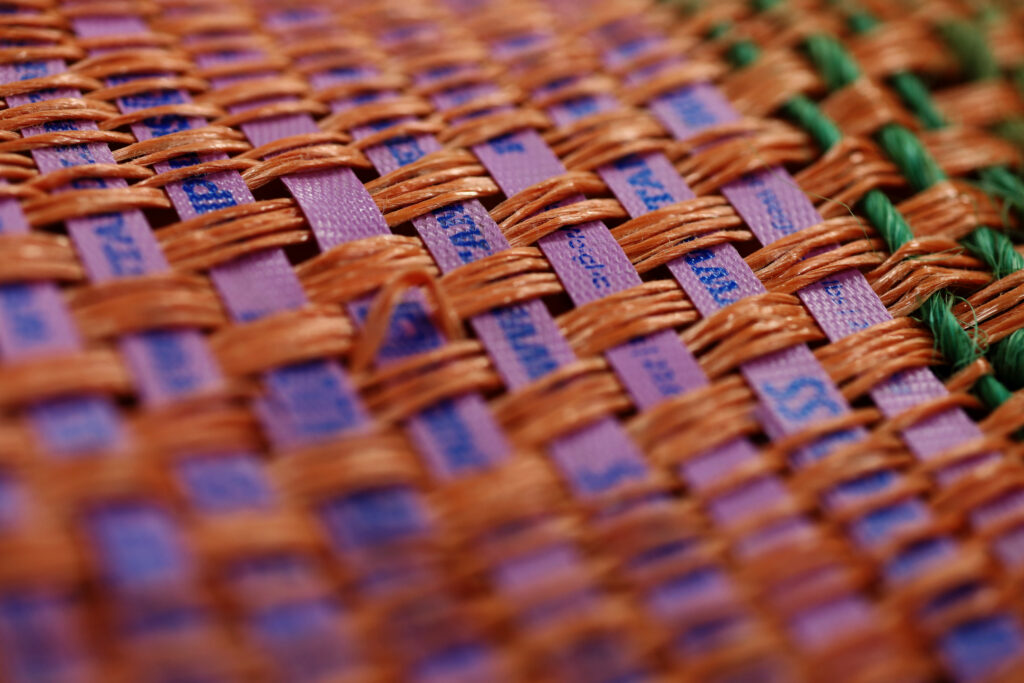
The studio is populated with many looms, handspun skeins, yarn from Rachel and Johanna Bystrom’s project Fiber Fleet, and a piece Rachel wove at her residency inspired by the spot pattern on the flank of her ram—his identifying marks, “like a fingerprint”—backed with colorful grids of repurposed materials.
Rachel stops to point out the ten-foot wall behind her, masoned with colorful textiles—turquoises, pinks, deep reds.
RMH: This is actually very important.
When I go away to make work I have these space bags and I have my friends come over and fill the bags for me, because I think this wall is overwhelming—so my color palette comes from first, the people who gift me these things, but secondarily through my own community who is literally making choices for me, and then I’m recombining that through a process of elimination.
Most of this material has come from people I’ve purchased equipment from because they’ve bought too much, or my mother-in-law’s friend who likes to spin yarn, she’s happy to send that away and have it be made into something. [Some of it] I’ve found at thrift stores for a buck or whatever and most of it is wool. I seek that out because the life cycle of wool is more ethical.
There’s sort of an inherent important process to reintegrate textiles that maybe shouldn’t go through washing machines or re-enter watersheds or compost and by putting it in an artwork on a wall, then it is sort of a harm removal or harm reduction in a way, nobody is wearing it on their body and there’s also a really, really nice metaphor.
[Ultimately] weaving is a community of people that has a shared mindset. Using something that comes from a shared mind-space [via secondhand materials] is a poetic way to acknowledge the people that I learn from or people who share their resources with me. There’s a presumed notion of how to be ethical about material: some of the wool [that I use] comes from my farm and is hand-spun and it’s grown in a beautiful way and that’s a “gold star,” but there’s another way to think about ethics and how we engage with it, too, and I think that’s equally important.
About the author: Jamie Yonker is a writer and farmer living in Brooklyn, New York by way of Grand Rapids, Michigan. She likes writing about people who exercise devotion.
About the photographer: Viki Stark (she/her) is a photographer based out of West Michigan that really loves to create a safe space for people to lean into their most creative selves. She blends aspects of surrealism with nostalgia to provide a way to step into a fantasy world full of color.