Whenever I need a shorthand to convey the vastness of the Great Lakes to someone who hasn’t seen one, I recall an anecdote from my undergraduate years, when several friends and I ventured into Chicago from our suburban campus to see a play at one of the city’s storefront theaters. After taking the train downtown, we caught a taxi that drove us up the thoroughfare now known as Jean Baptiste Pointe DuSable Lake Shore Drive. As Lake Michigan came into view, my friend Sydney, who grew up in a land-locked state, responded to her first-ever glimpse of that endless stretch of blue with an awed exclamation: “It looks like the ocean!”
This sense of wonder permeates the latest anthology from Belt Publishing, aptly titled On an Inland Sea: Writing the Great Lakes. Featuring 33 contributors from Minnesota to Ontario to New York State and many locales in between, this collection of essays and poetry explores how living near one of these bodies of water can shape an individual’s identity, relationships, and sense of home. The book is also a treasure trove of regional lore, delivering historical, geographical, and scientific facts from personal angles that add emotional weight to the narrative.

On an Inland Sea transcends the genre of nature writing, but it’s undeniably full of evocative descriptions of the great outdoors. Callen Harty captures the “spiritually elevating, mystical and magical” experience of visiting Lake Superior’s Apostle Islands ice caves in his essay, “On Thinning Ice.” Other authors describe a host of sensory details: the bodily shock of plunging into a frigid Lake Michigan (“Water Kisses,” Santiago Barraza Lopez); the gritty traces of the beach carried home after long summer days (“Sand,” Joan Donaldson); the taste, smell, and texture of fried walleye freshly caught from Lake Huron in Michigan’s “Thumb” region (“Rituals and Revelations at Days on the Lake Bar and Grill,” Sarah Pazur). The ghostly confluence of the manmade and natural worlds haunts “Prins Willem V,” Benjamin Madeska’s account of diving to explore one of Lake Michigan’s numerous shipwrecks.
As I would hope to find in a collection of creative nonfiction, many contributors go beyond beautiful physical descriptions to contemplate the deeper significance of these places in their own lives and for the communities who inhabit them. In “The Queen of Sherwin Avenue,” Kathleen Rooney writes, “Place is a space that resonates with meaning. Spaces become places when humans create social connections to and within them.” Meaningful connections tied to particular places run throughout this collection, especially in the more memoir-style pieces, which relate memories such as summer romances, friends lost too young, and the birth of a first child.
For Shea S. Davis, childhood memories of family reunions at Lake Huron echo during lakeside walks in Chicago, where she moved as an adult in search of “a new life that involved community with other Black and queer people” (“A Siren’s Song: Melancholic Beats of the Midwest”). As she contemplates the sense of belonging she felt at the lake as a young child and the loneliness she later experienced among her family and peers, Davis connects her own story to Black Trans elders such as Jackie Shane, a pioneering soul/R&B singer who similarly “had to leave to find a place where her voice was loved.” Davis writes, “I felt like an imposter there [back home] for so long, and I held my breath waiting for someone to tell me I wasn’t, and I heard my ancestors speak. I returned to the water to find them and found my roots were already planted.”
Staci Lola Drouillard, who is a direct descendant of the Grand Portage Band of Ojibwe, highlights Indigenous traditions of rice harvesting in “The Gift of Manoomin.” A process “more like a ceremony than an agricultural harvest,” manoomin harvesting techniques have been passed down by her people for thousands of years, with current practitioners including Drouillard’s cousin, Sue Zimmerman. “Until you have experienced how difficult the process is, you can never understand why every single grain that makes it onto your plate is a precious gift that connects people to the land,” Drouillard writes. This gift is not only precious but also precarious, with many wild rice waters currently facing threats from industrialization and climate change.
Haudenosaunee poet Kenzie Allen, a first-generation descendant of the Oneida Nation of Wisconsin, reflects on her ancestors’ journey across the Great Lakes region in the collection’s closing poem, “In Our Long Walk, My People Came on Ships.” The Oneidas served as key allies of George Washington’s colonial army during the American Revolution, but in the following decades, New York State illegally annexed much of their territory, prompting many to migrate to northeastern Wisconsin in the 1820s. (For more on this history, see Douglas Metoxen Kiel’s forthcoming book, Unsettling Territory: The Resurgence of the Oneida Nation in the Face of Settler Backlash.) Evoking their first approach toward “Millioke1, the good land,” Allen writes, “The water / welcome, welcoming. / The shoreline already / harboring light. / No tear trails, / but a ship sailed toward a horizon / so distant, and so dear.”
In addition to these thoughtful reflections on place and home, several contributors focus on themes of embodiment, drawing parallels between great bodies of water and the experience of living in a human body. In “Ballast,” Jessica Leigh Hester compares the ubiquitous species of zebra mussels to the tumor that doctors discovered on her pituitary gland in her 20s—two ecosystem-altering entities that can’t be eradicated but only managed with a flexible, resilient approach. Martha Lundin contemplates Lake Superior’s near-total freeze in 2014 and their own complicated relationship to breast-binding (“The Bound Body”), while Kristin Idaszak sees similarities between her chronic illness and the Great Lakes’ vulnerability to climate change (“chicago has a great lake”).
Although climate change is a common theme, it isn’t the only threat to the Great Lakes region that looms in this collection. Joan Donaldson (“Sand”) highlights the ongoing fight to preserve Michigan’s Saugatuck Dunes from a billionaire’s plans to build a gated resort. Looking back at the region’s history, she recounts how deforestation and sand erosion caused by the logging industry literally buried the sawmill town of Singapore, Michigan in the 1800s. She cautions, “Nineteenth-century avarice destroyed an ecosystem.”
In “Little Bloody Run,” Laura Marris recalls the decades-long toxic chemical pollution discovered in 1977 in the Niagara border region of Western New York, noting that “No one fully knows, now, where all the chemicals are.” Lisa John Rogers outlines an urgent issue of environmental injustice in “Heat Islands in the Great Lakes: The Human Health Cost,” and Sara Maurer wonders what will become of the “cold, hard heritage” that residents of Michigan’s Upper Peninsula hold so proudly in “What Are Yoopers Without Winter?”

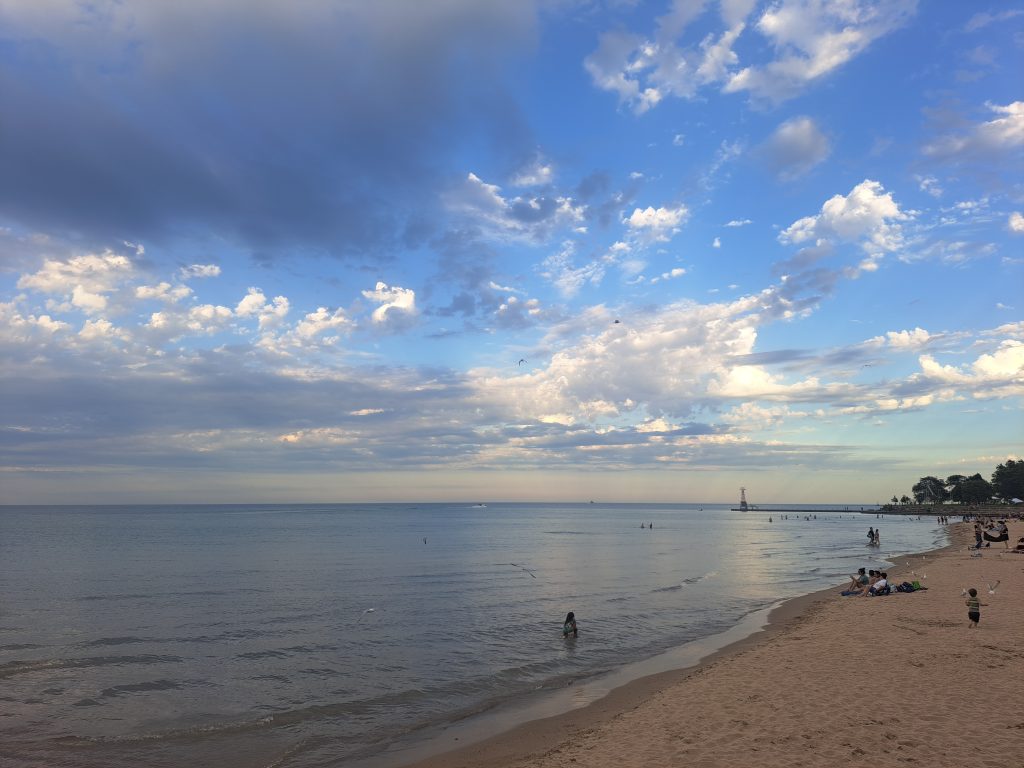
On an Inland Sea significantly expanded my own knowledge of the region where I’ve spent most of my life. Growing up in northwest Illinois, my first encounters with a Great Lake were on family vacations to Washington Island, Wisconsin, a 23-square-mile island off the tip of the Door County peninsula. Though the location is idyllic in many ways, the power of Lake Michigan instilled in me an awed fascination, mixed with a healthy fear, as ocean-worthy waves pounded the limestone shores of Schoolhouse Beach when the northerly winds hit just right. Reaching the island by ferry, now a generally safe journey, requires traveling over a stretch of water ominously called “Death’s Door” for the many historical vessels that sank in its currents.
During most of my adult years in Chicago, I’ve been lucky enough to live within walking distance of Lake Michigan, and I still feel a thrill when high winds whip up angry waves or massive ice floes form overnight during a sudden chill. But mostly, I associate the lake with a sense of peace. Like many Chicagoans, daily walks along the lakeshore offered solace during the most isolating months of the pandemic, and it’s still my favorite place to walk with an audiobook or let my mind wander as I gaze into the blue-green depths. Even as I write these words, the weather is unseasonably warm, and the lake beckons.
- An Algonquin word commonly recognized as a root word for “Milwaukee” ↩︎

About the author: Emily McClanathan is a freelance arts journalist and critic based in Chicago, primarily covering theater, books, and music. Her work has appeared in the Chicago Tribune, Chicago Magazine, Chicago Reader, American Theatre, Playbill, INTO, and more.

About the illustrator: Julia O’Brien was born and raised in Colorado before earning her Bachelor of Fine Arts at the School of the Art Institute of Chicago. Her work explores how the body can hold histories and tell stories as the boundary between internal and external identity. She describes herself as an image maker and a storyteller who loves learning new skills and hearing silenced voices. @pepperplease612 Website