In a 2016 staging of Elfriede Jelinek’s 2013 play Charges (The Supplicants), or Die Schutzbefohlenen at the University of Vienna, around thirty to forty right-wing extremists stormed the performance and attacked both performers and audience members. The radicals sprayed fake blood into the audience and threw leaflets swathed with the phrase “Multiculturalism Kills.” Several people were hospitalized as a result of the attack and the incident was condemned by the mayor of Vienna.
Jelinek, the Austrian writer perhaps best known for her novels The Piano Teacher (1983), Lust (1989), and Greed (2000), was inspired to write the play after a group of around sixty asylum seekers sought refuge in a Vienna church and based the play’s structure on the ancient Greek Suppliants trilogy. While most of the trilogy has been lost to time, the framework of the play’s first part informs Jelinek’s Charges: there is a group of refugees who are seeking asylum. We don’t know much about them. They speak as a hydra-headed chorus. We do not know their names, their hates, their favorite colors, their favorite books, we just know that they are here and desperately in need.
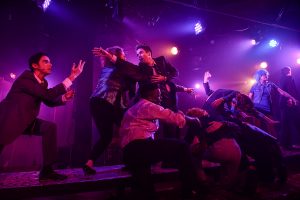
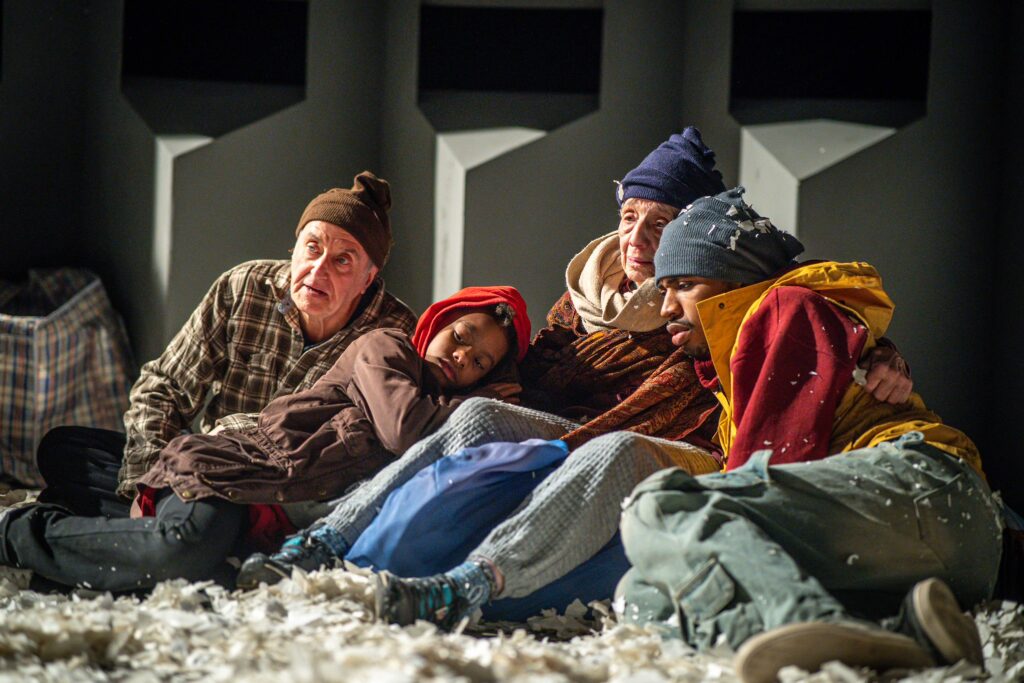
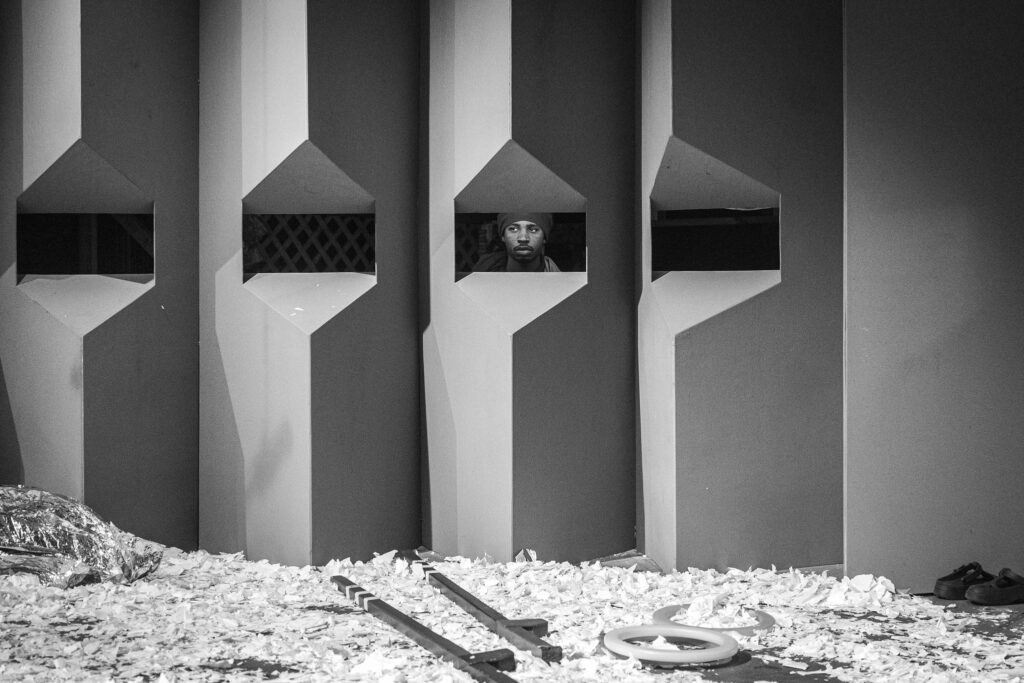
This is an intentional element of the play’s design, for Jelinek provides no direction on movement, staging, or the total number of people even talking in her script. Theatre Y takes up this challenge with aplomb, creating a makeshift stage-cum-viewing apparatus by way of an isolation chamber in which each member of the audience is given a small portal hole to view the action of play. The holes are based on the windows of German bunkers from the WW2 battle of Normandy Beach and from them we can see the actors in a space akin to a chicken run built for humans. In an email exchange with dramaturg Evan Hill about this choice they explained that, “Walls are built twice—once in language, once in concrete. Charges kicks holes in the first wall. The text, as it were, removes these bricks of received language that shape immigration discourse and holds them up to the light.”
After the violence at the University in 2016, there are few recorded stagings of Jelinek’s play in Europe. The play was also never performed in North America. Until now. Charges recently premiered at Theatre Y in North Lawndale. Co-directors Héctor Álvarez and Melissa Lorraine, alongside dramaturg Evan Hill, envisioned Jelinek’s lack of stage direction as action that takes place under a microscope, a story told through the windows of a panopticon. This absence of a particular time or place then creates the possibility of help being needed, anytime, anywhere. The lack of delineation between characters, the spoken pleas for help, makes their appeals a mass cry, undifferentiated, an overwhelming collective need.
What would you do in the face of such demand? This call for aid could be from a bus of Venezuelan migrants headed to Chicago, a Mexican child trapped at the border, a Syrian family lost at sea, a Palestinian man fighting to survive in Gaza, or nameless maidens of ancient Greece attempting to escape unwanted lives, laws, marriages.
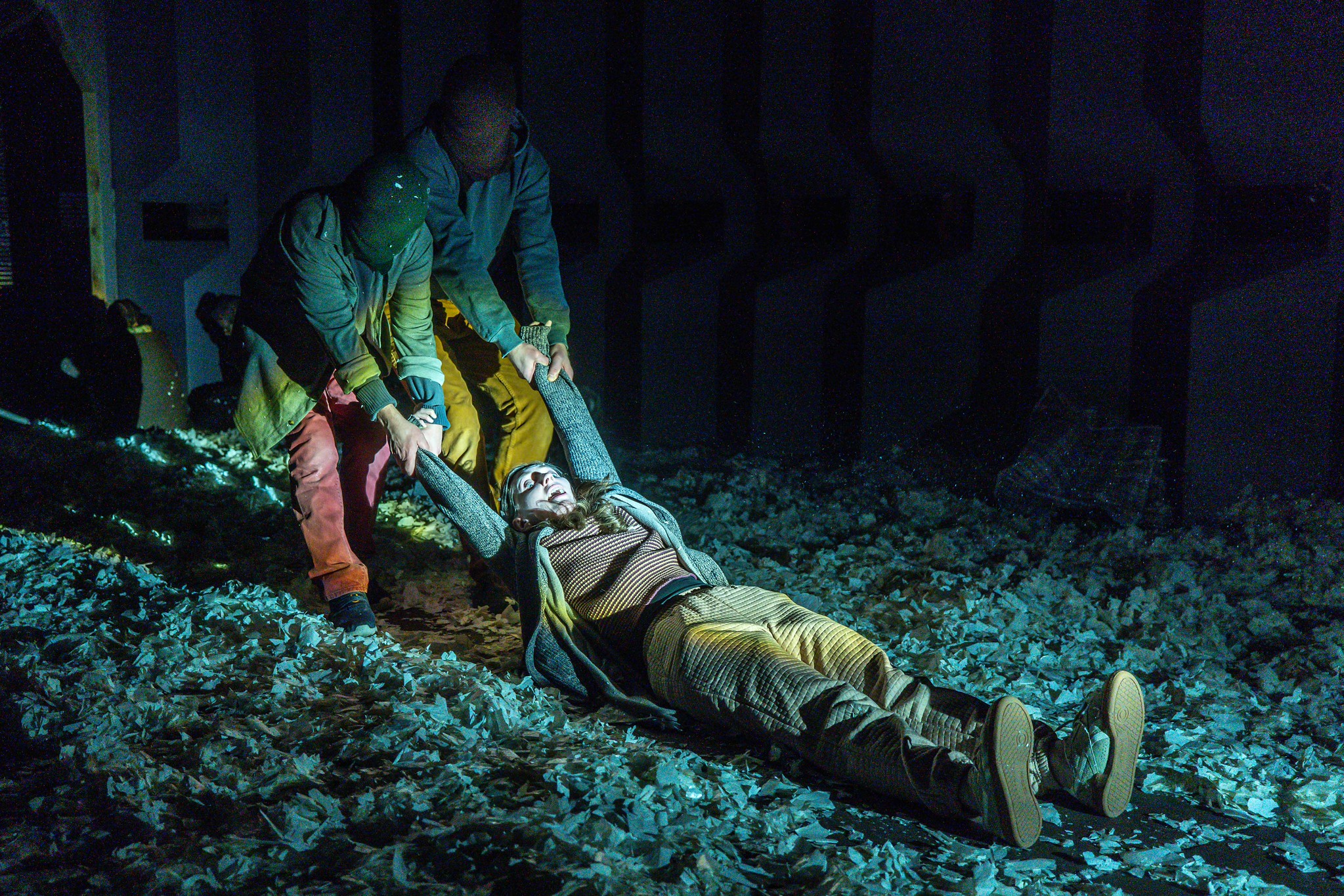
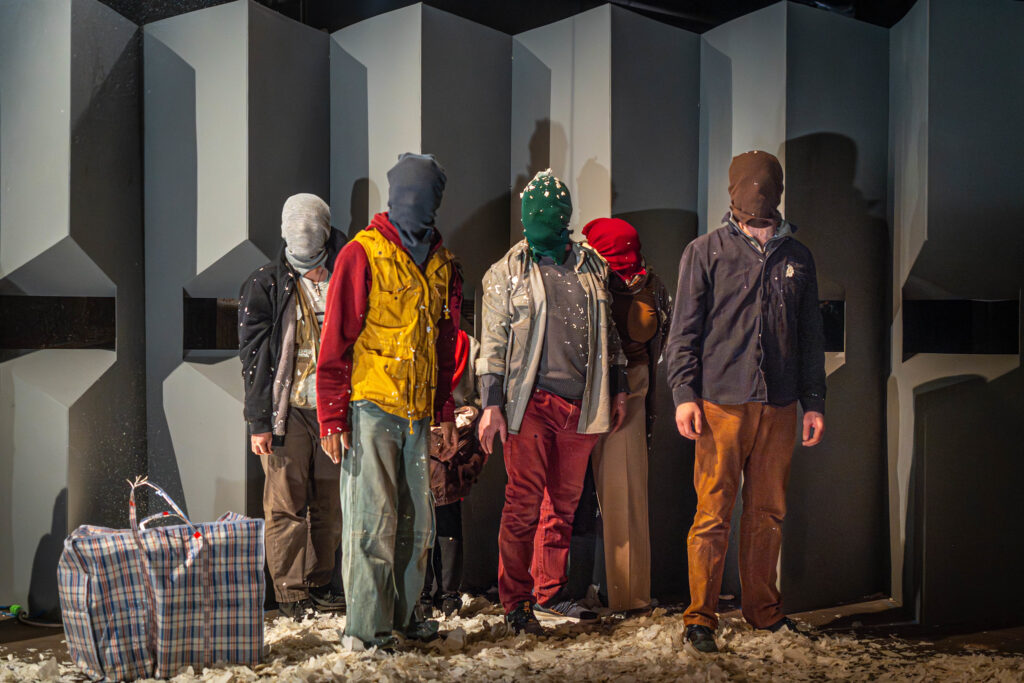
At the beginning of the play the actors enter the enclosure holding large nylon laundry bags with their faces covered in scarves. One by one they remove their scarves. As viewers can first see their faces, the bags are overturned and mountains of shredded documents given to the refugees by countless, nameless agencies and officials spill out. The actors’ share their lines like a musical round, we’re given bits and pieces of lives that have passed, but not too much. We’re kept firmly in the inescapable present, the life that is here, this moment, now.
I wondered at first why Jelinek’s play was chosen by the theater, a play that hadn’t been performed for around ten years, and never in the US, but Álvarez and Lorraine were quite forthcoming in conversation that they believed in the power of Jelinek’s work and its unique ability to meet this American moment.
In addition to the high-profile ICE raids that hit the city of Chicago last year in their “Midway Blitz” campaign (but still quietly continue according to Southside Weekly), Propublica also reported that in the first seven months of Donald Trump’s second term as president, his administration arrested and detained the parents of over 11,000 US citizen children. These children are the collateral damage of the Trump administration’s aggressive implementation of ICE, many times against the country’s own citizens. It should be noted that as the agency was only made in 2003 as part of the Homeland Security Act, a great deal of us reading have lived in a world without ICE. Those detained by ICE are then held in privately-owned detention centers across the country, this new system of immigration control powered by for-profit prison corporations like CoreCivic and GEO Group. The fear that the refugees of Charges feel when they’re rounded up by nameless forces with guns and spotlights feels prescient as we realize this is happening, in our country, in our state, in our city.
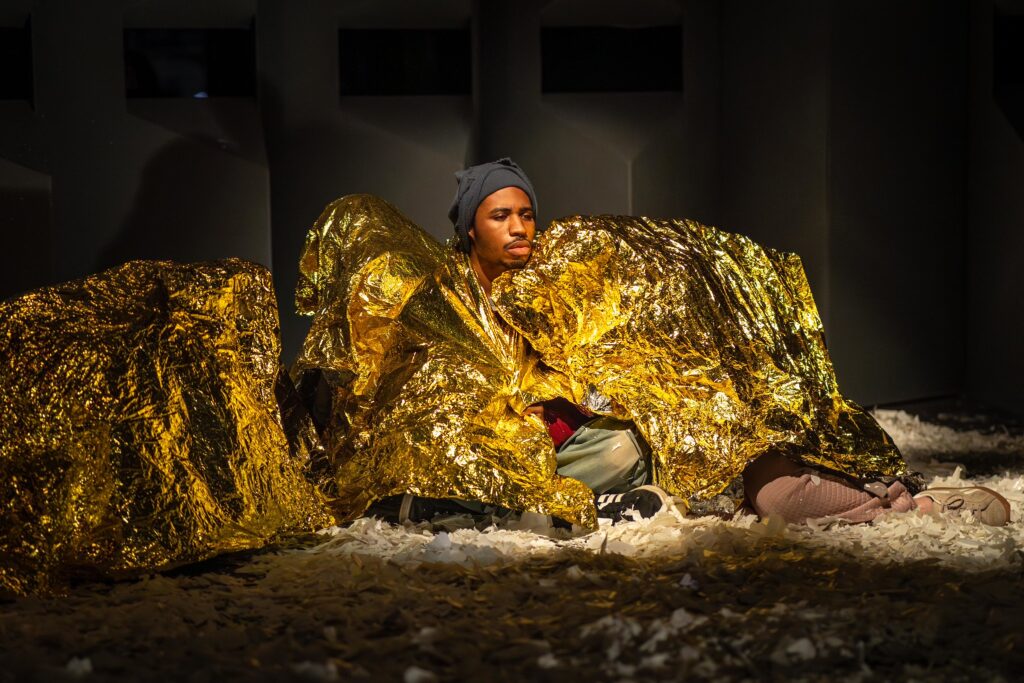
Another compelling cultural touchpoint is Jelinek’s conception of “the one who is paid for.” The figure of the “one who is paid for” is a refugee but she stands apart from the group. She’s been protected from the worst of their plight by way of another’s money and her beauty. In Theatre Y’s production, she appears and walks across the reflective material of rescue blankets. Her face is covered with a watercolored silk scarf. She wears a cocktail dress and holds a cowbell. She does not speak. She addresses no one. She only rings her bell.
Jelinek writes, “behold the one who has been paid for, here she is, the new one, from heaven high she came to earth, on eagles’ wings, no, sorry, by plane, she arrived on an airplane.” Jelinek then likens these young women, girls, and beautiful boys all held in the form of “the one” to the Greek myth of Io: the young woman who becomes the lover of Zeus but is cursed to be a refugee of sorts by Hera (Zeus’ sibling wife) in the form of a cow, forever tormented across oceans and lands by the sting of a gadfly. “Even as a cow she would still be beautiful, even transformed, traversing our meadows, even as a cow!, what pasture, pray tell, what cattle track do you belong to, woman?”
For me it’s difficult to separate the “one who was paid for” from the young victims of the Epstein files filled as they are with silent and silenced girls and women; children with their own silk-stuffed mouths, offered up by guardians to warm the beds of rich men, our very own dark gods. Though distinguishing the two groups might not be necessary given that Jelinek illuminates here how sexual exploitation is writ large upon lands and bodies plundered by war, greed, colonialism, and capitalism. The “one who is paid for” carries her own heavy debts.
I mentioned above that the play’s source text, the ancient Suppliants trilogy, is lost to time. What we do have of the play is its first part in which fifty daughters of the mythic Io, the beautiful girl cow, flee from Egypt to escape coercive marriages. At the end of the play the women are saved and given shelter. Yet in the lost second part, the action is reversed and they’re somehow forced to marry their unwanted suitors. All but one woman agrees to kill their new husbands on their shared wedding night. She betrays her fellow maidens because she has unexpectedly fallen in love. This traitorous sister is then forced to stand trial for her betrayal.
The nature of her crime complicates what we think we know. When confronted by love’s own confounding nature, what do we owe each other, what are the ties that bind? Just like moments in the play where refugees are forced to perform increasingly elaborate tricks, feats of strength and clever gags, we’re left to wonder how we adapt and force others to adapt in turn, whether it be for love, sympathy, or basic human dignity. What is it exactly that we ask, that we need from one another?
Something troubles me about the text though. In the introduction to the UChicago Press’ printing of the original play, the writer describes the play as “not very exciting.” The logic here is that the women, speaking as a chorus, comment on their predicament from a distance, they prod their pain like spectators, from the outside in.
This distance is still present in Jelinek’s version as voices blend together and refugees become a jumble of words, musical streams of sound, of language, merging into a single mass. Theatre Y attempts to combat this phenomenon through their styling of the actors and the physical immediacy of the stage. You are a spy, a voyeur, a bit of a pervert as you peer through your portal hole. Near the play’s beginning the actors peel off their facial stockings. Faces, the ability to look, constitute something like a revelation. From your window the actors return your gaze, you psychically poke and prod one another, you fall into the tenuous camps of us and them. Yet, even with the knowledge that this all is happening, that we are so close, that nothing separates us from those who are hungry and unhoused, who had their homes taken from them, is knowing this enough?
I don’t think so.
Art cannot save us, it never could, think back to the ersatz chorus of right-wing terrorists during the play’s Vienna run. Where is the response to such an act, how is such violence met in turn? Can violence be answered with something else, with art? Art, listening, watching, reading, consuming it, is an imperfect response. It lacks. It is confounding and useless. Yet, this very confounding and useless thing is often our only source of rebellion, a declaration of our shared humanness, in a world ruled by profit and production. Know this then when you take your own seat behind a portal window at Theatre Y or somewhere, anywhere else. This is not enough, this was never enough. But for right now, it’s all we have. It’s our job then to live, build, and do everything in our power to make that lack less painful for everyone.
About the author: Annette LePique is a freelance writer based in Chicago. She has contributed to the Cleveland Review of Books, Frieze, Momus, and ArtReview. Annette writes frequently for Chicago’s own NewCity and is a member of the International Association of Art Critics. She was the recipient of a Rabkin Prize for Arts Journalism in 2023 and is a big fan of dream logic.