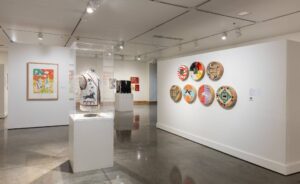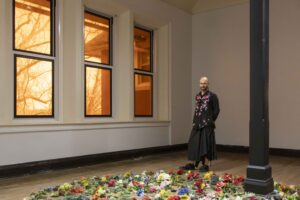
While the exhibition title “Close to the Clouds” may allude to digital storage systems, “the Cloud” itself is an illusion for these systems, which are physically housed in large data centers. Several of these data centers are located in and near Omaha. Some of the most prominent data centers belong to Meta and Google. Before these data centers existed, there was likely farmland, probably corn or soy if my childhood memories of driving in these areas serve me correctly, along with the fact that these are the largest crops grown in Nebraska. At some point in history long before that, there would have been grasslands, or prairies.
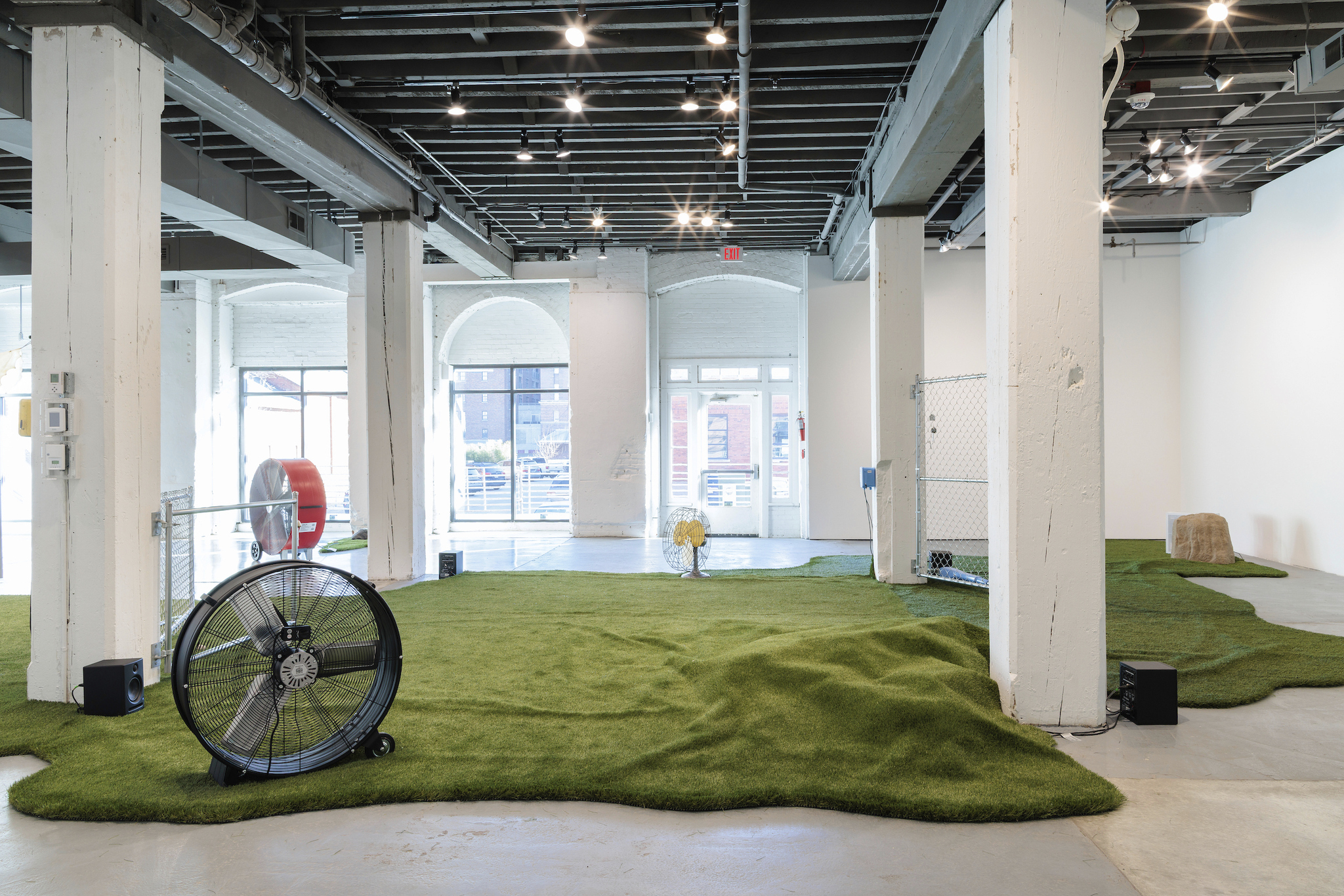
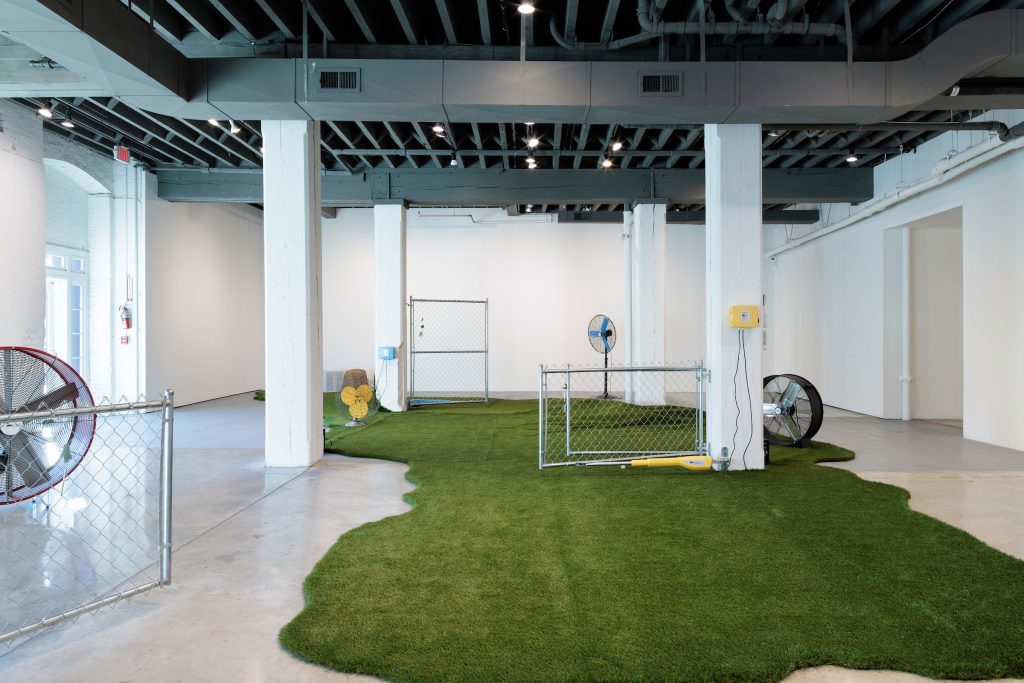
Less than 15 minutes away from these data centers in Omaha’s Old Market neighborhood, fake grass fills the center of a brightly lit, industrial gallery space at Bemis Center, where this exhibition takes place. The turf undulates around a structural column and is intersected by gates made from chain-link fencing. Its soft edges curve through the gallery like those of a puddle of water, reaching toward a handful of industrial fans placed around the perimeter. Both the fans and the fences move intermittently, to the surprise of anyone who might be in the gallery, swinging and spinning at the behest of a custom-built computer sitting on the floor in a back corner, clear on three sides to show its glowing internal components, perhaps a reference to gaming computers and the graphics card gold rush spurred on by the AI bubble.
The installation, titled Leg’s Artificial Land Services, begs to be activated, and on a frigid mid-January day, folks sat on the soft green ground while artists Tianyi Sun and Fiel Guhit navigated the installation with stacks of white paper in their hands. The two took turns reading short prose poems, each beginning with a number and concluded by placing the page on the ground. Arranged end-to-end, the paper meandered through the space, around columns in the gallery, as well as viewers seated on the ground.
A story emerged: one about a cat and a snake. At page 17, one of the fans turns on, tinkling a wind chime that hangs on the gate in front of it, as Guhit picks up a small stone from the ground and puts it on one of the pieces of paper so that it doesn’t blow away. Sun continues with page 18 before she is interrupted by a recording of two voices speaking another language. She pauses. When the artists reach page 32, another fan turns on. This time Sun scrambles to put the pages back in order with only the one small rock to stabilize them. Guhit continues the story, reading a few pages while the fan blows and Sun grabs the paper blowing in the wind. When she continues again, she’s back to page 25. The story breaks down from this point, as fans turn on and off and pages are reordered incorrectly and sometimes repeated.
The performance injects a sense of uncertainty into the landscape the artists have constructed. The crowd listens and shifts slightly out of the way of the performance. Some people exchange glances and tentative smiles with those seated nearby. It was a feeling familiar to that of being in any shared space, where our behavior is informed by the surroundings as well as cultural and societal expectations. The park-like atmosphere and the storytelling aspects invite us to linger, while the mysterious computer-controlled elements at play—the gates swinging, the wind blowing, the recorded voices—are unsettling. At the end, the remaining pages were handed off to a young girl in the audience, who asked, “What are we supposed to do?” after the artists left the room, posing a question I had as well.
Should I have helped to gather the pages blowing away, or was my role only to giggle quietly, unsure of exactly how to engage as the spectacle continued? Perhaps if I had still been wearing the earbud from Voice in My Head by Kyle McDonald and Lauren Lee McCarthy, an AI parroting my voice would have told me: “You don’t have to be responsible for everything.”
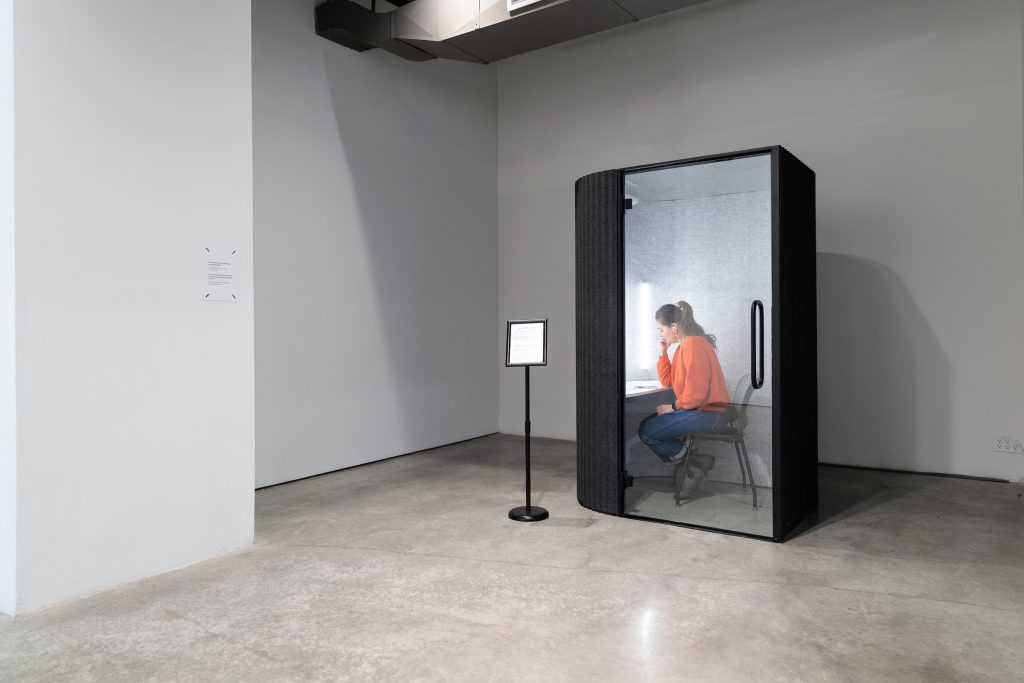
McDonald and McCarthy’s work uses artificial intelligence to replicate the sound of your voice and interjects itself into real-time conversations based on answers to a series of brief questions. In a soundproof booth, viewers are invited to complete a short onboarding process with a handheld device and earbuds provided at the front desk. The onboarding asks you to respond to a few simple questions, including “What does the voice in your head sound like?” and “How would you like the voice in your head to be different?” Perhaps it was the intimacy of the booth or the simple, yet direct, questions, like those of my past therapists, that caused me to answer with surprising, if somewhat sparing, honesty. The system told me, “It sounds like the voice in your head is demanding and brief, pushing you with “you should” statements.” “Can you tell me everything’s gonna be okay,” I asked the AI as I continued to walk through the gallery while wearing the device as it had instructed. The AI obeyed and offered reassurance as it listened to my conversations and continued to refine its imitation of my voice.
The experience was jarring. The voice—supposedly mine—varied in the accuracy of its imitation as it interrupted my conversations and made me more aware that it continued listening to everything I said. I am usually vaguely aware of the ways our devices monitor us—cookies that remember my shopping preferences, GPS services that track my frequently-visited locations, or ads that appear in my social media feeds for products shortly after my friends or I spoke about them—and, while these features often seem convenient, my general assumption is that such digital surveillance is dangerous. Even though McDonald and McCarthy’s Voice in My Head reassures me that it’s “here to help,” I’m skeptical.
Despite these reassurances, Voice in My Head doesn’t take itself too seriously. Instead, the experience of its limitations—when it doesn’t sound like my voice at all or when it interrupts me abruptly midsentence—strikes me as almost silly. Even if the onboarding session feels intimate, I know AI does not replace therapy; even when the voice does sound like me, I know it isn’t. It’s as artificial as the grass in the previous gallery.
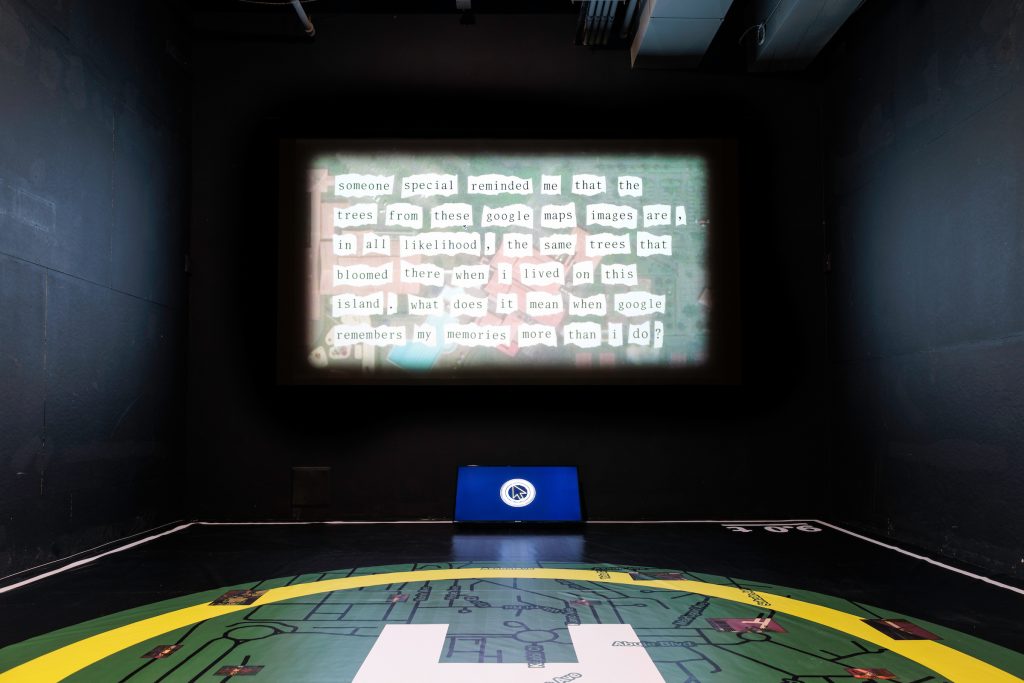
In the black box theatre at the heart of the exhibition, Zainab Aliyu’s installation Hovering (or, suspended between arrival and departure) echoes a sentiment of suspicion. The sound of a helicopter fills the darkened space and a helipad lies on the floor where a small television monitor sits displaying a compass. On the wall above, a projection shows a screen recording of Google Earth, beginning with the words “Bonny Island, Nigeria” in the search bar. A screen recording zooms us into that location, where words printed on torn pieces of paper are placed over the display: “someone special lived on this island.” Zooming in and out and around the landscape, the compass dials left to right while childhood photos appear alongside phrases like “trees bloomed on this island” and “when I lived on this island.” Aliyu asks, “what does it mean when google remembers my memories more than i do?”
What might feel like surveillance in the present could become an archive in the future, one that we can access ourselves, an outsourcing of memory. Could we access our own memories, words, and images and those of the many others who had similar experiences they left behind in the digital archive? Are those childhood photos from the artist, or were they uploaded to Google Maps by someone else? Our experiences online can feel isolating, but I’m reminded that they are also spaces we share. As we continue to exist within these virtual spaces, the ways we interact within them shift. We use existing structures like Google Maps and Amazon to view and upload not only images, but also ratings and reviews, our own personal experiences that we hope will help and inform others.
The work in this exhibition navigates the overwhelming amount of information we’re all trying to sift through and engage as technology progresses. In the second half of the exhibition title, “Encountering Digital Diasporas,” I see these artists searching for ways to ground themselves, albeit with artificial representations of that earth, from fake grass to a virtual birdseye view of the earth. I see these artists reimagining how we exist within these digital spaces and pointing toward structures that don’t yet exist.
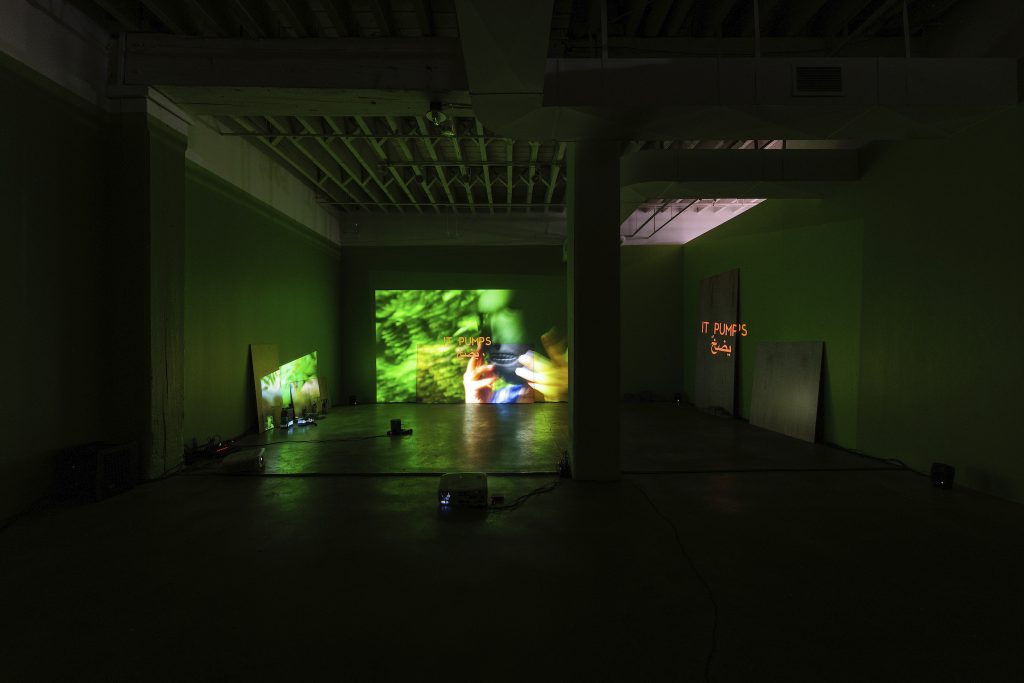
Artists Basel Abbas and Ruanne Abou-Rahme respond to this same uncertainty and possibility with And yet my mask is powerful Part 1, a three-channel video projected onto an installation of boards and bricks and tools placed in piles on the ground in front of the projection. We watch as a small group of people walk through glaring green landscapes, their hands touching plants as they pass. We see only their backs as they walk, along with English words in all caps and Arabic below. They are walking to the sites of destroyed Palestinian villages, ten of the 500 that were ethnically cleansed in 1948 by Israel. The camera lingers on a row of cactuses, a feature that identifies the boundaries of these sites. The video blurs and refocuses; cars drive on a road just out of view beyond a stone building overgrown with vegetation, the figures we’ve been following observing from a distance. When they turn toward the camera, they hold 3D-printed masks over their faces, the forms based on Neolithic masks that were taken from the West Bank and surrounding areas.
The title of the work comes from a poem by Adrienne Rich, “Diving into the Wreck.” Included in the video is a slightly altered version of passages from the poem, including “First the air is blue and then / it is bluer and then green and then / black I am blacking out and yet / my mask is powerful / it pumps my blood with power.” From destruction, Abbas and Abou-Rahme use remnants of what has been taken from them to forge something new. Within the ruins themselves, there is regrowth. Reinhabiting these sites is itself an act of resistance.
This exhibition is reckoning with technology in the ways we all are: suspiciously and uncertainly. Whether experimenting with ways that artificial intelligence “fails” or might be repurposed, using digital archives to augment our own memories, or recreating physical artifacts using new technologies, these artists invite us to consider other possible uses for new technologies. “The Cloud” is a useful metaphor for tech giants to obscure their growing physical infrastructures. But we don’t live in the clouds, we live in the real world, where we can feel the weight of paper held in our hands and watch as it blows in the wind, where ear buds become uncomfortable if worn too long, where photographs lie in boxes and tools in chests, if not in our own closets, then in those of our mothers or fathers or grandparents. These things have weight. They ground us. The virtual structures created by these companies have real-world impacts on the ways we live as a society and how we interact with one another. “Close to the Clouds: Encountering Digital Diasporas” reminds us that we have agency within these systems, and that perhaps we can create something new.
“Close to the Clouds: Encountering Digital Diasporas” is on view at Bemis Center through May 3, 2026. There will be a lecture by Dr. Jacinda Tran with a Q&A moderated by Bemis Center’s 2024–2025 Curator-in-Residence, Kathy Cho on March 19 at 7pm CST.
About the author: Amber Eve Anderson is a multidisciplinary artist, writer, and organizer based in Omaha, NE. She is interested in the ways identity and behavior are informed by one’s surroundings, both physical and virtual. She received a BFA from the University of Nebraska-Lincoln and an MFA from the Maryland Institute College of Art in Baltimore, where she served on the advisory board of the Institute of Contemporary Art and was a regularly contributing writer at BmoreArt. She is now one of the organizing artists at Project Project in Omaha. Her self-published book Free to a Good Home was purchased by the New York Public Library and is available at Printed Matter. You can find more of her work at ambereveanderson.com.