When I was little, I spent most of my free time alone. To combat boredom, I developed this game where I tore out pages from books, writing pads, and magazines, cut them into lines and individual characters, then scrambled them on the table. I then pick out random strips and see what paragraphs they would form. If you flipped the paper, you would sometimes get sliced words, mismatched shapes, or bright, colorful strips on the other side.
What I pieced together became a language that only made sense to me, a secret code of play, imagination, and unrestricted thoughts. I could go on for hours, forever absorbed in the organic movements of colors, shapes, and vocabularies.
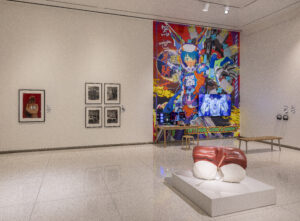
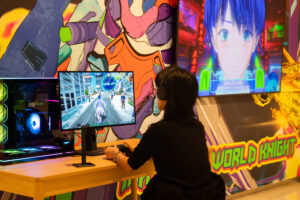
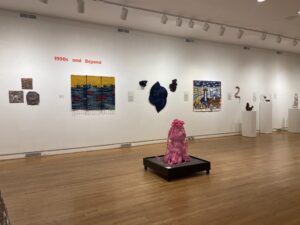
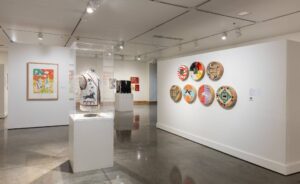
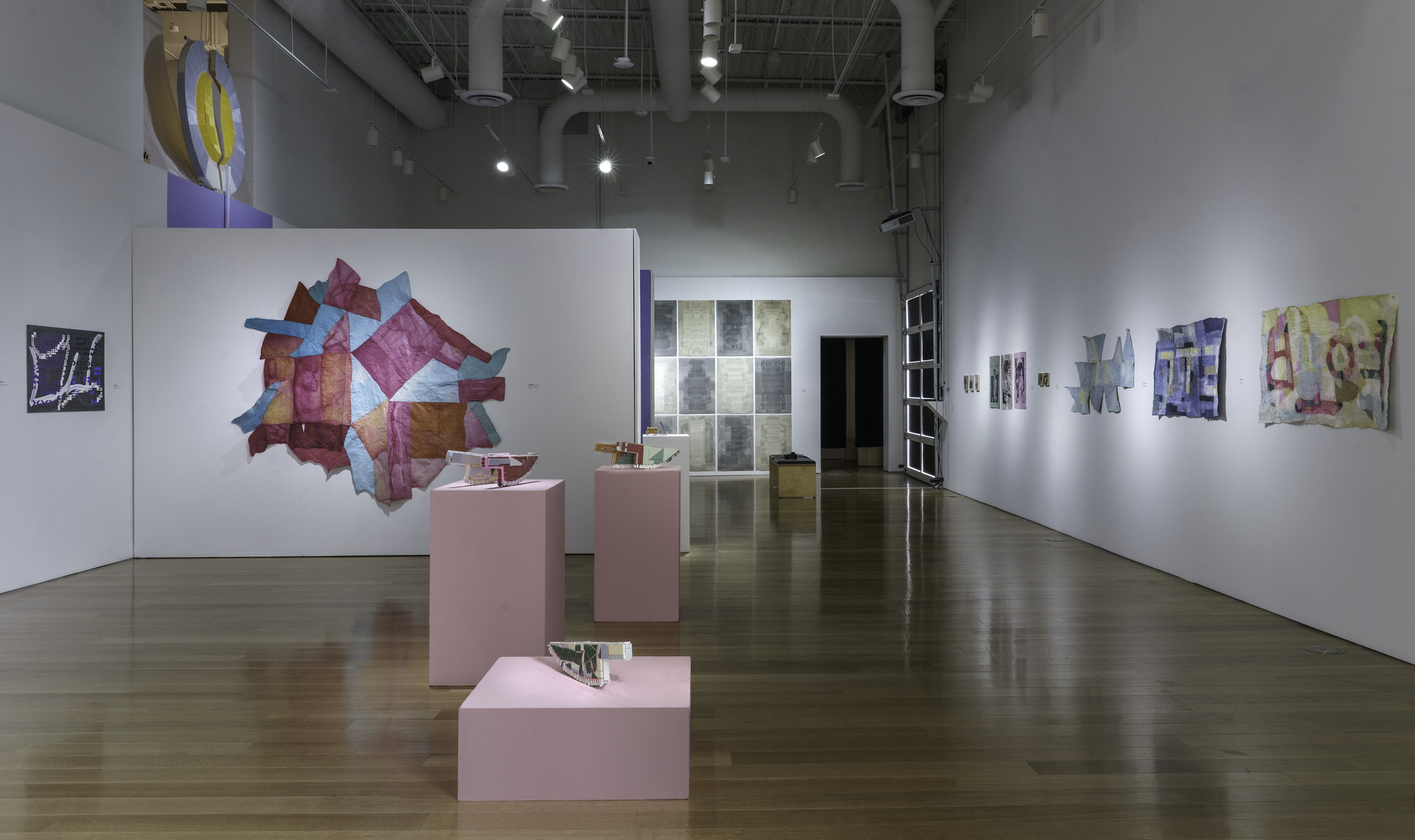
Shifting Tongues at Charlotte Street Foundation in Kansas City, MO took me back to this childhood game again. Curated by Arkansas-based papermaker, artist, and arts educator Danqi Cai, the exhibition began as an inquiry into multilingual experience and evolved into a playground for languages to break free of their traditional forms. Departing from the familiar, predictable words, characters, and sentences, the eight participating artists infuse movement, shape, sound, and gesture with meaning, using their art as building blocks to construct linguistic systems that are intimate and interactive.
Like my childhood game, meaning-bearing characters played a central role in many of the exhibition’s pieces. The artists would borrow, modify, or transform characters in their mother tongues. Instead of focusing on their intended meaning, the artists looked at them as physical instruments and experimented with their shapes and forms.
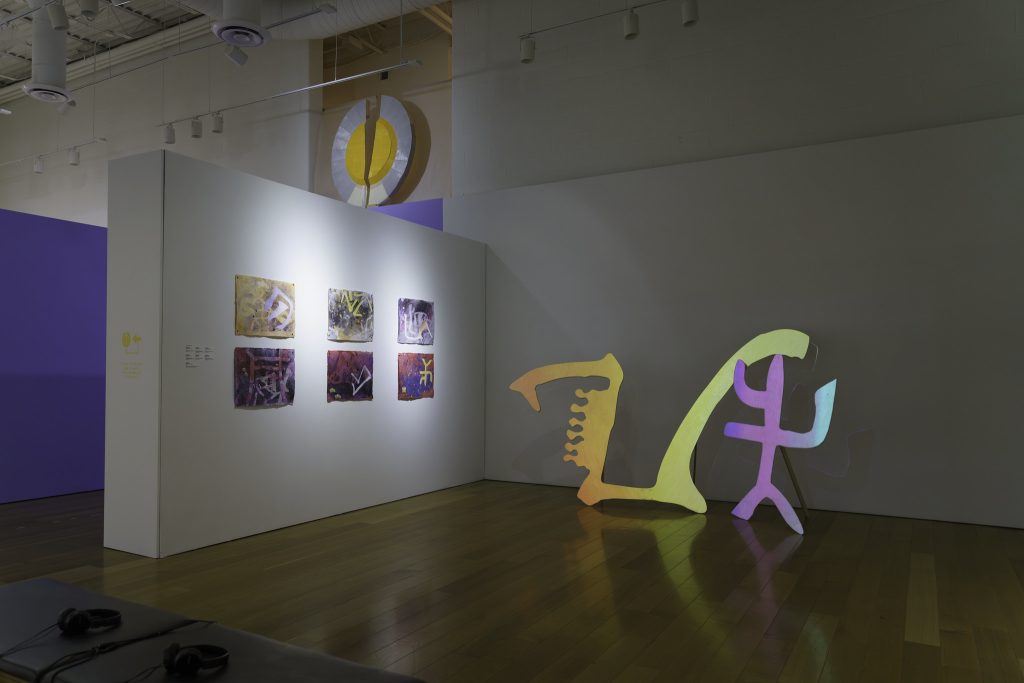
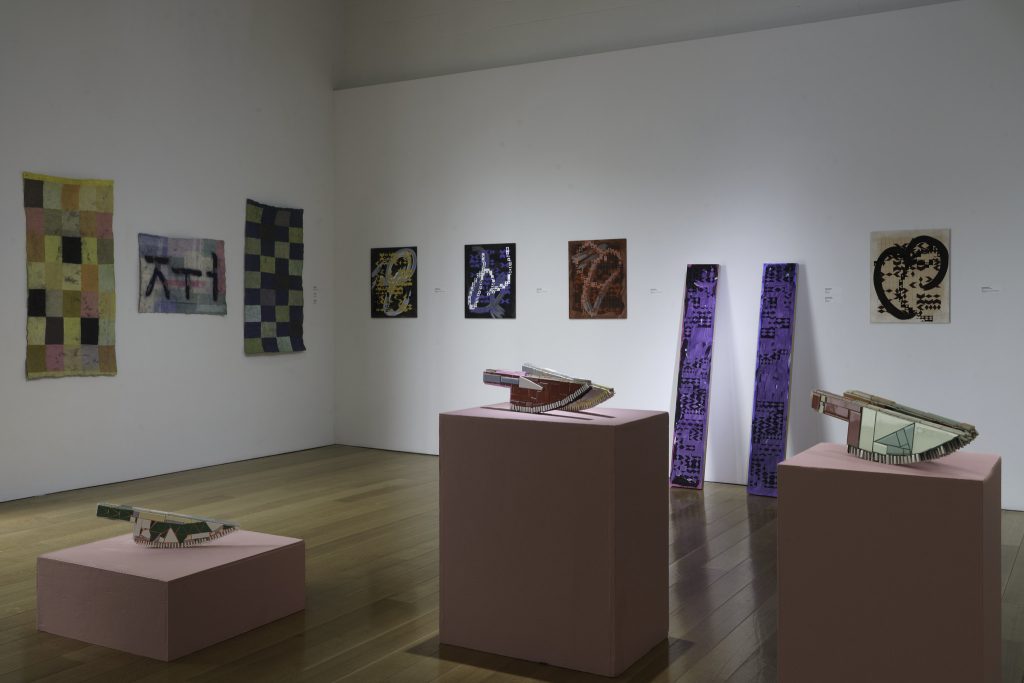
For example, Danqi Cai broke up Chinese characters and allowed them to run wild from her colorful hand-crafted paper to the gallery’s floor. The strokes looked like flailing arms or stretched legs of over-excited stick figures. It is impossible to determine which characters they originated from, even for someone like myself, who grew up speaking Mandarin. Instead, one must allow Cai to guide us via color and texture, trusting our sensors to pick up the hidden messages behind the hazy, feverish shades of red in Butterfly Dream or the pulsating flesh tones in Encoded Desire. And pay attention to how the meanings change as the colors projected onto the two sculpted characters changed from blue to purple, yellow, orange, and red. Like the same pronunciation in Chinese can carry vastly different meanings depending on intonation, the sculptures elude our comprehension and refuse to allow a single definition to be assigned, as if they were another entry in a Chinese-English dictionary. This reminds me of my geeky conversation with Cai over coffee, when she told me how people talk about language and vocabulary as if they were just this “sterile” thing: as if it were locked into a definite existence. The speaker can change, grow, evolve, and migrate; So why shouldn’t language?
“Not just in the… add new words to the vocabulary type of change,” I nodded as I whirled a little symbol on the cold foam in my drink, and thought about my childhood game of cut, tear, mix, and match again, “Something entirely different, but familiar at the same time. But still, different.”
As I reflect on language after this exhibition, I do believe it’s human nature to want to build our own languages, even if it’s nothing more than a codified system that makes sense to only one speaker. Since language is the process of codification, then language-making would be an attempt to decode. It then builds a safe space to process and understand what happens within and around us, and provides a unique tool for archiving and communication.
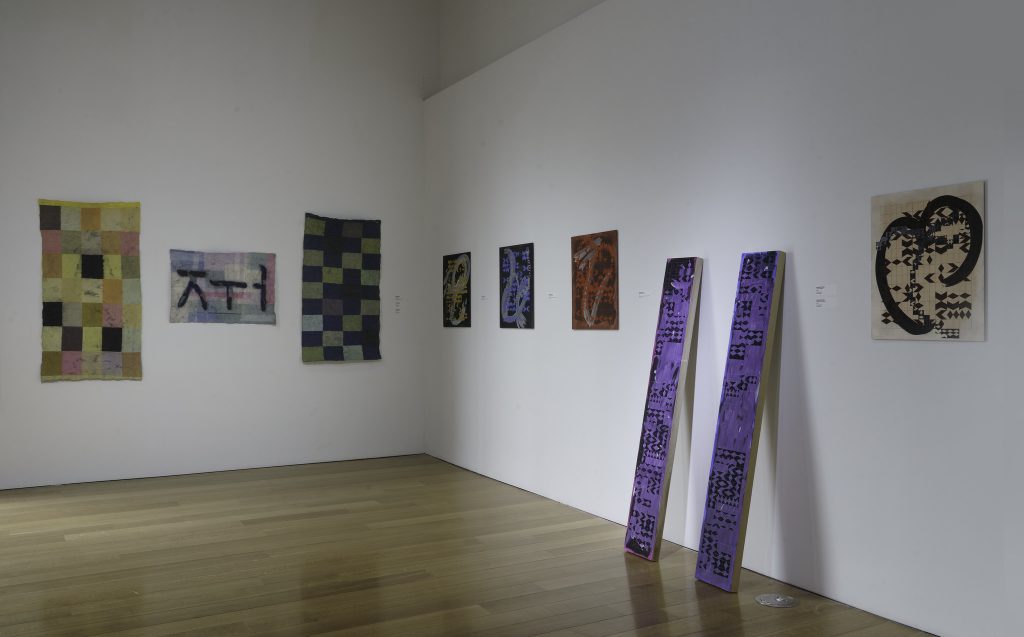
Kansas City-based painter Samantha Haan uses arrow-like symbols as her code. They remind the audience of simple computations, zeros and ones conjoined and redirected by logic branches. Though unspecified, one could easily attach meanings to each cluster of arrows based on their directions and intervals. Mapped on top of an abstract background, these paintings build the impression of a language. The harder one tries to decipher the codes, the more elusive they become. Yet the impression that a meaningful message is embedded behind the marks only grows stronger.
“The speaker can change, grow, evolve, and migrate; So why shouldn’t language?”
Similarly, Yanbing Park’s paper series also uses textures, repetition, and differentiation as a way to construct visual codes. Park builds a language of duality with hand-dyed Joomchi and Hanji, two types of traditional Korean papers with significantly different weights. The first layer of information comes forward in the form of colorful patchwork, like a blinking radio transmitter. The second layer is the heavier and lighter papers and their corresponding textures, like the dashes and dots in Morse code.
It’s fascinating to see how the strategic arrangement of materials and visual signals imply meaningfulness in these pieces. It makes me wonder about each artist’s creative process. Do they move each unit in their language system around? How do they realize they’ve got it right? Or perhaps they never do, just like I never knew a proper way to arrange my shredded pages of colors and symbols in my game. This uncertainty is what makes this exploration of code and language fascinating: even when an arrangement is presented as a final product, it’s still temporary. The language continues to shift and morph, and that animated energy shines forward, making each finished piece only a snippet of mid-movement, but never the full image.
However, as much as language may shift to something shapeless and formless, it never strays. After all, words, gestures, and symbols require an anchor to exist. In Shifting Tongues, this anchor often comes from the past, securing each artist firmly at their core. Memory, heritage, personal and collective histories are the guiding thread–tying phonetics and lexicons to their unspoken, underlying essences like the wire held onto by that beaming child while their kite soared high in the sky.
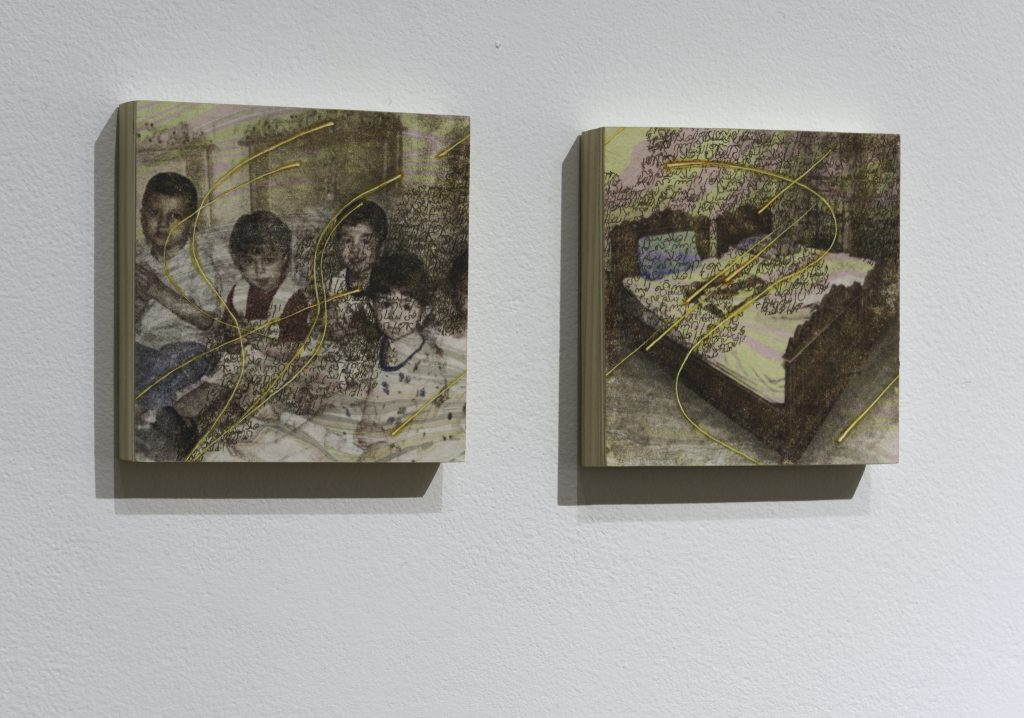
In her paintings, Syranian Lebanese American artist Nada Bayazid writes over scenes from her childhood. Thin, black script overlays the images like a delicate veil, echoing with the abstract lines and shapes shifting under or gliding above the surface. In A Brief Return (set of two), shining, golden lines slice across transferred photographs, leaving behind bright, sharp traces. In Asif (set of three), ink ripples run across colored paper, interfering with the screenprinted photographs, twisting shapes and contours, and leaving ghostly shades everywhere. You hang in the balanced push-and-pull of a remote dream and an immediate reality. The scribbles whisper the artist’s hushed secrets in your ears.
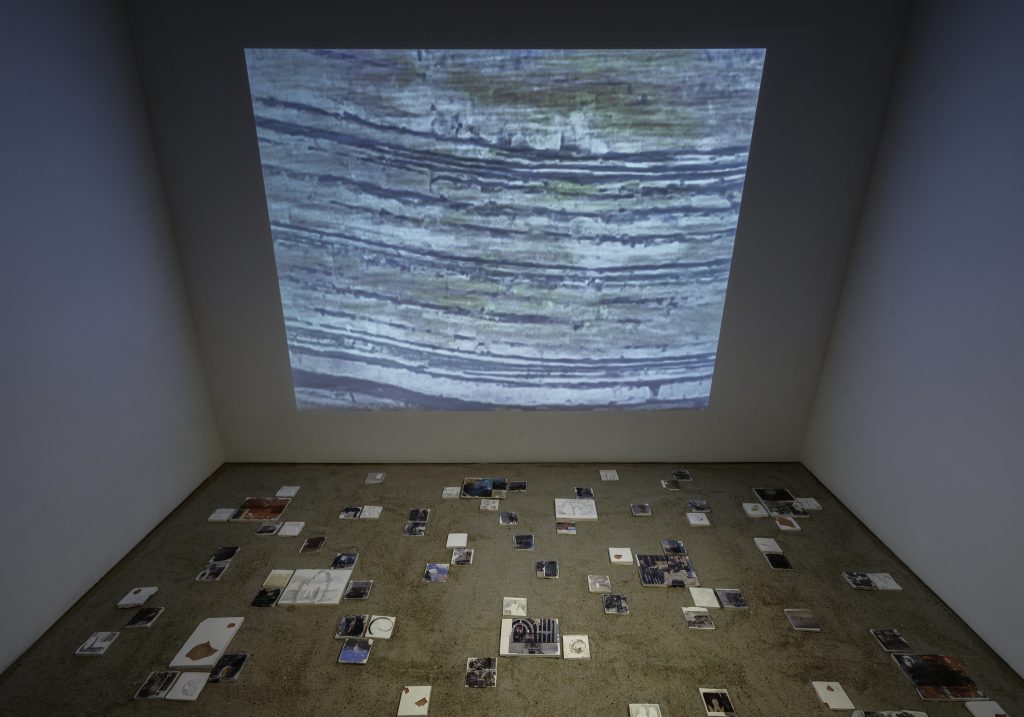
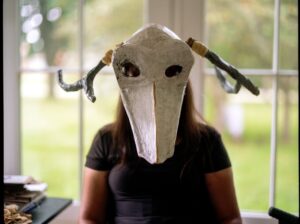
Mexican artist Kiki Serna also toys with fragments of the past. In Paraíso (Entre)rrado, family photos, images of familiar architecture, letters, and personal ephemera are printed onto white tiles. The images are cracked, chipped, blurred, or rubbed raw. A video was projected onto the wall in front of the irregular matrix of tiles of memories. In the darkened alcove, it feels like you’re seeing the world through Serna’s eyes. You feel both out of place and yet couldn’t help but fall deeper into this foreign soul that has opened its perspectives to you. Everything felt muffled and ambiguous. The images elude you, and the light casting from the projector makes you a bit dizzy. You became a note in the symphonic flow of information and emotion, or a bird blended into a murmuration. The changes around you may be rapid, but you stay attuned, chanting a language shared by humanity but vocalized by none.
A linguist might dissect language by its structure, formation, and configuration as if it were a static, dead thing. However, in reality, language is not a fixture. It is alive and fluid, constantly rearranging itself using the basic modules of sound, gesture, movement, and shape.
Suddenly, I was back home in Shanghai, sitting alone in the dining room. My form seemed too small compared to the massive redwood dining table. I’ve just spent an hour playing with my text tiles. Now, I have a colorful patch made with chopped sidewalks, shop windows, and poster slogans in bolded font. The combination made sense. Satisfied, I swept the little blocks of text, image, and color off the table into a clear Tupperware for storage. They lay dormant, but would be revived at any moment. The same building blocks will form a new missive for me to read. And I think about the work in Shifting Tongues, how they are eternally suspended in a beautiful state of incompleteness, and their meanings will change depending on the reality at the moment of interaction.
The artists attempt to codify and decipher the many nuances of lived and inherited experiences simultaneously, using their art as their system of documentation and archiving. While we may never fully understand their secret languages, our bodies recognize patterns, such as a certain way of repeating or a harmonious grouping of sounds. Hence, our mind grasps onto the familiarity and makes meaning of these codes on our own terms. And we become part of this linguistic metamorphosis.
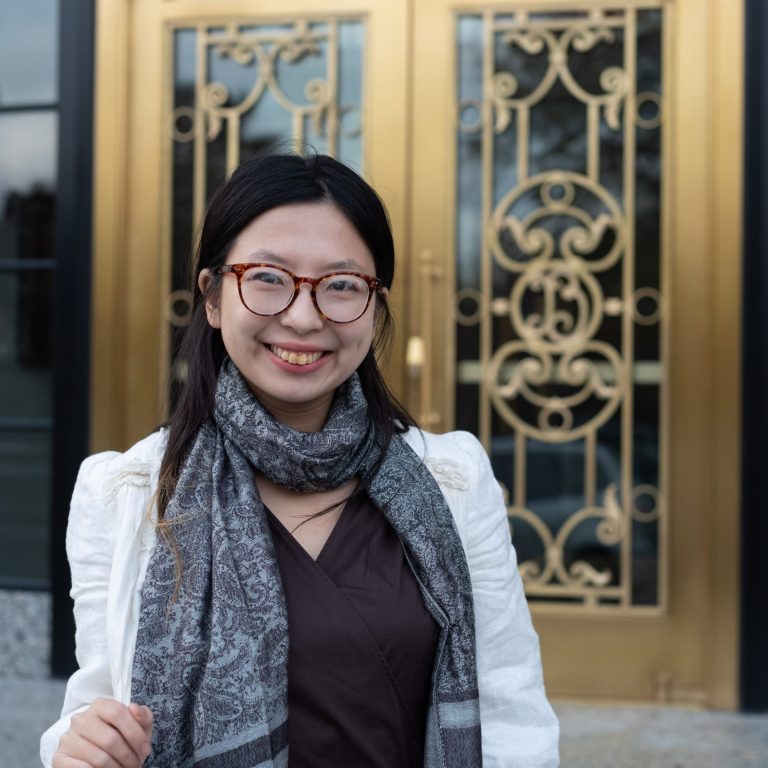
About the author: Xiao Faria daCunha is a practicing visual artist and an independent journalist covering what’s happening in the Midwest belt, focusing on lifestyle, art, and culture. Her visual art practice includes mixed-media illustration on paper, printmaking, and mixed-media collage. Xiao was the former Managing Editor for Urban Matter Chicago and her bylines have appeared in Chicago Reader, BlockClub, BRIDGE.CHICAGO, KCUR, The Pitch KC, and more. Xiao’s artistic and writing practice explores the intimate, vulnerable truth of the BIPOC, migrant, immigrant, and diaspora communities. She considers everything she does art journalism and aims to speak on behalf of those who haven’t been heard and shed light on what hasn’t been seen, whether it’s emotional, cultural, or societal. By weaving her personal experience with public narratives, Xiao creates emotional and engaging conversations to interrogate, challenge, and advance existing perceptions of women, Asian diasporas, and other immigration populations.