
Lee en Español aquí.
Minimalism is known for its hallmarks of formal purity, order, and a supposed insistence on neutrality. Exemplified by figures such as Donald Judd, Robert Morris, and Hal Foster, minimalism emerged in the 1960s. Minimalist understandings are being reconsidered by Chicago-based contemporary artist Joseph Josué Mora as he uses minimalist codes of formalism and authority to interrogate its claims of neutrality in his practice at-large, and especially in the installation Upon Loss, How Can I Move on Now? (2025). Through this, Mora critiques various sites of power including museums and governments, often through abstraction and poetics. In his practice, Mora upholds art historian Anna Chave’s critiques of minimalism in her essay “Minimalism and the Rhetoric of Power” (1990). In this essay, she states, “The Minimalists effectually perpetrated violence through their work—violence against the conventions of art and against the viewer—rather than using their own visual language to articulate a more pointed critique of particular kinds or instances of violence.”1 Chave further asks, “And how are we to understand [Minimalism’s] cool displays of power in relation to a society that was experiencing a violent ambivalence toward authority, a society where many were looking for the means of transforming power relations?”2 These questions, posed again contemporarily, and its potential responses, permeate Mora’s practice as he considers current ideological dilemmas evident in local and global politics and the art world, particularly in affronts to ethics and truth.
Characteristic of minimalism and Mora’s practice, the installation consists of four artworks that are largely made of industrial materials, predominantly tempered glass, polyurethane foam, and drywall. Through their materials and placements directly on the floor, many of the works in Mora’s practice engage in the resurgence of the ready-made within minimalism and the rejection of the pedestal, both literally and figuratively. The two largest sculptures West Pershing Road & South Campbell Avenue (Preventative Care) and West 34th Place and South Damen Avenue (Preventative Care) each consist of four found car window panes and their brackets from various vehicles.
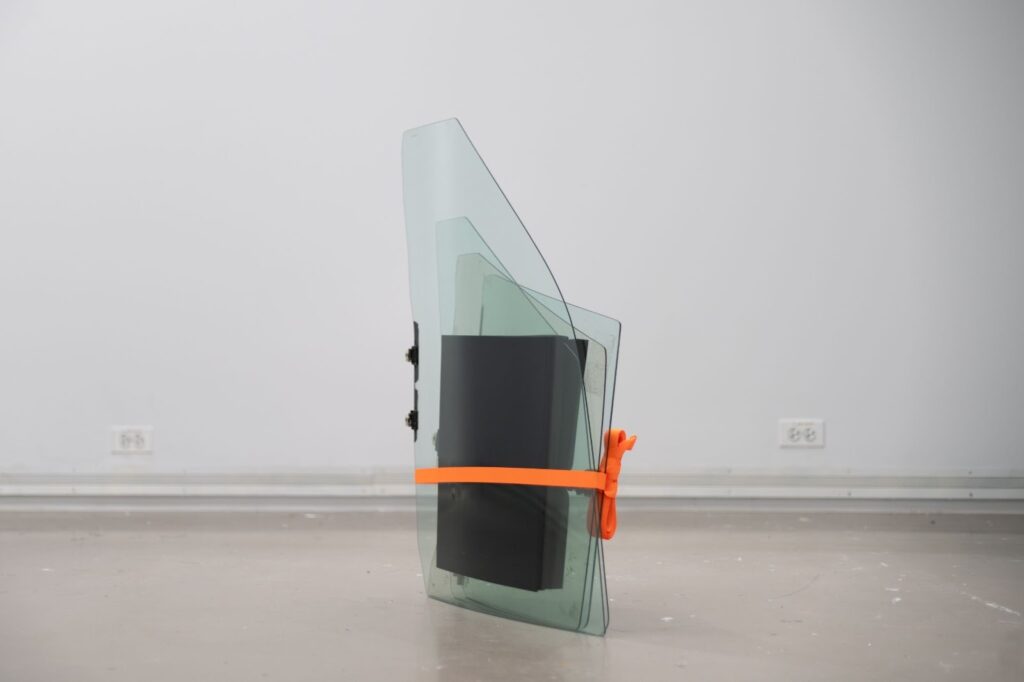
The brackets are notable because of their disruption of the smooth and irregularly shaped glass. The brackets and discolorations of the glass are the two most obvious indications that these panels have been used. Between each window pane is a polyurethane foam square that prevents the glass from touching. The windows and foam squares are held tightly together by safety orange ratchet straps and their s-hooks, each with neat bows tied to prevent the straps excess from pooling on the floor.3 The sculptures are standing on the floor at skewed angles at a distance of about 10 feet from each other with A Memorial Takes Place between the two and I’m Passing Over You Like a Satellite off to the side closer to Pershing & Campbell. The artworks cause a sense of precarity that enacts a control over the viewer and their movements due to their spatial configuration, materials used, and presence. These are some of the ways minimalist sculpture asserts itself, through material, scale, and especially, its presence. The artwork’s presence embraces its objecthood and in doing so, the viewer is acknowledged as a part of the environment within which the artwork exists. Due to this quality and precarity in this installation, power is exercised over the viewer, which coerces the viewer to conform to the authority of the artwork. Through this control, the viewer is recognized as corporeal, existing in and navigating the space, rather than as a bodiless beholder merely observing the work.4
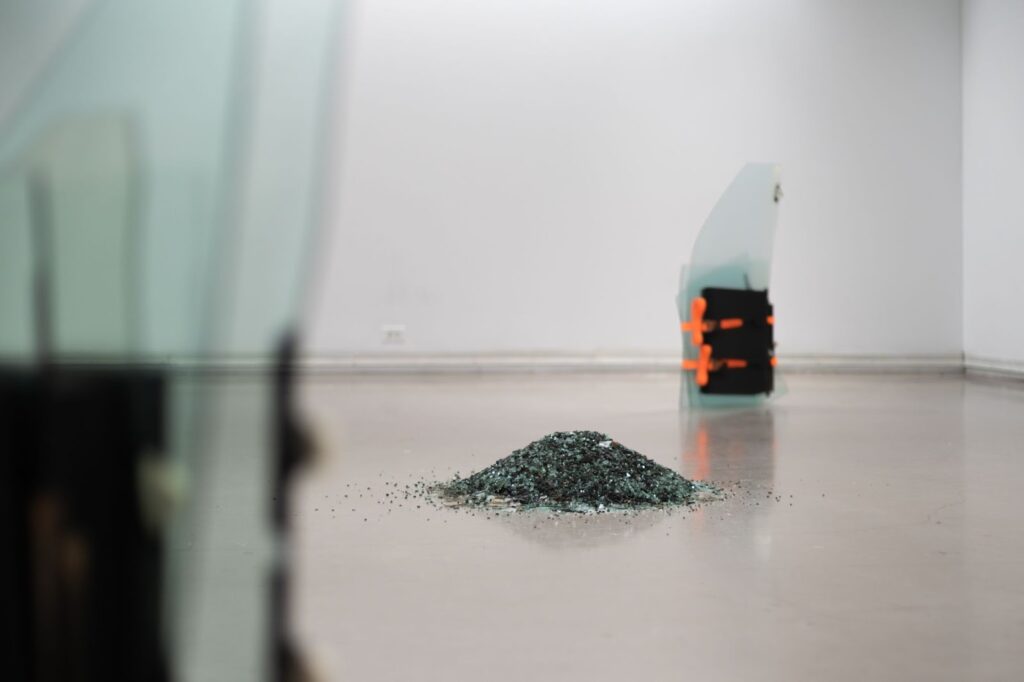
Chave notes that this dominating tendency of minimalist artworks was parallel to, but not necessarily as a result of or in response to, the cultural and military clashes of the time, including the Vietnam War.5 Mora’s work, alternatively, is a direct response to the displays of racialized aggression from the U.S. Immigration and Customs Enforcement (ICE) in the McKinley Park neighborhood of Chicago, Illinois, at the intersections of W. Pershing Rd. and S. Campbell Ave, and W. 34th Pl. and S. Damen Ave.6 In this context and with the title, A Memorial Takes Place, the work signifies the mourning in the aftermath of violent interactions that often involved the breaking of car windows to forcefully abduct people. This ICE activity, most often concentrated in Latin American communities, has resulted in anger, stress, and fear. McKinley Park itself, as of 2023, has a population of 15,443 with 55.7% being Hispanic or Latino making it a target for ICE violence.7 This aggression in Chicago, done under the guise of safety is in reality largely a product and practice of racism and the intentional spread of hatred.8 The effect in these communities is similar to the spatial control seen in Mora’s work as many individuals have now altered their daily routines, gestures, and demeanors out of fear that it may result in detainment and/or risks for themselves and those around them.
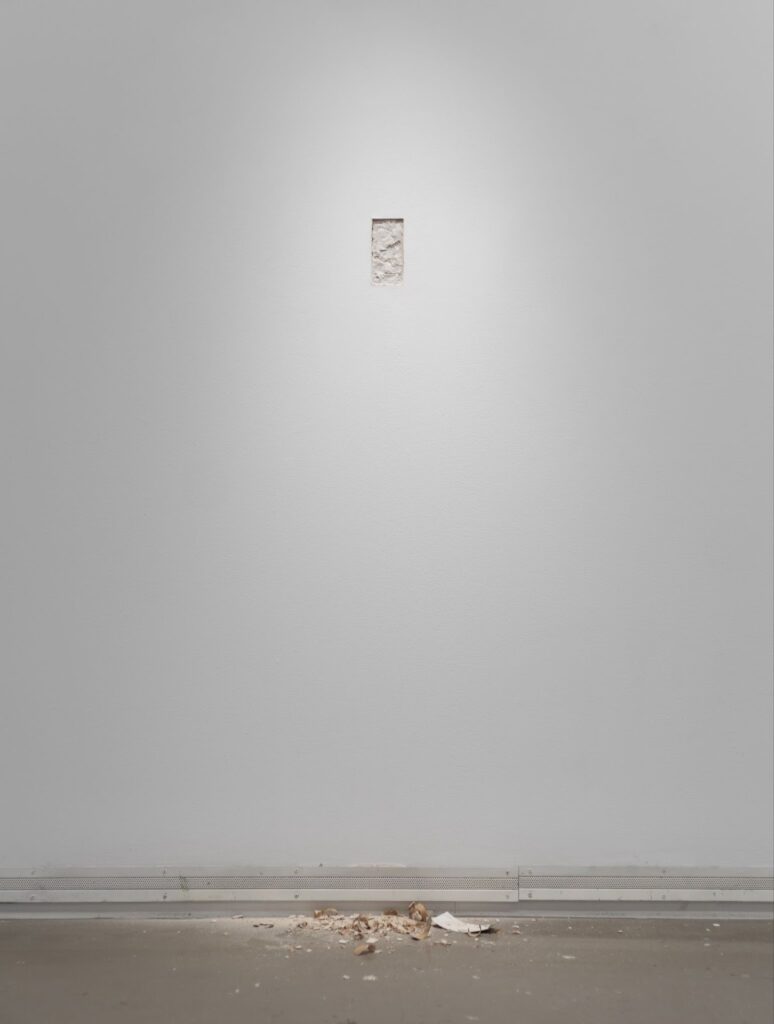
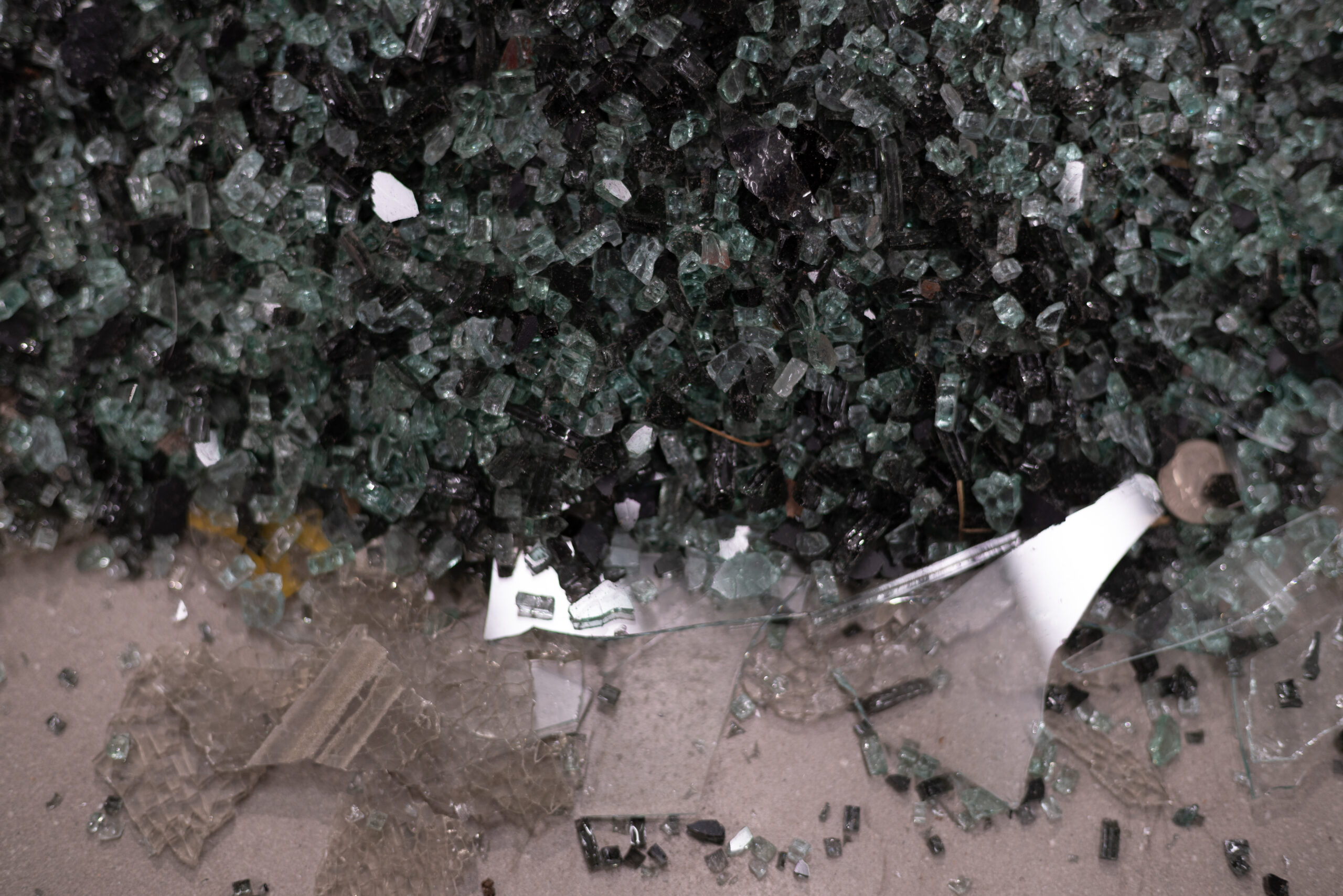
I’m Passing Over You Like a Satellite is a rectangle carved directly into existing drywall at roughly average eye height. Its dimensions resemble common smartphones that are often used to document the ICE aggressions and inform others through community-based websites, group chats, and social media.9 The physical carving of its dimensions and the shattered remnants of drywall at its base may reflect the smartphone’s uses as both a weapon and a witness in these scenarios. While ICE has bought sensitive information gathered by smartphones, particularly location data, which largely works through satellites, to target individuals, phones also serve critical functions as a witness, allowing individuals to record the ICE incidents that include street checkpoints, abductions, and violence in an attempt to protect and inform the community of urgent information.10 I’m Passing Over You Like a Satellite presents both a passive, yet involved role, similar to that of the passerby.
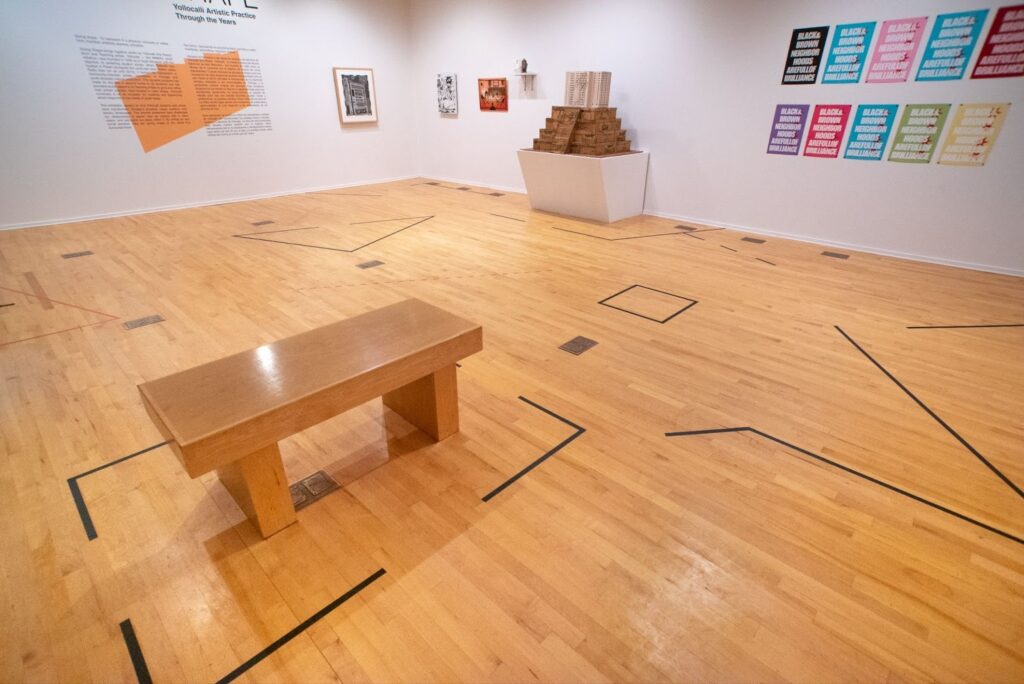
ICE’s violence and dilemmas parallel similar contemporary conversations in museums regarding ethics and authority. More specifically, questions including: when a system’s (museums, governments) pretenses are illegitimate and actions ethically reprehensible, what becomes of the legitimacy of their systems of authority and how do the duties of those within that system change in response? As a reply, Upon Loss, How Can I Move on Now? reflects on the impulse and responsibility to gather, inform, and mourn as a community. Another of Mora’s works, The Right of Ingress and Egress (at the National Mexican Museum of Art) (2023) challenges the authority of the museum (as a broad concept) and the movement of the viewer by enacting sensical and non-sensical lines and markings on the gallery floor.11 The title references the legal privilege to enter another individual’s property,12 typically to access one’s own property. This artwork questions and satirizes the authority of the museum and the privilege of the museum visitor as well as interacting with the many legal battles surrounding provenance and ownership in art institutions. The Right of Ingress and Egress and Upon Loss, How Can I Move on Now, act as two reactions to these systems’ ethical violations.
Through the work of Upon Loss, How Can I Move on Now? Mora uses the aesthetics of minimalism to abstract the violence experienced by Chicago’s Latin and Hispanic communities. By grounding his work firmly in state-sanctioned ICE activity and in conceptual interventions of labor and immigration studies, Mora avoids the pitfalls of minimalism illuminated by Chave, directing the viewer to consider how authority and power influence their relationship to their communities, to the state, and to canonical aesthetics.
“Screaming, ‘Upon loss, everything is quiet now!’”13
Editor’s Note: Upon Loss, How Can I Move on Now? is not currently on exhibition, but readers can see more of Mora’s work at his website.
Footnotes
- Anna C. Chave, “Minimalism and the Rhetoric of Power,” Arts Magazine 64, no. 5 (1990): 54.
- Ibid., 44.
- The bows on the ratchet straps are undoubtedly a nod towards Mora’s art handling experience and the politics of what is and is not cared for. These signals towards labor and art handling are typically more overt in Mora’s practice.
- Malin Hedlin Hayden, “Out of Minimalism: the Referential Cube: Contextualising Sculptures by Antony Gormley, Anish Kapoor and Rachel Whiteread,” (PhDiss., University of Uppsala, 2003), 59–100. It should be noted that in art critic Michael Fried’s original text, “Art and Objecthood,” he is making an argument against this notion of sculpture that acknowledges the viewer, but that argument is extremely contingent on Modernist notions of both the viewer and the artwork. There is also an interconnected discussion with Art Historian Hal Foster, he states: “In this way, as Judd exceeds Greenberg, so Morris exceeds both, for here, in 1966, a new space of “object/subject terms” is acknowledged. The minimalist suppression of anthropomorphic images and gestures is more than a reaction against the abstract-expressionist model of art; it is a “death of the author” (as Roland Barthes would call it in 1968) that is at the same time a birth of the viewer: “The object is but one of the terms of the newer [a]esthetic. … One is more aware than before that he himself is establishing relationships as he apprehends the object from the various positions and under varying conditions of light and spatial context.” Hal Foster, “The Crux of Minimalism,” in The Return of the Real: The Avant-Garde at the End of the Century (The MIT Press, 1996), 50.
- Anna C. Chave, “Minimalism and the Rhetoric of Power,” Arts Magazine 64, no. 5 (1990): 44.
- McKinley Park throughout its history has consistently been a working-class neighborhood since its beginnings in the 19th century with canals and railroads. As industries have evolved throughout the 20th and 21st centuries various businesses including steel mills, a Pepsi-Cola bottling plant, and Vienna Beef Factory have populated the neighborhood. “McKinley Park,” Encyclopedia of Chicago, Chicago Historical Society, and Newberry Library, accessed February 4th, 2026. http://www.encyclopedia.chicagohistory.org/pages/802.html
- Chicago Metropolitan Agency for Planning, “Community Data Snapshot | McKinley Park,” 2024, https://www.cmap.illinois.gov/wp-content/uploads/dlm_uploads/McKinley-Park.pdf.
- Geoff Hing and Jill Castellano, “New ICE Midway Blitz Data Shows What Happened to Arrestees,” The Marshall Project, December 18, 2025, https://www.themarshallproject.org/2025/12/18/ice-chicago-immigration-blitz-data.
- For a collection of community resources and information please see the following source. “Resources Towards Solidarity, Care, and Community Defense.” Sixty Inches From Center, February 23, 2026. https://sixtyinchesfromcenter.org/resources-towards-solidarity-care-and-community-defense/.
- Anika Venkatesh and Lauren Yu, “DHS Is Circumventing Constitution by Buying Data It Would Normally Need a Warrant to Access,” American Civil Liberties Union, January 15, 2026, https://www.aclu.org/news/privacy-technology/dhs-is-circumventing-constitution-by-buying-data-it-would-normally-need-a-warrant-to-access.
- This artwork was a part of the exhibition Giving Shape: Yollocalli Artistic Practice Through the Years curated by Marina M. Álvarez and including artwork by Bianca Díaz, Salvador Jiménez-Flores, William Estrada, Gabriel Villa, Rafael “Roswel” Rojas, Izze Ortiz, Stephanie Manríquez, Charlie García, Joseph Josué Mora, and Maria Gaspar.
- Legal Information Institute, “Egress,” accessed February 20th, 2026, https://www.law.cornell.edu/wex/egress.
- This is the final line of Mora’s poem, “Stanchioned Absence” (2025) in which he describes the experience of witnessing an ICE abduction.

About the Author: Matthew Cortez is an artist, curator, and scholar at the intersection of practice and theory. In 2025 he graduated with a BA in Art History, Theory, and Criticism, from the School of the Art Institute of Chicago (SAIC) he is exhibiting artworks, curating exhibitions, and authoring contemporary scholarship. In 2023, Cortez exhibited his first solo exhibition with Northwestern University’s Dittmar Memorial Gallery, Matthew Cortez: I Love You. I Love You? I Love You! He was recently the Director of the 30th Anniversary at SAIC’s SITE Galleries and is Editor of SITE Galleries: 30 Years of Student-Led Art, Exhibitions, and Archives published in 2025 by SAIC. His publication has been acquired by over 30 institutions including the Museum of Modern Art (MoMA) Library and Yale University Robert B. Haas Family Arts Library.