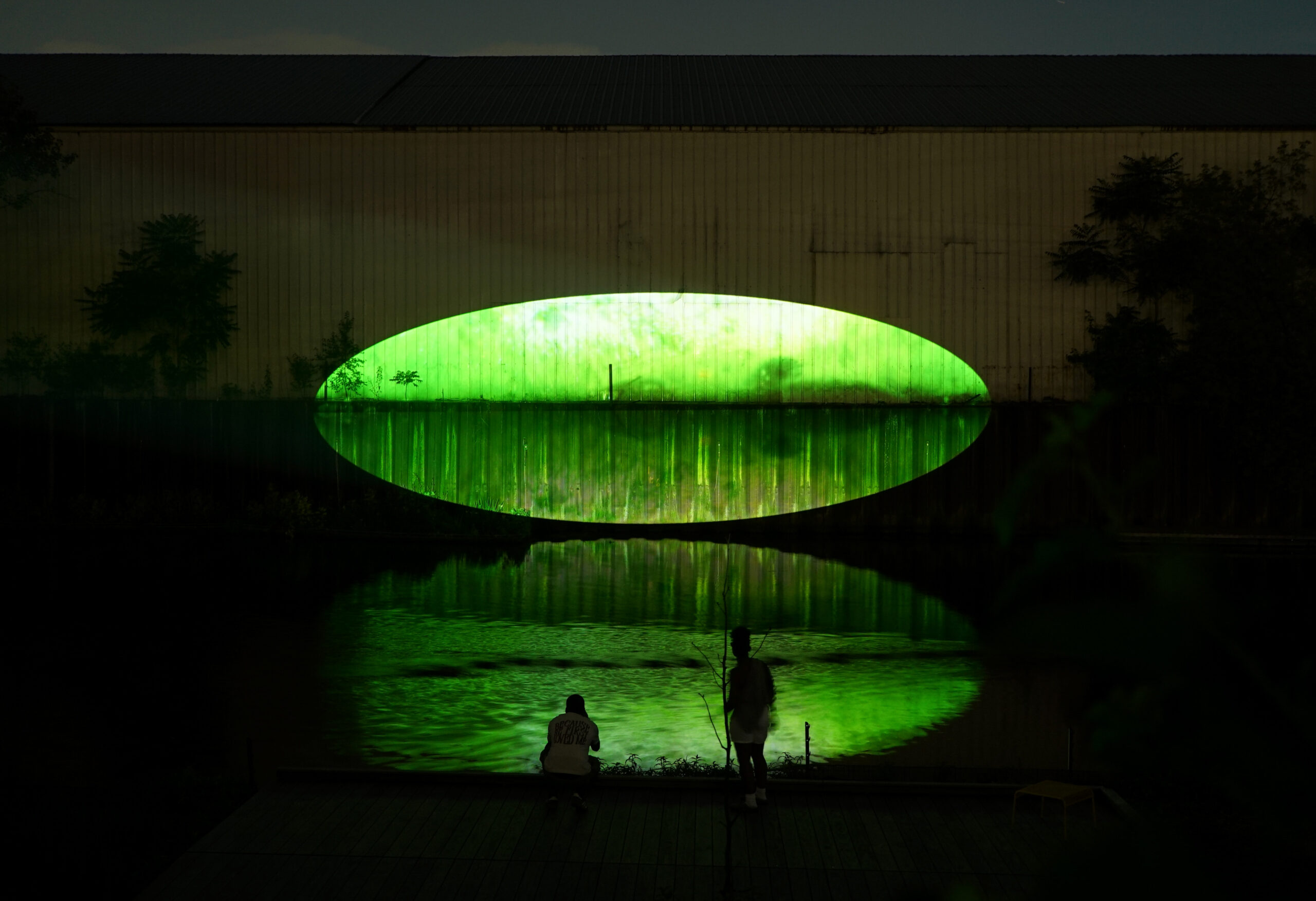
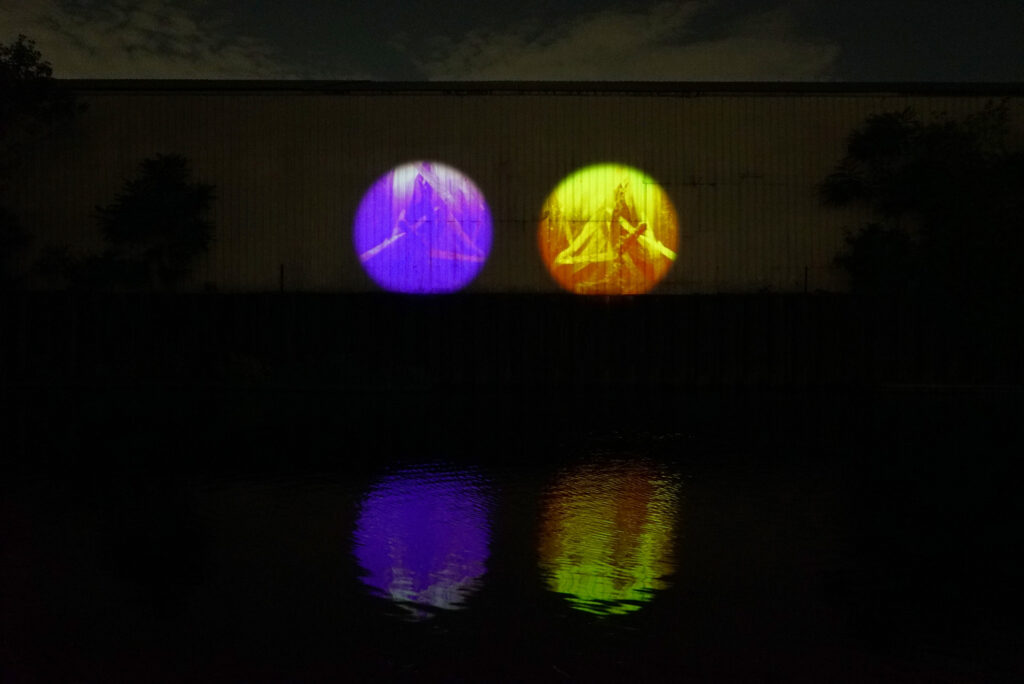
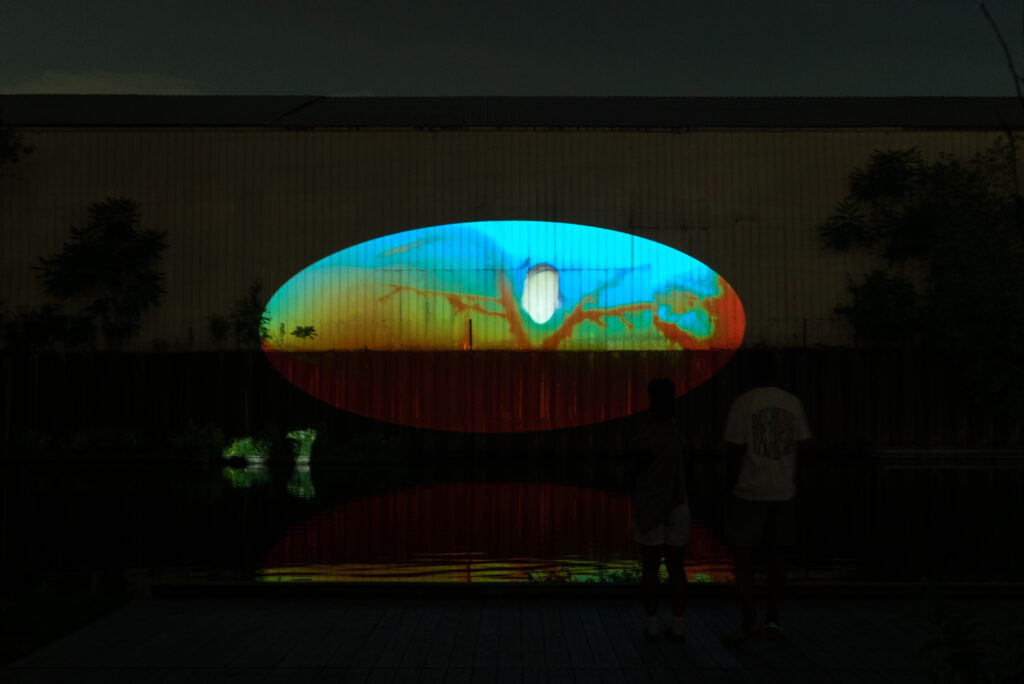
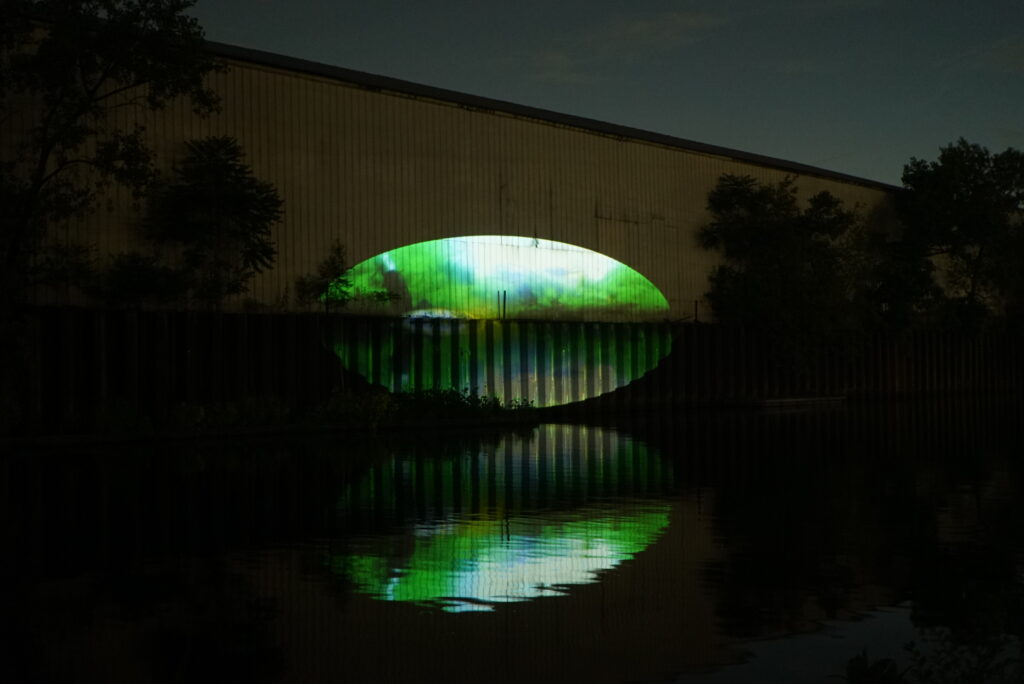
Projected across the waters of the Chicago River, Xingyu Huang’s Beneath Breathing (2025) turns the façade of a riverside warehouse in the Wild Mile Park into a fleeting extended cinema of light, sound, and ecological attention. Presented as part of The Wild Mile Projections, a public art series co-developed by Merav Argov, Nick Wesley, and Jan Tichy, the work extends the language of environmental art through public projection and time-based media. Created in collaboration with Wild Mile scientists, Huang dug into an existing underwater footage archive and conducted field recordings near Wild Mile Park, where restoration efforts have reintroduced native mussels to help filter the river’s water. The resulting 2-minute-30-second projection moves through drifting sediment, flashes of fish, currents, and traces of human presence, composing an underwater archive of precarious systems that sustain urban life.
Sitting on the riverwalk, immersed in the moving images, Xingyu and I began talking about rivers that run through the city, both natural and unnatural ones. I found myself thinking back to my childhood growing up by The Grand Canal (#13. City of Changzhou, China), where I remember the sounds of freight boats passing and the cries of street vendors gathered along the dock. The water was always muddy, opaque, resistant to easy visibility. Xingyu spoke about her own fascination with the Chicago River when she first moved here, a curiosity that gradually deepened into sustained attention. Beneath Breathing is, in many ways, her tribute to the river. It offers more than an image of underwater life; it invites another way of sensing the city itself, one attuned to the interdependence of human and nonhuman worlds. This interview explores the making of the project, the challenges and possibilities of producing collaborative ecological media work, and the future trajectories that emerge from it. Through Huang’s reflections, the river comes into view not simply as a site, but as a collaborator: a living archive where art, ecology, and community converge.
Jessica Zi Chen (JZC): What does “beneath breathing” mean to you in this work in terms of the biological, the ecological, or the urban? Why did you choose this title?
Xingyu Huang (XH): Breathing, or more broadly, respiration, is a vital physiological process shared by nearly all living beings to sustain life. Through the exchange of gases, different organisms coexist within a single, interconnected system. Simultaneously, the ecosystem inhabited by these forms of life is inherently dynamic, constantly circulating resources with other ecological spheres. In this context, breathing represents the most fundamental state of existence: a shared rhythm that binds all living beings closely together. Yet while we can feel the air moving in and out of our own bodies, we remain insensible to the breath of other species. Humans in general cannot breathe underwater and, as a result, we often consciously or unconsciously otherize or alienate the lives that exist beneath the surface. Through this title Beneath Breathing, I hope to offer a reminder that beyond the world we are familiar with, other organisms thrive in a domain that is entirely their own.
At the same time, the projection reveals the world directly beneath the floating walkway where the audience stands; a hidden, subsurface environment just below the water, invisible to the viewer at that moment yet constantly changing, inhabited by organisms that are breathing alongside us.
JZC: Located along the North Branch Canal of the Chicago River, how did the waters of Wild Mile shape your work as a collaborator?
XH: This project is deeply informed by the Chicago River’s historical narrative, its current ecological state, and modern human interventions. Consequently, the river has shaped every dimension of the work—from its site and mode of observation to its central themes. As a highly industrialized waterway famously reversed by human engineering, the river serves as a powerful symbol of urban control over the natural world. At this specific site, a tributary of the Chicago River, the water speaks to me in more intimate detail, revealing the granular transformations occurring within its body. The reversal of the flow has somewhat cleansed the water body, allowing invasive species to take root while native species gradually disappear. Rainwater washes soil fertilizers and vehicle gases into the river, leading to a slow spread of green algae across the surface and a depletion of dissolved oxygen underneath the water. The manual planting of native aquatic vegetation has attracted more wildlife, while the presence of human maintenance has become an increasingly frequent sight.
The development of this project spanned from winter to summer; the seasonal cycles of growth, decay, biological blooming, and constant flux provided the raw material for my work. As viewers stand on the floating walkway, level with and gently swaying alongside the current, they witness projections of movement and rippling reflections which place them directly within the rhythmic “body” of the site itself.
JZC: Right, the constant flux of a changing ecosystem feels deeply in sync with your dynamic projections. I see this sense of collaboration potentially also extends from the Chicago River to the site and audience. Having the work exist as a temporary public projection, what do you think about time here—2’30’’ in duration, nightly repetition, seasonality, and the fleeting attention of passersby? What does public projection allow that a gallery presentation cannot?
XH: The decision to screen the work from 9:00 to 9:30 PM during the summer was a deliberate choice based on Chicago’s local weather. Given the city’s long, harsh winters, summer nights are the rare moments when people naturally gravitate outdoors to linger and explore. The massive scale of the projection demands precise lighting conditions to maintain visual clarity. In mid-summer, twilight lingers until around 8:45 PM; starting the projection at 9:00 PM ensures the darkness necessary for a high-fidelity viewing experience from the very first frame. The 2min30sec duration is a calculated response to the site’s logistics. Located along a community garden path, the work intercepts people in motion. Two and a half minutes aligns with the natural “attention window” of a passerby, long enough to immerse them, but brief enough to respect their movement through the space.
The fundamental difference between a public projection and a gallery setting lies in accessibility and pedagogy. A gallery audience is self-selecting, who visit these spaces with the intention to consume art. In contrast, this outdoor installation, collaborating with the ecological research and workshops of the non-profit Urban Rivers, reaches far broader demographics: environmental volunteers, research scientists, kayakers, and local families. During nearly every screening, passersby would stop to ask: “What are you doing?” or “Why is there a giant fish swimming on this wall?” In these moments, as I explain the project’s intent, they listen attentively and develop a newfound curiosity about the history of the Chicago River and the ongoing ecological interventions conducted by Urban River. This organic, educational exchange is something a traditional gallery simply cannot facilitate.
JZC: This responsiveness to site, duration, and embodied encounter also points to a larger concern in your practice: the shaping of perception through space. You trained in architecture at the University of Edinburgh as an undergraduate, and in our previous conversations you mentioned “rebuilding perceptual architecture” as a key methodology in your practice. Could you elaborate on that idea, especially in terms of how your architectural and environmental design sensibilities inform the way you choreograph the viewer’s attention and experience of space in this piece?
XH: We often consume information about aquatic environments through screens, photographs, or books, intellectualizing the flow of water and seasonal shifts in our minds. This abstraction makes it difficult to feel the genuine urgency of ecological crises. In my work, viewers step into a summer night and onto an unstable, floating walkway that sways with the river’s pulse. They hear the chorus of insects, the flow of water, and the rustle of leaves; they smell the damp grass and the faint, briny scent of fish. They witness a world beneath their feet shrouded in excessive algae, where a fish, four times the size of their own bodies, glides through the murky depths. It is akin to forcing the audience into a “shared apartment without partitions,” creating a visceral sense of presence that exposes their senses to this immersive reality. It serves as a reminder: this underwater world is real, active, and you are currently within it. I believe this direct confrontation is far more potent than any data or didactic lecture; it forces the viewer to face the reality that change is happening, and it is inextricably linked to our own existence.
In my architectural and environmental design practice, the manipulation of scale is a fundamental tool for structuring human perception. By magnifying microscopic or aquatic life to the monumental scale of a three-story building, I trigger a visceral, bodily response that bypasses pure intellect. Furthermore, I treat the water itself as a primary “building material,” utilizing its inherent opacity and fluid uncertainty to complete the spatial experience.
JZC: How did working with Urban Rivers and Wild Mile scientists shape what you filmed and how you composed the narrative? Was there a moment when scientific knowledge directly changed an artistic decision?
XH: At the beginning, the project began as an open-ended inquiry. My initial investigation was centered on the artificial walkway as a site of intersection. I sought to document the shifting compositions of its structure, its curated vegetation, and the spontaneous presence of wildlife as they evolved in tandem across the four seasons. However, through my sustained collaboration with the Urban Rivers team, especially during a dialogue with scientist Phil Nicodemus, I was introduced to the complex lifecycle of freshwater mussel restoration: from controlled laboratory cultivation to the manual “seeding” of colonies on the riverbed, and the symbiotic roles every organism plays in sustaining these populations. This insight led to two profound realizations. First, I understood that a human-engineered ecosystem is not a seamless return to a pristine past; rather, it is the construction of a high-maintenance machine—a living infrastructure that demands continuous human stewardship to function. Secondly, I realized that focusing exclusively on the walkway was akin to isolating a single component of a vast mechanism. To fixate on the intervention itself while ignoring the subject of that intervention is to miss the core of the narrative. The walkway and the hidden life within the river are not separate entities; they are inextricably linked, each exerting a constant influence on the other.
That specific meeting served as the turning point for the project, shifting its trajectory and ultimately shaping the work into its current form. As an artist, I believe that true depth and urgency are born from an uncompromising engagement with the facts, especially the ecological and social realities of a site. Without this deep comprehension, the work remains merely superficial. With it, art becomes a vital response to the world we inhabit.
JZC: Totally. On a more practical note, could you talk a bit about your workflow, from underwater capture and field recordings to processing and composition, and the tools that were essential at different stages of production? I imagine many of our readers, especially fellow artistic practitioners, would be really interested in that process.
XH: I worked with the Wild Mile’s extensive video archives from the past two years, a vast and disorganized database comprising hundreds of hours of recordings. The preliminary stage involved a rigorous process of data mining and curation. I spent months sifting through raw files (many of which were mere hours of darkness) to identify specific ecological phenomena directly linked to the mussel restoration process. During post-production, I manipulated the narrative sequence, the perceived camera position within the water column, and the saturation of the imagery. These formal choices serve to communicate my philosophical inquiry into the “hybrid nature” created by human intervention, while simultaneously challenging the authoritative power dynamics inherent in traditional environmental media.
My primary tools were Adobe Premiere and After Effects. However, a crucial component of the workflow was the spatial prototyping—testing how the light would interact with the industrial facade and the water’s reflective surface.
JZC: What feels most innovative or original about your approach, and how do you see it scaling to future public or institutional projects?
XH: I paid close attention to the texture and structural rhythm of the industrial warehouse, selecting a projection ratio that honored the site’s architecture. Critically, parts of the work are not cast directly onto the wall but are revealed through specular reflection off the river’s surface. This dialogue between the digital image and the physical environment is the most innovative aspect of my practice, drawing directly from my background in architecture. In my public installations, the site acts as an active agent rather than a passive backdrop. Looking forward, I see this methodology scaling into large-scale institutional commissions and urban interventions. My goal is to collaborate with specific architectural landmarks to create site-specific light installations that don’t just “show” environmental data but allow the public to “inhabit” it.
JZC: It’s fascinating that you were working with an existing underwater archive, and that you approached this scientific dataset through an experimental archival lens. I feel there is an intentional rejection to nature-documentary gaze or a kind of purely aestheticized image of ecology, can you explain some of your artistic choices there?
XH: By underwater archive, I refer to the river as a vessel that encapsulates time, human intervention, and biological metabolism. It serves as a record of an ongoing history—one that is often obscured by the superficial layers of the urban landscape. For me, the most critical element of this archive is the turbidity of the footage itself; it documents the actual state of the water at the precise moments when the camera captured the behaviors and movements of aquatic life across different seasons. Water quality, the original catalyst for the reversal of the Chicago River, remains the defining force shaping the ecosystem under modern intervention. As the primary focus of Urban Rivers’ restoration efforts, this water quality is the ultimate referent for every component within the archive: the fish, the algae, the sediment, and the man-made structures. To challenge a conventional documentary gaze, the imagery in my work moves beyond a straightforward depiction of “nature.” The deliberate manipulation of shape and color, such as the perfectly elliptical frame and the unnaturally hyper-saturated hues, is not intended to present a peaceful or exotic “wonderland.” Instead, these visual strategies foreground the transformation of nature under the weight of human intervention and an anthropocentric perspective.
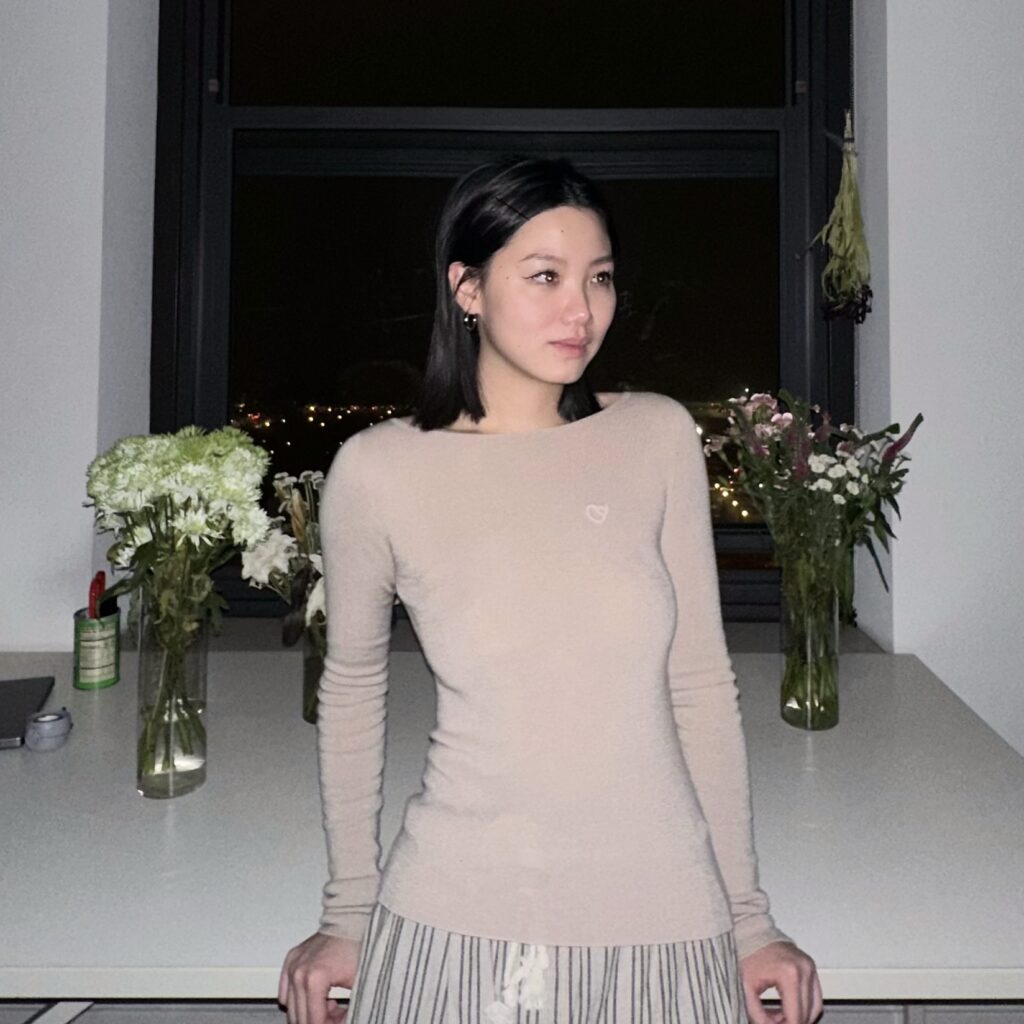
About the author: Jessica Zi Chen (she/they, b. Changzhou, China) is an art historian, independent curator, and community builder currently based between Chicago and St. Louis, the homelands of the Odawa, the Ojibwe, the Potawatomi, the Osage nations, and the Illini Confederacy. Her research focuses on contemporary ecomedia, including experimental film, video, performance, and sound practices that engage environmental criticality and vernacular knowledge, with particular attention to transnational connections among Asia, Asian diasporas, and Latin America. Chen’s broader practice includes community building and curatorial experimentation. She is the co-founder of Working Title, an initiative that connects scholars and artists across institutions and supports cross institutional exchanges within and beyond the Chicago art community. She has also been a resident writer at Muña Chuquimarca and a member of the Queer Ecologies Collective at Mildred’s Lane New York, experiences that continue to inform her interest in expanded artistic practice and environmental inquiry. Follow her work @jessicazichen.