“What a day for a daydream. What a day for a daydreamin’ boy,” The Lovin’ Spoonful chimed on the radio.1 Ice flowers were melting and refreezing on the taxi’s windows in the slumping winter weather.2 The tires squealed in the residual snow slush. Arriving, the building’s red block neon lettering collided with the cab door.3 A toe jabbing onto the curb, the threshold ahead seducing Robert Williams to fold into the ether. The Lincoln Baths, a covert space for gay encounters among closeted men, laid bare ahead.
Once disrobed at the lockers, he stomped down the slicked wooden stairs (sweaty feet had worn them). He had that sand-papery washed-too-many-times white towel on (let’s not investigate the bleached stains). The consummation: an anonymous man’s percolating breath on his stubbled neck. Nothing was a better reverie-break than random man-on-man action.
It should’ve just been the steam filter’s purrs, but boots soon tremor’d those oiled steps. Yelps replaced grunts.
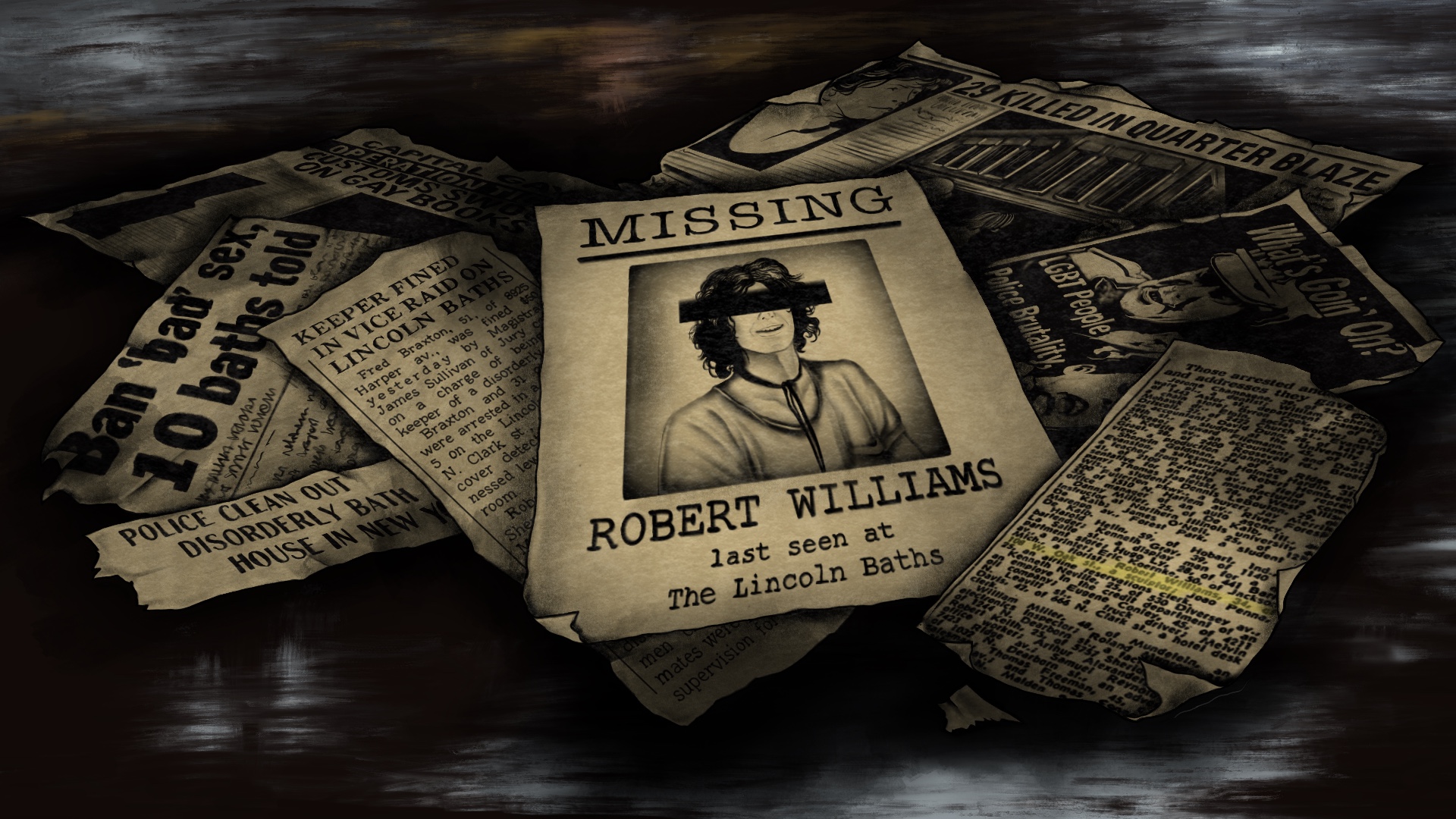
Chicago Police raided a North Side bathhouse on March 5, 1966—arresting 32 men. Right after, the Chicago Tribune published their names, ages, occupations, and addresses. This was a common occurrence in the twentieth century, especially in 1960s Chicago. A wide range of occupations were featured in the Tribune, including: a florist, student, dentist, teacher, etc. One in particular stood out: Robert Williams, 34, of 108 W. Oak Street, a sculptor.
When I stumbled upon “sculptor,” I became fascinated (bordering on obsessive) about Williams’ unknown life, what his art could’ve been, and how he encountered the environment of ‘60s Chicago.
I recognized my obsessive desire to understand Robert Williams is characteristic of my nature as a queer artist. It’s a want, a need, to seek out unknown ancestors. Archives supply significant absence. Such a glance at past trauma, however, can also be a “turn to the negative” as Heather Love wrote in Feeling Backward: Loss and the Politics of Queer History. Her epistemological critique of queer studies was an investigation of morose retrospection, wherein loss and devastation “are often understood simply as historical waste products, visible traces of homophobia considered shaming in themselves.” Robert Williams, a sculptor turned social pariah at the hand of the state, was detritus in a long game of fake morality wars. Yet, Love wrote that embracing a history of “forced exile” is imperative to return political agency to those erased: “Those subjects do not wake up after a century haunting the underworld ready to plunge ahead into a glorious future.” (p.70).
While I’m sleuthing through archives for other projects, I always search for Robert Williams, chasing after one of these underworld specters, wondering: Would Williams hate this “glorious future?”
My years of research have not yet revealed this Robert Williams: a popular name for a politically and artistically chaotic time. Perhaps my search is an uncanny reconciliation of my place as an artist in Chicago’s saturated scene today; a hope that the objects I make live on past me. Even with a seeming-permanent digital footprint and coinciding hulking artworks, what will happen to the queer sculptors working today when our country is in a similar tumult as the ’60s? Will they share Robert Williams’ fate and disappear, too?
I assumed a quick Google would quench my curiosity. The internet search revealed two Robert Williams: The House Music Godfather and proprietor of the Music Box in Chicago, and Robert Williams, the American painter, cartoonist, and founder of Juxtapoz Art and Culture Magazine. Yet neither the cartoonist or House music Robert Williams’ ages matched the article.
I knew his name, age, address, and occupation. Focusing first on his identity as an artist, I forayed into Chicago’s extensive maker archives. Harold Washington Library contains the Chicago Artist Files: a chronicle of artists working Circa 1890-2014, with bulk dates from 1946-2014. Brief searches in their online catalogue showed two RWs; Robert Williams, a photographer, and Robt. Williams, a calligrapher. Photographer RW’s prints fanned out of their manila envelope at the library: a still life of bottles, a bowl of fruit, and a nightscape of trees. Calligrapher RW’s stamp christened old paper: 5703 Blackstone, Chicago, 60603, with his name kissed into the interior. These couldn’t be correct.
Returning to the public library’s newspaper archives, I found a possible Robert Williams at University of Illinois at Champaign pictured in the Department of Fine Arts’ yearbook. He also appeared in a photograph with his fraternity brothers. University staff dove into my inquiry. From the student ledger cards, they found a Robert E. Williams and Robert Franklin Williams who were both born in 1932, the former in Chicago and the latter in Waukegan, IL. However, these students entered the University in 1961 and 1958 respectively. The yearbook photo is from the 1953 Illio; meaning that these students are unlikely to be a match. Then, a score: a Robert Williams who looked like the man in the yearbook image. He had the right birthdate and pictured with Phi Kappa Psi fraternity in 1952 and Chi Psi fraternity in 1953-1954. Several articles in the student newspaper from 1951-1954 featured this RW as social chairman and decorator for events.
In similar circumstantial wranglings, another RW appeared in the Chicago Daily Tribune, 1951, in an announcement for the Scholastic Art and Writing awards: RW of Evanston High School. After I inquired for comment, Scholastic Art and Writing wrote they do not have archives going back that far. Evanston High School did not respond to inquiry. The fraternities mentioned above also did not respond.
I had discovered seven RWs existing during this timeframe in the Chicago area and would likely uncover more if I kept looking. Yet, they are all unproven; they are all extrinsic tangents.
In an embodied certainty bordering on foolhardy, the Department of Fine Arts’ yearbook felt like the first glance at his visage; the first actualization of his slippery form. For more confirmation, I reached out to the only classmate from that yearbook I could find today: Gregorio Zolko. I found him on Instagram: he is alive and a practicing architect in Sao Paulo, Brazil. His studio assistant responded to my DM, saying she would ask Zolko’s daughter if he remembered this RW. Months later, she responded: “Unfortunately, he doesn’t remember!”
A steely exterior-skin greeted Williams, a sci-fi structure that was brutal in its adjudications of the law. The old courthouse, conceived and constructed by the city and architect Henry Ives Cobb in 1906, had been replaced the year before Williams’ arraignment.4 The new building bore future-glances of an American ideal of crime. Williams recalled a Chicago Tribune article that described the old building as “a granite octopus doomed by the loop of progress.” He felt similarly doomed: the Bauhaus, Brutalist modernism of the new building felt like a stripping to skin and bones. The Chicago Tribune exposed this impending doom feeling in ‘60, and years later, Williams thought, he was similarly exposed. It was a Chekhov device for what lay ahead in his hearing: the inside made outside. His suede boots had absorbed the outside chill that longed to be warm and tensed on the granite lobby floor, making an annoying squeak as he entered.5
I found the Bathhouse raid article in Owen Keehnen’s Leatherman: The Legend of Chuck Renslow, as a reference for the temperature of LGBTQ+ rights in the 60s. The chapter included other raids as context for Renslow’s own bathhouse Man’s Country (closed 2017), which faced many encounters with the police. Newspaper public shamings permeated ‘60s Chicago’s queer nightlife scene, occurred decades prior, and continued for decades after. The arrested men are oft-lost to history; the defamation, however, permanently took jobs, homes, and lives.
From the 1890s on, public Chicago bathhouses were notorious for underground homosexual gatherings. “While some managers tried to curtail homosexual activity, others turned a blind eye,” wrote St. Sukie de la Croix in Chicago Whispers: A History of LGBT Chicago Before Stonewall. Specifically, the manager of Lincoln Baths, Fred Braxton, acquired a fortune from the extra-curricular activities occurring at the bathhouse, although legal troubles were always in the way. Predating the 1966 Tribune article, police also raided the bathhouse in 1964 and charged the owner as a “keeper of a house of ill fame.”6
With the evolving nature of LGBTQ+ activism in the 60s, groups circulated strategies of self-protection against the police state. Mattachine Midwest had a newsletter, helpline, and other advocacy for the community. In the collection of Gerber/Hart Library, the newsletter from April 1966 included a snippet of the Lincoln Baths’ raid: “Last month 32 men were professionally ruined because they did not know their rights,” stated Mattachine, “information that led to disastrous public exposure.” They promised a forthcoming “Know Your Rights” campaign. That March 5, 1966 raid was premature and unfortunate in its timing with upcoming advocacy and law changes: in June 1966, the Supreme Court delivered their decision in Miranda v. Arizona, writing that any arrested person “must be warned prior to any questioning that he has the right to remain silent,” instituting what we know now as Miranda Rights.7
The Tribune article ends with a March 14 appearance in court for those charged with “public indecency, lewd acts, and being inmates of a disorderly house.” Ideally, these court records should be on file with the city. When I filed a Freedom of Information Act request for the files, I was met (months later) with this statement: “CPD Records confirmed with a ‘Records Disposal Certificate’ these files, per the years in your request, were destroyed, therefore CPD has no responsive record.”
More context emerged, however, from further research. The Tribune article listed (first) Jerome Champagne, a dentist. In circumstantial evidence, Champagne “was said to have sued The Chicago Tribune for publishing his name before the trial and won.”8
These turbulent records and uncertain word-of-mouth all collapse into rumors of rumors. While trying not to editorialize, these responses and elusive facts continue a willful erasure of this raid.
Williams viewed The Hairy Who as mysterious and cunning. They were an underground uprising of young artists close to his age. The contorted figures splashed in a flamboyant circus in their works: organs splayed, eyes erupted, and colors were brash. Williams’ gaze jived in a quasi-synesthetic method at their exhibition at the Hyde Park Art Center: he was enfolded into the sublime.
The hues of the Hairy Who contrasted with more traditional sculptural objects he saw in the winter of that year. He couldn’t help but contrast those forms: it was machine versus body in comparing all the recent shows, although he was hypnotized in both. It was paradoxical: he compared the nouveau experimentation with the reliable strength of object-centered artworks he was seeing now. Art was smashing the new against the old, and legacies were rapidly forming. More successful artists at his time had notoriety in all the right ways; he had them in all the wrong ways. He didn’t exist in this world with them any longer, his image one of deviancy versus avant-garde expression in the local papers. Their publicity was in their art; not their sexuality.
The Chicago art world was chaotic in 1966 and the years surrounding. There were battling art critics, contrasting art and political movements, and young artists’ hunger to find their place in the scene.
‘66 marked the first gathering of the Hairy Who at Hyde Park Art Center. They were six artists from the School of the Art Institute of Chicago who, annually from 1966-1969, mounted irreverent exhibitions due to their lack of landing solo exhibitions.9 Reviews were not always positive. A Hyde Park writer described their experiential exhibitions as “phlegm” with “all the appeal of half-chewed food.”10 At the same time, critics were also dismayed with “Vicinity,” an exhibition of sculptors at the Art Institute.11 A couple Northside galleries also prominently featured work disparaged by Chicago Tribune Art Editor Edward Barry for its “predictability and capriciousness.”12
Some resolute voices stood out with gazes beyond the typical art historical canon. Critic and University of Chicago Professor Harold Rosenberg wanted perspectives beyond aesthetics, and remarked on his desire for “art vanishing into life,” but with a “more jaundiced eye: performance, confrontation, and Happening were an endgame for anti-art and anti-object tendencies.”13 Artists also joined the critique circus. Barnett Newman attributed much of his practice to his Chicago days and the formation of his Surrealist group here.14 He directly rebelled against the Art Institute’s Dada and Surrealist exhibition at the time, mounting a 1966 exhibition at Bugs Bunny gallery in Old Town.15
There was always a proving-yourself and dick-sizing contest in Chicago. For colleagues, of course, but also for the greater American scene. Chicagoans were seeking New York opinions as vindication, inviting the likes of Clement Greenberg to comment on exhibitions.16
In 1966 artists spilled into the streets. Artists were involved politically, particularly in protests against the Vietnam war. James Falconer was a leader of the Artists Against the War in Vietnam in Chicago, which officially formed in 1967 after gatherings in 1966. Many prominent exhibitions protesting the war occurred in 1968, around the Democratic National Convention. The politics also extended beyond the war, into the administration of Mayor Daley and the Chicago police. Thus, many significant political artworks were created in in the late 1960s.
In all this turbulence, my Robert Williams was—in my research—an unknown sculptor. Where did he fit into the momentum of edgier, alternative artworks he would see? Did he have craft roots? Did his work fit into an Avante-Garde constructivist style, impacted by the burgeoning public sculptures in the city? Did he loosen the knot of canon and get experimental, puncturing trends and making monstrosities out of unconventional materials? In the context of 1966, there were a myriad of influences Williams might have been affected by. My search for his work continues to wander circuitously… My search becomes one of fiction.
Hyde Park Art Center responded to an inquiry they had no documentations of RW. The Art Institute’s Ryerson Library had no record and the vast collection of files on the Vicinity exhibitions did not include him. Any other archive with potential for a wisp of my specter fell into nothing.
Lynne Warren, chief curator of the Museum of Contemporary Art from 1980-86 and avid scholar of the Imagists and early contemporary Chicago art, wrote she had never stumbled upon a sculptor Robert Williams. “Good luck in tracking down information on him, Sam!” she wrote.
60 years after Robert Williams’ arrest, we deal with a lot of the same things. There’s still police brutality, political uprisings, State persecution, and the erosion of the few LGBTQ+ rights gained over the past few decades. We may have to view Williams as someone sculpting in the shadows… But we can also turn him into a wayfinder for the work queer artists do now. Current work about the ecologies of cruising, the queer nightlife scene, and confronting moral panics that inhibit LGBTQ+ artists’ personal and professional lives can and should be—however tangentially—his legacy.
After more than five years of research, I’m still trying to prove that Robert Williams was more than a sculptor arrested at a bathhouse. So now I ask you: do you know the sculptor Robert Williams from 1966? Or did art history, the Tribune, and the police succeed in his public excoriation and resulting erasure? Email me at schwindtnews[at]gmail.com with any leads.
References
- A popular song released in February, 1966.
- The weather at Chicago Midway airport, March 5, 1966.
- The Lincoln Baths was in the basement of the Lincoln Hotel. While I do not know the signage at the time, there is now red neon lettering for its name above the door.
- The history of the courthouse Robert Williams was arraigned.
- There was a “British Invasion” of fashion due to the Beatles’ popularity. The Chelsea boot was a staple of fashion by the mid 1960s; the weather on the date of the hearing.
- De La Croix, Chicago Whispers: A History of LGBT Chicago Before Stonewall, p. 121.
- The Miranda Rights Court Decision.
- De La Croix, Chicago Whispers: A History of LGBT Chicago Before Stonewall, P. 224
- The group included Jim Falconer, Art Green, Gladys Nilsson, Jim Nutt, Suellen Rocca, Karl Wirsum, among others.
- Art in Chicago: A History From The Fire to Now, P. 169.
- Gray, Richard. “Critic Finds ‘Vicinity’ Show Substandard.” Chicago Tribune, May 9, 1965.
- Barry, Edward. “Unique Art Forms Seem Tame Today,” Chicago Tribune, March 27, 1966.
- Article in Art Forum by Donald B. Kuspit in September, 1978.
- This group included Schlecter Duvall, Robert Greene, Eric Matheson, Lester Dore, and others. Newman viewed the Surrealist and Dada exhibition at the Art Institute of Chicago at the time as a “personal political statement”, according to Robert Cozzolino in Art In Chicago …. p. 182.
- Art in Chicago: A History From The Fire to Now, p. 221.
- Art in Chicago: A History From The Fire to Now, p 133.
About the author: Samuel Schwindt is always looking for the maddest spectacles and vampiest explosions. A word|object|surface-smith, he originates from an evangelical community and contradictory motorcycle culture in Indiana (he left religion on highway 65 north to Chicago). Through his young-life he honed skills in wood and metal, and used his craft-history to receive a BFA in Studio Art from the School of the Art Institute of Chicago and an MFA in Interdisciplinary Art from University of Illinois at Chicago. Now, he works as commission-based leather-gear crafter, archivist, sculptor, curator, freelance writer, and educator.
About the illustrator: summer mills (she/her) is a printmaker, illustrator, and graphic designer from Chicago. Her work is inspired by the art nouveau movement, religious/spiritual imagery and concepts, music, and various types of literature. For her, the enjoyment of creation is the patience and trust it requires her to practice.