Nearly a decade ago, a BBC film crew installed 24 camera traps in the Himalayan mountains near Ladakh, India and captured rare footage of snow leopards scratching rocks with their cheeks and urinating on them, creating a unique, pungent fragrance that allowed other leopards to identify each other without making contact. The crew managed to film a female leopard and her two-year old cub as the mother signaled to neighboring males that she was available to reproduce again by marking her surroundings and calling out from a peak where prospective mates could hear her from miles away. Two male leopards eager to reproduce arrived and fought, injuring the female as she feigned submission to allow her cub to escape the potentially deadly conflict. A month later another camera captured the female on a high ridge—walking alone—before capturing her cub walking the same path an hour later. The narrator explained the leopards will likely never see each other again, though they will be reunited through the messages they leave on the mountain rocks.
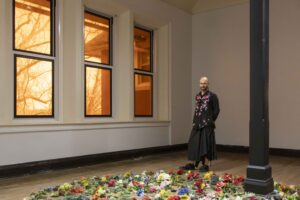
I watched this scene from BBC’s Planet Earth II several weeks after I saw Mountain Call, a two-person exhibition featuring artists Ivan David Ng and Hai-Wen Lin at Roots & Culture, and metabolized the story of these leopards as a cryptograph that could be used to decipher the conceptual framework of their collaborative work. Both Ng and Lin are Hakka, a group of people with contested origins who dispersed from the central plains of China. For this exhibition, Ng and Lin drew inspiration from “Shan Ge” (mountain song) used by Hakka laborers and farmers to communicate with each other across long distances while cultivating crops on hills and cliffs to reimagine how nomadic people might preserve cultural, pictorial images as they migrate and find ways of calling out to one another across great distances. Lin’s improvisational sculptures resembling a radio transmitter and receiver and Ng’s repurposed fresco fragments invite us to consider the methods people (or, I might also propose, animals) use to communicate with each other in spite of a hostile or remote environment. And as the current authoritarian regime in the United States politicizes and brutally criminalizes migration, such tender consideration for the cultural practices of diasporic people offers a consoling promise: if you call out to them, your people will find you.
*This interview has been edited for length and clarity.
Riley Yaxley (RY): I would love to start the conversation with the origin of your relationship as collaborators, artists, and, I imagine, as friends. I know you both met in 2023 while you were residents at the Skowhegan School of Painting and Sculpture. Can you describe your experience at the residency? What initially drew you to each other? Did the idea for this exhibition originate from the residency or afterward?
Hai-Wen Lin (HWL): I can give my version. Within the first week of Skowhegan, which, if you’re not familiar with the format, there’s 60 artists in residence for nine weeks. The first week, we did something they called a “slide marathon,” where each artist was given five minutes to present our work. That seems like not a lot of time but to do that for 60 people was literally five hours of looking at artwork.
Ivan, I forget if you or I went first, but Ivan presented his work. I presented my work. I don’t even remember if we had talked before that. Maybe casually, kind of like chit-chat, because we were all trying to get to know each other. But I remember thinking after that presentation: “Oh my god. What just happened?”
The language we were using to describe our work felt like it mirrored each other. We both mentioned Hakka identity, and we were both working with the sky as subject matter, but our work looks vastly different. You know, Ivan’s primarily coming from a painting background and also working with new media and VR (virtual reality), and I am primarily working with the environment, sculpture, and kite making. It was so beautiful, this parallel, where we both arrived at a similar understanding of the meaning of our identities through such different mediums and that’s when we decided we should be friends.
Ivan David Ng (IDN): That’s my version of the story, too. I think Hai-Wen went first during the “slide marathon.” I’m Singaporean. I moved to the U.S. in 2022. My wife and I lived in Singapore from 2016 to 2022. She’s American and I had done my undergrad in the U.S. before that, but I’d never met another Hakka person in the U.S. What are the chances of meeting another Hakka person, especially an artist who is Hakka and making amazing work, you know?
I realized afterwards that Skowhegan tends to curate people together during the admissions process. It just so happened we applied in the same year, and that there was an affinity, or synergy between our work. Our meeting was chance, but also there was some orchestration, or finessing, by the admissions jury. I think they intended for us to have this kind of relationship during the residency, and I also think they thought about relationships that might continue after the residency. We hung out, and shared our life stories, and we went for a few walks while at Skowhegan.
To answer your question, whether [Mountain Call] came from the residency, not really. I think we just became friends, and then we stayed in touch, texting each other and we had a few long phone calls over the last two years. Hai-Wen pointed out when we were installing the show that it was only our second time meeting. It’s weird because it hadn’t occurred to me that I hadn’t seen Hai-Wen since 2023. We felt very present in each other’s lives, at least for me. Hai-Wen has done a ton of other residencies, but that was the only residency I’ve done. I still feel very connected to that experience. Those nine weeks felt really deep.
HWL: I would add on to say with certainty that this show wasn’t born during Skowhegan, but I think we were already thinking we should do something together at some point. Truthfully, I’m not the type to apply for open call exhibitions, but because we had this natural pairing, this relationship with Ivan, it gave us a good excuse to apply for Roots & Culture’s Double Exposure program.
IDN: Because Hai-Wen is very busy, with two museum shows coming up, we thought, “Okay, if we don’t jump on this opportunity, it might be five years before we can again.” The way Roots and Culture managed Double Exposure was quite low-key. They give you the space, the money, and then you can do whatever you want with that platform. We wanted to flesh out certain thoughts we’ve discussed over the years, to make something improvisational, that felt like a sketch. It was an opportunity to work differently, without high expectations.
RY: That’s such a tender and sweet story. Especially because I’ve seen attempts to pair artists fail spectacularly.
HWL: I think there’s this belief that if someone makes similar work, they will resonate, but then sometimes they’re both drama queens. I don’t know, I guess Ivan and I are identity bound in some way, but if you just looked at our work, you wouldn’t immediately think, “these two people belong together.” Ultimately, it’s about values, but maybe that’s harder to discern in an application.
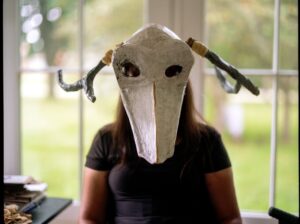
IDN: Coming back to Skowhegan, one of the reasons Hai-Wen and I spent time together was because I wanted help with certain things. I remember attempting to make my first costume for a performance during that time. I don’t know jack about costuming. I wanted to make this moth-like cape. Hai-Wen spent a day with me trying to figure out how to cut a hole and sew another kind of fabric in. Applique? Of course, my collar was too big, so it kept falling off my shoulders. I called in Hai-Wen, the resident polymath. That was one of the reasons we also spent a lot of time together. I needed help, and they were so generous.
RY: I want to return to what you said about improvisation. When I was researching you both beforehand, I was more familiar with Hai-Wen’s work. I was curious because I knew you were a painter, Ivan, and I knew you experimented with new media, but I was really delighted to see sculptures when I arrived. The exhibition felt like a true collaboration and sharing of materials and expertise. Maybe this is a good time to talk about what you hoped to accomplish with the work and the materials you were experimenting with.
HWL: First of all, there was a literal sharing of materials. Ivan arrived with some really heavy ceramics. And I had all these miniature gourds. We don’t explicitly state it on the exhibition checklist, but I drafted the garment patterns for Ivan, and then Ivan gave me the materials for my sculptures, things like that.
We were both doing some research and looking into various aspects of Hakka culture. My parents are from Taiwan. There’s a regional specificity there. My mom was telling me about how you would see Hakka villagers picking tea in the mountains. Hakka people are known for a style of music called “mountain song” or “Shan Ge.” The idea is, because they’re across mountains it’s easier to hear song and melody because of the variation in pitch than it is to hear spoken words [on the mountain slopes], and I was struck by this idea as Ivan and I were working on this show together. We were speaking across long distances. The idea that singing is an easier way to understand one another, that musicality, was interesting.
I was looking into traditional Hakka music, and I discovered that, in Taiwan, they often perform in ensembles. You could think of it as like Chinese chamber music. They’re called Bayin ensembles. In the Hakka tradition in Taiwan, they particularly like to use this instrument called the suona.
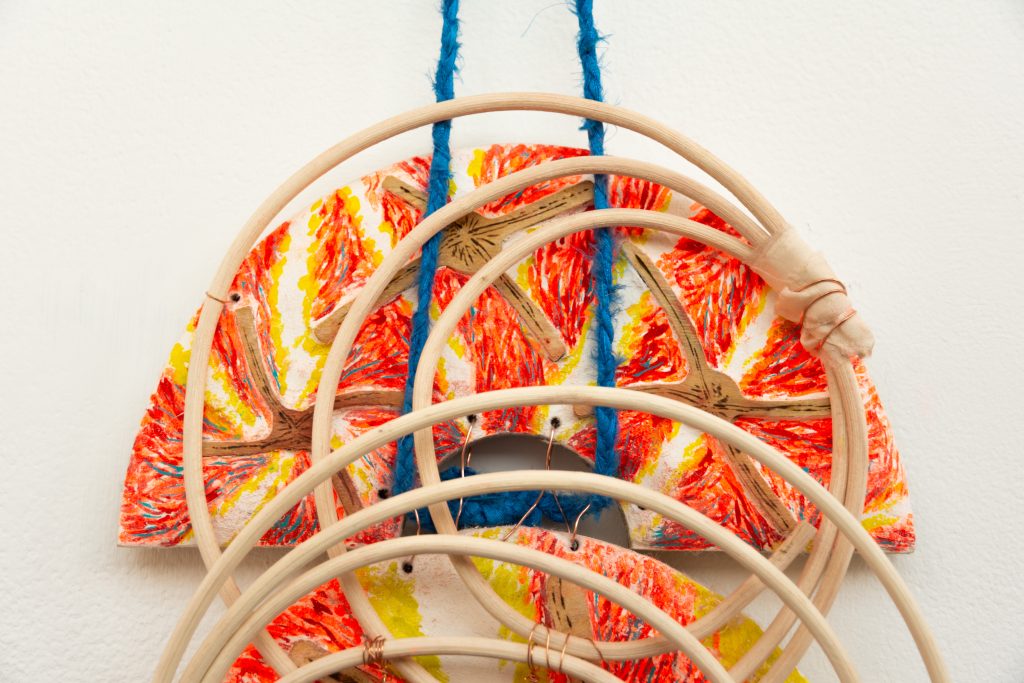
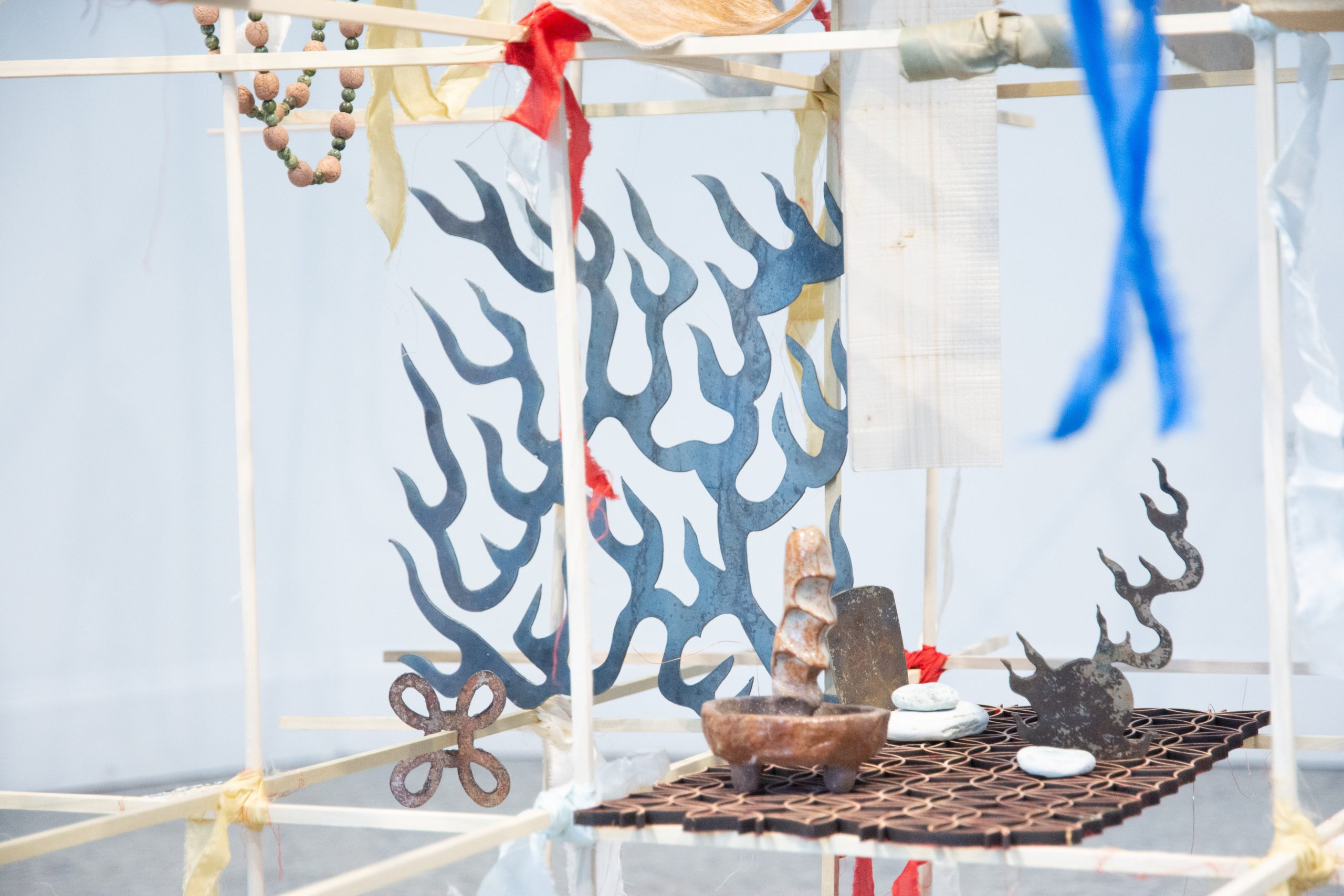
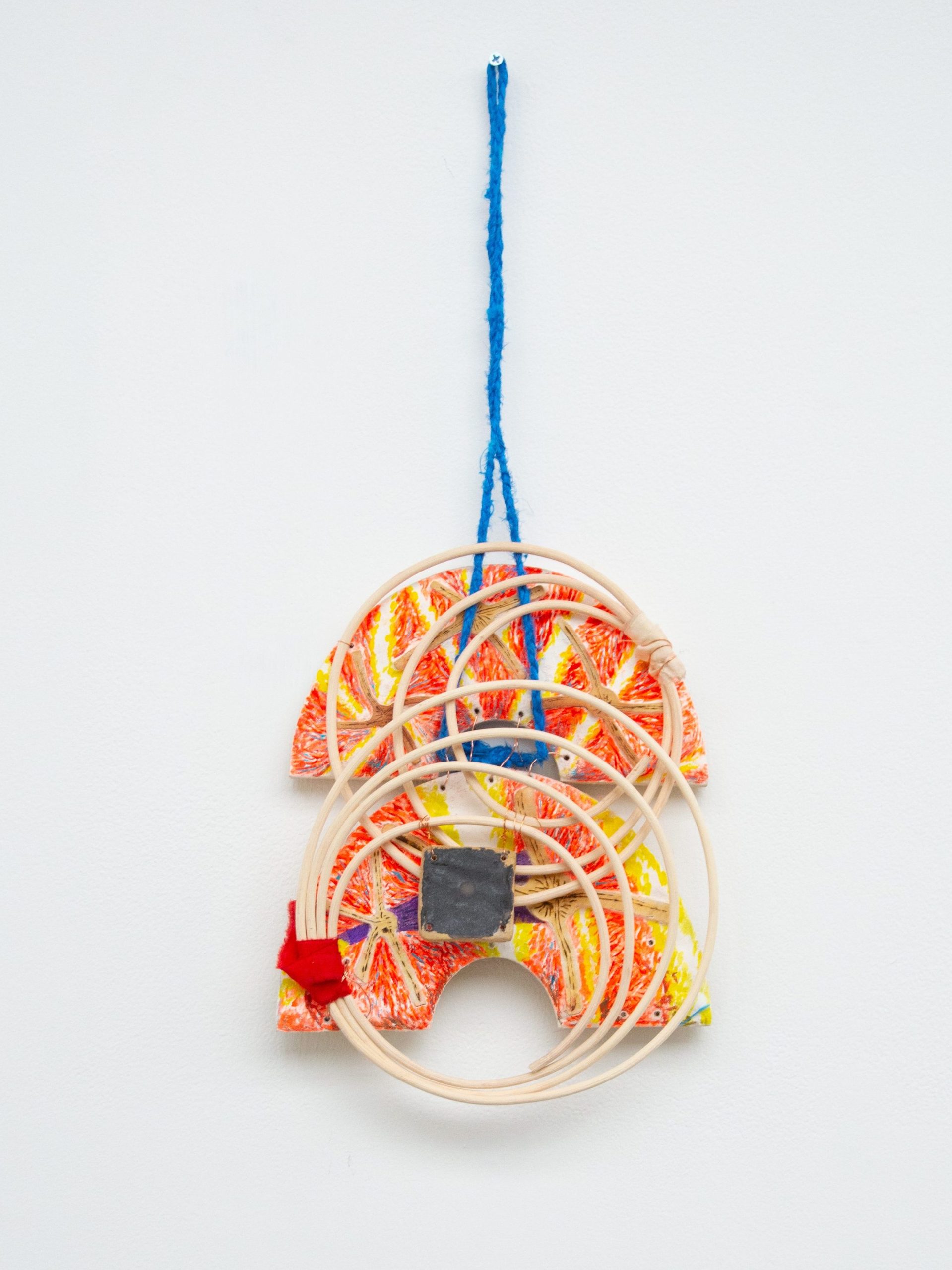
But I also learned Bayin refers more broadly to Chinese instrument classification. Instruments were classified by the material used to create them. Bayin literally translates as “eight sounds.” And I loved the idea that Bayin essentially provided a material list. It’s gourd, silk, hide, metal, rock, clay, bamboo, and wood.
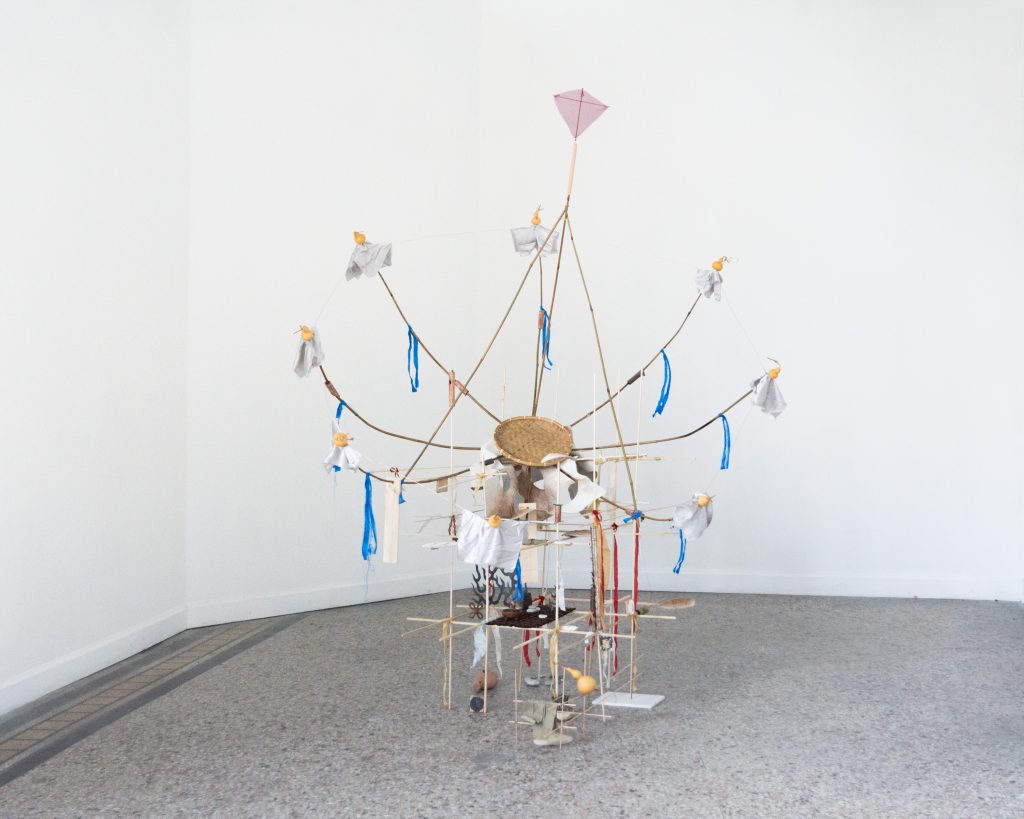
I decided to use everything that was in my archive or trash bin and on my shelves that was made of those eight things, and that we were going to improvise a song. Ivan and I were going to sing to each other. We were going to improvise on the spot. That was one of my personal aims with the show. I was interested in improvisation, not knowing where you’re headed, communicating an idea with a sense of speed and urgency.
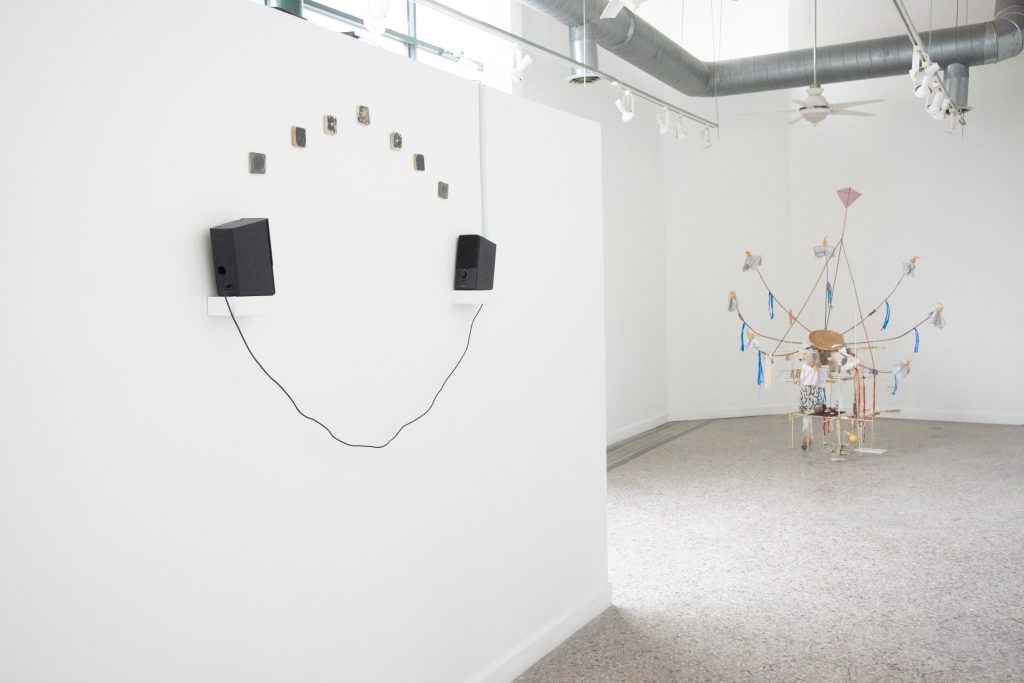
What’s great about artists’ run spaces in general, like Roots & Culture, their ethos in particular, is that the show doesn’t feel high stakes. I felt like I could improvise and fabricate a sculpture in the gallery. Maybe it would fall over and break, but I didn’t feel like there was a risk of that being an embarrassment. Though, I’m still crossing my fingers that the whole dish in bayin ensemble (transmitter) doesn’t sink halfway through the show.
IDN: I think one piece fell off the wall or has been falling and the manager was fine. He put it back up.
Roots & Culture’s program and staff are supportive. There’s this feeling you can do something meaningful and that they’ll support it. I won’t say that’s rare in the art world, but it’s definitely uncommon. With other art spaces, they want you to align with their vision, but this opportunity with Roots & Culture was really precious for us.
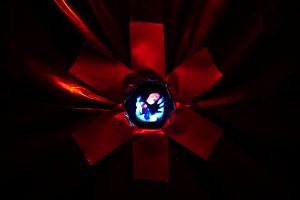
RY: I’m drawn to your description of musicality. When I saw the exhibition, I was thinking about “mountain song.” There were two speakers near the front of the gallery, I think they were yours Hai-Wen. Between the two speakers there were these ceramic tiles in an arc on the wall, and I thought it was such a wonderful visual parallel of Hai-Wen’s Bayin transmitter and Bayin receiver. It made me think of Ivan’s work as sort of music notes, that they were being transmitted between these sculptures in some way.
HWL: Which works were the music notes?
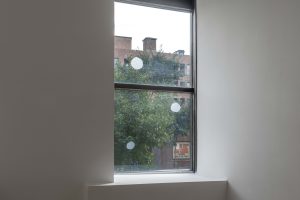
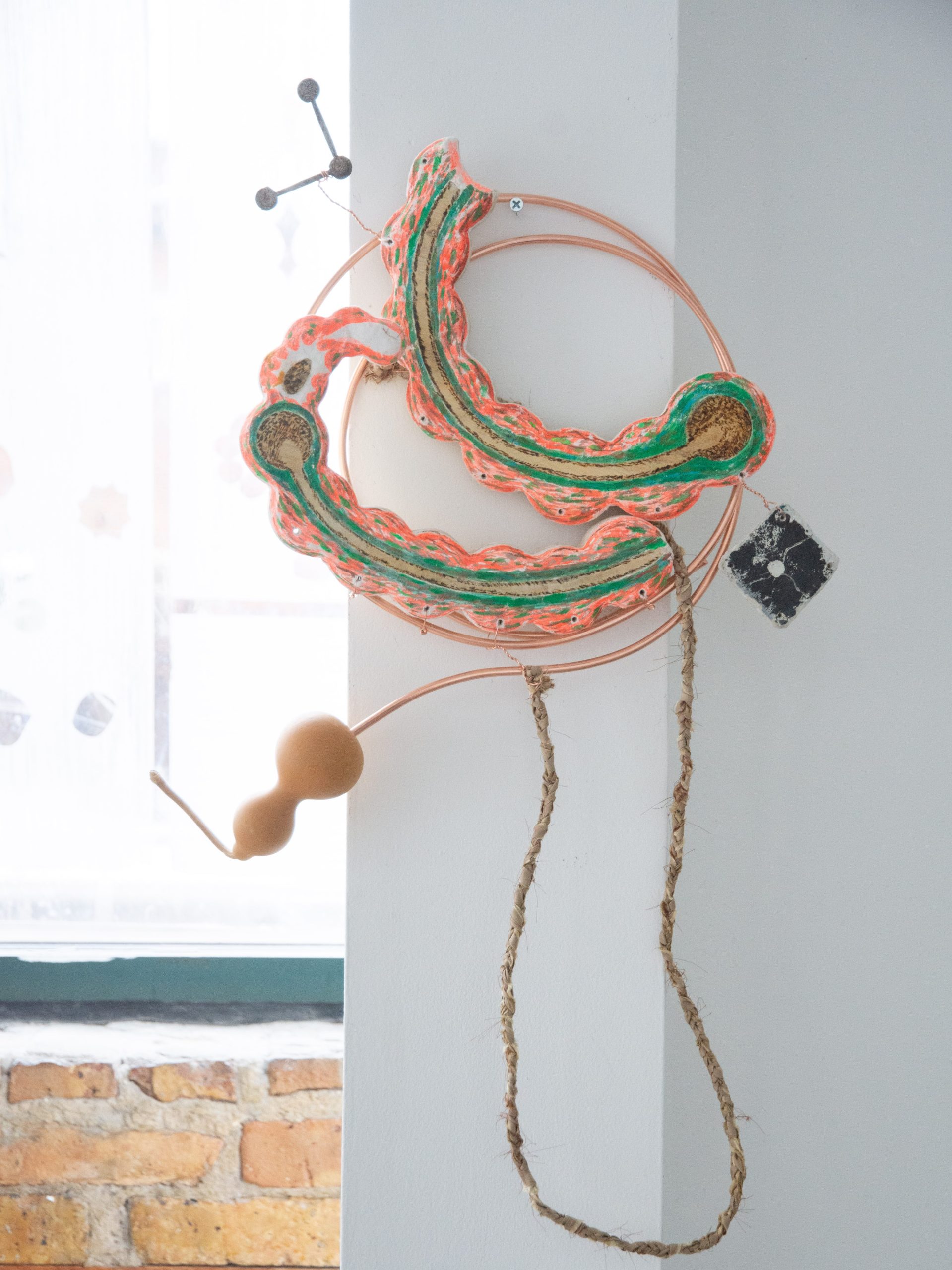
RY: Sky Score in the window, and Sending a Picture (Worm) on the column in the center of the room. It had copper tubing and a gourd, I think. They felt like they were floating. Could you both speak to the experience of improvising and what you learned from that process? I’m interested in this material constraint, having a limited range of shared resources, while responding to each other in real time. These constraints feel exciting.
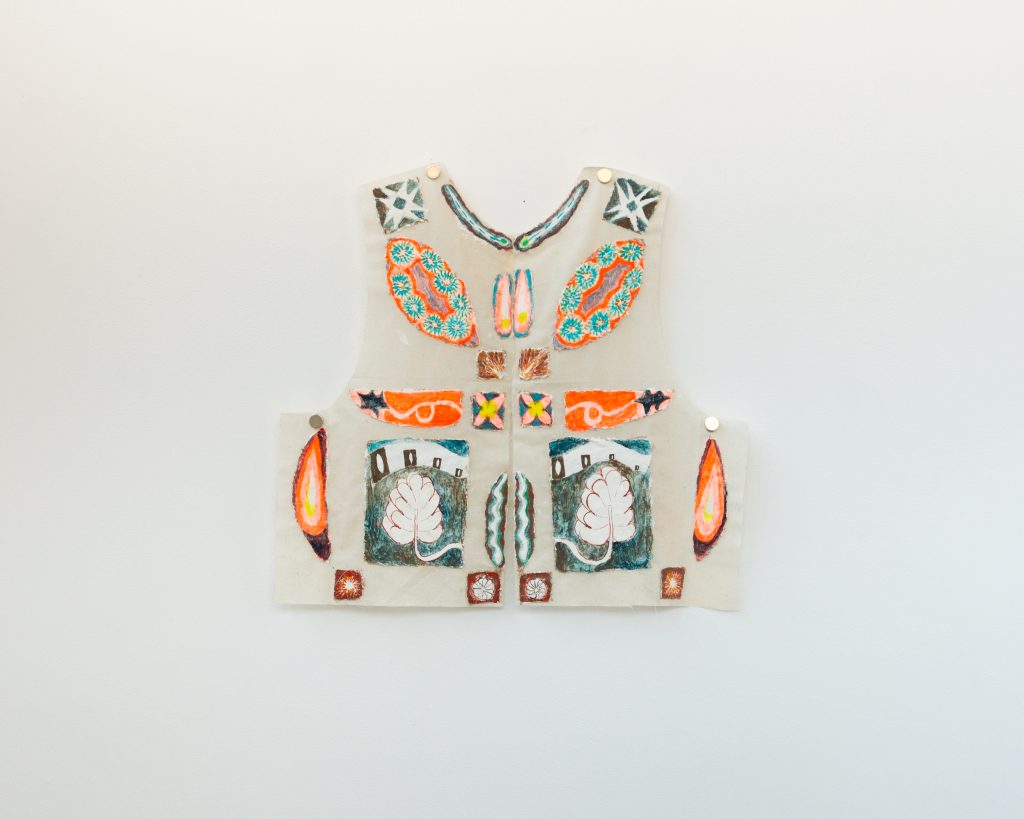
IDN: Maybe this is a good time to talk about the portable frescoes. There’s the garment, and then there’s the improvised, carryable sling formats I’ve experimented with. Continuing in the same vein as Hai-Wen, I approached this show as an opportunity to make something not typical for me. I’ve been thinking about fresco for a while. When we think about frescoes, we usually think about Italian expressions of it, or maybe Greek expressions of it. But actually, frescoes are a global inheritance. Cultures across the world have used some kind of lime-based painting method to create images that communicate their cosmology, their ideas about morality, origins of the world, their way of life, thoughts about life and death. There are Indian frescoes, Chinese frescoes, Mesoamerican frescoes. The cave art we can see today, they’re accidental frescoes, because they were unintentionally painted on limestone caves, and the water coming through the cave walls actually encrusts the pigment underneath a calcium carbonate crystal layer. That’s why they last 20,000 years.
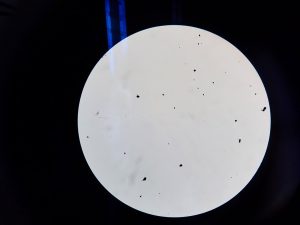
I wanted to think about the possibilities of fresco for a fleeing group of people, because fresco is always architecture bound. For example, the mythology of the Hakka people says they left the plains of Central China in successive waves. The typical, commonly accepted reasons for fleeing are war, famine, and strife. So they’re fleeing circumstances that made staying in their ancestral homeland untenable. Which means they would have left all their frescoes behind. It’s like a disruption or rupture in their cultural memory, because frescoes preserve images. Songs and stories preserve language and stories about a people, but images are lost when frescoes are left behind. I wanted to think about the possibilities of fresco painting for nomadic people and how they might preserve their visual culture. I’ve been devising modular frescoes—large format frescoes with hinges, and a fresco that’s like a ceramic suit. Some of the ceramic fresco pieces from this wearable, which I originally made for a performance during the solar eclipse in 2024, ended up in Hai-Wen’s work. That’s the piece I brought to Chicago and took apart. This is another iteration of thinking about portability and frescoes, and now with the show, it’s constrained by the Bayin material list.
Frescoes, when you carry them, they’re heavy objects. They’re not very nimble. I wanted to figure out how I could create a nimble fresco painting that has longevity from the limestone chemistry. If I speculate backwards in time, would one of my ancestors want to carry these things or would it be so heavy that it would crush or injure them while they’re trying to transport the frescoes?
That’s when I had the idea to make the garment. You mentioned earlier that it looked like it was in-progress or being deconstructed. It’s a sketch. I’m just trying to figure it out. How can I make a fresco garment that doesn’t flake or crumble when I wear it? Because the Italian method we learned at Skowhegan produced really crumbly frescoes. In my frescoes on the garments, there’s fiber mixed into the mortar so that it’s flexible and doesn’t crack when warped. These are some of the more experimental, transgressive ways of working with frescoes that I wanted to figure out in this show. For me, it’s almost like sketching.
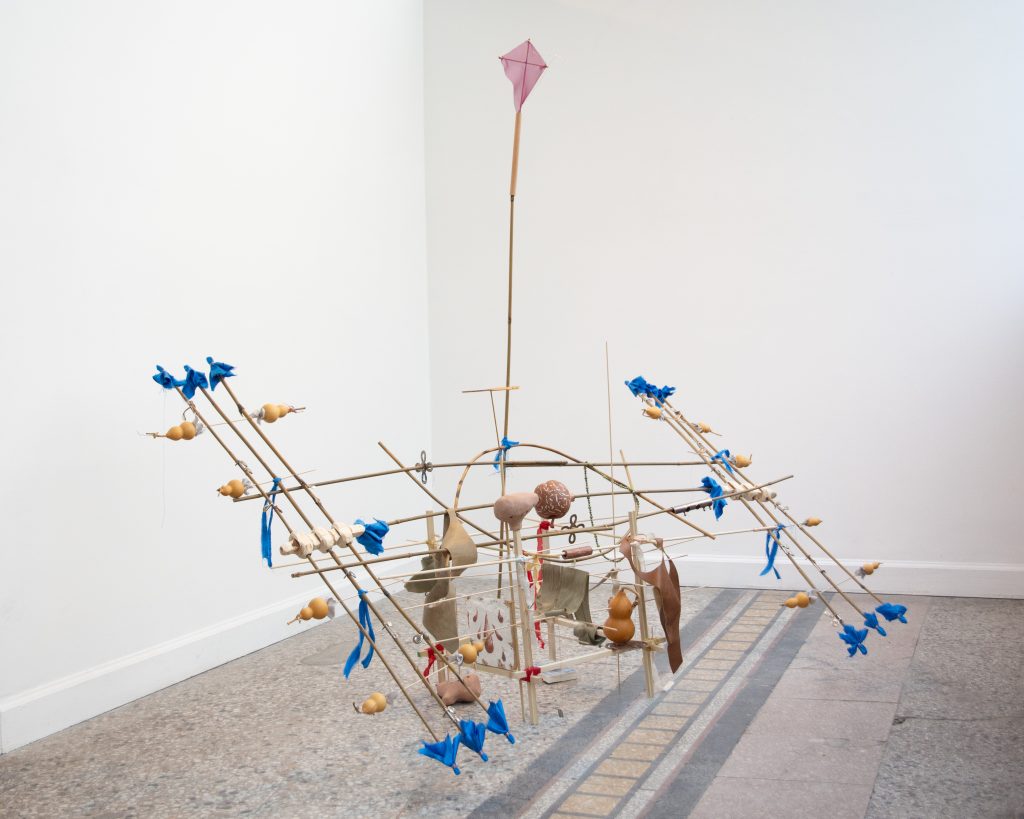
RY: Looking at the work, I kept thinking about the folk art practices that clearly show up in the work, and the way you both were experimenting and playing with those methods and images. I think you alluded to such folk art practices in the exhibition text without it feeling didactic or overwrought. The work felt evasive, hard to pin down, which was exciting. Especially your sculptures, Hai-Wen. There were so many delightful details. I’m amazed that you were able to improvise and build these structures onsite. They look so elaborate and carefully constructed. Can you speak more about the different elements of the sculptures and your approach to putting them all together, whether there was a particular arrangement or sequence?
HWL: You could say I made the sculptures in a week, but you could also say it took me three years to accumulate all the materials. It’s kind of interesting because it’s mostly what I’ve been calling byproduct, the metal I use to rust dye fabric for kites, or the leftover beads I didn’t use for kites, clay I experimented with for a show in Canada, and an apple because I was interested in the Adam’s apple and its modulation of the voice. These are the byproducts of what I would consider, I guess, my career practice.
I felt the materials spoke to the nature of migration and displacement, fabricating a dish, or some kind of communicative device from what is left behind. As I listened to Ivan talk about Fresco and this idea of longevity, holding onto culture, and what it means to carry that culture with you. I’ve never thought about this before, but I think it reveals mine and Ivan’s different interests in time. I’m much more interested in ephemerality. Like, I put a kite in the sky, and then I take it back. I use fugitive dyes that fade over time. Textiles are the first cultural objects to be lost. I was in Mexico recently and most of the artwork in the museums are ceramics because the point at which you can preserve textiles is so much later. It disintegrates.
I like the idea that, when Ivan deinstalls the show, my sculpture will be broken down and mostly tossed in the trash. That’s fine with me. I’m glad the image existed at all, for any moment. I’m interested in transitoriness, things constantly in motion, rearrangements of existing objects. I’m trying to redirect myself to your question about folk practices. I guess I’m interested in modes of moving fast and moving slow. I was cross stitching for most of January. I don’t know if it’s obvious that’s how I spent most of my time when you see the show because the sculptures are ultimately an assemblage, but I’m interested in a slow attention to certain things that may be incidental in the end. Maybe that’s in conversation with the history of feminist labor or craft in general. These objects, clothing and textiles, are so pervasive throughout culture. Historically, they’re all made by people, often without credit, and end up in anthropological collections. There’s an illegibility of authorship that’s interesting to me.
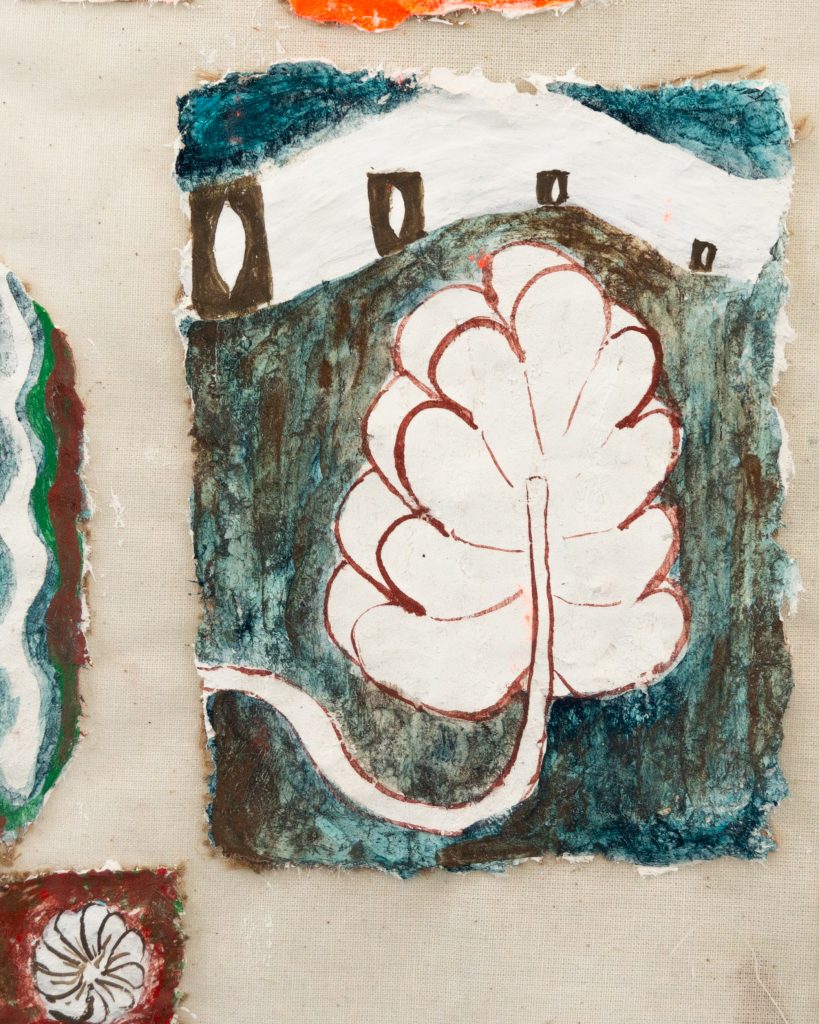
RY: I like that phrase, the illegibility of authorship. I noticed that when I saw the show. I couldn’t tell who fabricated the different pieces, who the material belonged to. There were so many ceramic tiles, there was the cross-stitched hide, there were bits of copper and wood. The shared authorship made it difficult to identify your collaboration. Obviously, the individual works were attributed to you each, respectively. But I couldn’t identify who fabricated or collected the various materials, the ceramic tiles, cross-stitched hide, the bits of copper or wood, or the disassembled musical instruments. Were you thinking about how you might invisibilise those typical boundaries of authorship and labor while you were working?
IDN: Yeah, I think we intentionally didn’t want to make individual work. We wanted to make something together rather than simply have two people’s artwork in the same space. Of course, there were challenges since we were physically apart. For example, the large window sticker Sky Score was my piece. But the idea actually came from a long WhatsApp conversation at 1am. We were talking about musical annotations and scores.
HWL: If we consider “Shan Ge,” you know, the mountain song as a form, as a methodology, co-creating across mountains, I think Ivan sang his part, and I sang my part and then there’s parts in the song where we sang together. We have our own verses, of course, but it’s one song. We were trying to make one piece together.
RY: That’s a great way to describe it. That kind of brings me to my last question. I was thinking about how the show responds to the world we’re living in now where migration has been so demonized and criminalized across the globe, but particularly in the U.S. and I felt these folk art practices, and your work, might offer strategies, or narratives, that are useful for people who have been displaced or who are migrating across borders. Does that make sense?
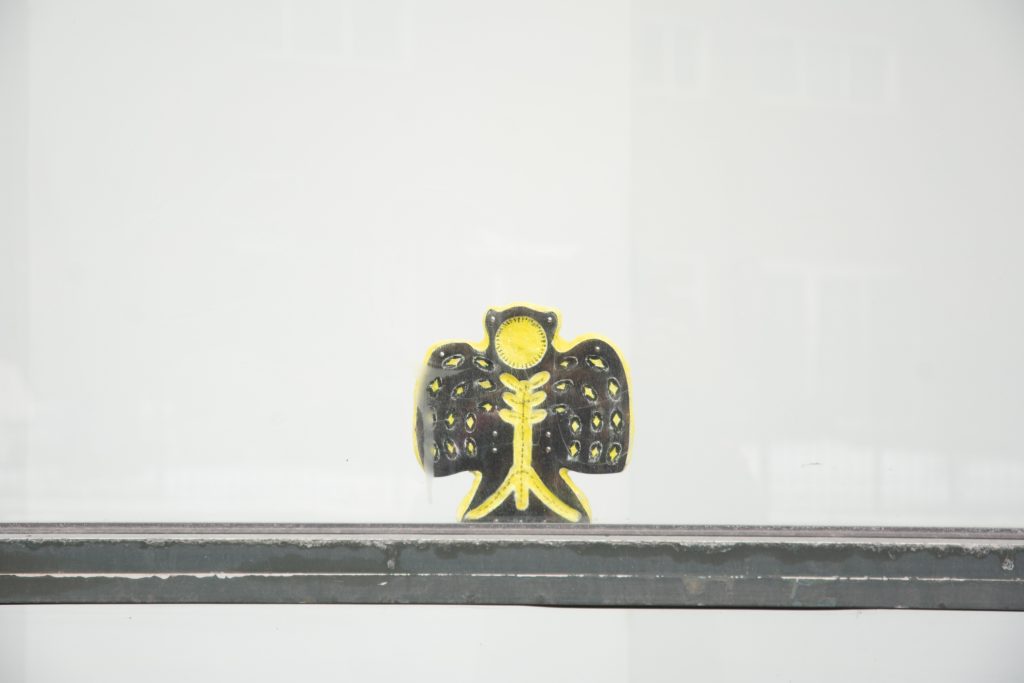
HWL: I can attempt to answer first. Ivan and I were just talking yesterday. We thought this was such a crucial question. I’m improvising on the spot, but I feel like Ivan and I, when we think about Hakka identity in particular, this notion of being a “guest.” We’re both interested in ideas about Indigeneity, and how this idea of being a “guest” could trouble settler colonial ideologies. Guesthood troubles this ideology in an interesting way because we’re saying that we’re people that don’t have a land we’re indigenous to. This idea of being a “good guest” can be wielded in both directions. You know, Trump can post videos where he says, “You’re all a guest in America, so act like it or get out,” but they’re wielding insane violence on borrowed land too.
As far as strategies, I return to this idea of guesthood, and how we could interpret this concept in relationship to culture and land and environment. We are guests of the land. We are guests of the sky. It’s a certain kind of stewardship and I also think this is a shared diasporic practice, communicating across great distances. In this day and age, we are able to communicate, or “sing,” across borders, across boundaries. Ivan and I both looked at the sky because there is a certain borderlessness there that anchors us. Maybe it sounds trite or cliche, but just the notion of talking to each other across states, and that’s naturally where we have to start or begin—talking to someone.
IDN: For me, I feel like making a show about guesthood speaks to the time because the U.S. often lives in a state of amnesia. It’s like a lot of guests pretending to be hosts here. We are two artists from an ethnic group literally referred to as “guest families,” making work about guesthood. I think that subtly invites the viewer to confront ideas about who’s a “guest” and who’s a “host”—to trigger some kind of reflection or introspection. Our work doesn’t respond to ICE or the current administration’s immigration or border policies, but it does celebrate resilience, making do, improvising under new circumstances. This is the ethos, or methodology, of the show, which is something immigrant communities and displaced people do all the time. We’re drawing on a kind of ancestral practice.
And then there’s the desire to communicate with people across geographies. The narrative about land is always about what is mine and what is not yours. Who belongs here? Who doesn’t belong here? The story of land is also about extraction, genocide, conquest, exploitation. But what about the sky? What is the corresponding narrative of the sky? Every culture tells stories about themselves on their land and in relation to the sky. The sky is always invoked in every cultures’ mythology or origin, this narrative about how earth came about and what life means. The sky is simultaneously claimed by all these cultures. It’s inexhaustible. It’s generous. While land is scarce. There is never enough. That’s why it needs to be parsed out. “This is mine.” “This is yours.” But the sky is enough for everyone. The sky is indivisible.
This scarcity narrative around land poisons policy, but everyone has a right to the sky. Thinking about the sky allows us to untangle ourselves from this poisonous narrative about land. As Hai-Wen and I communicated online, the signals go through the sky, right? Hai-Wen’s two satellite forms invoke communicating information through the air and then my fresco, the name of it Sending a Picture does too. Information is exchanged through the sky. To come back to your question, I hope we can de-emphasize ideas about land and its corresponding scarcity narrative and pivot instead to the sky, to find another way into that conversation.
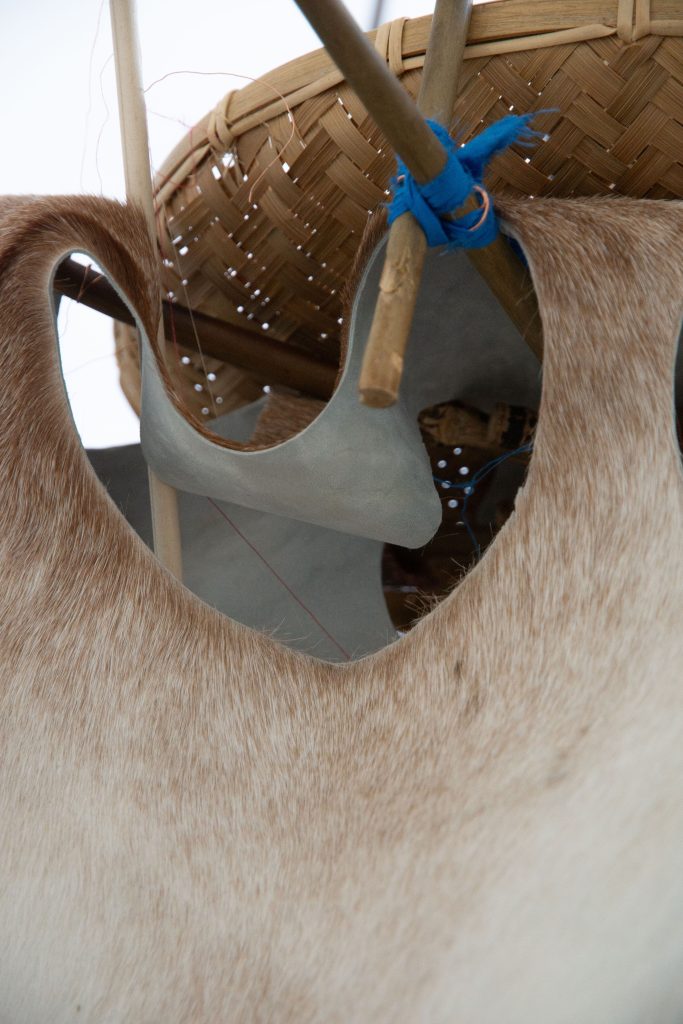
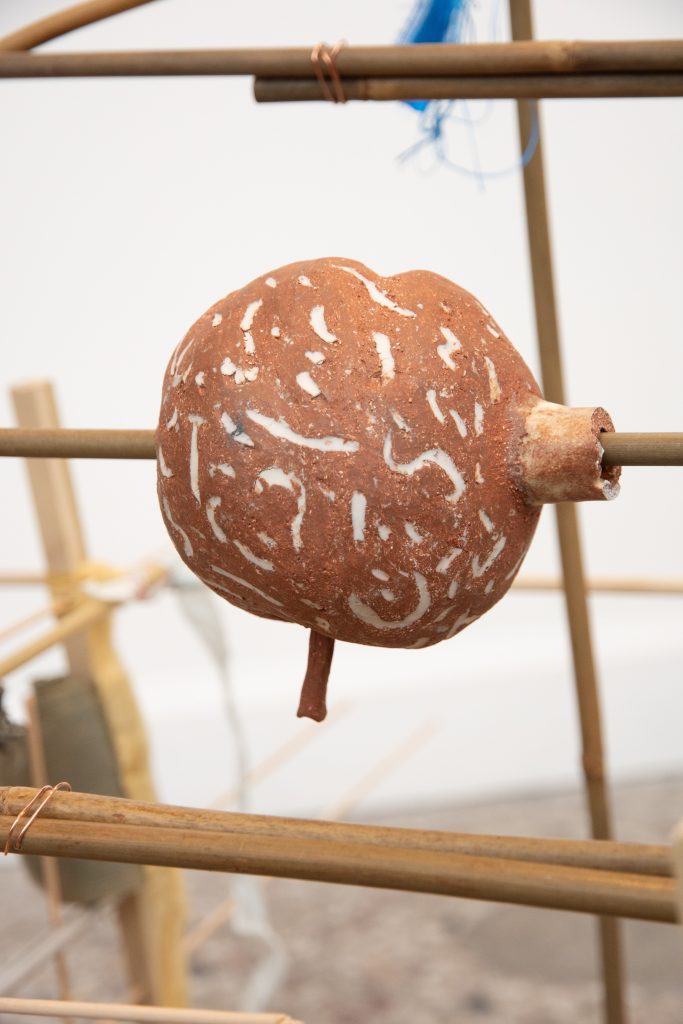
HWL: We’re operating from an abundance mindset, really. And I think also just as an organizing principle: we can improvise with these materials and build something new. And with this idea of the satellite or radio station, we are putting out a call. When the two of us speak, we form a message we hope is heard, and that maybe then other people will start singing.
IDN: Do you want to talk about who actually got drawn to us by this show?
HWL: We were talking about this yesterday during an interview with a writer in Boston who is also Hakka and wanted to write about the show. My housemates and I sometimes host Mahjong nights, and I told one of our guests that I had an opening coming up and then she shared [with me] that she is Hakka. There’s something incredible about invoking identity. Oftentimes, I just say I’m Taiwanese, but there’s levels of specificity. To some people, I just say I’m Asian. To some people, I say I’m Taiwanese. But I rarely say I’m Hakka. By making the show with this specificity, I think it attracts people who are tuned to this frequency, like a radio, who never thought to stake that claim to their identity so clearly. We found that so special, like we had made a certain call, like the way we spoke to each other that first time during the slide marathon in Skowhegan. What if we hadn’t introduced ourselves as Hakka in either of our presentations? Would we have become friends? By declaring that identity, just saying the word itself, it acts like a call or signal, saying, “they’re out there.”
The exhibition Mountain Call: Hai-Wen Lin & Ivan David Ng is on view at Roots & Culture Contemporary Art Center from February 7th – March 14th, 2026
About the author: Riley Yaxley is most often a dinner party host, a fishkeeper, a beach rat, a flâneuse, a glutton, a flirt, a dancer, a delinquent daughter who forgets to call her mom; and she is also a writer and editor.