
The Chicago Archives + Artists Project (CA+AP) connects archivists and artists to reimagine futures and histories. This year’s research continues our current theme of “embodying the archive.“
This series of interviews profiles this year’s archives + artists pairings, which include the National Public Housing Museum’s oral history collection (archive) + Dr. ShaDawn Battle (artist), Honey Pot Performance (archive) + Siobhan McKissic (artist/archivist), and one trio: Chuquimarca’s art library (archive) + Crystal Vance Guerra (poet) + Mariana Mejía (archivist).
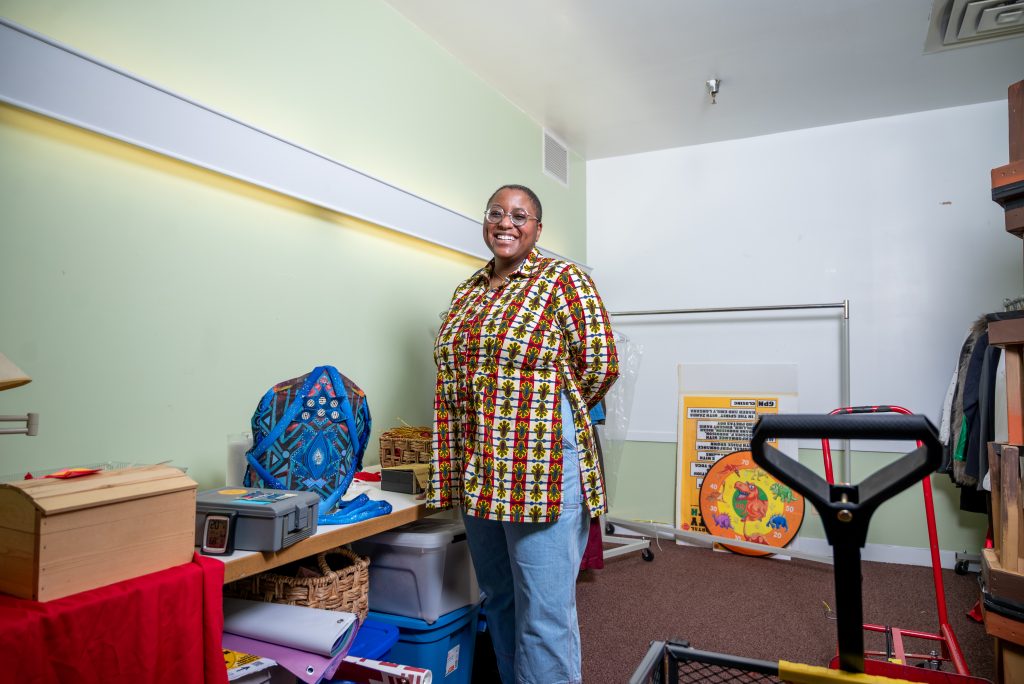
For this interview, Tonal Mondae spoke with archivist and artist Siobhan McKissic (she/they). Siobhan McKissic (they/she) is an artist, independent archivist, and performer born and raised on the South Side of Chicago. Their library and archives work foregrounds the histories of Black people, the importance of non-textual resources in the research process, and considers how a shift away from Western-centric ideas of information literacy can create more engaging learning experiences for students, instructors, and the public. They are currently the Senior Archival Specialist for the Vivian G. Harsh Research Collection. This interview highlights the archive’s history, growth, and its role in remembrance.
Honey Pot Performance (HPP) is a creative collaborative chronicling Afro-feminist and Black diasporic subjectivities amidst the pressures of contemporary global life. Since 2001, HPP has cultivated an approach to performance integrating movement, theater, and first-voice to examine the nuanced ways people negotiate identity, belonging, and difference in their lives and cultural memberships.
Tonal Mondae: Could you tell me a little bit about what is in the Honey Pot archive? Or about your experience with the archive?
Siobhan McKissic: I come from a background of working primarily with institutional archives, so I think it was really fun! [Honey Pot’s] archives are particularly interesting because they are an institutional archive, because [Honey Pot is an] institution. Except the stuff that’s [in their archive] is theirs. And because of their space—they’ve been in their church space for two years now—their archive is still kind of growing.
I was primarily focused on the physical archives and really trying to understand what they mean to [Honey Pot]. A lot of the archival work they do is digitizing materials, specifically the Chicago Black Social Culture Map, created by community members.
[Honey Pot] wanted me to look at what was more of their physical stuff. Some of their physical stuff is in-house at the church while a good amount is still spread out, which I think is actually—I’ll be honest—fairly common for organizations that have so many members.
They’ve got a lot of what you might assume, like costumes, props, and also a lot of early documentation of their group. Mainly in the form of early paperwork from Thick Routes [Honey Pot’s former name] and applications from the early 2000s, which are really cool. [There are also] scripts for pieces that they were working on, flyers for events, and just so much audio tape. There’s so much tape! So many video recordings; some have been digitized because they were used in soundscapes later, but others have not.
TM: What was the most exciting piece of art? Either in the physical space or digitally within the archive? Why do you think it was interesting?
SM: For me, I think the most interesting stuff in any archive are the personal items that show who the people are.
What was interesting to me was not just that, but also the fact that it’s so great to see people recording their conversations with each other. Some of the audio recordings are of just them talking. Some, you could tell, were sort of creative building, and they just love being in conversation. As they talk through a lot of stuff around Black feminist lineage, it’s really cool to just find them talking to one another, to find them just having regular conversations, friendships, and the things that really demonstrate the relationships that they’re building with each other. Also, [there are conversations] with the people they’re bringing in to help shape some of the larger performances. There’s something about the naming…their naming structures are really cool.
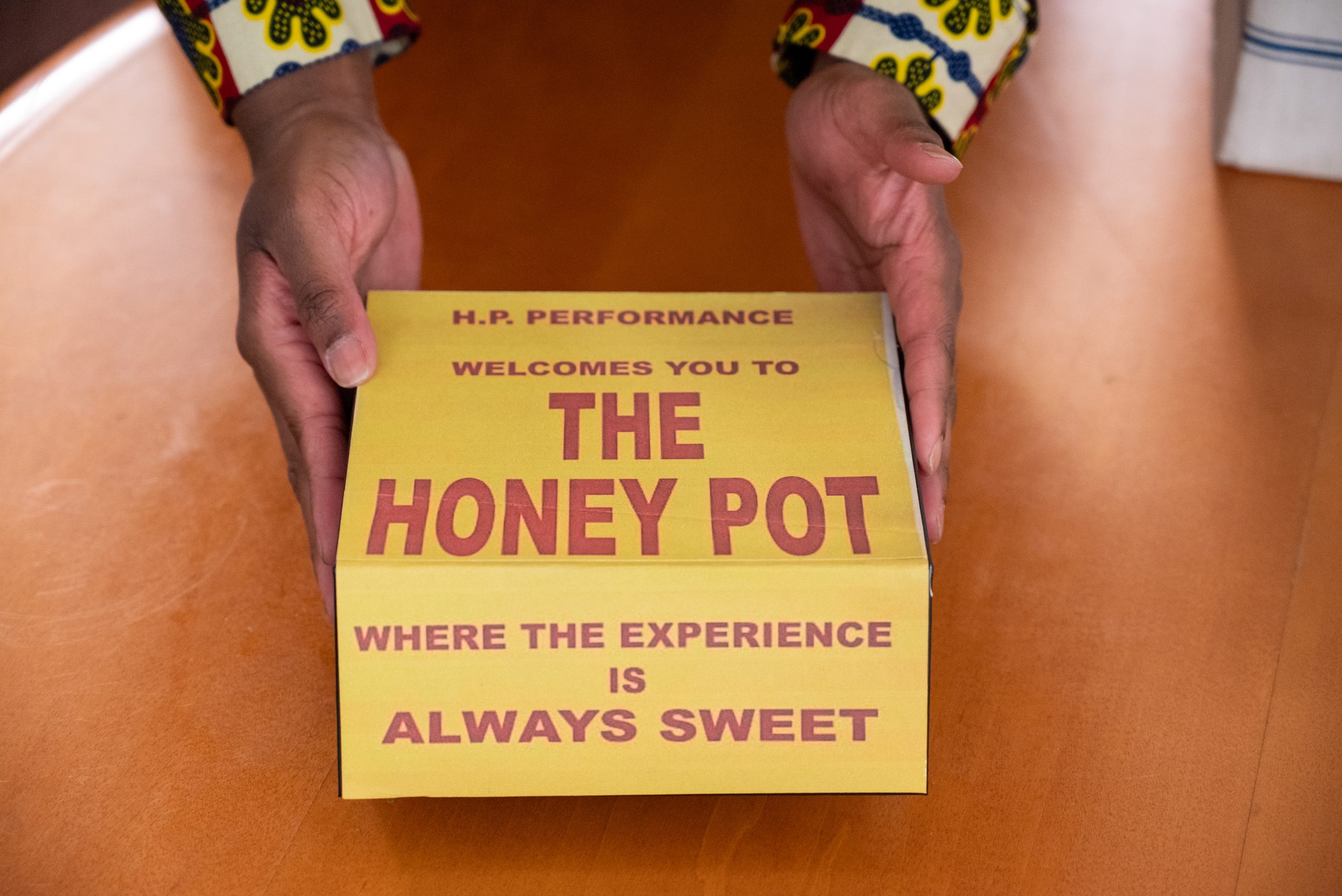
Then I found one of their older posters that just says, “HP Performance welcomes you to the honey pot, where the experience is always sweet!”
As an archivist, I’m going through it, trying to see if there’s any good ephemera in there. I found a poster for a mutual aid event that was happening in real time. I was like, we got to keep this! This has to be kept to demonstrate the community work they’re doing, but also to document of some of the mutual aid that’s been happening in Chicago. A lot of things have been named mutual aid more recently, but people have been doing it for a long time.
TM: Can you give me an example of some naming structures?
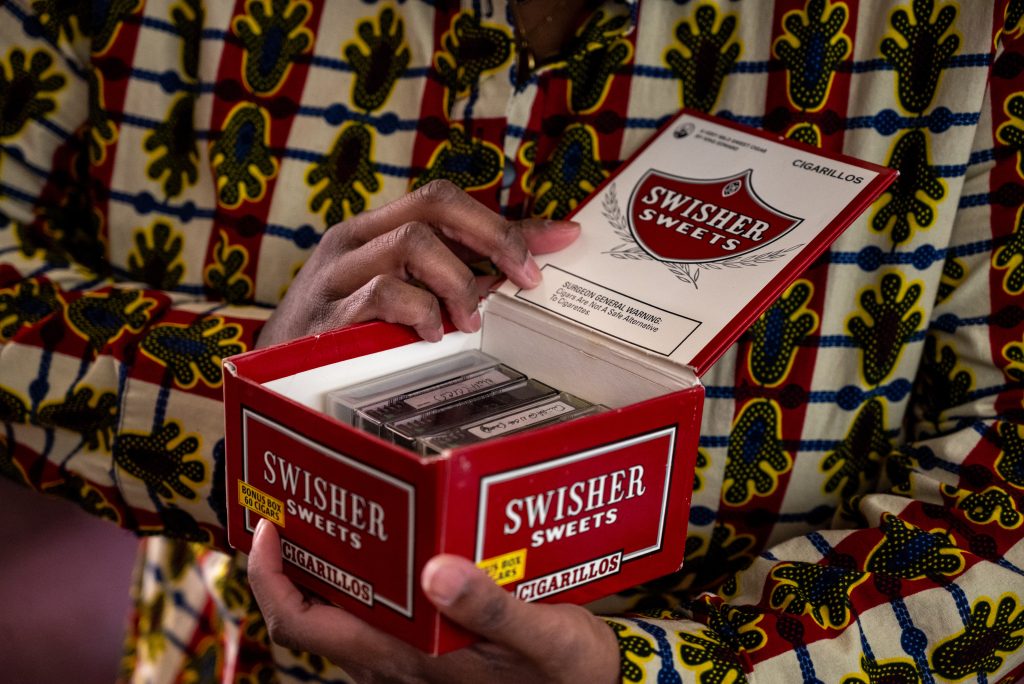
SM: I think the tapes are really cool, not just for the naming structure, but personally, because I think that analog media is very fun! It has its challenges, but frankly, it’s a bit more sustainable and lasts much longer than many digital materials.
I’m looking at one of them [right now], and it just says: on the street interviews, rehearsal tape number one and two, or sounds of the Caribbean. Just the way they’ve gone about it is kind of fun.
A lot of the time, they’re talking about the different experiences each of them brings as they work together and build their relationships. It’s really nice to see all this physical evidence of all these different things they’ve done, all these places people have been, all these different lives that they had before they got to this point.
“One of the questions I was asking them was, what are the things that deserve to be in your archive that are difficult to document? Are there particular bits of choreography that you’ve never been able to get out of your body?”
TM: I read that within your archival work, you’re guided by curiosity. How has that led your work with the Honey Pot archive? What were you most curious about, and what prompted that depth of analysis?
SM: What I was looking for was evidence of how they work together, because I have a lot of writing about how they think about how they work together, but I really wanted to see how this process works. How does their collaborative process happen? What are the physical ways they collaborate that can be saved on paper or in digital materials beyond just video, right?
One of the questions I was asking them was, what are the things that deserve to be in your archive that are difficult to document? Are there particular bits of choreography that you’ve never been able to get out of your body? Are there conversations you’ve had with people after a performance, for a performance, or during a performance that maybe didn’t make it into the final script, but that really impacted how you chose to move a story along?
SM: Especially when it came to a lot of the workshops they do around the social-cultural map. There’s so much conversation around what it felt like to be in those spaces, what it feels like as a DJ, to sort of feel the room and make choices about how you want that feeling to continue, right? There are plenty of ways that archivists have tried to document that in terms of, like, maybe you get the set list for the event, right? But I wanted to know what it smelled like. I really wanted to have a good sense of all the sensations that they felt during the creative process. I was most interested in the things that kind of get left out.
One thing I was really shaken by, and really drawn to, was the fact that every single room where they keep materials, sometimes for storage or equipment, had a very particular smell, because they put a smell in there. There was incense.
Their Power Portal Deck talks about ways to set the mood, which I really appreciate. I wanted to think about how that smell could get incorporated into how their material is kept. It sounds small, but smell is typically a very off-limits thing. When it comes to archiving, there are many racial and class implications. But then again, there’s also mold, and you don’t want to smell too much mildew. I was just really taken by that, I’d never smelled such smells going into an archive before, and it made me really happy.
TM: Can you name one of the smells?
SM: I think there was a vanilla incense in one room, there was this one that I have at home. I was just surprised; it was really fun because I thought, “What does this smell remind me of?” It was the first time I’ve been to archives that had a particular scent or a particular mood. It was so important that it had to be in the room with the materials. I just wanted to generally be led by my senses.
TM: You were quoted in an article that when you work on archives, you need to make sure you are doing right by the material. Were there any considerations you had to make before or during your time with the Honey Pot’s archive?
SM: The main consideration for me was just making sure that I had a solid understanding of not only how they felt about their own material, how they wanted to interact with the material, but also how they intended to have it used later. It was very clear, and I love that it was clear what they wanted from their archive: to be accessible to others.
They want to be able to access it themselves, but they also want it to serve as a point of inspiration for others, not simply for traditional research on the organization, which I really appreciated. That does change at times, how materials end up being organized, depending on whether this is for them specifically or for other people. They’re pretty accessible in their language, which I think helps people search for them digitally.
I wanted to make sure I was respectful of the material they were bringing, because I didn’t really know what they’d bring. I truly had no idea what they would have, and I made sure that I was careful and consistent in the ways that I handled the material. A good amount of it was posters and tapes, so it was fairly standard.
I was primarily looking at their materials to give them a general assessment of how to properly preserve and organize them, [so] they’d have a better understanding of where things were and practical things. How many boxes do we need, or do we have? They have digitized a lot of material, but do they have playback material for everything? A lot of the video tapes that I found, I was like, we’ve got to find something to watch this on if we really want to have a better understanding of what gets used.
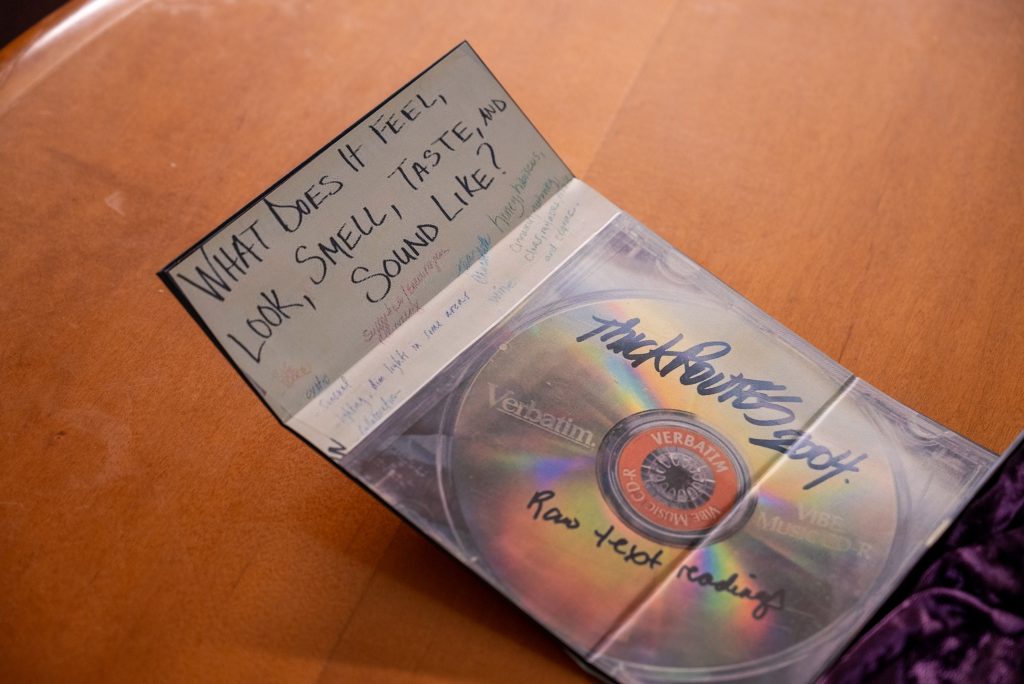
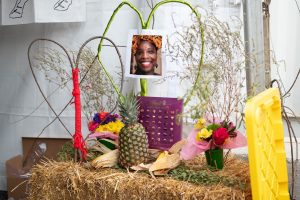
Image: A partial shot of a handmade archive box created by Siobhan McKissic, made of items and images from Honey Pot Performance. The interior of the box contains two images, one of a physical CD with the following text handwritten: “Thick Routes 2004, Raw Text Readings.” The image to the left on the other flap has text written that says, “What does it feel, look, taste, and sound like?” It includes a list of handwritten responses from Honey Pot members in various colors. Image by Tonal Mondae.
TM: What challenges or moments of joy have you found working within the archive? Can you speak to any?
SM: I just get excited when I see evidence of Black women. Seeing examples from our perspective of motherhood and of community and realizing that, yes, you want to do this collaborative work around people, feeding people, making sure they’ve got something so that they can think creatively. I was really taken by the number of examples of how they support other artists and by the different people they have worked with. One of the things I talked to them about was trying to get a better understanding of how many people they have worked with, how to document all of that, and to talk it through with them. How can you actually figure that out?
One of the first things I got a good chuckle out of was when I walked into their offices and looked to the side, and there was this giant poster of an archiving event they did in 2017. I looked at it, kind of squinted at it, and I saw myself. I was like, “Oh my gosh, that’s me!” It’s of me when I was in graduate school, and I had come up for this event.
They are sort of world-building. No, they’re doing it! I think it was really inspiring just to see all that they’ve been able to accomplish over the almost 25 years they’ve been doing it, and all the different ways it has expanded.
It was an enjoyable experience to peek through the process and see how different it was from person to person. They all have very different approaches to how they’re going about the work, but the collective documents they’ve created are still very specifically a group’s.
TM: So, tell me, what’s your next archival project after your time with Honey Pot?
SM: The hope is just to continue doing archival work. I really enjoy, specifically, doing work for Black folks and artists. It’s always been something I’ve done, and it’s really important to see yourself in the world. Saving things is a part of that [for me]. There’s something about a box, [they say] think outside of the box, but sometimes I’m like, no, you gotta hold things. Things need to be held. How can we better hold our own histories? How can we figure out ways to show up for each other? We’ve always figured out ways to document our histories, even if it’s writing down the history of your family in a Bible. I just want to continue to help people continue doing that in the same ways the Honey Pot is also trying to figure out ways to document.
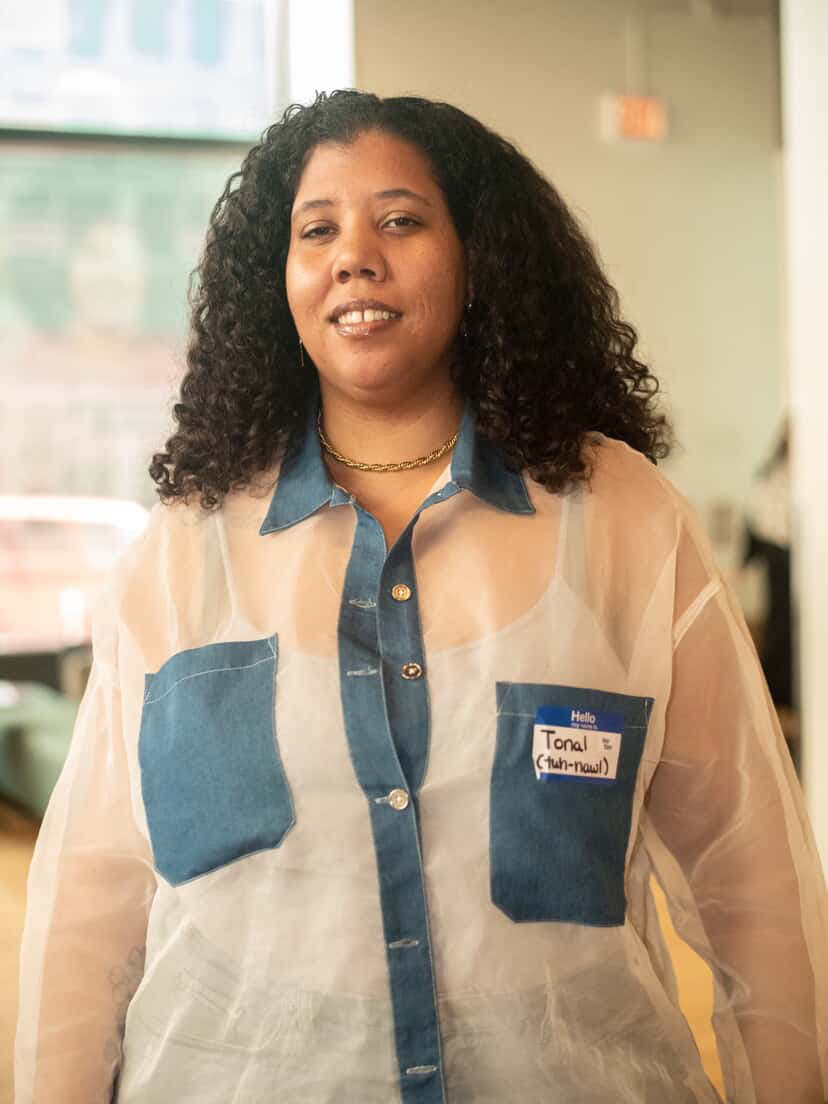
About the author + photographer: Tonal Mondae (they/them) is a documentary photographer and writer based in Chicago, IL. Their work creates visual narratives that celebrate personhood and seek to explore the relationship between belonging and environment. The use of collaborative portraiture is an act of resistance that promotes the right to self-authorship for Black, Brown, and queer people.