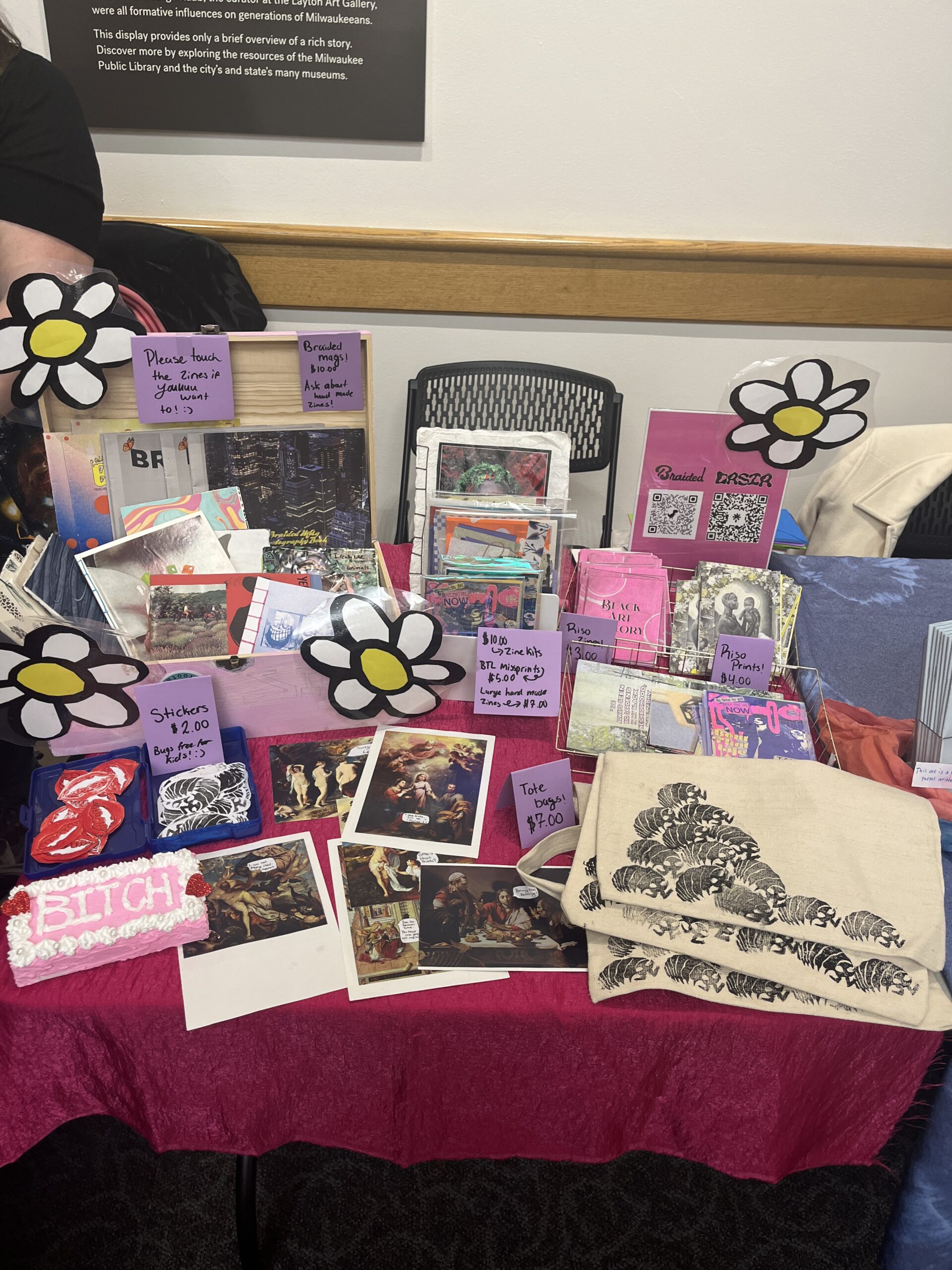
At this year’s Milwaukee Zinefest (MZF), tables overflowed with hand-cut collages, hand-drawn comics, manifestos, self-published histories, poetry, and guides to local resources. Each table revealed an almost infinite range present at the festival—materials, ideas, and stories. What you’re holding when you hold a zine is never just paper. Zines have always held the everyday and the urgent and the people making them have always understood that those things aren’t so different. I sat down with two Midwestern zinemakers, LaDasia Bryant and Johnny Willems, who tabled at this years MZF to talk about how zines have shaped their practices as artists and activists, and why zines matter now more than ever.
These interviews have been edited and condensed for clarity.
LaDasia Bryant
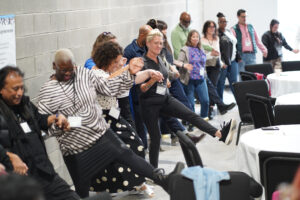
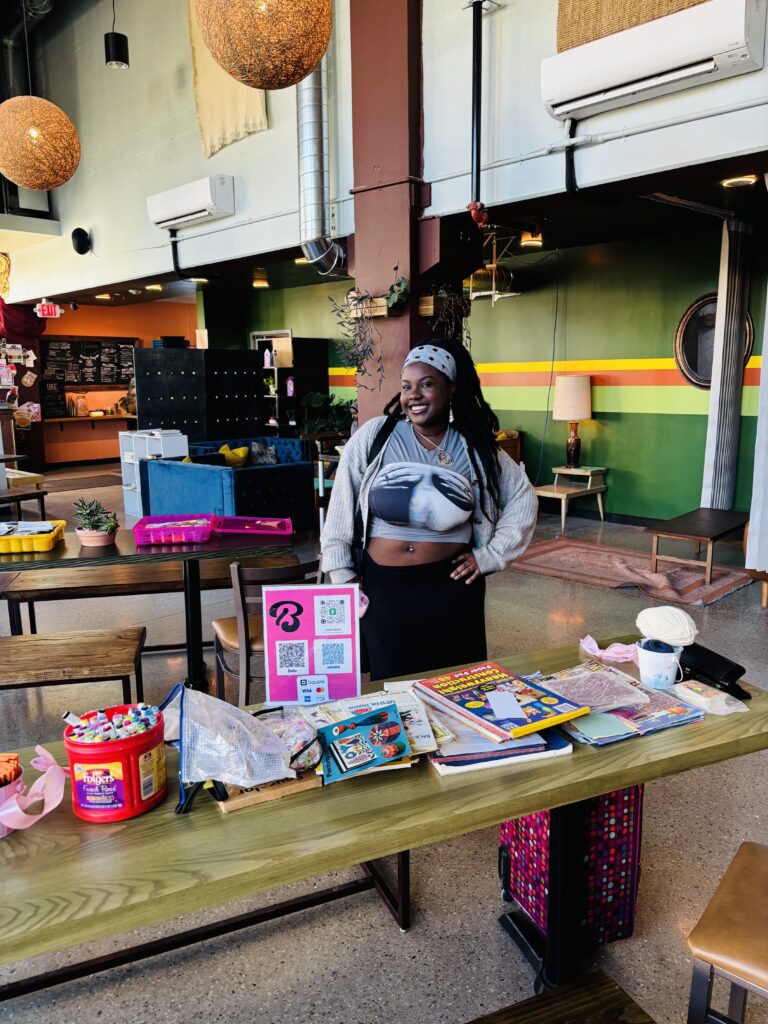
LaDasia Bryant is an educator based in Milwaukee and the founder of Braided Magazine, a platform dedicated to centering BIPOC artists and their work. She also hosts Seed Zines, a monthly community gathering at Haven Cafe where people can browse zine libraries and make their own. Her Zines for Literature workshop at Milwaukee Zinefest was an exercise in connecting thoughts across page spreads.
Nadya Kelly (NK): Tell me about the workshop you had at the Milwaukee Zinefest.
LaDasia Bryant (LB): I made a workshop called Zines for Literature. There were a bunch of zines and books on the table, and it was a game where you look through the zines and match them with a book—the idea being that the zines help you understand the books better. For example, I had a zine called The Black Panthers, which was about the Black Panthers’ thoughts on race and class. It pairs really well with Angela Davis’s Women, Race & Class. You have to look at what the book is about and consider what all the zines are about too, and then find the connections.
NK: What did you notice watching people interact with the zines and books?
LB: A lot of people opened my eyes to pairings I hadn’t even thought of. They would read a book and go deeper than I did, and they’d match it with a zine I wasn’t expecting at all. I thought that was really cool.
NK: At the core of it, what are zines to you?
LB: I think they are the freest form of art you can do. Whenever I’m teaching zines, the first part of the lesson is to just look at them. I have zines from a Milwaukee creator called Hotties on Potties, and it’s just drawings of people on a toilet, or cats using the litter box. I have one that’s just about rain. It’s literally just pages of blue watercolor. There’s one that’s just bugs, where every page is a different bug. Zines are cool because you can say, “I just want to make something today,” and you can grab a magazine, find a few pictures you like, cut them out, put them together, and someone out there is going to find it interesting.
NK: How have zines helped you find community?
LB: Zines naturally create their own community. Some of the earliest zines can be traced back to the Harlem Renaissance as a way to spread information in the most free and affordable way possible, because printing used to be really inexpensive. [I believe] it started with Fire!!, which was a literary magazine that published Black writers like Langston Hughes and Zora Neale Hurston, and people could get it for free. Some people even consider the newspapers the Black Panther Party made to be a form of zine. The whole purpose was for them to not be a big expensive production, but something affordable and accessible to anyone who needed the information.
Zines have always had a rich culture of connecting people. They’ve always been part of queer culture, Black culture. Every culture has its own version of where zines started, and we’re all willing to trade them because they didn’t cost us that much to make. Usually a zine is about something you’re interested in and want to share and talk about. Most of the zine fest is me talking to people about zines and then we trade. It’s an easy way to build community because who doesn’t want a free little book?
NK: How did your monthly zine event at Haven Cafe come about?
LB: I had this thing called Seed Zines that started as a K–12 zine class, but as an adult I also just want to look at zines and make zines. I started asking friends and the online community if they had a zine library they didn’t mind sharing for a day. The thing is, at a zinefest, sometimes you just want to look, and you’re a little broke. I wanted a space where there’s no sale, no pressure to buy anything—just libraries everywhere from me and my friends, and you can come and look. If you’re feeling inspired, there’s a big table to make your own. Every month, people come to enjoy zines and make zines.
NK: Why did you start Braided Magazine?
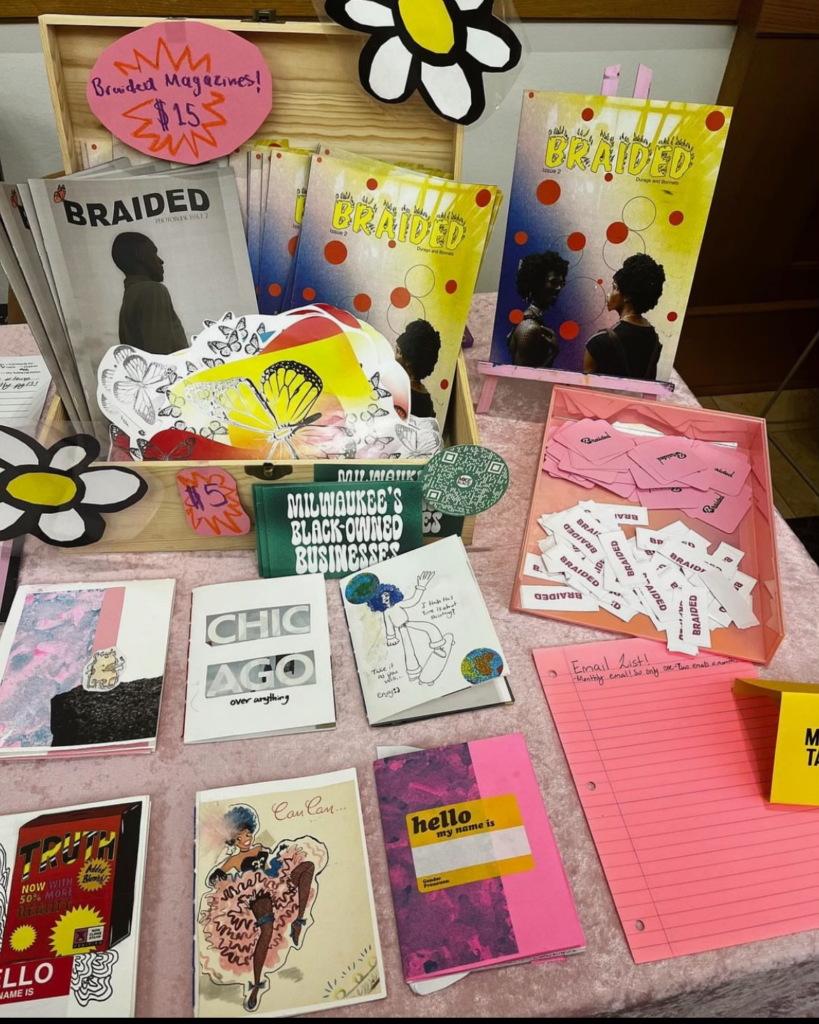
LB: Braided started in 2018. I started it in high school, and honestly, I did not mean to start it. I was in an interview for the John Walt Foundation for a grant project, and they asked me what I would do with the money. I had made this big piece where I braided these wall-length braids, and I made it because I felt like I wasn’t connecting with my Blackness enough in a white-dominant art world. Every show those braids were in was so white, and I was like, ain’t nobody connecting with this for real. They just want it in there because I’m a Black person. So at the interview, I just said that I want to host an art show called Braided, and it’s all Black people. White people can come and enjoy it, but it’s not going to be about them. They told me to say more.
They ended up letting me use their space for free, and I used the grant money for snacks and things for the events. I didn’t expect it to get so big, but more and more people kept showing up. It became some people’s first art shows, the thing that kicked off their careers. And then I got interviewed, and it just kept going. So I kept it up, because I actually like hosting and I like seeing people interact with the work. I started doing fashion shows, art shows, and music showcases. Then COVID hit, and I was like, what can I do? I had already been making magazines, but COVID made me really lean into it. COVID pushed me to really go deeper with the zine work and connect it to everything else I was building.
NK: How has Braided helped you advocate for the issues you’re passionate about?
LB: I’m a person of color, and I am so tired of us being in spaces where we’re either a token or not respected, especially in the art world. People love Black art, but they don’t really want to understand it. I wanted a space where we could come together, understand each other, understand our art, make new art, think about it, and talk about it. Since I graduated college and became an educator, that’s where the intentionality has really come in. It was cool before to just have fun and host these more party-type settings, but I’ve been asking myself: how can I be more purposeful? That’s where Seed Zines came from. Right now I’m really focused on women’s health, especially Black women’s healthcare. I’ve been hosting more events around that, and thinking deeply about how I can be more of a platform to help other people.
Johnny Willems
Johnny Willems runs Clear Truth Studio, a micro press for zine making and screen printing, both for their own artist practice and for grassroots organizations and local business. Based in Indianapolis, Johnny has been an active presence not only at Milwaukee’s Zinefest but also at zine fests across the Midwest, including as a co-organizer for Indianapolis’ Monkey Wrench Zinefest. For Johnny, zines were an entry point into making art that could be radical and resonant without demanding vast resources.
Nadya Kelly (NK): When you first started making zines, what were you making them about?
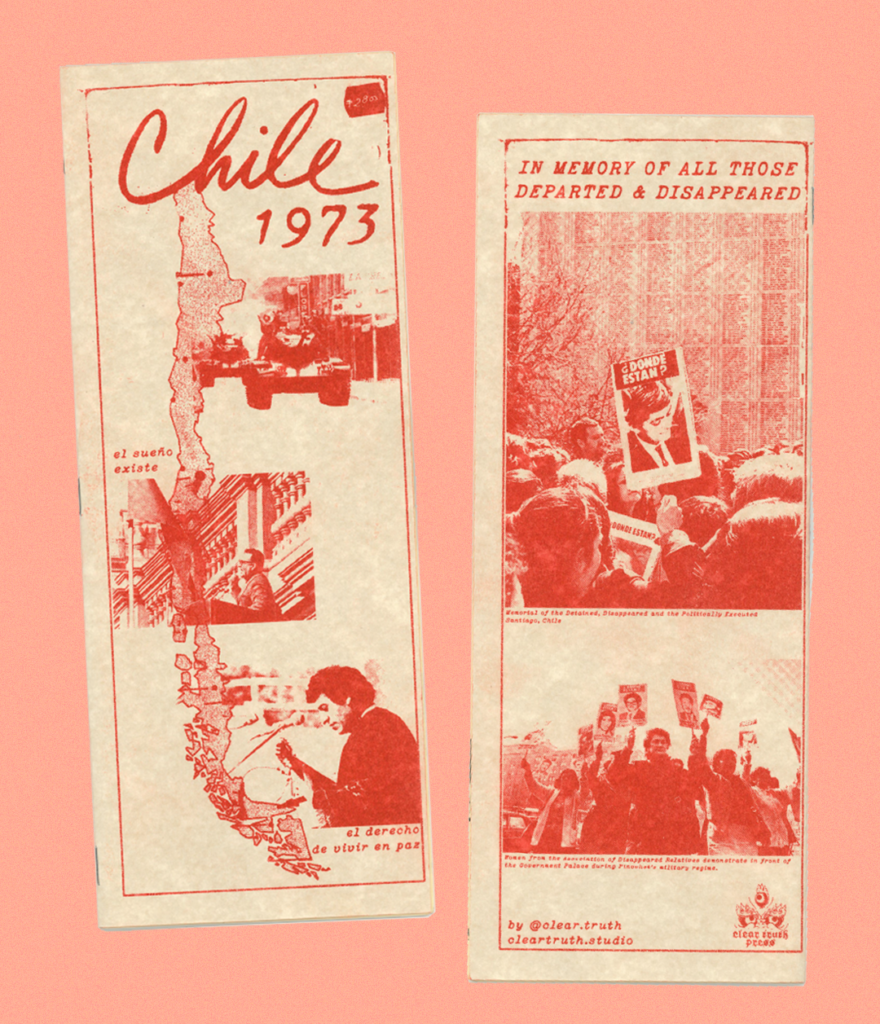
Johnny Willems (JW): I was doing a lot of cut-up collage and poetry. A lot of my artwork is grounded in my own spirituality. I converted to Buddhism when I was seventeen, and that’s where the name Clear Truth comes from. It’s the Buddhist name I was given. I was making zines about the fear of death, about Buddhist spirituality and philosophy. I also put together a collaborative zine with my local meditation group, my sangha.
NK: Would you say activism led you to zines, or did zines lead you to activism?
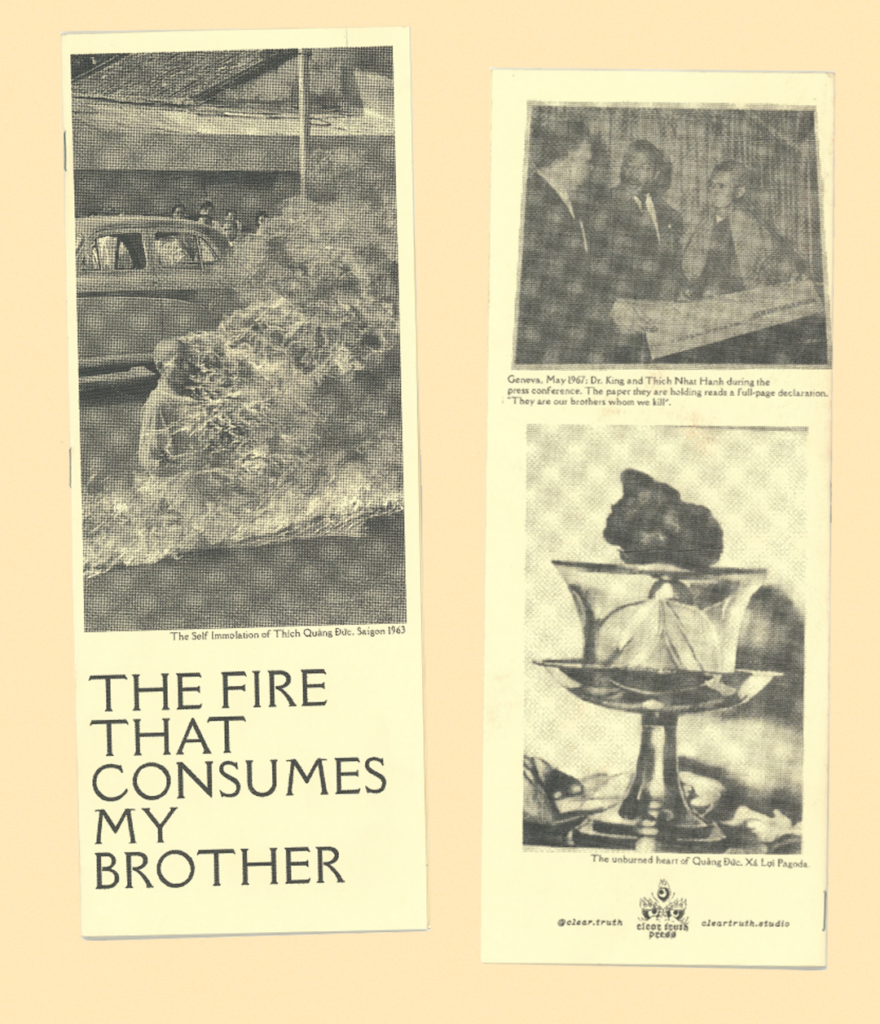
JW: It all kind of came at the same time. I was always, from a very young age, very politically inclined. When I first started going to leftist spaces and punk shows in Chicago as a teenager, zines were just there. I remember going to a free DIY show in Michigan City, and somebody handed me a free batch of poetry and anarchist zines. My art has always been political. The first thing I was doing was spray paint stencils for Black Lives Matter, and people told me that could be art. My art practice lives at the intersection between the spiritual and the political. In Buddhism we talk about liberation in a spiritual sense, and liberation action in a political sense. I always tell people in my spiritual communities that if you want to stay true to your values, you have to take them out into the streets. A lot of the zines I write document a historical tradition of Buddhists who were actively and politically engaged, which doesn’t get talked about enough, especially with Western Buddhism being so commodified and sanitized.
I’ve also done work in Indianapolis with local meditation and yoga groups to create things like Meditation for Liberation. One of my good friends runs a yoga practice at our local community center specifically for activists and community members. Often it’s through zines that I bring all of these things together.
NK: Why do you think people are turning to zines right now? What role do they play in your activism?
JW: Zines have been exploding in popularity again, especially in reaction to corporate algorithms, censorship online, and the rise of artificial intelligence. People want something you can hold on to, but also something that isn’t traceable. There are online distros that give away zines for free that anyone can reproduce and print: zines that tell you your rights, how to respond to ICE agents at your door, how to organize locally, how to build a rapid response network.
Zines are a community tool for spreading information and for documentation. At Ujamaa Bookstore in Indianapolis, a friend of mine runs an anarchist distro where they document stories that no one else is recording, like the gentrification of Indiana Avenue and the historic Black communities that were pushed out of that area, and the way data centers are encroaching on Indianapolis neighborhoods—the stuff that doesn’t make the news.
NK: You also use zines and artwork to document your own family’s history. What has that process been like?
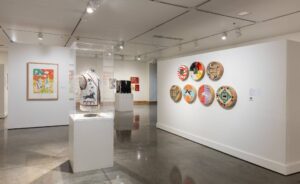
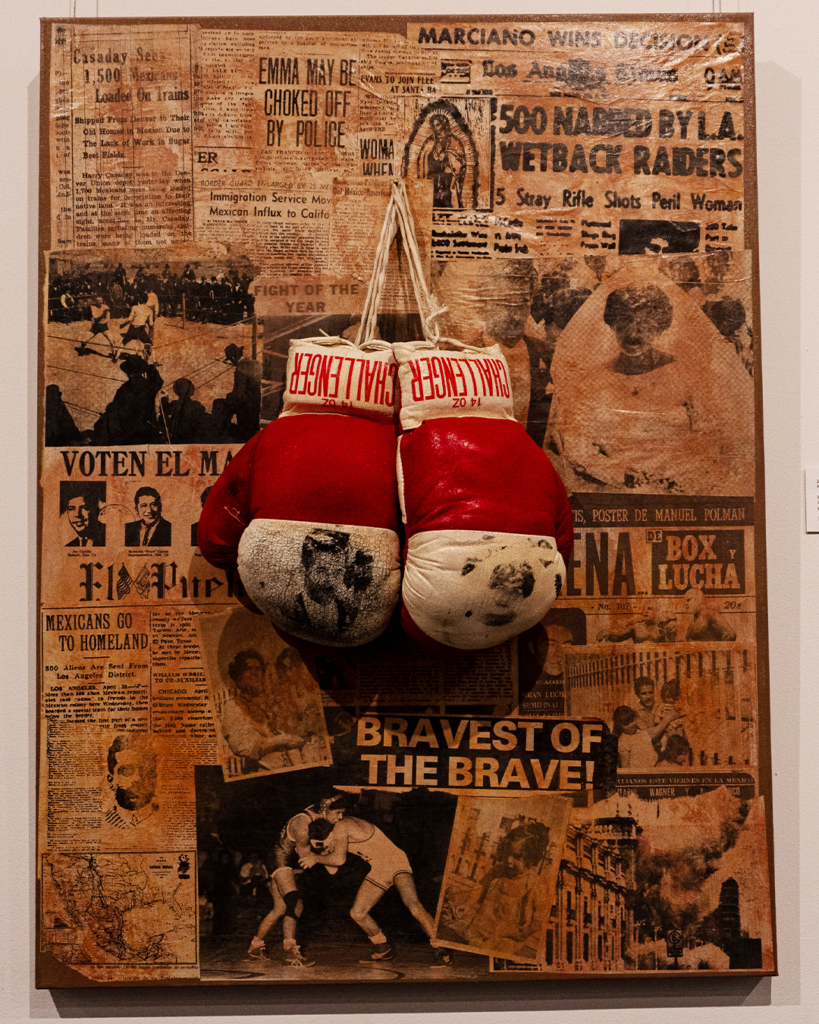
JW: Some of my work starts as a zine and then grows into a full art piece. I’ve been gathering family photographs from relatives, interviewing people, putting it together, then developing it further into posters, then into a larger artwork. One piece I made is a sort of a nontraditional portrait. It’s a poster of collaged newspapers behind a pair of boxing gloves, which are decorated with a portrait of my grandparents, my abuelito and abuelita. This was featured at the Eiteljorg Museum and is showing at the Pilsen Arts & Community House. The thesis is that every migrant is a fighter. I wanted to document what fighting means across generations.
My grandfather loved boxing, and boxing is very crucial to Mexican working class culture as a tool to escape poverty, which lines up with the story behind his migration to the US to fight for a better life for him and his children. For the second generation, my parents’ generation, the fight was about assimilation, trying to find an identity in very white spaces. My father grew up in Indiana and took up folk-style wrestling, and some of the photos come directly from his own wrestling matches. And through this, I found out that my grandfather, when he was still working in Mexico, worked at a newspaper printing factory, so he was using the same exact methods I’m using today. Newspapers are recreated with screen printing and Risograph, so [I’m using] very similar methods that he might have been doing as a typesetter back in the day.
My fight now is to keep these stories alive, to stay connected to my heritage as someone who’s third-generation. For this collage, I looked through archives of local newspapers my family might have been reading in the late sixties and early seventies—stories about deportations, but also the legacies of resistance, of fighting back, literally and figuratively, and what that means across generations.
NK: Hearing all of that, these stories of your family trying to make their way in a system that seems stacked against them, how do you process it? How does the art help?
JW: I’ve been a community activist for a long time, and it’s difficult work, man. I’m also a social worker in Indianapolis, so I work directly with marginalized communities—people facing housing insecurity, financial insecurity. You come face to face with the failures of capitalism and the people the system has left behind. What do you do with that? You need art. You need to tell these stories, because if you just absorb all of it without any outlet, it burns you out. You need community to respond to it. You need something to ground you, whether that’s art or a spiritual practice, because cultures are for resistance. That’s what they are.
You can see it through three generations of people facing marginalization and fighting back here in the United States, and then you think about Palestine, where there’s generations of resistance, passed down, baked into everyday life. For me, I need my art, my community, and my spiritual practice to stay grounded and keep going. My work is done with reverence for everyone who came before me. When I’m documenting the stories of martyrs or my own family members and ancestors, that’s what keeps me grounded—knowing this is a generational struggle and that it doesn’t rest on my shoulders alone. When you take that perspective, you don’t have to save the entire world. You can help one person.
NK: Zines do feel like they can be an actionable thing to make when you’re feeling hopeless.
JW: Zines are evidence of life. They’re evidence of a counterculture, of a resistance still pulsing. When you see a zine left in a bus station or a random cafe, whether it’s an anarchist zine or just a poem, that’s evidence of people who still want to create, who still have something to express and something to share. Whether it’s documenting the history of activists, serving your community, or just offering a tool or a resource, it is nourishment so we can keep fighting.
About the Author: Nadya Kelly (she/her) is an arts writer based in Milwaukee, Wisconsin. She uses text and audio to explore themes of Blackness, imagination, girlhood, through the lens of visual art, music, and performance and has written for publications across the Midwest, including Newcity Art and Milwaukee’s NPR. Nadya holds an MA in Arts Journalism from the School of the Art Institute of Chicago, and she is an avid gamer, tennis player, reader, and sunbather.