Wiwahokichiyapi: They Promised Things to Each Other engages contemporary artists to show Indigenous people grappling with treaties as living documents. In this exhibition, an informative history of treaties with Tribal Nations regionally and across Turtle Island is met with the artists interpreting their present day realities as the descendants of unconquered peoples. For Plains Art Museum (PAM) in Fargo, North Dakota, making connections with Indigenous-led institutions of the region and beyond provides deeper meaning to the histories it tells.
A rendition of a longstanding collaboration between Treaty Nations and the National Archives with the National Museum of the American Indian, the “Know Your Treaty” project takes root in the Great Plains region with PAM’s participation. Giiwedinong Treaty Rights & Culture Museum of Park Rapids, MN, which facilitates cultural programming and political awareness led by and for Anishinaabe and Dakota communities, was a proponent of this exhibition and provided research support for local interpretation. Key organizers at PAM were Danielle Gravon, Chief Curator, and Bret Salter (Akwesasne Mohawk), Curator of Indigenous Art and Programming. In addition Delia Touché (Spirit Lake Nation) played a significant role, which originated during her time as Curator of Indigenous Programming at PAM.
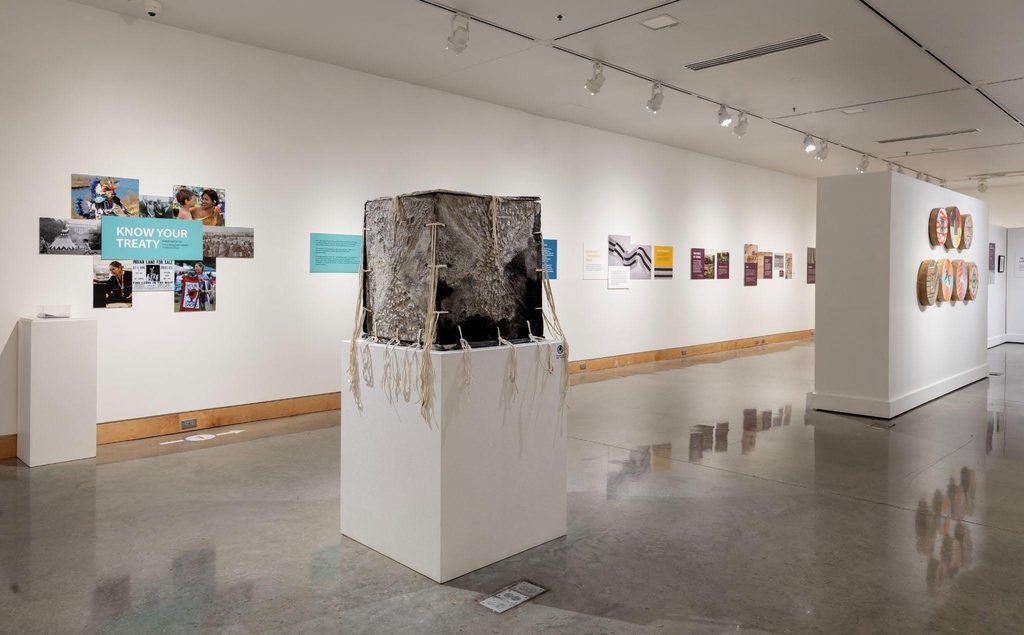
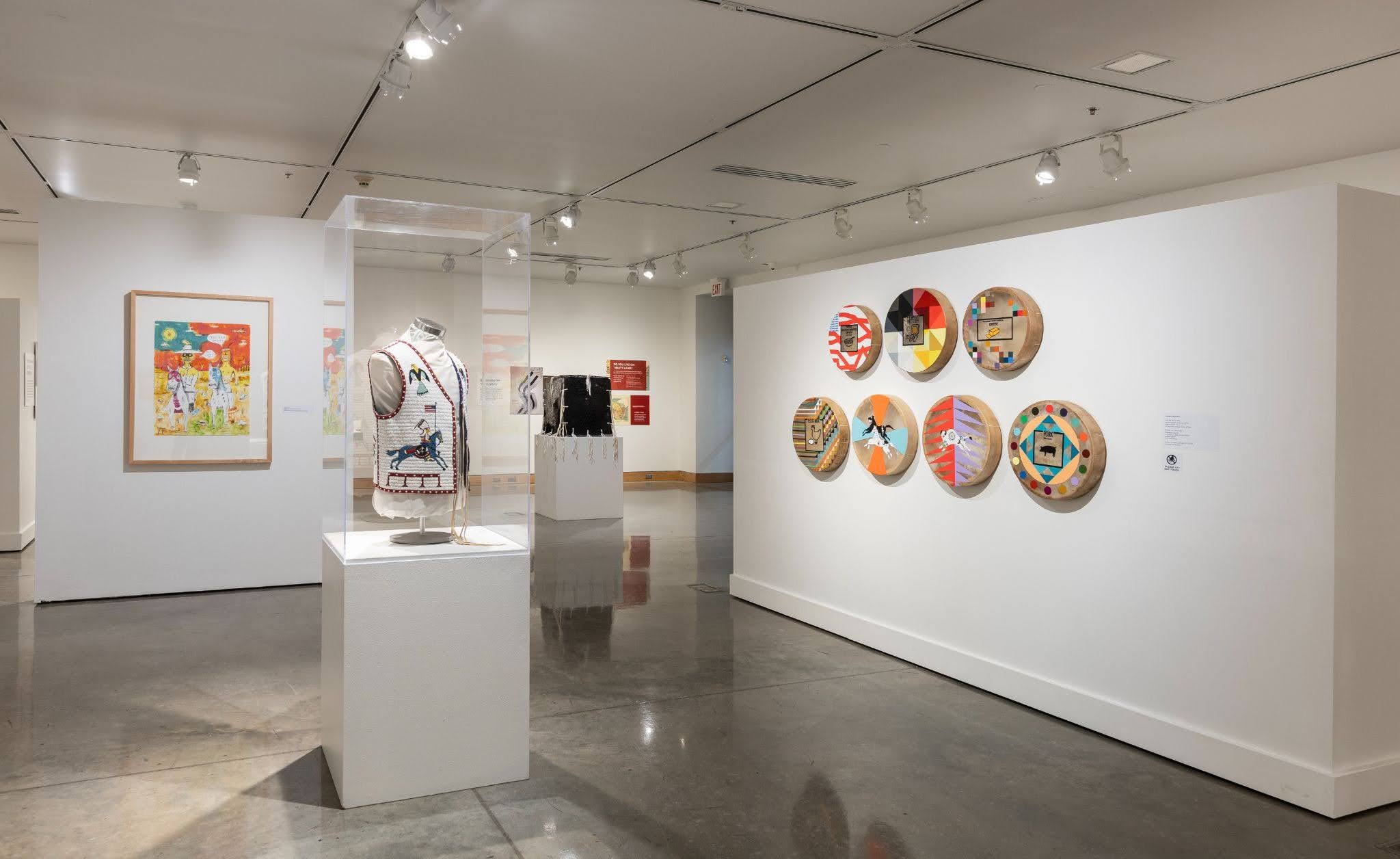
The outer walls of the gallery contain panels created by the National Museum of the American Indian in Washington DC, while panels on the interior provide the local, contemporary context. A numbered path is laid out to aid visitors in finding an order for understanding these political histories and their effect on the everyday.
Some treaties highlighted are the intertribal Sweet Corn Treaty of 1858, Fort Laramie Treaties of 1851 and 1868 which designated the Black Hills as unceded territory belonging to Oceti Sakowin people along with larger swaths of the Upper Midwest belonging to Northern Plains tribes, and 1867 Treaty with the Chippewa of the Mississippi which ceded 2 million acres of Ojibwe land and established the White Earth reservation.
The panels moved forward in history to acknowledge transgressions on these binding legal documents, including federal governments taking of treaty lands in cases such as the Garrison Dam that flooded Mandan, Hidasta, and Arikara communities out of their towns on the Fort Berthold Reservation in 1953, the Dakota Access Pipeline on the Standing Rock Reservation which was heavily resisted in 2016, and Enbridge’s Line 3 currently under construction on Anishinaabe lands.
Research by community activists like land defender Winona LaDuke at Giiwedinong Treaty Museum and scholars like archaeologist Tyrel Iron Eyes provided the basis of the didactics on these interior walls, many paired with images of material culture from the region including ledger art, historic beadwork, and contemporary painting.
Touché shares that it was intentional to mainly invite Indigenous women as exhibited contemporary artists, referencing the legacies of technique and design that Indigenous women have carried and passed on. This artistic knowledge has been stewarded and exhibited in museum contexts usually without credit and stripped of their names. Touché is an innovative artist themself showing mixed media prints and textile art in recent exhibitions like Queering Indigeneity at Minnesota Museum of American Art.
Oglala Lakota artist Mikayla Patton has been making profound statements through sculptures of repurposed paper, affected by smoke and soil and embroidered with porcupine quills and beads. In what the artist describes as reciprocity, paper documents were shredded, pulped, and strained in a process of transformation. Sharp quills emerging on the surface and stitched up with buckskin lace, this fibrous pulp re-formed into the solid walls of a rawhide case. Alongside conversations about the living realities of treaty documents, the materiality of her work makes a statement about the intangibility of the creation of law and complacency under US empire. Legality is entirely constructed, as US empire continues to enforce violence through the law and still selectively break its own treaties.
The use of rawhide leather in traditional parfleche cases is born out of a relationship with Tatanka Oyate (Buffalo Nation). By replacing this material with the pulp of documents, Patton engages with modern realities, as Indigenous people must protect their sovereignty through legal pathways. The treatment of the surface of the case with ash from plant medicine like sage, typically burnt in prayer, is another form of protection. The kapemni, an Oceti Sakowin symbol for the concept of “as above, so below,” is pressed into the sides of the case with fingerprints.
Several artists reference the aesthetic and material heritage of parfleche, or painted rawhide containers. “Parfleche” is a French term, coming from the foreigner’s observation that the hard rawhide was impenetrable by arrows. What is true is that rawhide was used as a material for protection, both spiritually, in the beautifully painted designs, but also practically, as the main function of these containers was to carry food and other resources, shielded from the elements. A lithograph print by Wendy Red Star, Where Bears Dance, features a cascade of bishkisché (Apsáalooke for rawhide container) moving down the print, decorated with abstract designs painted in vibrant colors. Red Star refers to bishkisché as an integral part of her creative ancestry and visual language as an Apsáalooke artist.
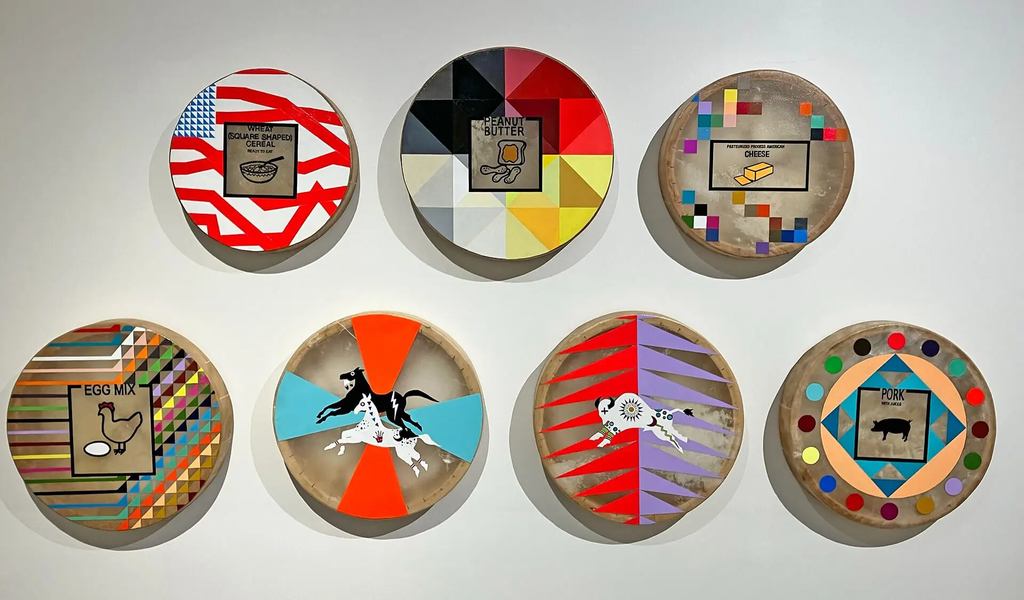
Danielle Seewalker (Hunkpapa Lakota) paints on the transparent rawhide stretched over the frame of a hand drum. Five of these drums are painted with the black square design of generic commodity food labels. The opaque neon shapes that dance across the drums contrast with the transparent rawhide beneath the designs. Commodity food distributed by the federal government is ubiquitous with the experience of Native communities on reservations.
“Seewalker makes playful use of symbology on her hand drums. It becomes clear that all of the drums carry the symbols of survivance.”
Provided with cheap, like white flour, butter, heavily processed meats and cereals, ancestral foodways were severed and nearly destroyed through colonial violence. Prepared with love to feed their relatives, many commodity foods also form a nostalgic part of cultural cuisine, as seen in dishes like frybread. Other drums represent Sun’ka Wakan Oyate (Horse Nation) and Tatanka Oyate (Buffalo Nation). Seewalker makes playful use of symbology on her hand drums. It becomes clear that all of the drums carry the symbols of survivance.
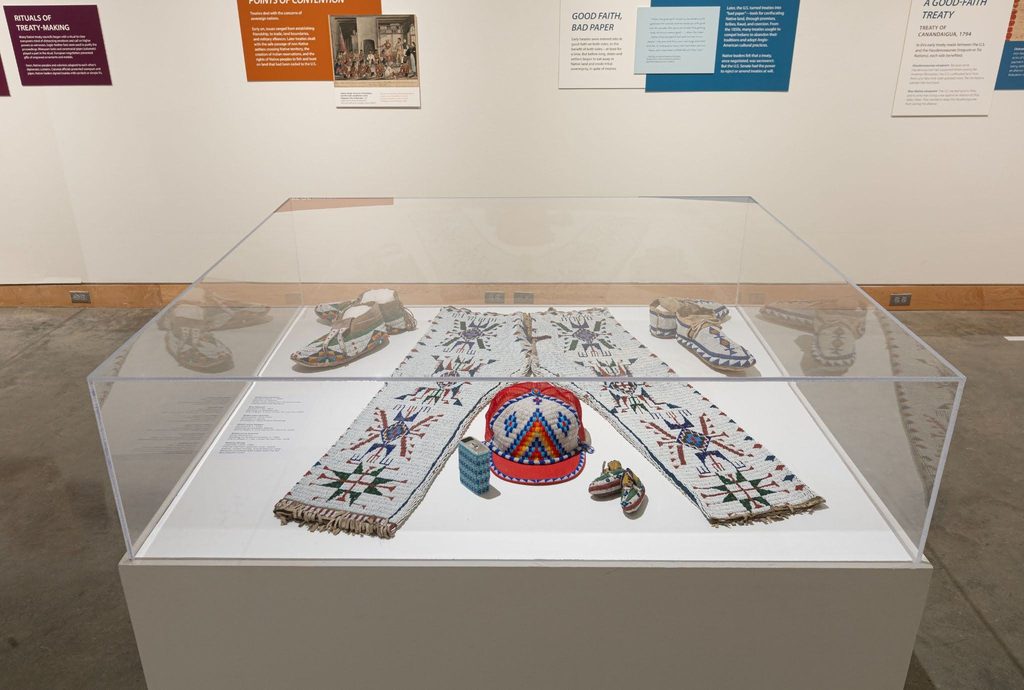
A case of historic beadwork included rodeo-style buckskin trousers covered front and back with thousands of thousands of glass seed beads, sewn into Oceti Sakowin designs. These fully beaded trousers along with other works of art from the region were gifted to the PAM by the Ralph T. Coe Center for the Arts in Santa Fe. The gallery, collection, and cultural center embarked on an intentional and transformative sunsetting of their institution. Concluding in 2026, the Center has “rehomed” its collection of Indigenous art and cultural belongings to more than 50 tribal nations and museums, led by Coe’s niece and Executive Director Rachel de W. Wixom. The campus itself was gifted to the Institute of American Indian Arts (IAIA). The Coe Center has demonstrated what responsible stewardship of Native art collections, namely deaccessioning and repatriating, can look like.
The inclusion of historic beadwork from the Coe Center alongside contemporary beadworkers like Maggie Thompson shows that these artforms have survived generations of continued colonial violence. The message is quite direct on Thompson’s work Fuck This (2025), a pair of earrings made of two tampons, wrapped in the title of the work in peyote-stitched beadwork. Indigenous artforms, including beadwork, are sites to interpret the political temporalities of treaty rights and sovereignty for Indigenous people.
. . .
Wiwahokichiyapi: They Promised Things to Each Other is open from April 25, 2026 until February 7, 2027 at The Plains Art Museum, after which the curatorial team hopes to share exhibition materials with smaller regional schools and cultural centers, including on local reservations.
About the Author: Cady de la Cruz (they/she/he) is a writer and community organizer currently based in Omaha, Nebraska, where they serve as Curatorial Assistant of Native American Art at the Joslyn Art Museum. As a person of runakuna (Quechua) ancestry living in diaspora, they are interested in Indigenous Futurisms as an artistic and political movement towards sovereignty and liberation. They create the zine series tupacalypse. Skills that they are growing with include community-engaged curatorial practice, plant identification and foraging, and cooking their favorite Peruvian dishes.