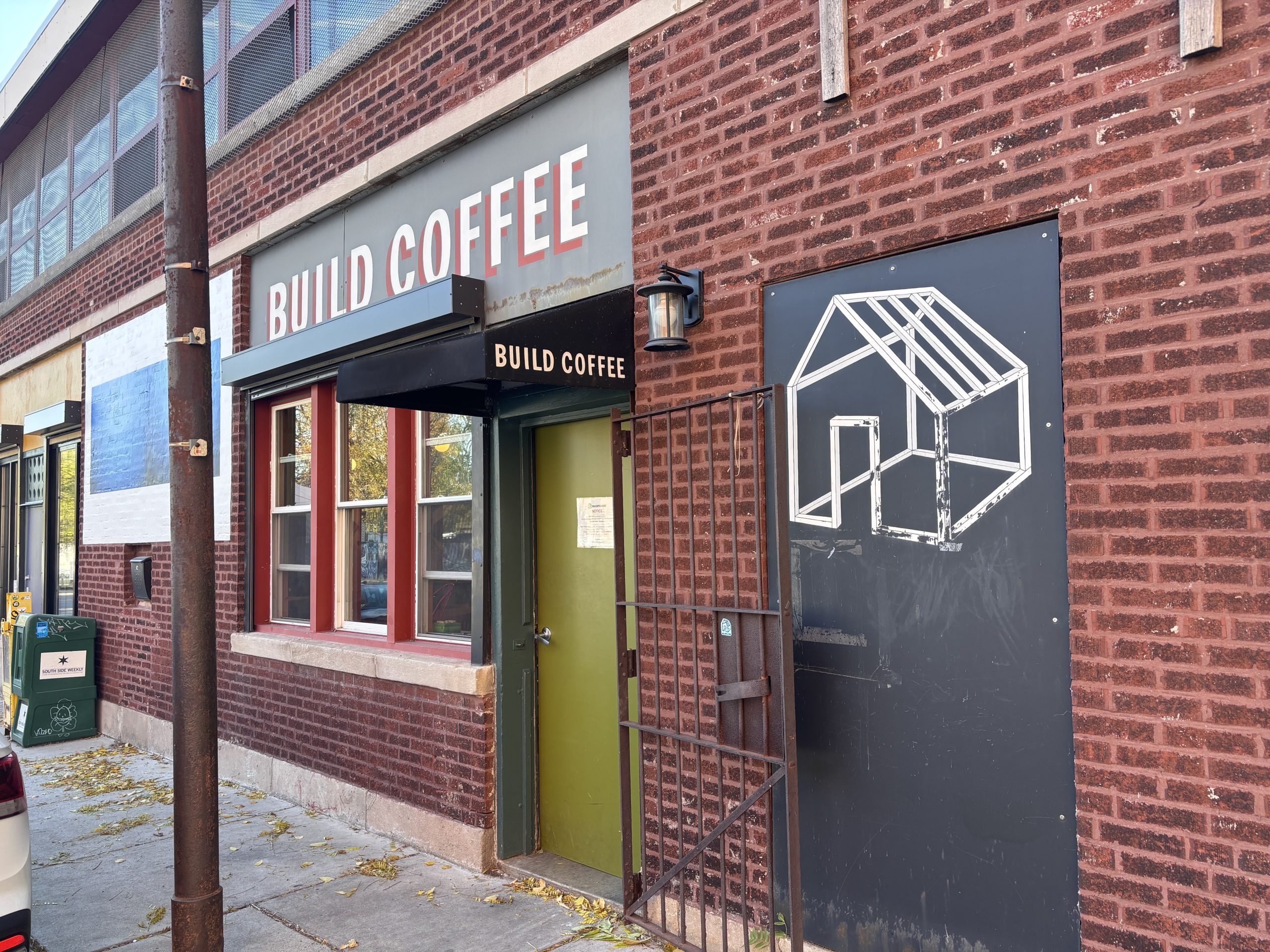
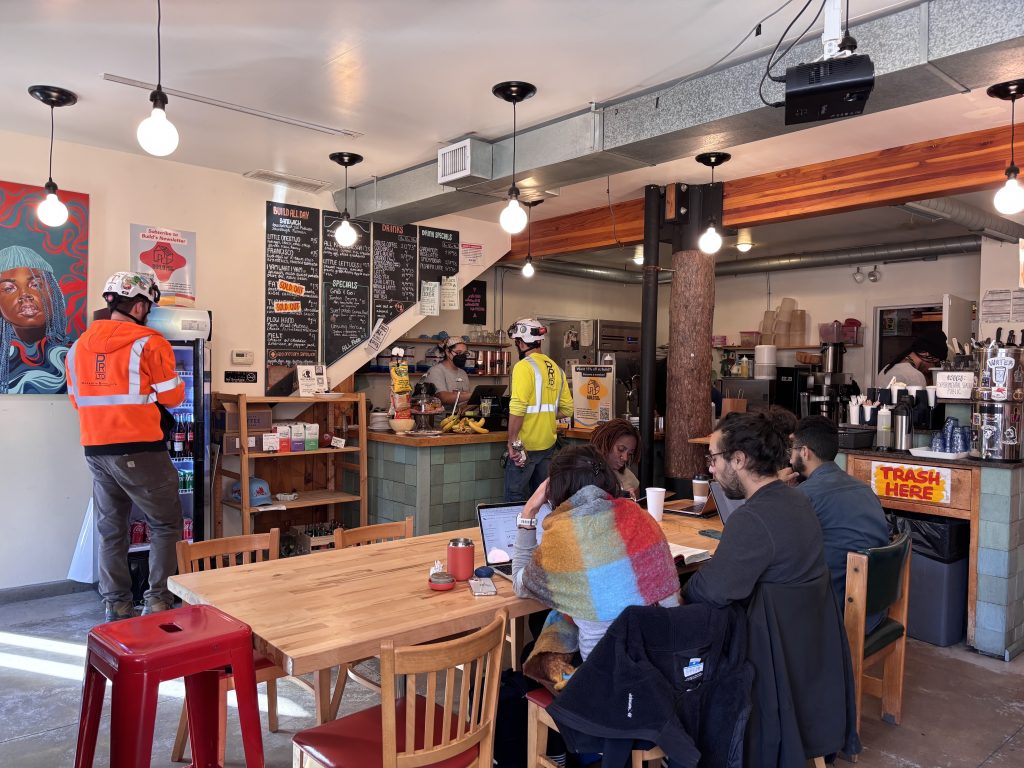
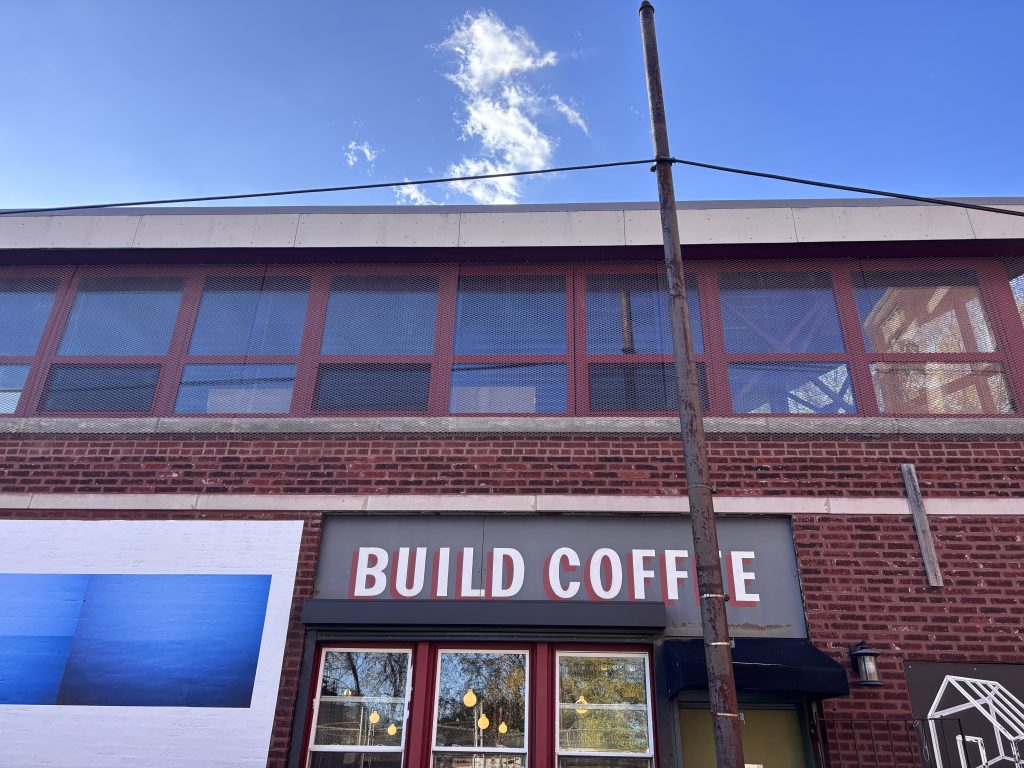
This past summer I took over a beloved Chicago cafe and bookstore, Build Coffee & Books, with two people I deeply admire: trina reynolds-tyler and Eve L. Ewing. When Build’s co-founders and co-owners announced on Instagram in June 2024 they were seeking new shopkeeps, the Spirit moved me to half-seriously text trina, “we should buy build coffee jk but not jk.” Build was the backdrop to much of my last chapter in Chicago—I’d spent nearly every Thursday evening there for three years facilitating a then-weekly workshop series for City Bureau, The Public Newsroom.
In the five years since I’ve left Chicago I’ve come back to Build to host my COVID-delayed farewell party, officiate a wedding, and feel anchored. It felt divine that during one of my trips home trina texted she was meeting with Eve. I skipped out on the work conference I was supposed to attend and hopped in an Uber to meet up with them. We’d been meeting weekly for nearly a year when the official announcement dropped that we were going to steward Build’s next chapter. The same week the news broke, I was leaving my journalism career behind for one in reproductive justice. I wanted to free my media-based organizing work from how I make ends meet and gave it a home once again at Build.
Just a couple months later, it was public that Ryan A. Sorrell and his team at The Kansas City Defender (informally called The Defender) were making plans to save and revive Missouri’s oldest Black bookstore, Willa’s Books & Vinyl. Before either of us were taking over community spaces, Ryan and I met through a mutual lefty/organizer friend who connected us over something completely different. During those conversations Ryan had mentioned that Willa’s Books & Vinyl was slated to close, and how The Kansas City Defender, which he co-founded, was wondering what their responsibility was to keep the bookstore alive. At the time I was reading former Chicago alderperson and community organizer Hellen Schiller’s autobiography, Daring to Struggle, Daring to Win, and what really struck me was how, before coming to Chicago, she had co-ran a movement bookstore called the People’s Bookstore for political education and resource connection in Rockford. As our current political climate becomes more repressive and the internet becomes less safe, Schiller’s Rockford space was an extension of her co-struggling with the local Black Panther Party chapter. The bookstore distributed the Black Panther Party Newspaper (something she continued to do when she moved to Chicago) and produced their own newspaper called the Midnight Special. I was fresh off finishing my divinity degree and still figuring out how to marry my spiritual and media-based organizing. I’d been wondering what it would look like to revive a more radical version of the Catholic Worker Newspaper, having random conversations with friends, asking if we should make a print publication that was delivered with a side of food. Everything, everyone felt too far apart, over complicated, or abstract if it wasn’t meeting material needs. Schiller offered something to better meet the times: a space to politically educate, nourish, and distribute people-powered information, to foster relationship and resilience
The parallel timing of Ryan’s and my decisions was comforting—it is a seemingly insane thing to do to co-own a business where you draw no salary, but to paraphrase Womanist Katie Cannon, this was work my soul must have. It’s emergent, and taking time to nurture it in the face of a lot of political urgency is hard work, but it’s also a reminder that there’s good soil to lean into—Build has been fostering a deep sense of community for eight years, and Miss Willa’s has been doing the work for over 40.
I wanted to reconnect with Ryan on the why, how, and what’s next in meeting this moment with a radical third space for the people. I wanted to understand how he was holding both the urgency of his editorial work with the slower (albeit equally essential) placemaking, keeping with Miss Willa’s. While there are important differences between the two shops and their history, I find the motivation and desire to be a hub and nourish a sense of belonging for radical changemaking is deeply kindred. Below are excerpts from two conversations Ryan and I had over the course of a couple of hours—I appreciate how we’re both still in transition, equipped with a willingness to be transformed.
Andrea Faye Hart: How are you doing?
Ryan Sorrell: Cool. Doing pretty good as things can be going. And I feel like inside our organization there’s like a lot of exciting things happening. But, of course, in the country all is crazy so. . .
AFH: What’s the exciting stuff inside The Defender?
RS: Have you seen about our Hamer Free Food program at all?
AFH: No, uh uh.
RS: Oh, God, yes [clasps hands together in excitement]. So there’s a grocery store called Sun Fresh in Kansas City. That’s the only full-service grocery store within I don’t even know how many miles. Basically it’s in a food desert and it was also a Black-owned grocery store. It closed about six weeks ago. We pulled together all the Black farms in Kansas City that basically used to do our grocery buyouts. We still had leftover money from our grocery buyouts and we were able to use that to start up this free food program named after Fannie Lou Hamer. Basically we were able to pay the farmers to increase their produce production. And then over the past month we’ve organized over 60 volunteers who were doing things like seeding and planting and all this kind of stuff. Just yesterday we had our first actual distribution day where we put together these free grocery boxes with fresh produce from all the Black farms and we distributed it to people living within a one mile radius of the grocery store that closed.
AFH: Are you? That’s incredible. Are you not. . . You’re not trying to buy that space, are you?
RS: Uh, not yet at least. Not the grocery store.
AFH:That’s really cool. That’s really incredible. I don’t know if you knew that the coffee shop bookstore that I now co-own was a partner in co-founding something similar. It’s called Market Box Chi. Anyway, that’s really amazing. Congratulations. How’s the team doing? Like, what is the size of the team now in terms of all that you were doing, especially after taking over Willa’s, and also producing editorial content?
RS: Yeah, actually, let me see. . . this is something that I made [shares a digital graphic of The Kansas City Defender’s organizational map].
AFH: I like nerding out with you about this stuff because it’s very inspiring.
RS: I appreciate it. Yeah, this just helps give structure to how everything functions now. We have a person who leads the Miss Willa’s campaign.
AFH: Why did Miss Willa’s end up under the mutual aid piece of the org chart or, you know, the organizational structure?
RS: It probably could honestly be its own thing under the community programs. It’s just under mutual aid right now because of the way that the whole situation came about. Last year there [were] two people on our mutual aid team [and] one of them actually went into Miss Willa’s bookstore looking for a job. And Miss Willa basically was like, I barely have enough money to keep the door open right now. So three of our people ended up volunteering just cause she’s 84 years old and she was having trouble, like bending over and picking stuff up. So they started volunteering I think in February of last year and then in July. Out of nowhere, Miss Willa tells one of our mutual aid leaders, Nina, ‘I’m going to have to sell everything by next week.’ And so Nina just kind of started freaking out and so she called me and told me.
We had an emergency meeting within our organization, and the next day, about five or six of us went up to the bookstore and had a conversation with Miss Willa. Basically, people were crying and we were more or less begging her, like, please don’t sell everything and we just asked her to please give us some time to try to come up with anything that we can do to keep her from having to sell all of this.
We started to pay her rent in August of last year and that started it off. The people who initially started our work with Miss Willa were all from our mutual aid team.
AFH: Can you describe the bookstore to me? I’m walking through it, what does it smell like? What does it feel like? Do you remember the first time you visited?
RS: The first time I visited was actually when she was in a different location and it was just packed to the brim with books. It was so cluttered and just packed everywhere. I don’t remember my first time coming to this location, but what I do know is every time you walk in, there’s usually jazz music playing on like an actual vinyl player because it used to be called Willa’s Books and Vinyl. She had this massive collection of vinyls that she had collected, but she sold all those off basically.
There’s always some Miles Davis or whoever else she has. She knows a crazy amount of history about jazz music and so there’s always some jazz playing on the vinyl. It’s just very Black, like there’s artwork everywhere, both like African and Black artwork and paintings.
AFH: I read somewhere that in the initial conversations with her you weren’t gonna necessarily make it a store, but that you were gonna retain the archive to have the space open, free for folks to look at the works. What were those early conversations like?
RS: Originally when Nina brought up the idea to Miss Willa’s she said ‘Hell no.’
AFH: Why did she say that?
RS: That was, like, her very initial response. But after we kind of explained it, she definitely thought it was a cool idea.
None of us are archival experts, so we’ve connected with the Missouri Valley Special Collections and recruited about 40 volunteers to help. They were the ones who helped catalog everything [in Miss Willa’s store], and quite a few people who helped with that process had librarian backgrounds or even archival experience. Originally we just wanted it to be free for people to be able to just come in and read or engage with the books. Part of what we’re doing right now is deciding what we want the archives focus to be or if we want to have multiple focuses—Kansas City Black history, national Black history, abolition or Black literary works broadly. All those are possibilities.
We’ve already spoken with some other amazing Black bookstores that double as community centers to understand their models. Ideally we want to fuse together lots of different pieces of models that are already working in other places.
AFH: That makes sense because it’s holding what it means to be a free community space and also be sustainable—what does that look like in a way that keeps it independent and open and strong? So that makes sense. I could see the desire —I mean, I understand that deeply—to look at different models, especially when your goal isn’t to make the most money or to accumulate wealth. If that’s what your goal was, there’s so much out there for you to pull from to just like plug into that. That’s not the desire for space. And so then you have to be creative about it.
What is it that you want to do without compromising the values and the integrity [of Miss Willa’s and The Kansas City Defender], but then also without the doors closing in a year?
I also read that the vision is part archive, part bookstore, part newsroom. How do you hope this space evolves and how is it in alignment with the media-based organizing work that The Defender’s been doing?
RS: Even before I started The Defender, I had done a lot of research on the history of the Black press and something that I always mention is the Soldiers Without Swords documentary on how the Black press used to be the second most influential institution in the Black community behind the Black church. And that was because they functioned pretty much like actual community centers. They had all these various programs.
Our model is heavily inspired by the Black Panther Party, which I would say is something that’s least often talked about when we talk about the history of the Black press—the Black Panther newspaper. But they were one of the most widely distributed Black newspapers in American history. It was actually the newspaper that helped fund a lot of the survival programs that they did. So just that fusion and the multi-functions of the Black Panthers, it’s something that we’re very inspired by.
For us, we already have that dual function of editorial [work] and [the] programs that we wanted to maintain it. Missouri specifically is where this modern book ban movement started. The very first book that got banned was in a North Kansas City school district.
We basically see Missouri as a front line, a site of experimentation for a lot of these fascist policies. The book banning is also why we wanted to start our Freedom School.
We view the press just like Ida B. Wells, that there’s no greater educator than the press, while also viewing The Defender as a place to practice fugitive pedagogy.
AFH: For those who are uninitiated, can you give a high-level explanation of fugitive pedagogy?
RS: One example that I really like that Fugitive Pedagogy author Doctor Travis Givens provides is about a black woman teacher who has this sanctioned curriculum, sanctioned book on the top of her desk because at that time the white administrators would just pop into classrooms at any given time to surveil what was being taught. So she would have this textbook that was sanctioned by the state on the desk, and then she would have Dr. Carter G. Woodson’s book on her lap. But as soon as the white administrator would walk in, she would shift her eyes, like she would not even have to say anything, but the students would be observing, of course, the fact that she was doing that to get back to the sanctioned curriculum. Broadly, fugitive pedagogy is the tradition of education and knowledge for Black people that serves a fundamentally different purpose from the hegemonic systems of knowledge.
AFH: I’m curious what the reaction has been so far, like locally, since the news broke that y’all were doing this?
RS: It’s been amazing. When we first published this article, both on our platform but also in The Call newspaper, which is an historic 107 or 108-year-old Black newspaper in Kansas City. We had at least 80 people who reached out wanting to volunteer. Nina and Lauren coordinated 40 of those volunteers to help catalog the over 20,000 books that Miss Willa has in her collection over the span of about eight months. That’s part of the support that we’ve seen, just people willing to donate their time and labor to help us.
We hosted Miss Willa’s retirement party and 300 to 400 [people] came in and out of the store over the course of [one] day. Our Congressman Emanuel Cleaver and our mayor came. There was somebody who traveled all the way from Saint Louis just to come to the retirement party. There were a lot of Black elders. All of these people in their 40s [came] who grew up knowing Miss Willa and who she introduced to reading. We’ve had people from all over the country reach out. We had this guy who’s an accountant reach [out], like, ‘Please let me know how I can help.’ So there’s just a lot of people who are very eager to help however they can.
AFH: Is the space very intergenerational then? Does that play a role in how you think about the space and expanding your work? My understanding is [that] a lot of the folks that work on the team are probably younger. Does this feel like an opportunity to maybe grow intergenerational relationships?
RS: We are very big on intergenerational solidarity and community building and power building. One way that we do that is through our B-REAL Academy [a.k.a. our Freedom School], which is an intergenerational cohort. Our second cohort just launched this past Saturday and our youngest student is 10 and our oldest is 81. That’s also why we collaborate a lot with The Call newspaper because they reach people over the ages of 40 and 50. The Defender publishes mostly on social media, so by nature we reach mostly young people. But it is crucial to us to reach more elders and older Black people.
Even when Nina was originally presenting the idea of taking over Miss Willa’s to us, she was saying how important it is because Miss Willa has dedicated her entire life to preserving Black knowledge. Now is a time for us to be there for our elders when they need us.
AFH: On a personal level, how much has this stretched you? How has this opened you up? I experience this often with Build where I come up against something and I have some resistance to it, but then if I just take a beat, it’s given me a new perspective on a lot of things. I’m just wondering if Miss Willa’s has done that for you?
RS: I think generally just the whole thing is new to me, honestly, because personally I just did not know much about archives before. My experience has been with news clipping archives. Learning about archives and researching has been a whole new world for me.
That and the capital campaign aspect of like, having to approach funders. I’ve had to do a lot of fundraising for The Defender but this is a different kind of pitching.
AFH: There’s a practical piece of that—is [there] a way to sustain the space in a way that feels ethically aligned? Is there a way for people to contribute to sustainability while getting something from the space, if they’re purchasing a book that’s nourishing them.
This gets at a question that I wanted to ask that I kinda asked before. And the reason I ask it is definitely very selfish because it’s a tension I hold often or think about often. How do you build something that feels sustainable and values aligned despite living in a capitalistic society with all the push pull factors? How do you keep the space pulling towards your center instead of the dominant culture center? I think about this with Build being a nourishing, liberating space for the long haul.
RS: We actually haven’t been super challenged with that just yet because so much of our funding is philanthropic and from grant funding. We haven’t really had to think like a [traditional] business very much. We expect to raise a large portion of the money to buy Miss Willa’s through philanthropic means. So we don’t have as much business pressure.
AFH: I think that’s true, putting my pre-Build hat on like that was kind of always my MO, right? Like, when I was at City Bureau or MLK50, it was [about creating] the runway to shore up resources so that we can be creatively free to do the thing that feels really true. But with City Bureau, what happened for me was, and this is going to sound naive, the realization that philanthropic money isn’t neutral. With City Bureau there was this pressure to expand at a level that ultimately felt incongruent with the mission and ethos and the reason I wanted to come together and make this thing [in the first place]. That expansion pressure is real and I’m always following an adrienne maree brown methodology of inch wide, mile deep—to build and foster connections with the community. A lot of the things that I really find inspiring in your work is that you prioritize building deep relationships and that results in significant impact.
And so now being in this position with Build where it’s a contained space, it’s small and we have no desire for it to be huge—what does it become? [I’m one of] three co-owners who aren’t receiving any income from it, but for me it’s a spiritual purpose to keep this third space thriving, for it to continue to be this third political and nourishing kind of space. And how does the selling of goods at Build participate in more of a generative, gift-type economy while still living in the reality of being a business? It’s a tension of holding the both/and: how things are, the conditions you’re stuck in, [and] how you want them to be.
What have been some challenges or tensions you’ve experienced when trying to move forward with Miss Willa’s in a way that aligns with your values? For us, you know, we had to file LLC paperwork, have an operating agreement, negotiate the sale with the previous owner who is a good friend. There’s this tension of the dream, the values, and then some of the legal requirements.
RS: I would say we only do the official stuff when we have to, like, even when we first started working with [Miss Willa’s] family, we did an MOU instead of a contract. We’ve been very communicative with [her] family and really we only do the contractual stuff when we need to. We do our best to decrease the amount of super formality or capitalist practices. Everything we’re doing is in good faith.
Our original plan wasn’t to continue to sell books or operate as a retail. I am interested in that potential now. I’m also a book collector myself and I also like to give books to people. Finding a book for someone [was] something Miss Willa was really good at—you’d walk in and she would kind of like assess you almost. Now I see selling the books, or at least distributing them, whether that’s through sale or for free in some way, as part of her legacy.
AFH: Let’s say you’ve taken over and someone walks into the new Miss Willa’s/Defender HQ. What are the books that you would be excited to share with them?
RS: I probably would have to have four or five different books within different categories.
One is, purely [for the] writing, is Invisible Man from Richard Wright. Then, theologically, I’ve bought at least like five different copies and given them out, The Politics of Jesus from Obery M Hendricks Jr. I always just keep going back to it. There’s also Black Prophetic Fire. In his most recent days I’m not the [biggest] fan of how Cornel West has been moving, but he did write this book, Black Prophetic Fire, where he goes through like five or six different people, I think including Ida B. Wells, and talks about what they contributed to the Black Radical Tradition. Definitely Revolutionary Suicide by Huey P. Newton, no doubt. Just off the top of my head.
AFH: Back in December of last year, trina and Eve and I [did this] eight-hour retreat/dreaming/scheming session before the purchase happened. One of the things we ended on was a future memory activity—so I wanted to share it with you. What is that future memory with Miss Willa’s and The Defender space?
RS: I will say my immediate thought, which is not really an answer to the question, is that we actually have a retreat coming up where we are going to be doing some planning and stuff, but it’s actually been a little difficult for me to… I’ve been working with [a] consultant person who’s been helping us do strategic planning for three years into the future and everything. But in terms of my actual feeling, it has been difficult to see past next year because of everything happening.
I don’t know if I mentioned it last time we talked, but I’ve been trying to do my own succession planning— not because I’m ready to retire but just in case, who knows? People are getting arrested left and right and with the crackdowns on free speech and everything. I do have my hands on a lot of different plates in The Defender currently and [have] access to systems that some people don’t have access to.That is a big part of my more immediate vision— me not being as necessary to the organization.
AFH: That’s heavy man and smart. I’m grateful that you aren’t doing this alone and there are people around you to just share all the things with—the big, the small, the crazy-making. It’s really sacred [for me] to have folks… I have so much gratitude for Eve and trina and truly the whole Build team, but especially to be able to bounce things off of one another or hold some big things that may seem impossible.
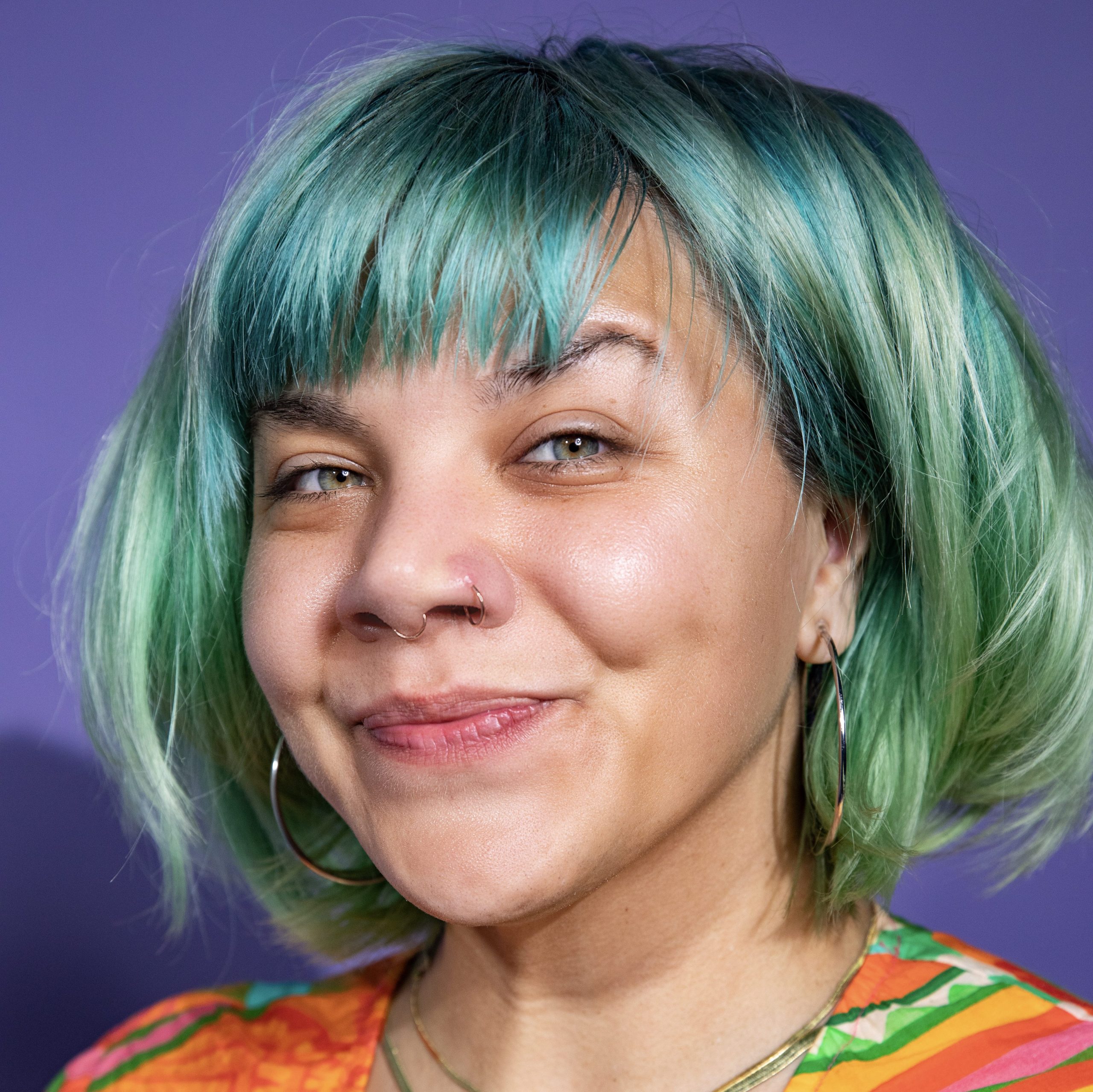
About the author: Andrea Faye Hart is a radical queer Quaker who believes, wholeheartedly, that Chicago is the center of the universe. She holds a Master of Divinity from Vanderbilt Divinity School with a focus on chaplaincy, where she served as the first chaplain intern for the Program for LGBTQ Health. For nearly twenty years, Andrea has worked as a media-based organizer—including co-founding the transformative journalism lab City Bureau in Chicago, growing the Memphis-based investigative outfit MLK50:Justice Through Journalism and supporting fellow community media entrepreneurs as the first membership director for Tiny News Collective —and has grown increasingly committed to spiritual organizing and to media as a tool for liberation. While living in Tennessee, she was part of a transformative justice network of organizers working between Memphis and Nashville. She currently co-owns the radical café-bookstore Build Coffee & Books on Chicago’s South Side and serves as the Director of Resource Organizing at ARC-Southeast, a regional reproductive justice organization that provides direct support, practical care, and political organizing across six Southern states.