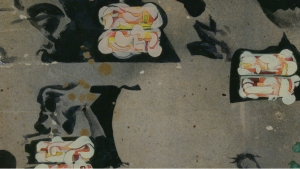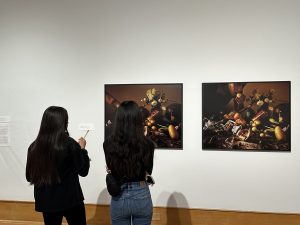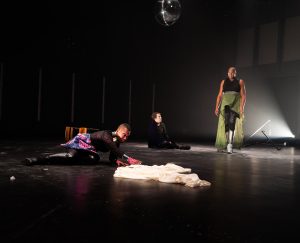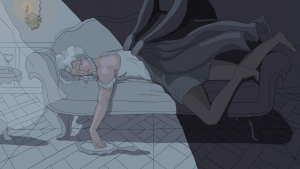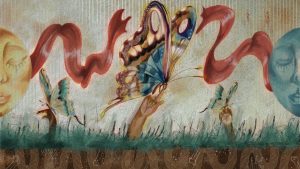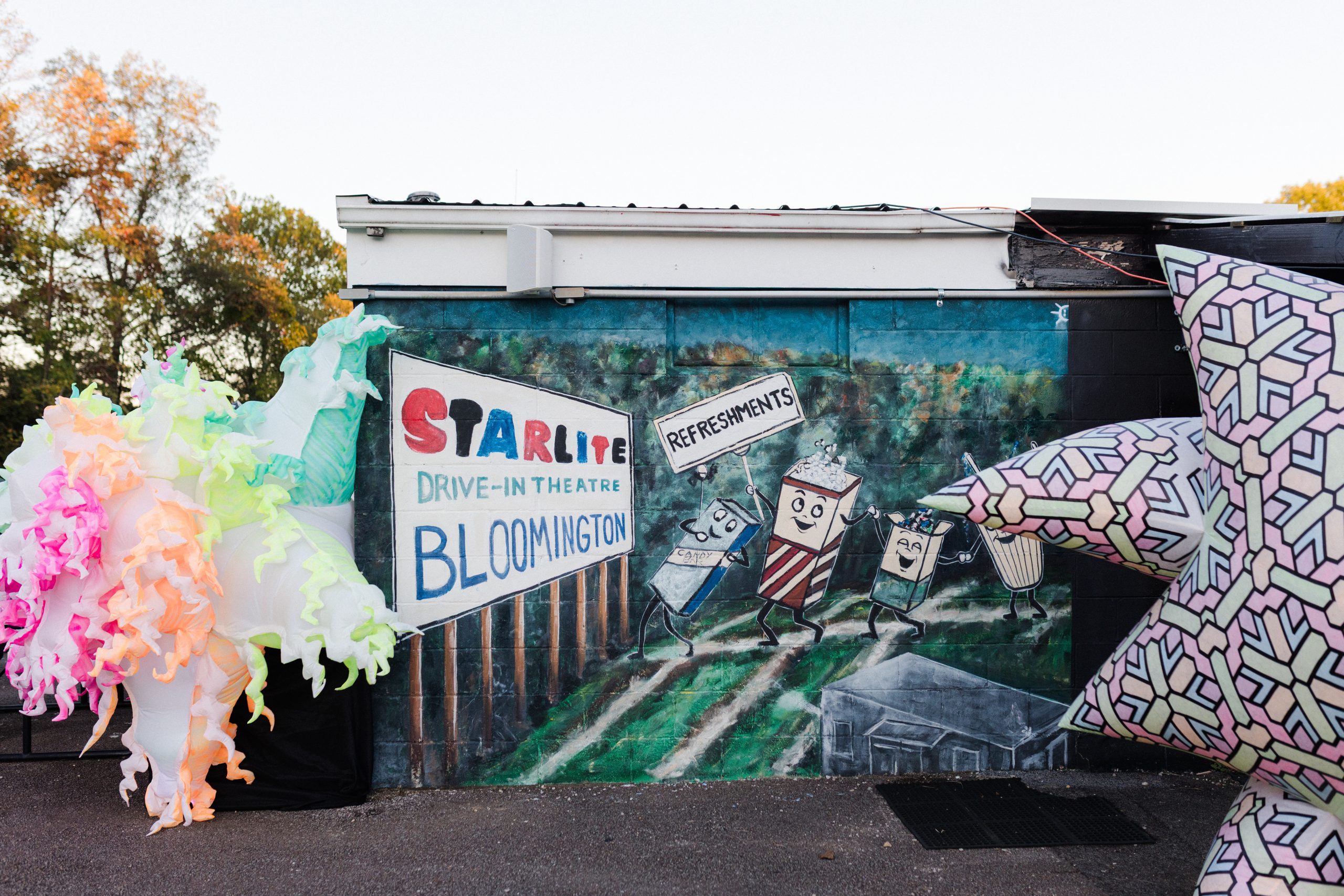
On October 9th, 2025, 150+ people attended Signal Overload (S.O.), an evening of live video art, electronic music, experimental film, and poetry at the Starlite Drive-In Theatre in Bloomington, Indiana, put on by Retained Image Collective, which consists of Josh Glinis, Luke Judd, and Dominick Rivers. The group intends, according to Judd, to “shine a light on, encourage and support weirdness and subversive art in Bloomington, IN and beyond.”
Participating visual artist/designer Psensibil spoke about how the event, “felt like an inquisitive stream of consciousness. Most work possessed some amalgamation of process magic–an unanswered “How?” that invited playful curiosity.” Why share time? We can talk about spending time, talk about “these times,” but what does it mean to share it? Is it hubris to think that time is something you have the ability to shape? Or is sharing time something else? Can it be love? As I reflect on S.O., it seems to bring up more questions than answers.
I wanted to reflect communally, and build on the multifaceted nature of reflection. The event was and can continue to be a communal experiment–similar in many ways to an autonomous zone, and pirate utopia. I want to adopt the method of the overload. I am stitching, patching, weaving perspectives together and letting signals cross and multiply.
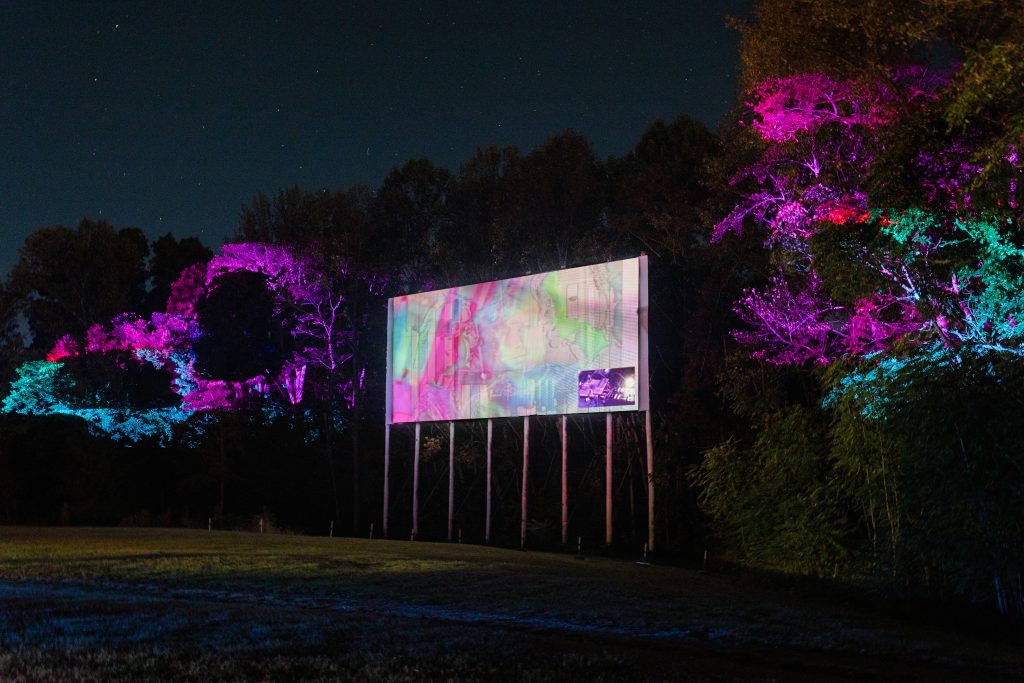
What does it mean to experiment outside? Outside of the lab, the theater, of expectations or conventions? We could talk about film experimentation like Brakhage and insect wings (e.g., Mothlight, 1963), or even Shakespeare in the Parks, but we could also tune our considerations down to signals, to chemicals, to interrelated stuffs. Often experimentation in arts spaces draws too much attention to the spaces, whose money paid for it and ignoring involved labors (e.g., positioned to make art into property, perpetuating whiteness as property). But S.O. was simply that: too much. Too much for a white wall or a bright screen framed by velvet curtains in a dark room.
An overloading of signals can lead to crashes (technological, emotional, logistical). Overload can also be like a prairie burn, a recognition and a rejection. What does it feel like to be overloaded with community obligations, to be in good debt to someone, to feel the ecstatic interconnectedness of all living things? You can turn your dial, adjust your threshold, and or reread a signal (misconstrued “signals” in romcoms have a lot to teach us here). The “outside” is welcoming to the “too much,” to the many, to the uninvited, and leaves ample space for community-building to organically happen.
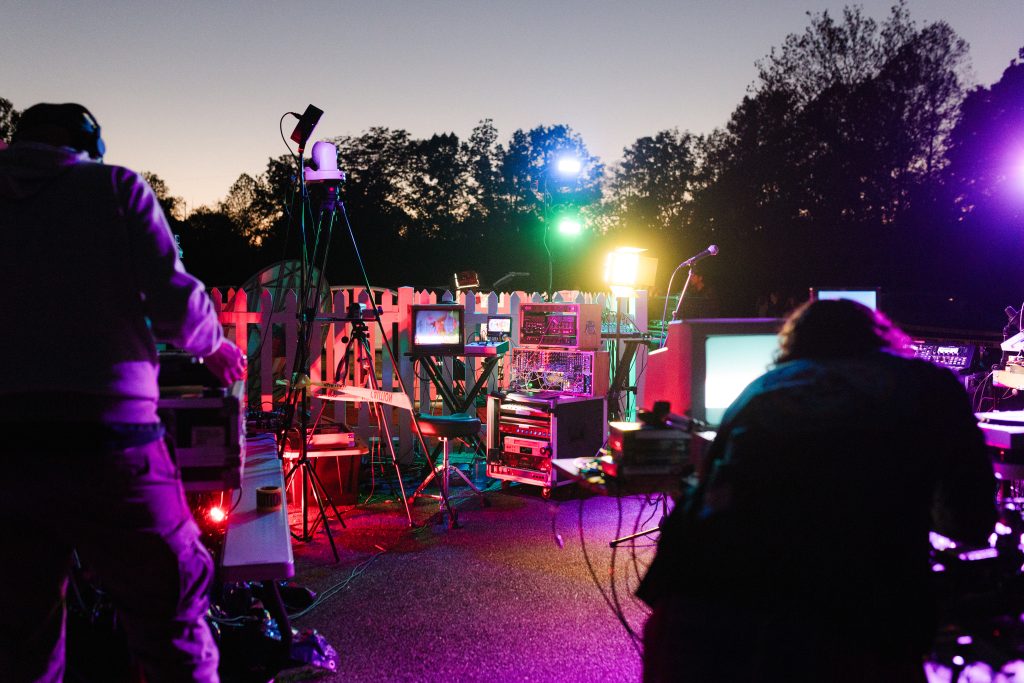
Using common film festival structuring, such as programmed shorts blocks, S.O. expanded into incorporating multidisciplinary collage with live video and music and poetry performances. This speaks to how multi-disciplinary exhibitions actually are, such as with films, (e.g., the Wurlitzer theatre organs used with early silent films, or contemporary live orchestras performing alongside Metropolis or films by Méliès) as well as the incorporation of projection in stadium concerts. The programing itself sought to connect nodes, as lens-based artist and technician jenelle ely stafford told me how their film the yard boy, a hand-processed Super-8 film poem based on a Joy Williams story, was programmed as a bridge between the poetry and short film sections.” Essence London, Publications and Programming Associate of the Black Film Center & Archive (whose collection brought works by Zora Neale Hurston and J. Stuart Blackton) attended the event with their thirteen-year-old:
“We were there [from] beginning to end and both really enjoyed it, which says a lot because my kid is not easily impressed. The light show on the trees was a highlight for sure, and the live feed to the screen of the poets as they read on-site. Those were features I had no idea would be incorporated. I love that the experimental went beyond content and into the actual structure of the event.”
Participant Hunter Ericson, aka Telephone Man layered and mixed signals within their performance, including a set of original electronic music alongside their partner junior conduit, who together played a mix of their music and their late best friend, spencer hutchinson, aka ersatz modem. There was also a collaboration with the Indiana University Libraries Moving Image Archive (IULMIA) of materials from their collection:
“Our collections encompass what we call, media of purpose and practice—moving images created with specific social, educational, or cultural objectives as well as works that explore the craft of media making itself,” shared Carmel Curtis, Interim Director of IULMIA.
Live video artist Kit Young sent in a “direct capture of an improvised session they did collaboratively with an artist Allen Moore (Chicago),” which speaks to how the event provided a container for the adding and remaking of archives of experimental art. As Ericson, aka Telephone Man further elaborated, “We are really still glowing from [Signal Overload].” When you weave threads together they can form a new unity, a textile, and signals are no different. If you inspect your socks or a blanket or a rope, and follow one thread from start to finish, you’ll see how much its identity is held up, built and remade.
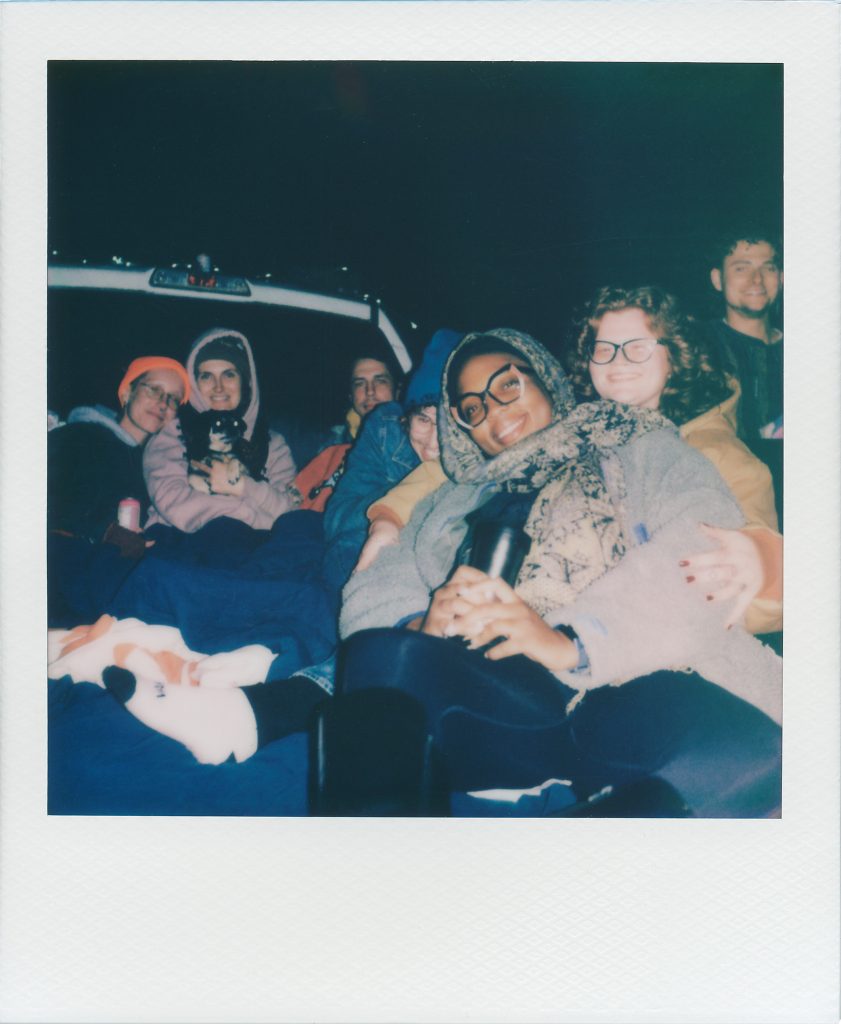
Relationships, like thread and signals, can get twisted. Participating artist junior conduit adds:
“There were moments while performing when my signal was showing up on my monitors, but was dropping out on the big screen. It was dark up there. I felt myself start to panic, but then I thought, ‘Hey, this event is called Signal Overload.’ It brought that into sharp focus. The electric aliveness of signal flow.”
Experimental artworks are often spoken about in reference or comparison to the traditional/conventional/canonical. Hollywood productions or Billboard Top 100 music might insert themselves as the reference point. So if experimental artworks are whatever is not normal, canonical, established, what does that mean when they are put in conversation with each other and in public? Many artists and organizers of S.O. spoke of their disappointment with the conventional spaces for cinema and events in Bloomington. Spaces too heavily focused on one side of the coin. London (BFCA) noted:
“Bloomington is a town that loves a quirky festival. We have a few that have big draws throughout the year like Lotus Festival, Taste of Bloomington, and Granfalloon. Signal Overload adds more texture to that lineup. It isn’t limited to one art form so is expansive in that way but, because the focus is a genre that necessarily subverts the rules, it appeals to a radical audience.”
Cicada Cinema, IU Cinema and the recently closed Ryber Film series all spoke to how time based media can be brought to audiences outside of the chain theater system. Rivers added that, “In the age of divestment and restricted funding, such as Mike Braun cutting the Indiana Arts Commission budget by 34%, we are honored to have still been able to curate this event.” S.O. was awarded a 2024 Arts Project grant from the Bloomington Arts Commission (BAC). Holly Warren, Assistant Director for the Arts for the BAC, spoke about how it was a great opportunity to not only showcase contemporary video art by local and regional artists, but also a great opportunity to showcase works archived in IU’s various collections. They elaborate:
“We rarely see this type of work elsewhere in the non-IU community. They showed a short clip of some video recordings of Zora Neale Hurston captured in Florida in the 30s. I grew up in the Everglades where she did a lot of documentary work as part of the WPA, and I love every time I discover her footage. I didn’t ever think I’d ever see that work in Bloomington, or that this work was archived at IU’s Black Film Archive!”
Warren’s (BAC) celebration and advocacy feels directly in line with Glinis’ reflection:
“I personally felt such joy at being able to bring this artform that consumes so much of my life to a space where this loving community of wonderful people can share in the experience.”
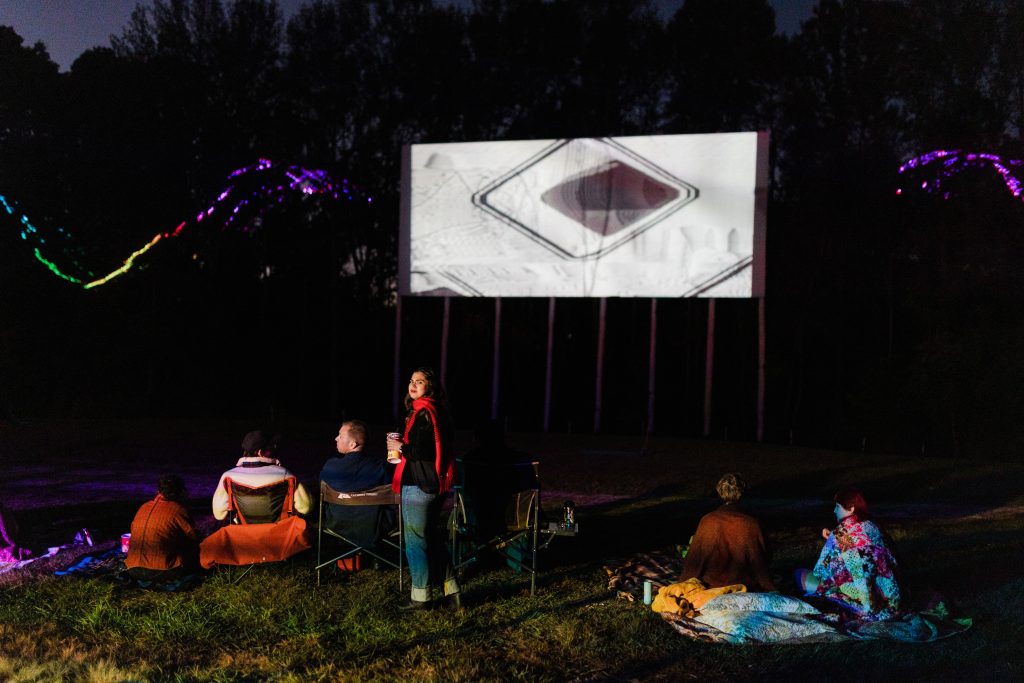
But why now? What does it mean to plug in a machine, to turn it on, to pull power to it, to generate that power, to program or ask an AI query, to project the digital with light in a physical space? What is the cost? This event had a footprint, digitally, but also culturally and physically. How does an event that engages with technology respond or counterbalance a shared moment of extractive data infrastructure, deep fakes distributed by a US president or AI slop furthering the fungibility of persons. Bloomington, Indiana and Indiana University have seen recent and ongoing protests in response to genocide in Gaza, which was met by new rules set by IU to limit demonstrations on their campus, cuts to IU academic departments and the canceling of a retrospective of Samia Halaby at the Eskenazi Museum of Art (EMA) due to supposed safety concerns. Curtis (IULMIA) reminded me that the university is not the exclusive site for creative, political, or scholarly activity in Bloomington. The collaboration between IULMIA and Retained Image Collective shows what’s possible when institutional resources and grassroots creativity meet. And perhaps transparency around complexities can be a form of direct action unique ot the arts? Warren (BAC) elaborated on the recent loss of private and public funding of the arts:
“Along with the pulling back of a lot of corporate sponsorships, means a lot of entities are having to stick to safe, more mainstream programming that flies under the radar … I’m also seeing a lot of entities being forced to [be] very pro-US programming as part of the US’s upcoming Bicentennial and the federal mandate to only fund patriotic programming related to this.”
Here experimentation matters. Rivers highlighted that the term, “experimental is quite a conundrum, isn’t it? The word carries some baggage, a kind of negative connotation that can make people wary.” In addition Rivers went on to state:
“We’re living in a time when images are generated faster than they can be felt. Art risks becoming frictionless and disposable. Every day, we’re inundated with horrors and the accelerating normalization of fascism-it’s no wonder that it’s easy to feel overwhelmed and powerless. We weren’t trying to fix the world’s chaos or escape it; rather, the festival sought to transform overload into connection, to create a space where artists and audiences could confront the noise of the present moment with curiosity instead of fear, through humor, experimentation, and shared absurdity. Sharing time and attention with one another might be the most radical act of all.”
So with these possibilities, S.O. can be seen as responding to the fact that, as fellow organizer Luke Judd stated, “we desperately need 3rd spaces where we can learn to see each other’s humanity again.” When I asked Carmel Curtis of IULMIA about what its means for an event like this to happen in our current moment, they encapsulated the forward learning tone of the event by stressing:
“Long live creative, diverse, artistic experimentation!”
S.O. was both an event of connection and challenge. Warren (BAC) reminds us of what is at stake, “in spite of Bloomington being known as the blue dot in the red sea, we’re seeing some real threats to body and gender autonomy and human rights overall.” Psensibil also highlighted that, “there’s a spirit of understanding shared amongst those that build nodes of weird creative communities in locales that don’t naturally lend themselves to experimental expression.” And what happens when the connections are a hybrid of digital and analog, personal and communal? RIC organizer Luke Judd suggests:
“The initial nugget of the idea [for the festival] was to take video art out of basements, internet subgroups and galleries. Hopefully recontextualize for people what it can be and introduce it to others. … [and speaking to the drive in aspect], people are welcome to isolate in their vehicles but also there’s a larger social environment to engage in, if you choose.”
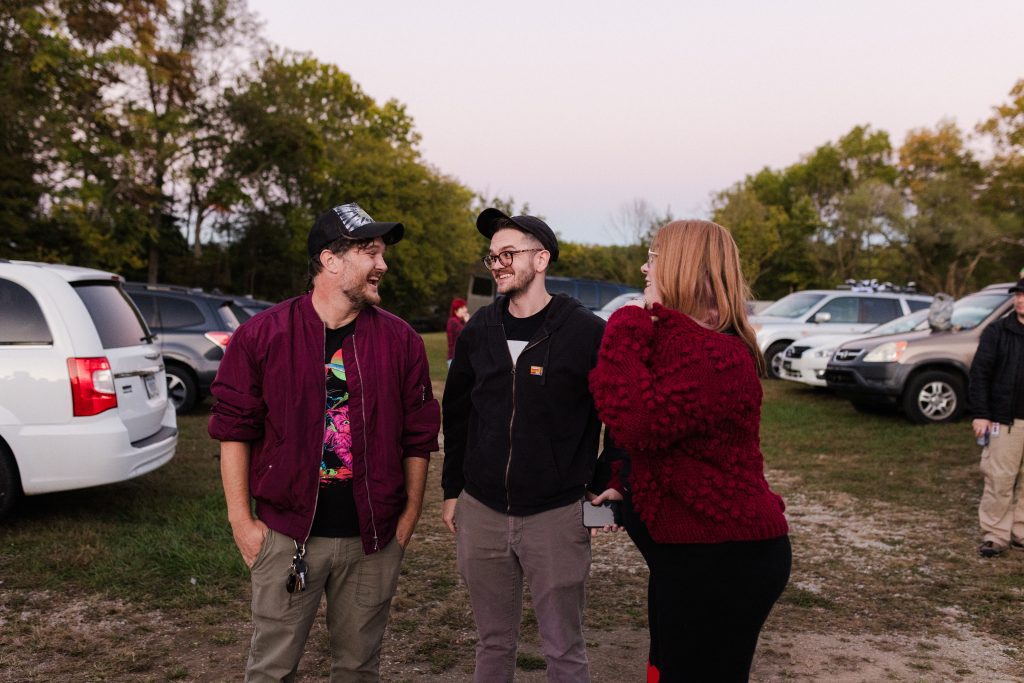
The event seemed to be for criterion collectors, analog purists, crate divers, edgy poets, critical theorists, punks, programming nerds, and stoners as well as self described “weirdos”, families and rural Hoosiers. It was an event where identifiers are not exclusive, and can become homogeneous or contagious. Curtis (IULMIA) added:
“Signal Overload built on an always present need for creative community spaces—spaces that encourage and support experimentation, dialogue, and play…the event opened up something that felt surprising and deeply connective.”
So why participate? Do you have to be in the here and now to participate? Signals flash reduced to patterns, but break into new life and repeat. Brought to S.O. by IULMIA “Pixillation” (1970) by early innovator and experimental computer animator Lillian Schwartz demonstrated, according to Curtis (IULMIA) the impulse to bend, break, and reimagine the electronic signal has been central to moving image art for decades. Having archival films, that we are caretakers of, presented in conversation with contemporary media exemplifies the everlasting power and relevancy of the archive! The audience and artist blurs in a way that creates a dissonance of community.
A spokesperson for the Starlite Drive-In noted that when they bought the 7-acre, 400-car outdoor cinema a few months ago their vision was for community cinema to flourish and S.O. provided them with an opportunity to not only support the arts, but to be part of an event designed to bring the community together. DJ Spike, who spun at the event, reminisced:
“It reminded me of raves I played in the 90’s and what was happening in the late 80’s when I first started DJing. Right now, artists and creatives need to get into more spaces that are emptying out due to corporate decay.”
Judd elaborated on the efforts of S.O. to be the change we want to see. Bloomington, though a college town, has an art scene that is currently dominated by baby boomer folk art. Everything is very safe and run through a communal filter. The huge music scene of the 90s and 2000s has dwindled to a couple of small clubs holding it down, but the main venue just panders to college students with cover bands all week long. Therefore the question of where and what it means to be a part of something like this event speaks to the needs of those participating. Rivers added:
“The festival responds to a need for experimental art that does not rely solely on language or logic, but instead embraces embodied communication, play, and cooperation as tools for subversion and healing. At the same time, S.O. addresses a cultural gap in the Midwest. While cities like Chicago and Milwaukee have well-established experimental communities Indiana has remained largely absent from that landscape. The festival was conceived as a way to put Indiana on the experimental map.”
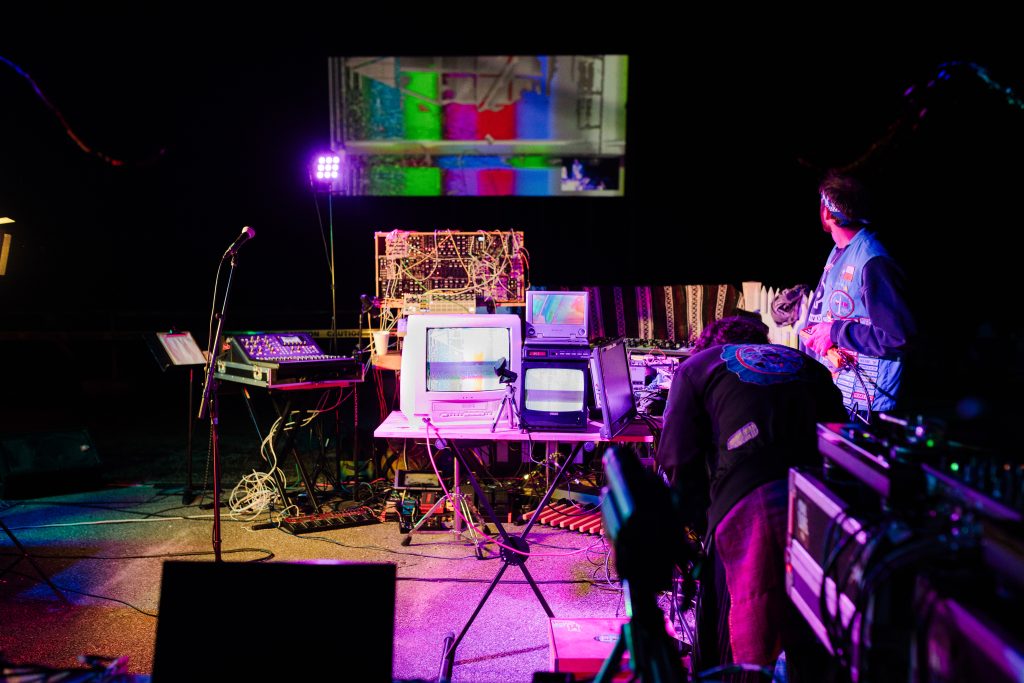
This experiment of sound, text, image and relation hit a nerve, but in a way that released tension. Overloading when embraced can be convergence. This shared community based experiment highlighted the experimental in nature, in communication and in bearing witness. The digital can be detaching and isolating, perpetuating consumption on multiple harmful levels, (thinking of Max Renn (James Woods) being pulled into the TV of Videodrome, 1983). Glinis brought this all the way down to the gear, in that:
“When you sync up with another person’s system, you consider their goals as well as your own, and you have to be aware of what inputs and outputs each of you have to contribute, and how various connections between you play on the relationship. Find harmony or demonstrate how a lack of harmony feels.”
Curtis (IULMIA) reiterated the sentiment:
“The physical setup—where you could literally see some of the mechanisms producing image and sound—also pulled back the curtain on how media functions, presenting the process as part of the art itself. There’s something powerful in demystifying the apparatus of technology.”
And if we consider synthesis, Judd pointed out to think about dissidence and harmony in the terms of social signal flow. Both have their value and can only exist in a relationship with something else. We all have our ideas of what notes should be played but without listening to each other we’re not really gaining anything that we didn’t come in with. S.O. provided space to play with consensus, conflict, and certainty. As these reflections happen, what signals are still coming through?
Our relationships to space, each other and with tools speaks to where we are and where we might go. junior conduit reminded me that there’s a lot in the state of things that can make technology feel cold and frightening, “I choose to engage with electronics in ways that feel connective and exploratory and human, and a little dusty.” Our shared present is not a neutral time, (perhaps this is an illusion to think that anytime is). London (BFCA) spoke of how S.O. responded to a frustrated radical underground in Bloomington, “we have organizers and queer spaces here, but at times we can be tucked away [which] can be a protective measure, S.O. gave us a safe space to enjoy each other and art out in the open.”
Rivers highlighted that the night before the event, they were writing a defense for why Indiana State University should keep its M.F.A. program, which is currently under threat of elimination by the state legislature, “the irony wasn’t lost on me. I was arguing for the value of experimental and creative work in one context, while preparing to celebrate it in another.” Warren (BAC) challenged the collective to continue to surprise and be weird and inspire other people to experiment with different artforms and think creatively about how they can be showcased in the community. Judd thinks about the impact of this event through beliefs in cross generational role modeling as a pillar of community. That goes both ways. Psensibil reflected that:
“There is a collective craving for community, empathy and understanding in our broader culture. That feels like a heavy crown to place upon a singular event, but I think that reinforces a greater appreciation for the variables and intentions that must exist in order for it to be possible at all. The significance of the influence one can experience in unique creative spaces can’t be understated and to cultivate these opportunities is a true service to a healthy and supportive arts culture.”
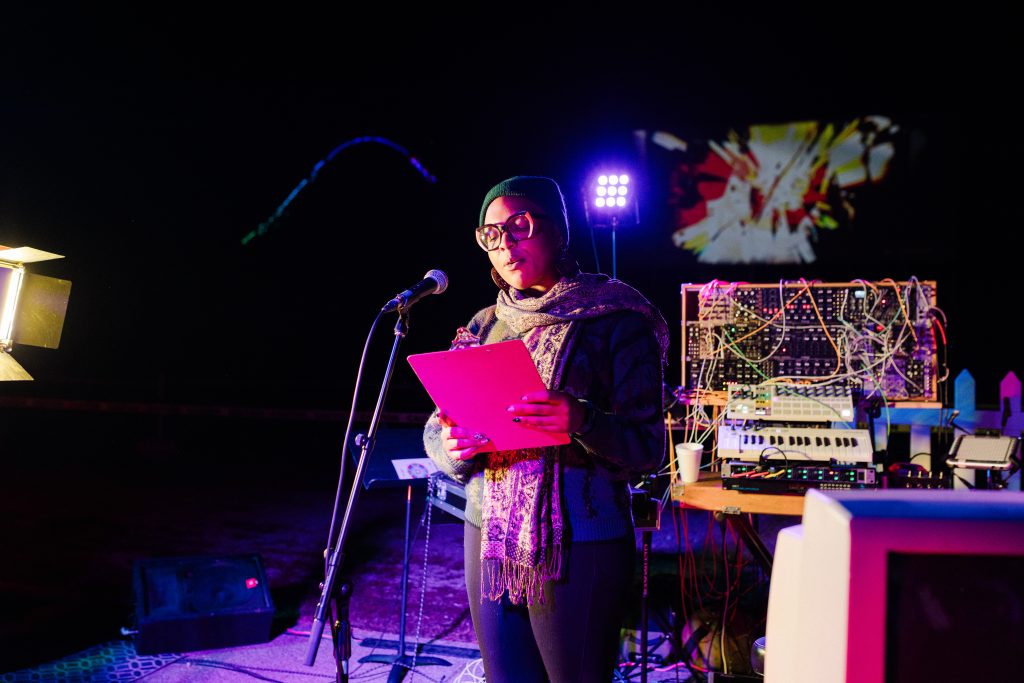
If the space is outside, both physically and conventionally, if the community can be found and welcomed, if the technology is waiting to be plugged in, then the experiment is ready. What’s the signal? Rivers affirmed that the need for these spaces was felt:
“There was something deeply moving about seeing that many people gather for experimental work, to commune in the dark and experience something unpredictable. It was a reminder that community still exists, even when it feels fractured. And that people want to engage, to be surprised, to feel connected! The turnout affirmed that this kind of work has a place here, that art which resists easy interpretation can still resonate deeply. It proved that a sense of wonder and participation can be found anywhere, so long as we make space for it.”
About the author: Ian Carstens (he/him) is a writer, filmmaker and curator based in the Midwest. His work explores temporality, non-human aliveness, multiplicity, as well as critiques of the archive, lens-based art forms and cultural institutions. He is the lead curator/filmmaker of Glass Breakfast, an ongoing archival project. His video works have screened at various festivals as well as on public television. His writing has been published with Burnaway, Sugarcane, The Pulp, Ruckus Journal, Fugue Literary Journal, and Sixty Inches From Center.
About the photographer: Garrett is a photographer in Bloomington, Indiana. Her personal work is largely focused on LGBTQ+ people and life in the Midwest. IG: @garrett_ann.