
The Chicago Archives + Artists Project (CA+AP) connects archivists and artists to reimagine futures and histories. This year’s research continues our current theme of “embodying the archive.“
This series of interviews profiles this year’s archives + artists pairings, which include the National Public Housing Museum’s oral history collection (archive) + Dr. ShaDawn Battle (artist), Honey Pot Performance (archive) + Siobhan McKissic (artist/archivist), and one trio: Chuquimarca’s art library by John H. Guevara (archive) + Crystal Vance Guerra (poet) + Mariana Mejía (archivist).
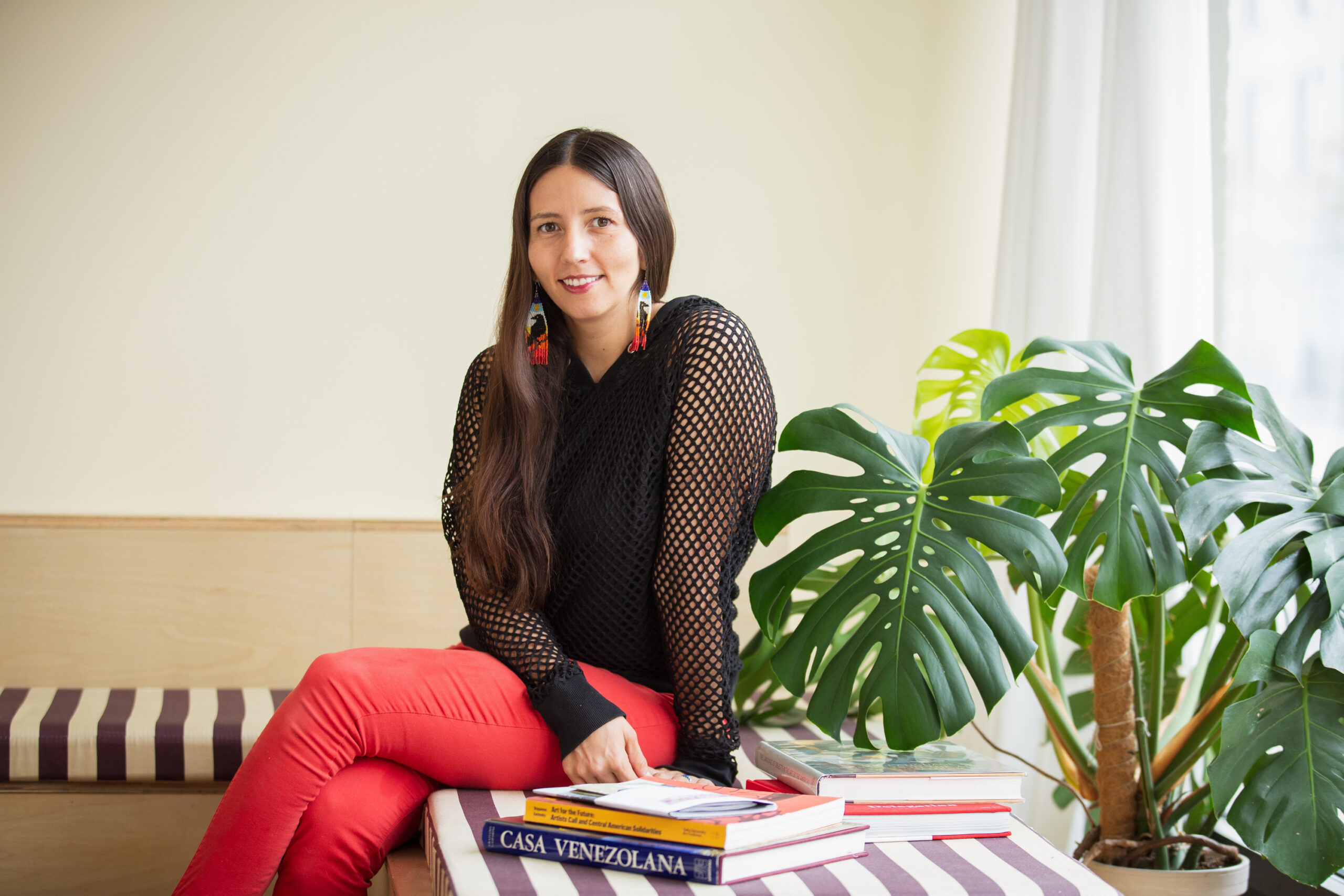
For this interview, Hilesh Patel spoke with Crystal Vance Guerra (she/her) who moves through the world as a historian, poet, and journalist. These are roles she sees less as separate identities than as different instruments for the same inquiry. Rooted in the South East Side of Chicago and shaped by her ties to Mexico and Honduras, her work begins in archives and ends in places poetry can find: the convergence of stories that official history tends to flatten or cut out.
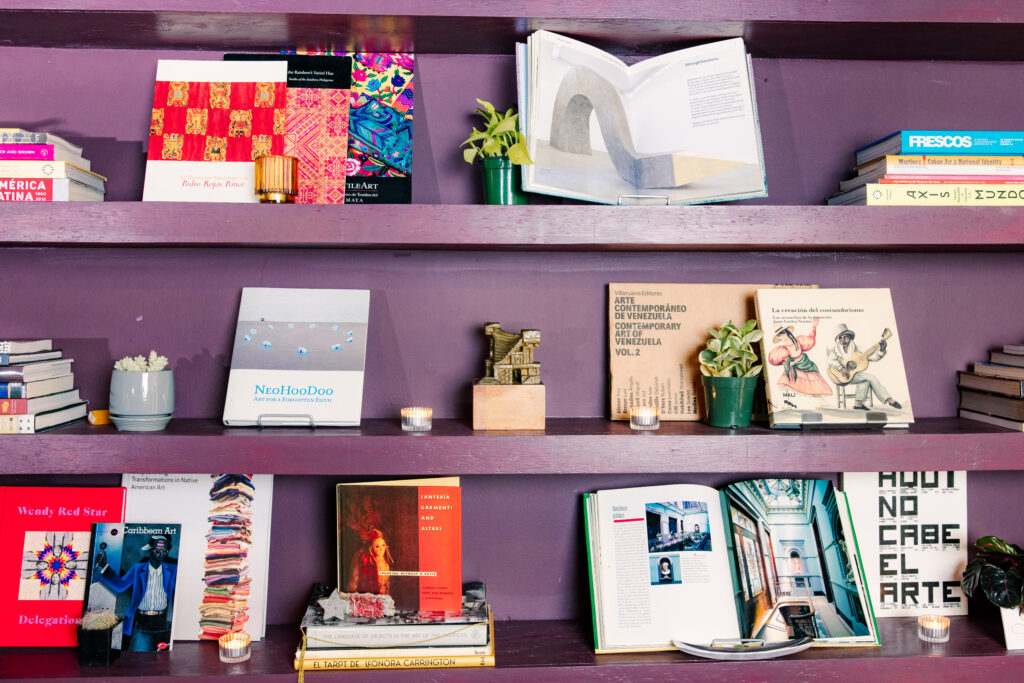
This conversation took place in the context of her collaboration with John H. Guevara’s Chuquimarca, a Chicago-based library focused on Latin American art and visual culture, and independent curator and archivist Mariana Mejía. During the interview Hilesh and Crystal realized that they had been in each other’s orbit without knowing it. Both of them had read poems at Guild Literary Complex’s Gwendolyn Brooks Open Mic Award a little while before. Crystal read a poem about the Mexican Independence Day parade that she references in the interview. As Crystal worked through the collection from books on colonial and pre-colonial objects, shifting maps of the Americas to contemporary Venezuelan art, she found herself looking for intersections, excavating the stories that are missing, and listening for phrases that get stuck in her head and won’t let go.
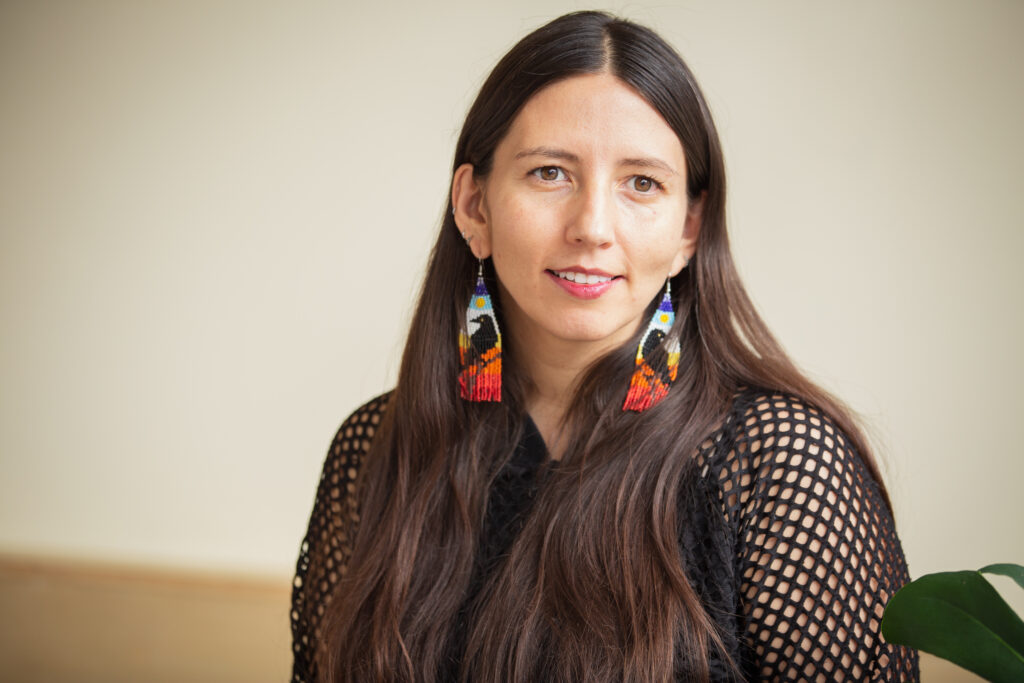
Hilesh Patel: Part of this conversation is about archives and artists and their relationship to archives, but I want to start broadly before getting into the more specific questions. So first, could you tell me a little about yourself, your arts practice, and how you think about archives in your work?
Crystal Vance Guerra: I base a lot of my work on history. That’s what I studied, and that’s what I like. I still consider myself a historian. So of course, archives are very important for us. When you study history there is a big focus on your sources and all the different stories you can narrate even using the same sources, right? You can tell very different stories, opposing stories, or just different perspectives, all [while] using the same archive, depending on how you focus on it, how you use it. How you find things within an archive, even knowing what to ask, all becomes really important. [That’s] something that you can play with as a historian, because…reframings are possible.
In a poem I wrote about the first Mexican Independence Day Parade being a protest, [I talked about how] no one called it a protest then. Again, the work of the historian, at least in the work that I do as a historian, isn’t just to [say] this happened on this date and this happened on that date, but to create these stories out of it, create that big picture. Again, relating to the poem, what was the big picture of things going on?
From studying history, I moved into journalism for a couple of years. I think of that time as my way of becoming a historian of the present. Because, when you’re a journalist, you’re not just reporting—you’re helping create the archive. These articles become primary sources. They’re what people will read in 50 or 100 years. So the big responsibility to be a historian of the present is you have to understand that big picture in the now. [Journalistic] writing couldn’t hold everything that I wanted to express from everything that I was reading from history, and that’s how I started to write poetry based on all the history that I was reading and digesting and living. So, yes, I spend a lot of time researching for my poetry. I really do rely on archives, and I see them in different ways.
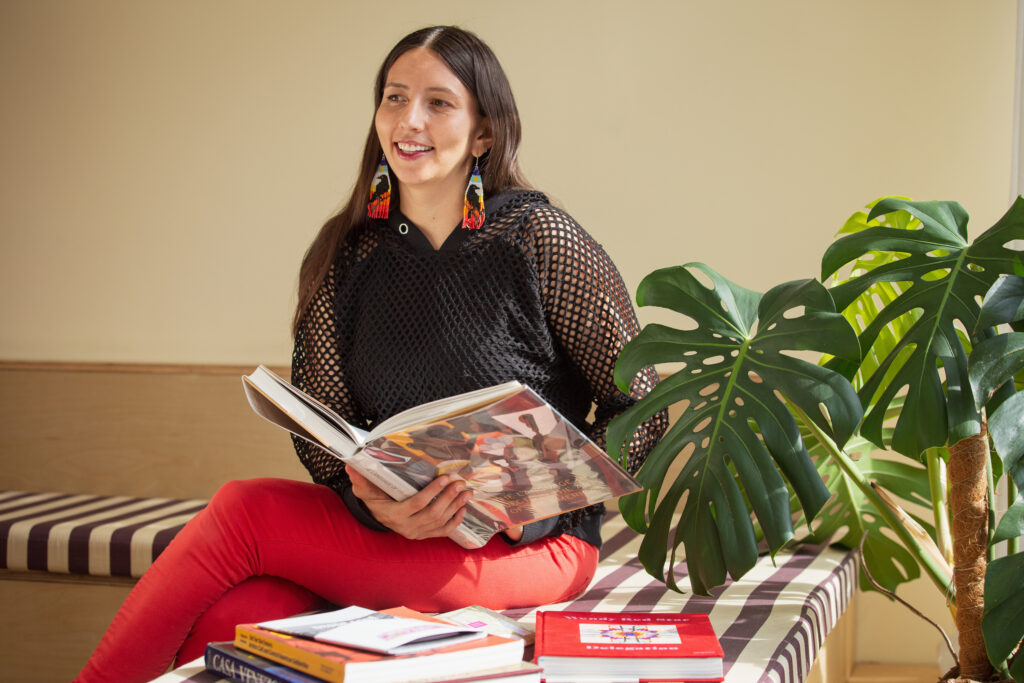
This nonverbal part of archiving really intersected with Chuquimarca, [which] is focused on creating a library without text—of course, all the books do have text, but that’s not really the point. A lot of the books are art-based, so either on street art or media art—things that aren’t necessarily words, right? They’re expressed through weaving, or graffiti, or [other] forms like that. And so interacting with that kind of archive has been really different from what I’m used to.
This type of archive, one that is centered on art in that way, is something new for me. Figuring out how to work with it—especially in collaboration with other artists—is also new. It’s a different process, both for me as a poet and as a historian.
HP: I’m not sure this is quite a question, but I want to surface something. The way you described poetry—how journalism keeps you present to history, but poetry gives you more freedom—that feels analogous to what you’re describing about the library as a nonverbal, practice-rooted space. I just wanted to name that connection.
CVG: Going through the books, it’s a mix. Some of them are basically all text, dealing with theory—of the nonverbal, or the practice, or the process—all those things that can’t really be put into words.
Then there’s the juxtaposition: you have all these art books where there’s an image on one page, but then it takes three pages of text to explain it; to say, where did this artist come from? What is the interpretation? What is the context, the history, the big picture? What is the precise thing they’re trying to say? There’s so much that can be contained in those art pieces, but they’re always held between those two things: their big pictures and their particulars. I don’t really work with art in the sense of painting or sculpting, but these books are about that—mostly different forms of visual art, some performing arts, and very little poetry. It’s cool to see and think about how much can be deciphered, and how all these art pieces also bear witness to their moment—just as much as a journalistic piece, or research, or an archive. And again, as a historian, my favorite thing is looking at those intersections across place and time, like seeing the history of Mexico City and Chicago intersect.
So in Chuquimarca’s collection, you have all these books mostly focused on Latin America. It’s interesting to notice patterns—like the 1950s in Peru, the 1950s in Central America, the 1950s in the Caribbean. There was something happening in that moment. Being able to put dates to that—to situate these art pieces within their political and historical context—that’s been new work for me, because I haven’t really done art history before.
HP: I want to ask you a question that I asked John H. Guevara from Chuquimarca. When I talked to the artist Amanda Williams a few years ago, I asked her about the very first thing she does when starting a piece or work, before pen hits paper, before anything physical. She said she starts with a question. So I’ve been asking artists that ever since. For you, wearing your different hats from historian, poet, archivist to journalist, is there a first step that’s specific to each role, or something that connects them all? Even if it’s as simple as making a cup of tea, or opening a book, or sitting with a question?
CVG: I guess all these projects are investigative in different ways, right? They’re all, in some sense, research projects. Whether it’s journalism, or poetry, or history, I’ll notice that two events happened at the same time, and that becomes the thing that guides my research. One of the clearest examples for me is the Great Migration north, right after the Civil War, lining up with the first wave of Mexican immigration in my neighborhood in South Chicago. Those two things are happening at the same time, but there’s very little written about that convergence, especially in the specific place where it happened. You have the steel mills, the first church built by Mexicans in Chicago, and a historically Black Baptist church—all of that existing together. That mix is what drives a question for me.
And that question, in part, drove a poem—thinking about deportations, thinking about the intersections of people being deported to foreign countries, and also about people escaping slavery who were forcibly returned to the South. It’s that research question, that attempt to look at parallels. Two things are happening at the same time, and I’m trying to figure out where they connect.
For a lot of my poetry, though, it starts much smaller. It’ll just be a phrase that gets stuck in my mind. Like, “The first Mexican Independence Day parade in Chicago was a protest”—that just stayed with me. Or another line that came to me when they were cutting down all the trees across the street from my block to start building: “I know the sound of trees falling.” That kind of thing just gets stuck in my head. And that’s how a lot of the work begins. I’ll see something, or hear something, and a phrase starts turning over and over in my mind until it builds into a poem.
HP: I love the idea that the sounds of trees falling and a protest could exist in the same archive. That’s so lovely. You talked a lot about this process of and the practice of investigations when you’re looking at intersections, when you’re surfacing things that you are doing. With each specific project, you might have a specific inquiry, whether it’s the Mexican Independence Day parade that kind of surfaced with the poem or another project. Is there an overall inquiry that drives you?
CVG: That big-picture understanding is what drives a lot of my research. I think most people understand that there’s more than one side to history, but even then, there’s still so much more to uncover if you really want to understand what happened.
One writer who really shaped that way of thinking for me is Eduardo Galeano. He has this series that starts with creation stories from all over the world, and then he moves through history, from those origin stories into the present day.
So you get to a moment like 1492—Christopher Columbus—and instead of just saying, this happened, he gives you multiple scenes. What’s happening in Italy? What’s happening in Spain? What’s happening in Mexico in 1492? What’s happening somewhere else in the world?
Because all of those things are happening at the same time.
And that’s what creates that sense of the big picture. Regionally, so many things are happening at once, and putting them together changes how you understand any single event. That way of thinking really stayed with me. Because you can say this happened, or that happened, but to actually understand it, you have to see it in relation to everything else.
And that brings me back to this idea of being a historian of the present. To understand what’s happening now, you have to understand how things got here, piece by piece. Sometimes I feel like—even in journalism—if you don’t have that historical grounding, it’s hard to fully report on the present. Like, how do you write about what’s happening now if you haven’t studied what’s been happening?
And the same goes for art. How do you make work about the present moment without understanding the histories that shaped it? So yeah—that big picture. That’s what I keep coming back to.
HP: Is there a specific piece in Chuquimarca’s archive that resonates with you, that you engaged with, that still sits with you?
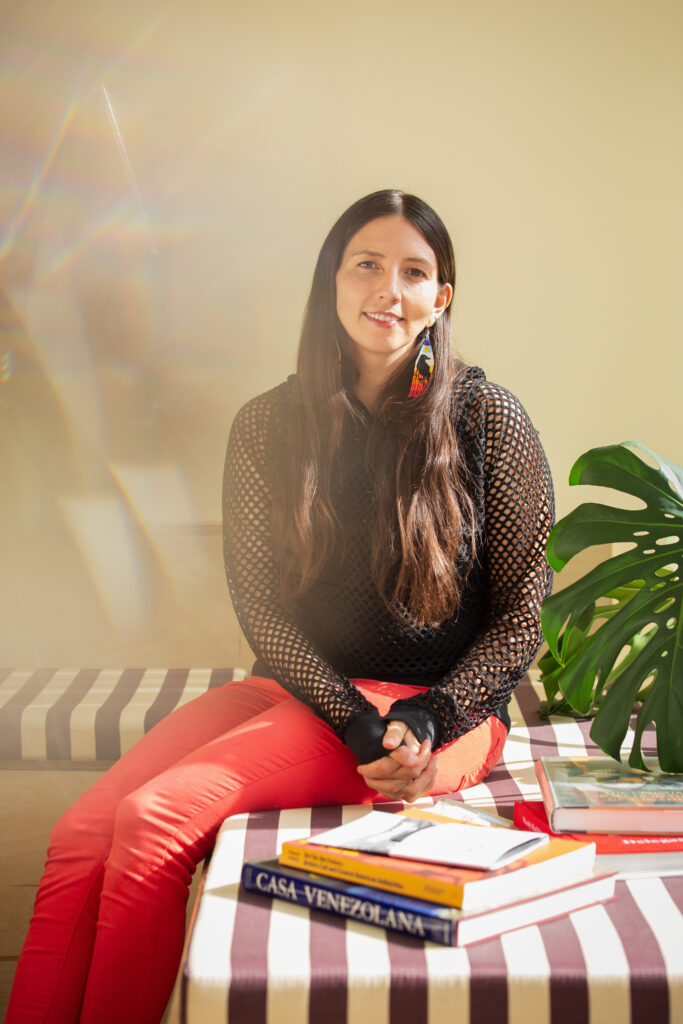
CVG: The Language of Objects in Art in the Americas [by Edward J. Sullivan] and Venezuela – Conexión a Casa [by Ganz Sisters and Federica Consalvi]—those are two of the main books I’ve been working with.
The first one is about different maps of the Americas. It tracks how maps and other objects were made through the process of colonization, and then how they kept changing over time. It’s this big, interesting book that lets you see that evolution [of] how the Americas were being imagined, named, redrawn.
Again, thinking about the language of objects [and] the different ways objects carry meaning, [such as] colonial objects, what we might call pre-colonial—but even that gets complicated, because these things exist alongside each other, right? Indigenous art, colonizer art, all of it blending together in the Americas.
With Venezuela – Conexión a Casa, it’s more about the contemporary [and] looks at Venezuelan architecture now, but still traces its political history.
Those are the two main texts I’m working with. I guess the inspiration for them comes from a third text that I added to the library. I’m not directly using it, but it shaped how I was thinking. I don’t remember the exact title—it’s [about] a Tijuana border project—but it’s this really interesting play between non-words and words. It’s like those older books where everything is bound together with a strap. Inside it, there’s a collection of reflections on organizing along the Tijuana border, and then there’s a map showing shifting borders over time—different lines marking different moments along the U.S.–Mexico border—and then there’s also a small collection of poetry.
So that format: having text, map, poetry, all together—that really influenced how I started thinking about my own materials. I don’t think I’m going to produce visual art myself, but my dream would be to do something interesting with maps and the books, playing between object, place, and time. Leaning into my strengths, I will write poems inspired by these books, create a bookmark for the library that gives access to a live archive database.
Essentially, given everything happening now—these large movements of migrants, these caravans, these mass displacements—the question becomes: what is going on right now and what can we learn from these earlier forms? From the language of objects, from maps, from borders, how countries are perceived at different times, how names change, how those objects themselves change over time. How do we get to what’s happening now?
To be able to talk about a moment in history through an art object; to trace the emergence of a certain object in Latin America and connect that to a broader historical moment [is so interesting]. I really want to focus on these objects in their time, and use them to talk about those bigger pictures. I’m not sure yet how much I’ll directly tie in the maps, but I want that presence to always be there: the idea of borders, shifting territories, changing names.
HP: That’s great. It seems perfect for collaboration.
CVG: Thankfully, John brings experience with visual work, so hopefully we’re able to create something that actually represents this visually. And then Mariana Mejía’s work as an archivist, [along with] our collective thinking around archiving, is also really shaping how I’m approaching it.
I’ve been thinking about doing something that even looks at where these texts were printed. Like, what if we map the printing centers? What does that show us about publishing in Latin America? Because I imagine you’d probably see certain hubs, right? In Argentina, Mexico City, maybe a few other major cities. And then suddenly you realize: all these books, even though they’re about all of Latin America, are only being printed in a handful of places. And that says something. It might show patterns of access, of infrastructure, of whose histories get circulated more easily.
And then, on the other side of that, you start to notice absences. Not intentionally—I know projects like Chuquimarca can’t collect everything—but still, there are gaps. There are histories that are just harder to find, less written about.
You can find a lot on Venezuelan art—even in places you wouldn’t expect. But then try to find work on Honduran art, for example. It’s much harder. Even compared to Guatemala, which is right next to it, there’s just less available. And that absence becomes part of the story too.
I’m thinking about using the archive not just as a collection, but almost as a database. Something you can read across to trace patterns. What connections can we find? But also—what’s missing? Because both of those things, the connections and the absences, are telling us something.
HP: Over the past year or two, I’ve been doing a lot of intergenerational work with elders and with youth. So thinking about the different people in your life across generations—elders, a partner or close friend, your children—are there specific archives or pieces from an archive that you’d want to share with each of them? Something you’d bring to an elder, something different you’d bring to your kids, and say, “this is something I want you to experience?” It doesn’t have to be something current. It could be something you’ve encountered before, or even something you’d want to discover together.
CVG: I haven’t really ever thought about presenting an archive to an elder—that’s really interesting. I usually think about archives more as collections of things, but I guess I do have my own archives. I have an archive of photography, mostly documentary and street photography from Mexico and Chicago. And then I have objects from my grandparents who have passed away. They’re like these small moments in time: a really old harmonica, some folding binoculars, a piece of my grandma’s schoolhouse that says “1919, from Kansas.” 1919 is such a heavy year, especially in Chicago, but really everywhere. So even a small object like that holds all this larger history.
In this little office space I realize I’ve kind of built a collection without really thinking about it. I have these historical bits, these personal artifacts. I have a piece of the Berlin Wall that an elder friend gave me—she was actually there. I also have this really interesting calendar from 1968, from Honduras, tied to banana production, so it connects to that whole history of the banana industry there. And again, it’s just another piece of how these objects carry larger stories. So it’s this mix of family history and global history, all kind of sitting together. At some point, I’d like to share that. I live between Chicago, Mexico, and Honduras, and part of that is because my husband is still waiting on his papers, so he hasn’t been able to come to the U.S. yet. I think about wanting to show him this archive of my life here so he can see that part of me, a version of me that he hasn’t been able to experience directly. And I know I’ll share all of this with my kids too—these little pieces of the world, these fragments of history.
As for an elder… I’m not sure. If I think about my grandma, what would I share with her? I think maybe photographs. I do a lot of family photography, so maybe I’d put together an archive of images for her—something she could look through, something that holds memories. I think at a certain age, there’s something about returning to those moments, being reminded of family, of the good things.
So maybe my personal archive is something I’d want to share someday, more broadly. Because not everyone gets the chance to do this kind of work—to make art, to build archives, to follow what they’re passionate about. So I feel really thankful to be able to do this work, especially right now.
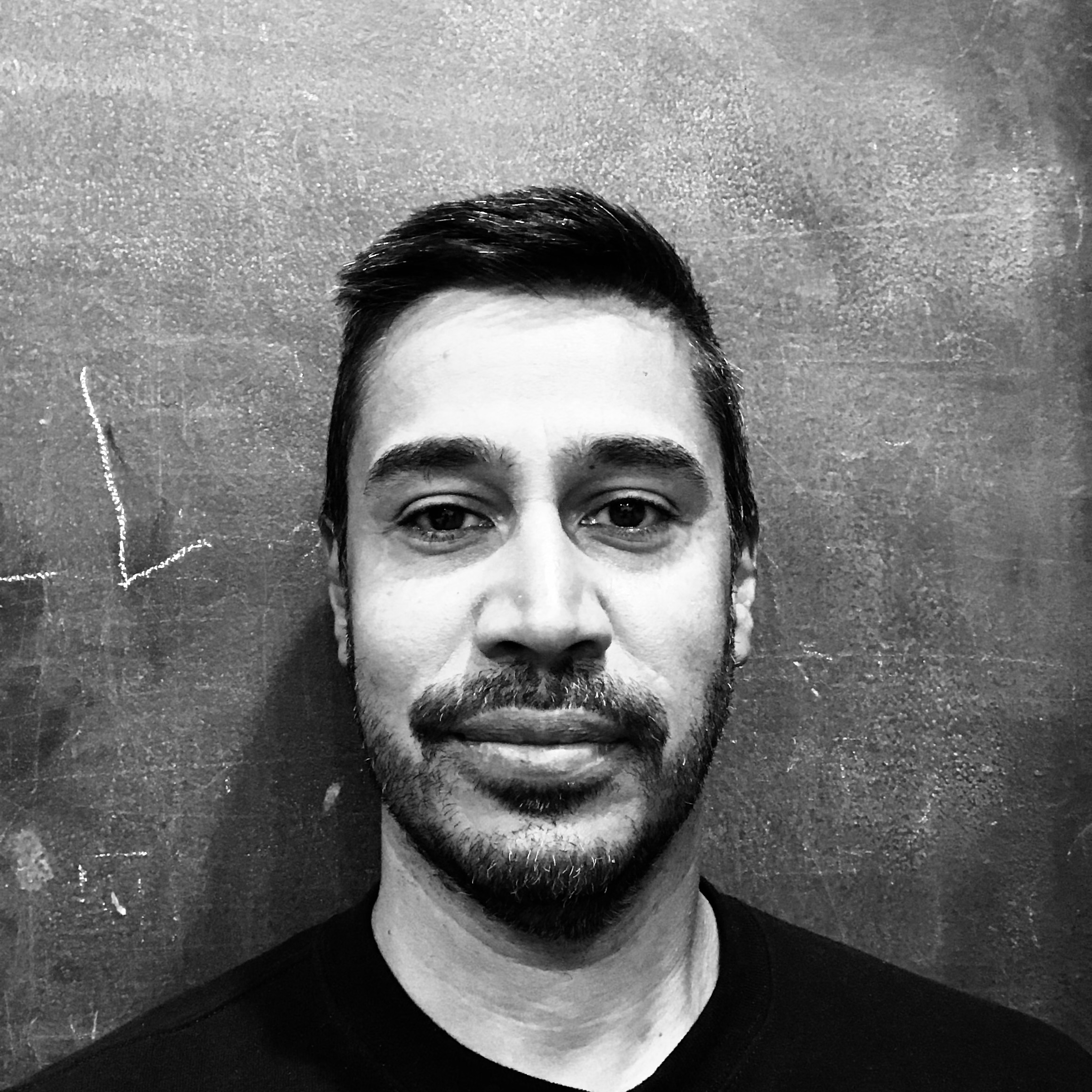
About the author: Hilesh Patel (he/him) is a disabled writer, consultant, and conflict mediator. He writes poems, articles, and essays engaging with political homes, memorials, migration, healing, and entangled histories. He is a member of arts and justice group The Chicago ACT Collective. @hilesh
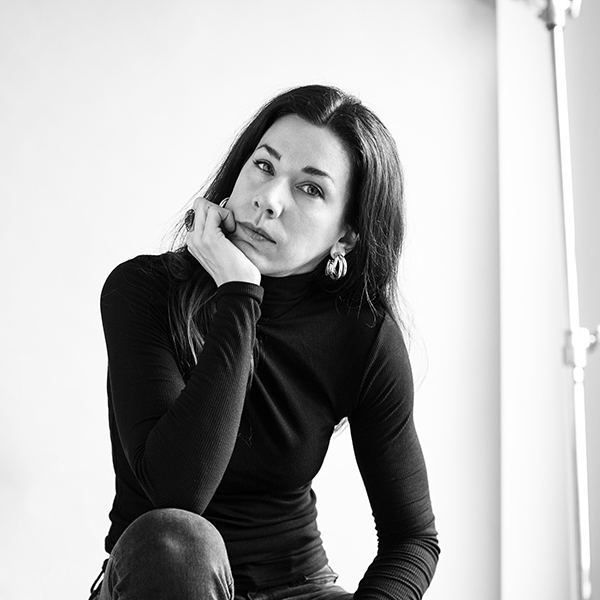
About the photographer: Kristie Kahns works in the photographic field as an educator, image-maker, writer, and independent researcher, based in Chicago. Her interests include contemporary and ecocritical approaches to photographic materiality, and the pedagogy of analogue and historical processes. Her writing has been published by Sixty Inches From Center, Lenscratch, and Bridge Chicago magazine. Most recently, she was awarded the 2025 Elaine Ling Research Fellowship from The Image Centre at Toronto Metropolitan University. She holds an MA from the School of the Art Institute of Chicago, and a BA in Photography from Columbia College Chicago.