In November of 2025, the Russian artist, dissident, and activist Nadya Tolokonnikova presented her immersive performance installation, POLICE STATE, at the Museum of Contemporary Art Chicago. Originally organized by Alex Sloane for The Geffen Contemporary at The Museum of Contemporary Art Los Angeles, it was the culmination of a full year of work that, as the Pussy Riot co-founder explains, was sparked by a conversation the day after Donald Trump was elected to a second term in 2024.
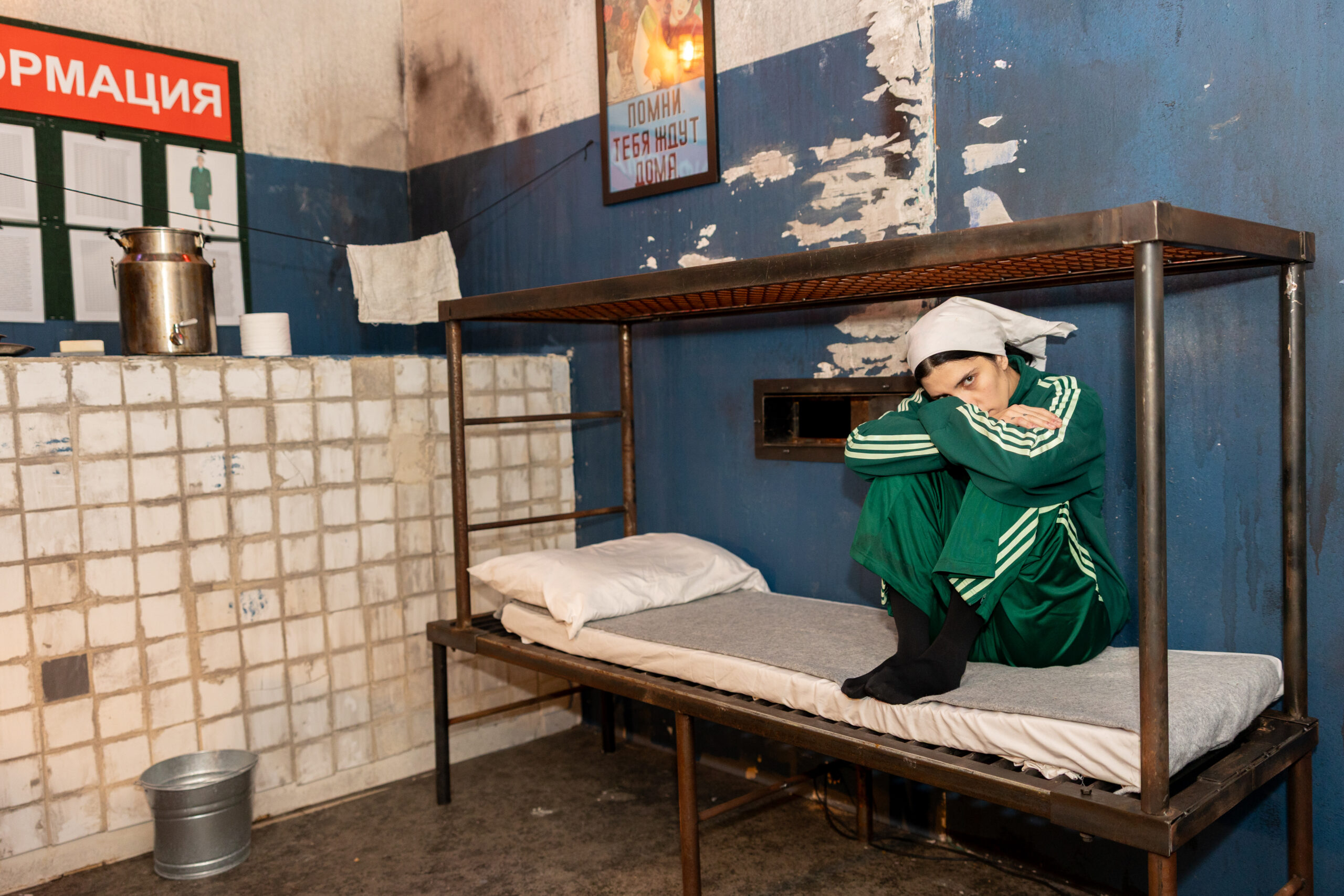
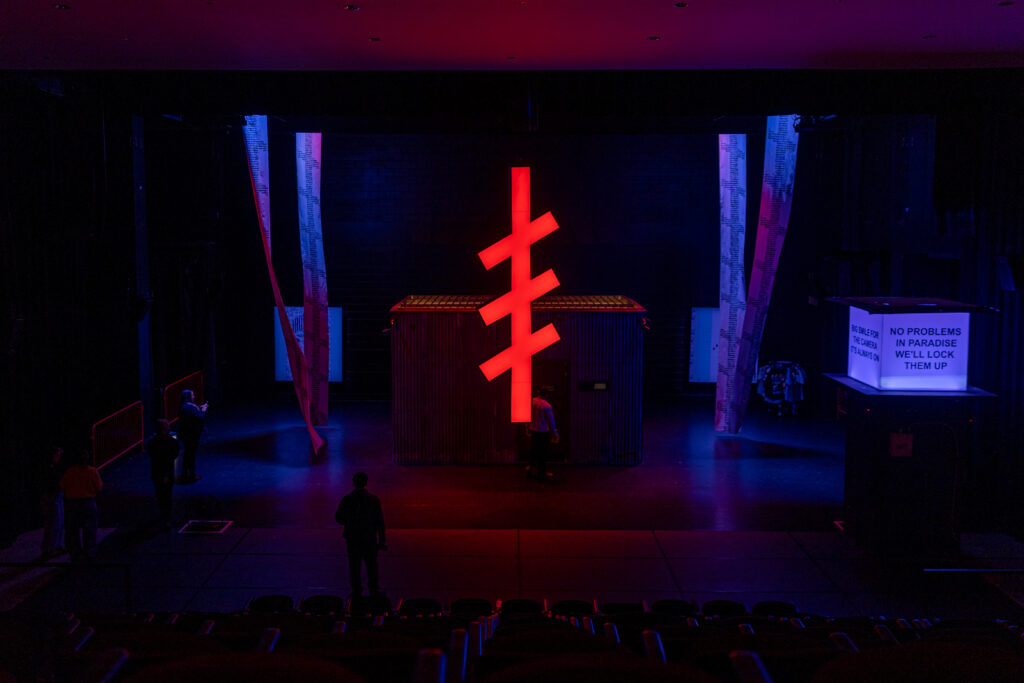
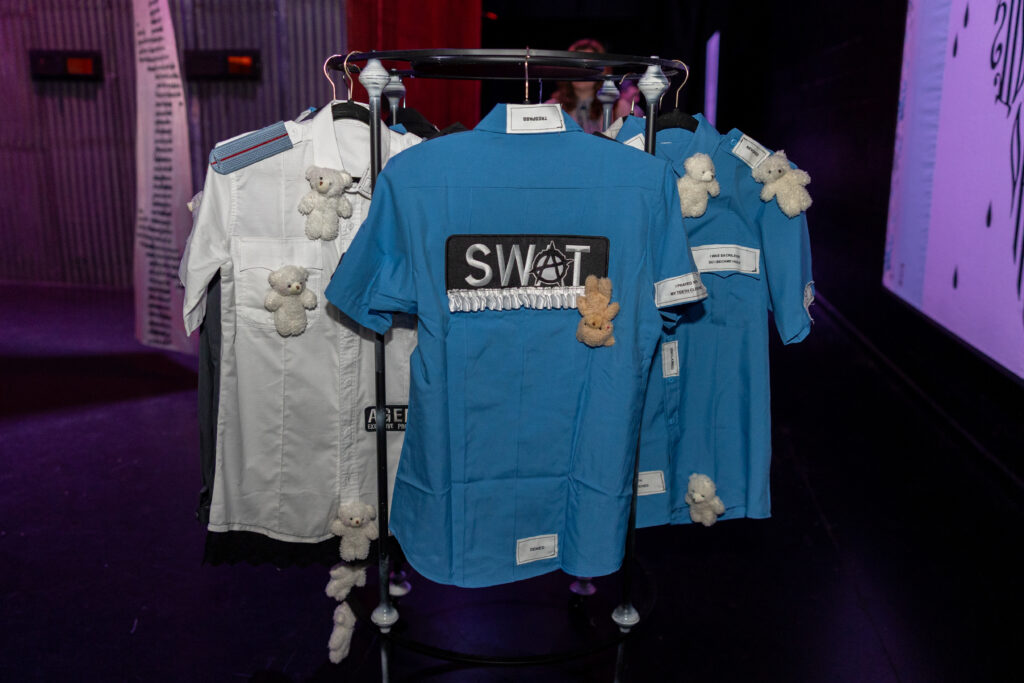
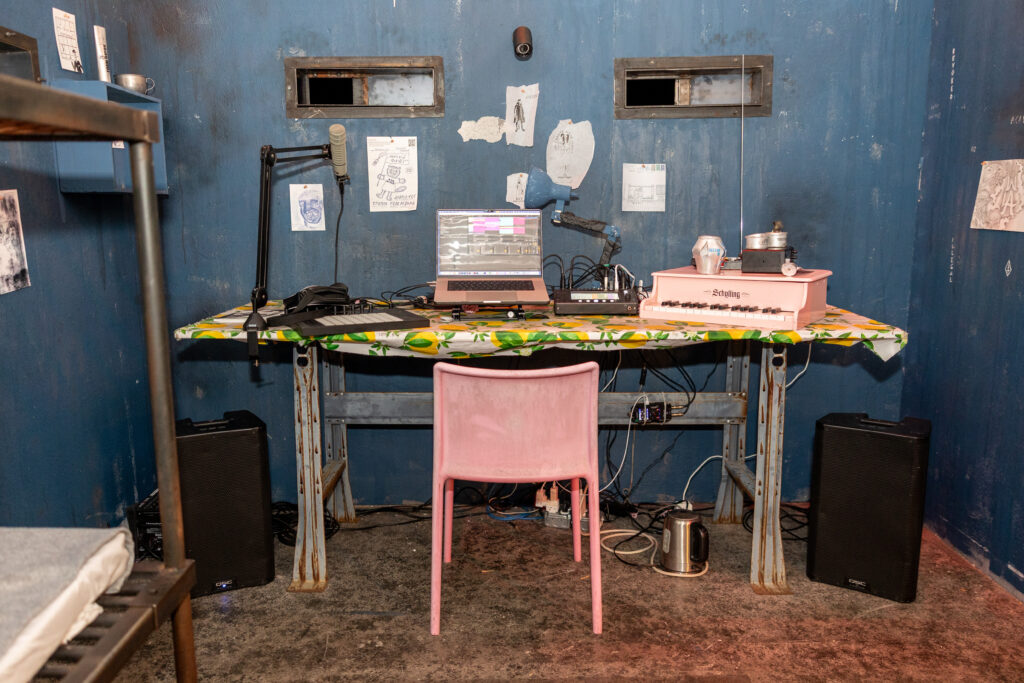
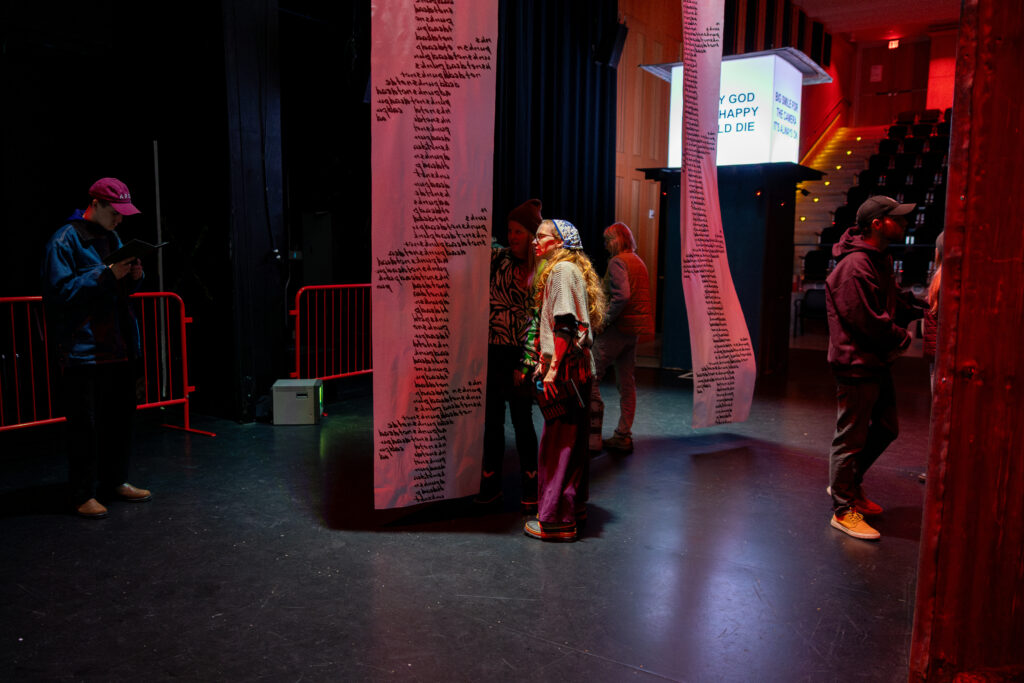
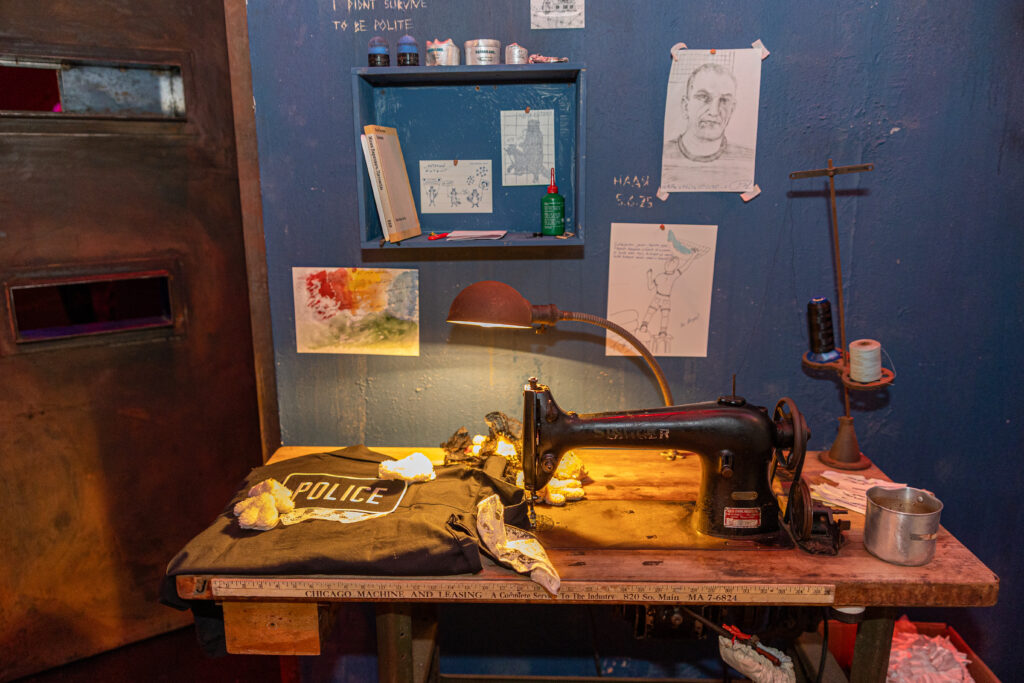
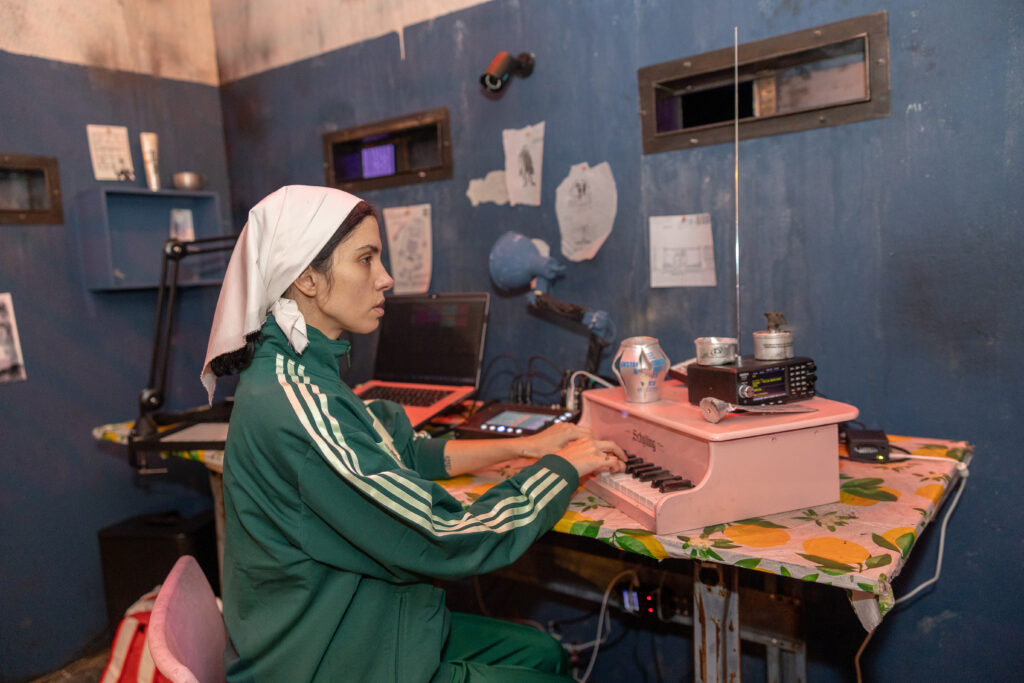
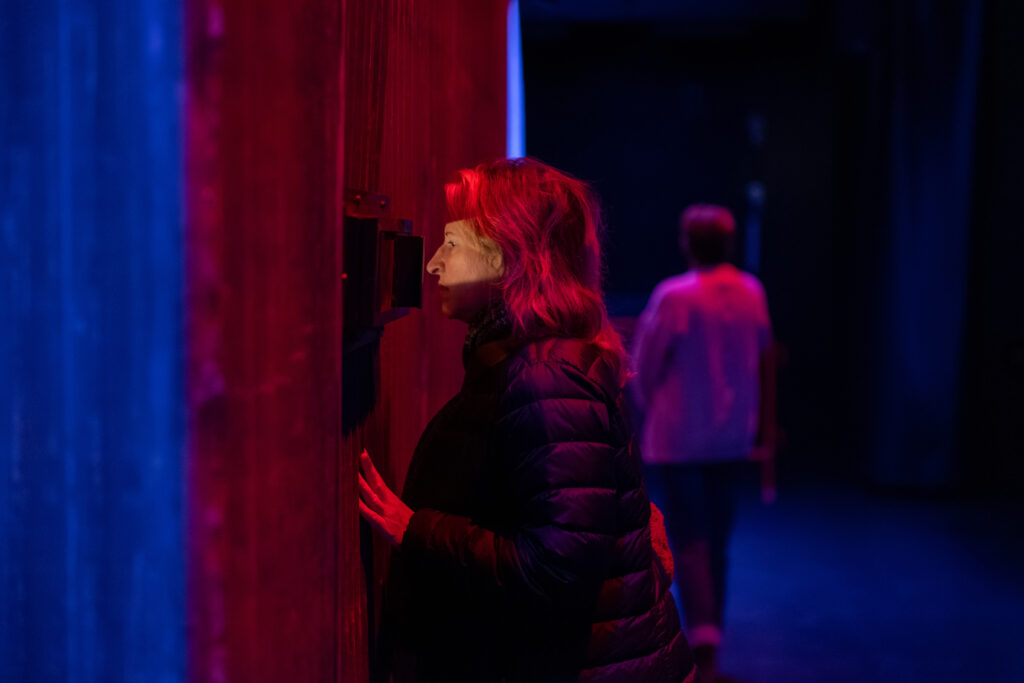
In POLICE STATE, Tolokonnikova—who served two years in a Russian labor camp for trumped-up charges of “hooliganism motivated by religious hatred”—occupies a recreation of the cell where she was imprisoned, this one lined with artworks by current and formerly incarcerated Russian, Belarusian, and American political prisoners. Throughout POLICE STATE’s duration, the artist sews garments as she did in prison and creates a haunting soundscape that echoes through the space. She is surveilled as she works, not only by a system of CCTV monitors but also by the audience. Around her cell, artworks that invoke symbols of state and religious power tower over the installation.
Though it draws on Tolokonnikova’s experience in the Russian penal system, POLICE STATE carries with it a provocation and warning that is larger than any one specific country or political event. As an artist exiled from her home country due to threats to her safety, Tolokonnikova is keenly aware of the conditions that lead to the violent oppression of political speech and creative freedom. In a live conversation on November 21, 2025, she spoke with Joey Orr, MCA Chicago Deputy Director and Chief of Curatorial Affairs, about the shadow of rising authoritarianism, her complex relationship to religious ideology, and her pursuit of the clarity and bravery of other artists imprisoned for political activism.
This interview has been edited for clarity and length.
Joey Orr: You’re at the MCA Chicago to present your work, POLICE STATE. You’ll be performing during all open museum hours. They are long days, and you’ll be performing the entire time. Could you tell us something about the origin of the work?
Nadya Tolokonnikova: I think this work comes, first of all, from my obsession with artist Ilya Kabakov. In 1992, he blew the minds of the Western artistic community by building a toilet [The Toilet, 1992]. It was at Documenta IX. It looked from the outside just like your usual Soviet toilet…he brought everyday elements of the Soviet people’s life. Ilya Kabakov is known for his “total installations;” that’s the term that he coined. And he started doing them in the 1980s, I believe, once he moved from the Soviet Union. I think he always wanted to move from the Soviet Union, and he was able to do it in the 80s, but before that he’d been working inside of this very closed, sealed institution of underground Conceptual Russian art.
Once he moved, he encountered new possibilities and new challenges. He was able to work with institutions like Documenta and museums, but he encountered the problem, which was that people there didn’t have the [Russian] context. So when Kabakov moves to the West, he understands that he needs to build the world for people to understand what he’s saying. And that’s what he does.
POLICE STATE comes from my obsession with total installation, and this trickery, humor, and self-irony that I find in Kabakov’s installations. Second, it comes from my experience. I spent two years in jail. And when I was in jail, I promised myself that I’m going to use this experience to share awareness about what is happening behind those closed doors. Not just in Russia—yes, it’s a recreation of a Russian prison cell—but it goes beyond that. The American prison industrial complex is absolutely horrific, and it should not be here in the so-called democracy. That’s bizarre to me.
Third, I think it came about because Donald Trump got elected as president. I knew Alex Sloane, the curator at MOCA. She wanted to do something with me. It is one thing to want to do something, but another thing to be absolutely sure that it’s urgent, and it needs to happen right here and right now. She wrote me a letter the day after Donald Trump got elected, and she said, “We absolutely have to do something.” And it turned into POLICE STATE.
JO: Since you’re bringing up the timing of the work, maybe you could talk about how you feel about what’s going on right now as you’re doing POLICE STATE?
NT: I think it all starts with dehumanization. I saw this process happening in my home country. People like me, people who oppose the ruling regime, are step-by-step turning into non-humans. Those who can be beaten, those who can be poisoned, those who can be thrown in jail, those who can be murdered. I had a number of friends of mine murdered, including Alexei Navalny, who got poisoned in faraway northern jail. This is how the autocracy establishes itself, through dehumanizing certain groups of people. Here, it might be someone else, the groups don’t have to be similar. Seeing how Trump targets immigrants and seeing how inhumanely ICE treats people in Los Angeles, and now in Chicago, in other cities, made me think that, actually, Trump is moving much faster in centralizing his power and othering certain groups of people than Putin was.
I think there is almost a problem with drawing parallels between Russia and the US because in the US things are developing much faster. For Putin, it took almost twenty years for him to launch a full-scale invasion in Ukraine and forget about the last traces of democracy. I think here it could happen a bit quicker. But as we’ve discussed before, I think there’s good news. A lot of people think that good art can develop under oppression. I think right now you are living within this very unique window when the oppression is not too big yet. You still can create. Most likely, you’re not going to get assassinated for that. Shit happens, though. There is a window of opportunities, but it closes at some point. Russia was an amazing place, believe it or not, for some time, where my community and I could create under danger, yes, but we were stimulated by that danger; we were stimulated by the mighty power that we are opposing. But today, it’s not possible anymore, and everyone I know is either murdered, jailed, or exiled.
JO: Could you describe what happened during POLICE STATE in Los Angeles?
NT: It was two days into the show, and POLICE STATE had manifested itself outside of the museum. I got out one evening, it was late, and I saw a line of the police and protesters, and then it escalated pretty quickly over the next few days. Eventually, the museum closed because that famous Barbara Kruger wall [Untitled (Questions), 1990/2018] in the parking lot became the backdrop of a fighting ground for the protesters versus the police, and police assaulting the protesters. The ICE jail was right in front of the museum. This was a very uncanny synchronicity. So the soundscape for the work started as something that I was manufacturing on my computer and then quickly it turned into an actual atmosphere, with helicopters, police sirens, and people screaming from pain as they were arrested and beaten.
JO: So the actual soundscape you were making during the performance was incorporating the soundscape from outside of the museum?
NT: Both. We had the live feed in the middle of the protests. My partner, John, was there in the middle of the protests getting tear-gassed, so that was part of the soundscape. But also the helicopters, they were pretty damn loud, so you still could hear them.
JO: Can you talk about some different components of the work? For instance, there are paintings in the work and also a lot of religious themes and religious iconography. As far as I know, you’re not religious. I think there is a line from Pussy Riot’s Punk Prayer: “Virgin Mary, please become a feminist.” I wonder if you could talk about the paintings or some of the themes in the work.
NT: The paintings…it was a long story and real adventure how to make them. I really love working with found materials, or ready-mades. You’ll see both in the installation. The canvas is the bedsheets produced by prisoners in a penal colony in Belarus. I wasn’t able to access Russian penal colonies, but I was able to access Belarusian ones. Because Belarus is under sanctions and you can’t just send money, I had to adopt seventeen fake identities and make weird financial transfers to procure these bedsheets. They look weird, naive, and quite childish, but they were made with pain and labor.
I was sewing while I was in jail myself. As forced labor. Once you get convicted, you arrive in the penal colony, and you are forced to sew eight hours a day, though they make you work much longer. You work sixteen hours a day. There’s no days off, and you have to perform a very high quota. And you’re untrained. You don’t know how to sew, so you’re making all these mistakes. The sewing machine is old and constantly breaking. The needle penetrates your finger, and there’s blood all around. But you continue because you must, otherwise you’re going to get punished. And not just you, but the entire unit. And guess what will happen if the entire unit gets punished because of you? They’re not going to be happy, and there’s serious people out there.
I was doing my best, so… Well, hence the painting. And the image that I put there is performed with this special calligraphy that I derived from old times in Russia. It was invented in the 13th century and was used mostly for religious purposes. It’s true, I’m not religious, or at least I don’t belong to any organized religion. I do think it would be correct to call me an atheist, even though it’s kind of weird with the Soviet history of atheism that was a part of government ideology. I’m not really big on adopting government ideology. I love looking at religious symbols and studying different religions in order to understand humans better because these are stories that we’re telling ourselves…they’re important and potent, and they can teach us something.
I quote Orthodox Christianity in my work because it teaches me there is something bigger than your own wishes and desires that you need to fulfill in life. It teaches me idealism, and I think this is something that we lack today, big time. Think about Jeff Bezos. Think about Mark Zuckerberg. Those people could solve so much with their money, but they don’t want to. They want to be pigs. And so I don’t care what it is that makes you idealistic, could be religion or anything else, love to your family, but I’m looking for that. I’m working with these symbols. One of the centerpieces of the installation is this cross that I refer to as feminist or queer cross. It looks a lot like the Orthodox cross, but not quite. It reminds me a bit also how prisoners count days, because they don’t have calendars often, so they draw these sticks, and then cross them out.
JO: POLICE STATE also includes work that’s been made by other political prisoners, right?
NT: Yeah. It was important for me to include them. This work, to me, it’s not about the past, even though I served more than ten years ago. I got lucky. I only served two years and came out alive. Today, the situation with political prisoners in Russia is much more dangerous. These people who contributed their work, it’s about thirty artists, some of them self-taught. They became artists when they ended up in jail because they wanted to find a vehicle for self-expression. So all of them have a lot to risk. The government could decide to add additional time to their term based on their artwork, especially if it’s political. And most of them are.
I think their work could be a great lesson and inspiration for a lot of us. At least it’s a great inspiration for me because I’m here in relative comfort, and sometimes I have this desire to censor myself, to make my life a bit more comfortable. But I think about these brave people who are creating art inside of labor camps and sharing it even though they risk a lot by doing that, and then I let go of this desire to self-censor.
JO: I’ve thought a lot about re-performance, what it means to perform something again, maybe to a different end. You’ve written about your experience when you were imprisoned and referred to the hard labor of sewing—when you first arrive you get the worst machine that’s missing parts, and it’s not working, and you can’t find the mechanic. If you left long enough to find one anyway, you wouldn’t be able to meet your production quota, which would cause trouble. There’s blood all over the table from the needles, and then you’re trying to learn how to fix a sewing machine. I’ve wondered a lot what it means for you to repeat this kind of action. But you have also said that when you were imprisoned, you were freer than your prosecutors.
NT: Well, one of my therapists who I eventually fired… I was so proud of myself for sharing this revelation. It was black and white. There is God and there is devil; there is truth and there are lies; and there is good and there is bad. My therapist told me it was a distortion of my mind because of the amount of pain that I had to endure, that it was a protective mechanism of my brain to create this crystal clear picture of the world. I fired him because I want to preserve this insight. The madness and revelations come hand in hand. People have done all sorts of crazy stuff to achieve this clarity, whether it’s praying, meditating, walking on fire, or taking drugs. I was happy to achieve this state.
I promised myself that I’m going to keep it, to carry it with me until the end of my life. But the second week after jail, all the clarity is gone. So you have to continue to, whatever it is, meditate, anything that works for you. I don’t recommend you go to jail for that. But there should be something else.
Sasha Skochilenko, one of the artists who we show inside of the cell in POLICE STATE, said something similar. She is an openly lesbian artist. The reason I’m saying it is because it’s really rare for a person to be openly gay in today’s Russia. It’s scary in and of itself. But then she made an art action against Putin’s invasion in Ukraine in 2022, and she ended up being locked away for seven years. She was released last year because of the prisoner exchange that happened between the Western countries and Russia.
She said the same thing while serving her seven-year sentence. “I’m freer than you because I can say whatever I want, and you say only things that the government allows you to.” She said this to her prosecutor and the judge. And I think it’s universal, and I don’t care if it’s craziness. It’s beautiful.
JO: I think a lot about surveillance and feeling implicated as spectators, but I’ve heard you say that you hope people come and sit in the theater and spend time with one another. There’s a tone of graciousness and generosity you express when you talk about your hopes for people’s encounter with the work. Can you say something about that?
NT: I would say, sit back and relax and smoke, but I think you can’t smoke in the theater. It’s a hard line, especially if you’re a political artist. You’ve got to be serious. You’re dealing with serious things, pain, not just your own. I can joke about my pain 24/7, but you can’t really joke about the pain of other people. So you’ve got to be serious to a certain extent. But also, you don’t want to be a prophet of doom because then what do you actually bring to people? It’s enough they open social media, and they have enough of that.
I think about church a lot, and I think about the architecture of the church, and the idea, the entire complex that constitutes church, as building, the community, the performance element by the priest, by the choir. If you wish, you could call it an immersive performance because there is very creative lighting and even smells and physical sensations. You get to eat something. You get to touch something. You get to drink something. And there is gore. You enter Christian church, and you see a bloody corpse on the cross. And it’s familiar, so we’re not really that scared, but look at it with kids’ eyes. It’s really, really scary. At the same time, this is the place that, for ages, we’re giving people hope. I’m really interested in this oscillation between gore, despair, suffering, the bloody and ugly truth of reality and transcendence, metaphysics, idealism, and looking for a utopian future.
JO: I was talking to you earlier about your sense of humor. And when I asked if you were doing anything in preparation for the performance, you said, “No, but afterwards, a glass of wine and a long therapy session.”
NT: Actually, I told the psychiatrist I quit. But pills, they do help.
JO: What I was calling humor in our earlier conversation, I’m thinking of more in terms of revealing absurdity. When we spoke about a week ago, you made reference to some Russian Conceptualists that were important to your practice. I was very taken with Dmitri Prigov’s piece, Russia (c. 1990), where he tries to teach his cat to say the word “Russia.” This is someone who influenced you. Do you want to say why and in what manner?
NT: I was fourteen, and I came to a contemporary art festival in my God-abandoned city of Norilsk. No one has ever heard of it, even in Russia, so don’t feel bad about never hearing about it. It’s a small city; nothing ever happens in it. But the hand of goddess brought this contemporary art festival to this city out of all the cities in Russia, and I encountered this video and got so taken by it that I abandoned my friends, and I spent hours watching the video. And then the performer himself, Dmitri Aleksandrovich Prigov, arrived. He had a live performance that totally changed my perception of life in general.
Why this piece in particular? Who knows? I think it has a lot to do with timing. When you’re fourteen, you’re like a sponge. I was lucky enough to get exposed to this kind of art, and I have realized that all that adults told me about life was a lie. They told me that I have to have a normal job, that I have to… There was a big list of things that I had to do and not a list of things that I can explore, that I can invent. Dmitri Prigov opened this for me. It wasn’t a given in my city. I think if you live in Chicago, if you grew up in New York, or Moscow even…I don’t know about today, but Moscow back in the day was a place where this kind of openness and creativity was encouraged. But not in my city. People were prepared to become miners or economists.
But I still stand with my love of this piece because he does a very absurd thing with a serious face. I think this is one of my favorite things about Russian Conceptual art. This has a lot to do with inventing your own mythology, and then communicating just enough of it to the outside world that you are not going to be sent to an insane asylum, but will still be perceived as somewhat of a weirdo, or a shaman, or this figure of the holy fool that I’m really attracted to.
There is a story about this holy fool named Basil, or Basil the Mad. The main square in Russia is the Red Square, and there is St. Basil’s Cathedral. This St. Basil was an absolute weirdo. He was running around Moscow naked, yelling at the crazy autocrat of that time, Ivan Grozny, Ivan the Terrible. Ivan the Terrible was known for killing everyone, all of his opponents. He killed half of Russia just because they didn’t look good enough to him, whatever. He didn’t need a reason to kill you. But when this guy threw a piece of meat to the feet of Ivan the Terrible, Ivan the Terrible asked him, “Why did you do that?” And Basil the Fool said, “Because you eat human flesh.” Instead of killing him, Ivan the Terrible built the cathedral and named it after the holy fool. It’s a very potent figure of a trickster and holy fool. Somehow they get away with saying the truth when other people get killed for that.
JO: I want to ask you about time, and how there might be different qualitative experiences of time. We can think about Fordist time, or Monday-through-Friday, nine-to-five, or clocking in and clocking out, and constantly being productive, as a way of experiencing time in our daily lives. And there’s been a lot written about how our experience of time shifts during moments of revolution, when spaces are occupied differently, and we are able to experience a different kind of social relation with one another. We have a different experience of time then.
You’ve talked about the symbol in your installation as resembling the Orthodox cross, but then how you’re counting the days in prison. I’m thinking about a different experience of time when one is incarcerated. And then, of course, lots of performance artists have talked about having different experiences and perspectives on time during their work. So I wonder if that lands with you anywhere, if it is meaningful to you, if you experience time differently in different modes?
NT: I have nothing profound to tell you about how I experienced time in my jail. But if you ask me about how time feels in jail, it’s horrible because one day looks just like another. If you look at the hour, it lasts forever; it lasts eternity. But then once a year passes by and you look back, it all collapses like some sort of crazy quantum function into one very dreadful, torturous day. So my theory is actually that judges and prosecutors should go to jail for at least two months as a compulsory part of their practice. They need to experience this profoundly different time before giving out people these crazy terms that they’re giving out…including for non-violent crimes.
The Midwest premiere of Nadya Tolokonnikova’s new performance installation, POLICE STATE, was on view at the Museum of Contemporary Art Chicago from November 25, 2025 – November 30, 2025.
This interview was published in collaboration with The Museum of Contemporary Art Chicago. For more information about partnering with Sixty Inches from Center, you can find more information here.