While many Chicago-based artists and architecture firms participated in the Sixth Architecture Biennial, SHIFT: Architecture in Times of Change (2025/26), the international collaborators, by nature of converging in Chicago, contribute to a framing of the city. The biennial functions as a looking glass, reflecting the city onto itself and revealing the instabilities embedded in its materials, systems, and social structures. Urban planning, as described by Project Manager at RM Chin, Mateo Baker, is “architecture in context,” and this framing underscores how architecture cannot be separated from the histories and conditions that shape it. Their five categories of architectural interventions for Chicago drew me in: glass as a ubiquitous yet unstable skyscraper material, how creative reuse and utopian informality are the future for Chicago, urban and environmental collaborations as defining steps of navigating the Anthropocene, creating comfort among discomfort, and the globalization of Chicago’s architectural influence. Through this lens, the biennial asks visitors to consider what architecture builds and reveals.
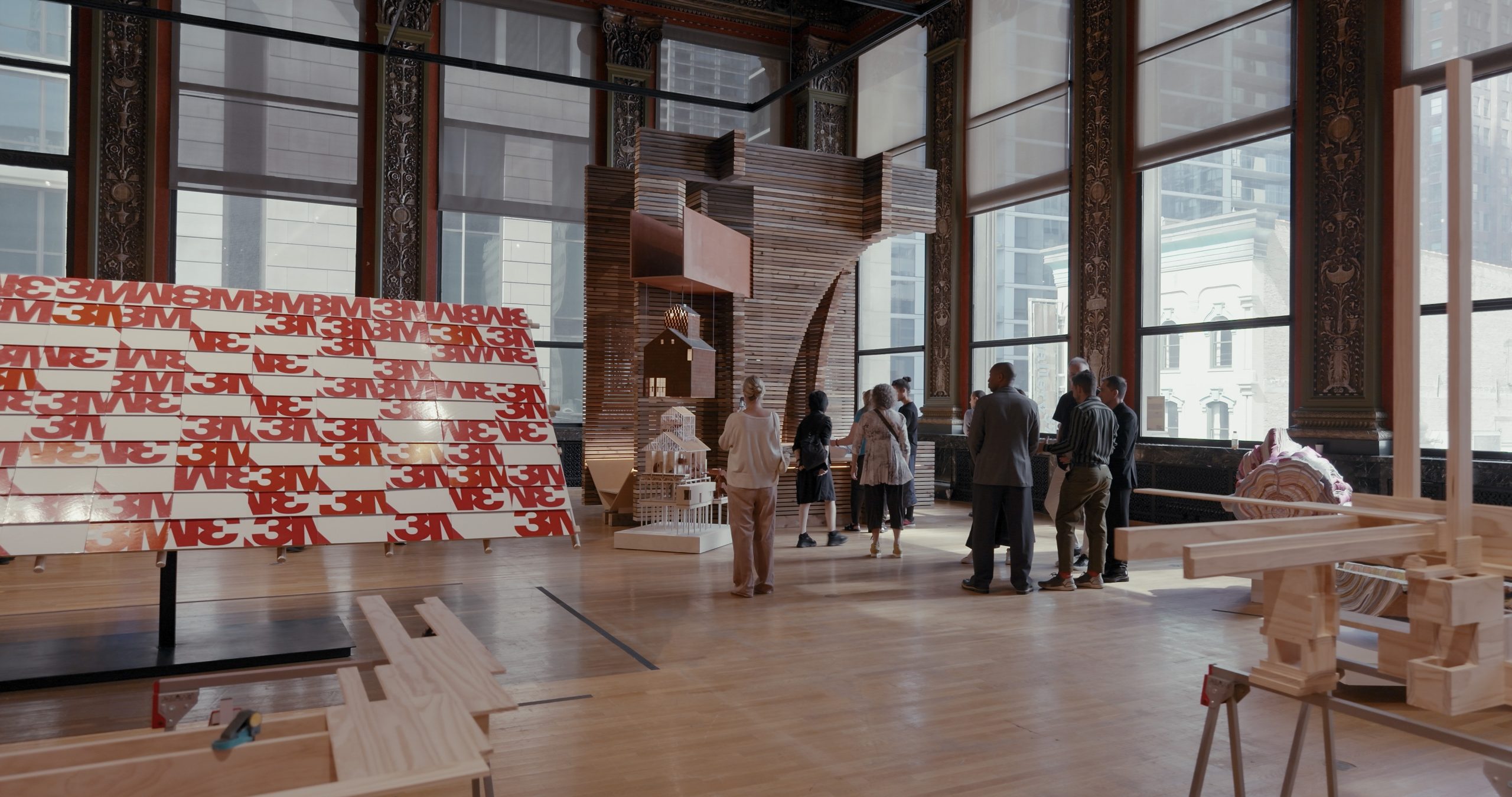
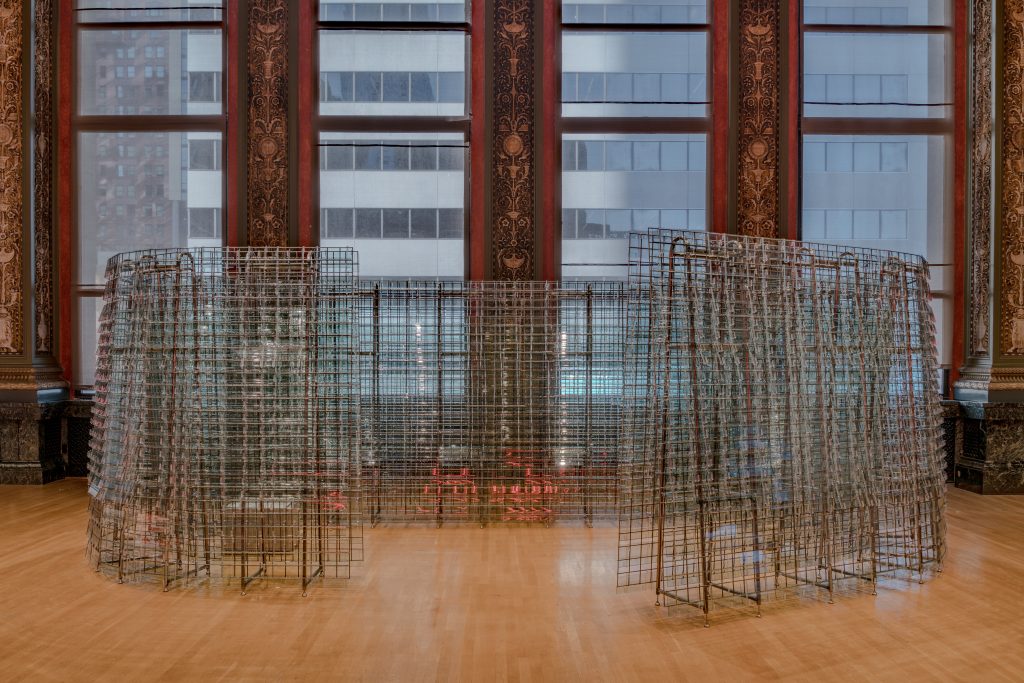
Privacy Glass Solutions calls glass a “cornerstone of modernity.” In a way, glass is a real material, but it’s also a social construct because it appears in idioms like “through the looking glass,” which are about reflecting on oneself. Even in the post-war period, glass became abundant because of the race toward modernity and the belief in the psychological benefits of a reflective material to encourage openness and boost social morale. Louis Sullivan, a household name in Chicago, created over 100 buildings and had a lasting effect on the city. He’s most known for the steel frame, form-over-function skyscrapers within the city. Our Second Skin, The Skin of the City, by RADDAR (a firm based in São Paulo), constructed a structure entirely of wasted, ill-fitting glass sheets from industrial projects. This brought attention to the unsustainable waste of a material used in so many cities across the world, and what possible solution (even hypothetical) may arise from using the wasted parts. Hooked onto a curvilinear metal frame, the glass sheets wrap around to create a translucent structure. The enclosedness of the space feels fragile yet comforting because it’s enclosed yet see-through. Seeing this work within the context of Chicago’s long architectural history, which mimics many downtown buildings, made me think back to a Stewart Hicks video, featured at the 840 N. Michigan Ave. location. Therein, he describes a window that flew off the CNA Tower in Chicago, killing a mother walking on the street with her child. He goes on to describe how the building, while garnering an award in the ‘60s, has a fatal design flaw. Glass expands when heated, and the windows are slightly inset, with the steel frame covering part of the window. This means that part of it gets the heat of the sun while the other part remains cool, which causes it to break. Overall, these two works in conversation with each other showcase the instability of these ubiquitous materials.
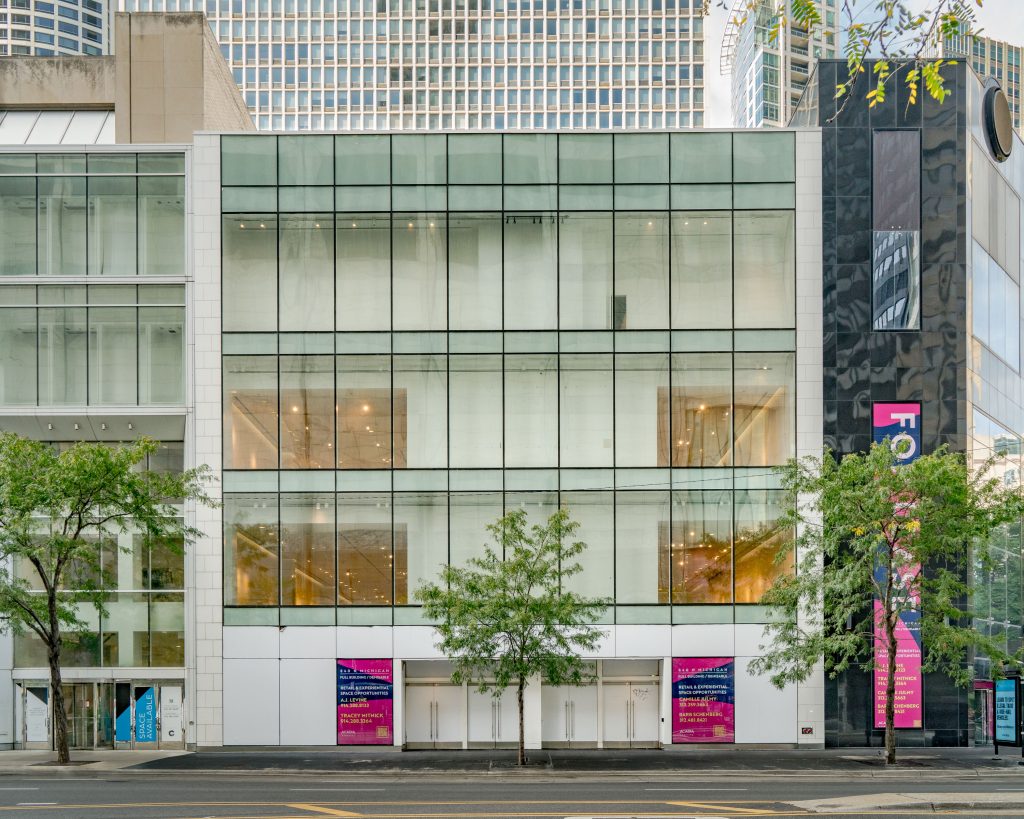
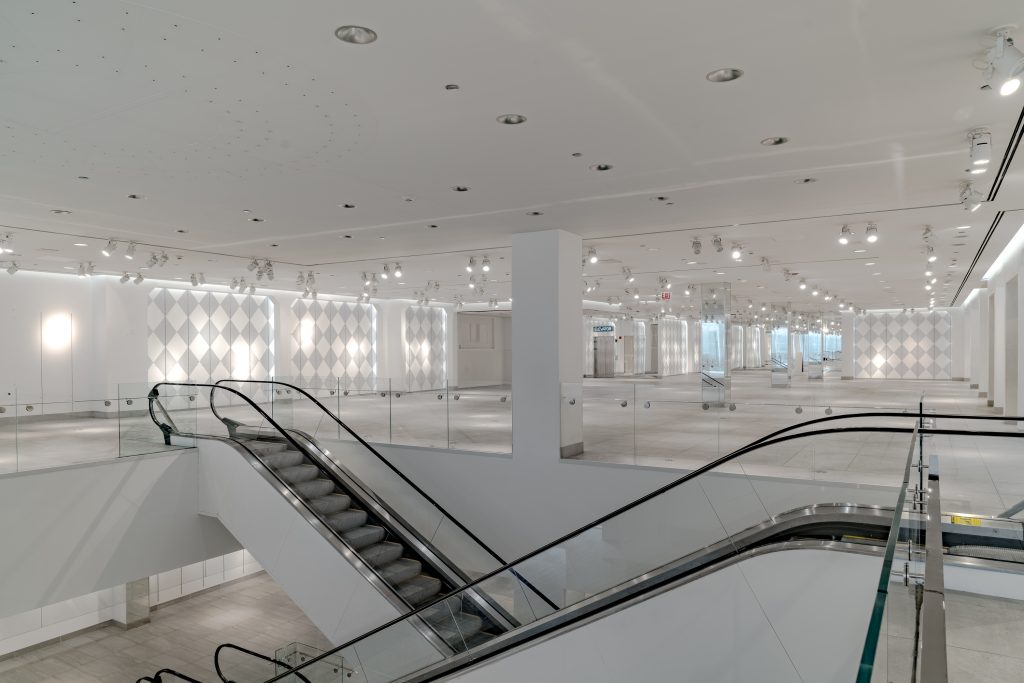
“Formality” in urban planning refers to a site being used as the designer intended. “Informality,” by contrast, emerges when people adapt space to their own needs, such as walking on the grass instead of the sidewalk. It is rooted in human behavior rather than the object itself or its predetermined use. In our post-industrial moment, marked by the decline of malls and department stores in favor of virtual spaces, informality and reuse offer a way to imagine new forms of collective life. 840 N. Michigan Ave., formerly an H&M clothing store, was one of the biennial’s sites and served as a case study in creative reuse through curatorial intervention. The four-floor building retained its oversized storefront display windows, mirrored surfaces throughout, and fluorescent retail lighting, drawing attention to the choreography of movement and how I might participate in the space. Yet it was marked by an eerie silence where department store music might once have played.
Another case study, Granville1500 by Lorcan O’Herlihy Architects (LOHA), presented at the Chicago Cultural Center, demonstrates how a former car dealership was transformed into student housing for UCLA. A geometrical concave building then becomes what they call an “urban village” as 153 units are offered to medical students and staff. It blends the storefront with triangular windows that entice the passerby to purchase a vehicle to bring harmony as a common space. Together, these projects call to mind the movie Divergent, in which the city itself becomes the setting for a fictitious utopia, and suggest that we may be edging closer to that speculative reality.
Extending this logic, not only can the shells of retail spaces serve as vessels for collaboration, but the natural and urban environments can do so for one another, as well. In The Bittertang Farm by Antonio Torres and Michael Loverich, plants grow among plastic, rubber, and other industrial materials, forming a speculative landscape of collaborative world-building. While the environment often performs this work on its own, sometimes by force (i.e. plastic-eating bacteria recently discovered in the ocean), the project asks what might happen if humans actively supported these processes. It recalled conversations with Baker about the potential side effects and ingenuity required in South Chicago, which is slated to become the site of the Quantum Computing Center, and raises broader questions about how technological futures might coexist with environmental repair.
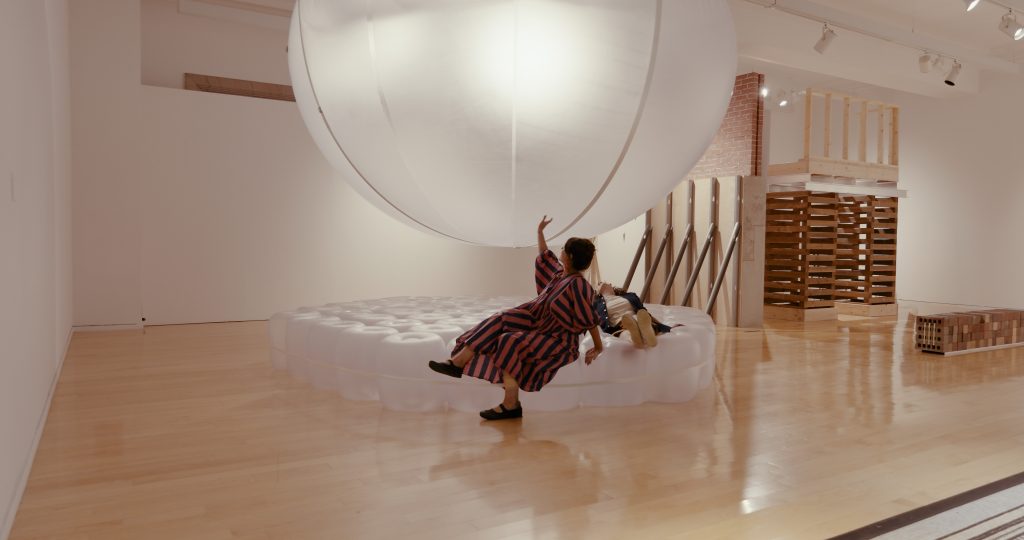
Another playful yet pointed intervention on this theme was the slightly kitsch, in a fun and necessary way, Future Climate Souvenirs by Parsons & Charlesworth. The kiosk featured hats emblazoned with speculative Chicago-based natural landmarks, channeling the familiar language of souvenirs to animate eco tourism in a future shaped by environmental change. By inviting visitors to collect mementos of an unstable climate, the project frames ecological transformation as something both intimate and ephemeral. Along the sides of the kiosk, playground-like interactive displays allow adults and children alike to turn and slide dials tracking species migration, lake levels, and heat. As the creators write, “Chicagoans imagine how the city might adapt its infrastructure—cultivating new nature reserves, regenerative schemes, and eco tourist sites—in response to predicted atmospheric changes and ecological shifts.” Through humor and interactivity, the work functions to reimagine and reflect how climate instability is already reshaping how Chicago imagines itself, its future, and what it chooses to preserve.
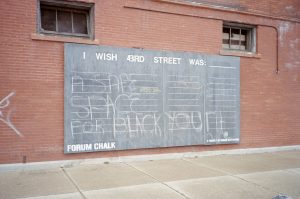
As the biennial addresses the convergence of histories, ideas of comfort and discomfort abound. A collaboration between two Chicago-based MacArthur Fellows, Tonika Lewis Johnson and Amanda Williams, showcases a project that extends beyond the walls of the initial site and takes place in Chicago itself. At the first biennial in 2015, Williams debuted her Color(ed) Theory series, in which she painted abandoned houses in Englewood, Chicago, a neighborhood that the Artistic Director at the time, Executive Director of the Graham Foundation, and current Co-Chair of the Biennial’s Board of Directors, Sarah Hedda, calls a “hospice for architecture.” The colors spark a conversation about the history of redlining and disinvestment in Chicago. Years later, Williams worked to recreate a shade of blue patented by George Washington Carver for two years. For the first time, this gestural marking, which included painting homes a deep purple for Crown Royal or the Pink Oil Moisturizer color, for example, was combined with an intervention by Lewis Johnson, who provided free home repairs on a block in Englewood and education on acquiring vacant lots from the city that residents would then care for. In their collaboration, they painted George Parker’s house. Parker turned his building into a transitional home for the formerly incarcerated. Williams says she painted it “blue to shroud things for innovation and art.” Their collaboration, George for George: An Unblocked Englewood x Innovation Blue Collaboration, raises the question of how the carceral system seeps into the built environment.
Another project that reflects on the legacy of past biennials is Forget Me Not Pavilion by Kwong Von Ginow, which reimagines the Chicago Horizon Pavilion, originally built to provide shade along the lakefront. A notable intervention is the replacement of a hard ground plane with a cork floor, creating a softer surface that encourages rest and pause. While the model and renderings are on view at the Chicago Cultural Center, the project stands out as one of the few proposals aimed at permanence. Looking beyond the temporal limits of the biennial, the designers reference projects like the High Line in New York City and its funding structure as precedents for integrating this pavilion into Chicago’s everyday life and leisure. In contrast to many speculative installations, Forget Me Not Pavilion foregrounds the importance of third spaces, suggesting that stability, care, and public gathering are themselves radical responses to a city shaped by constant shifts.
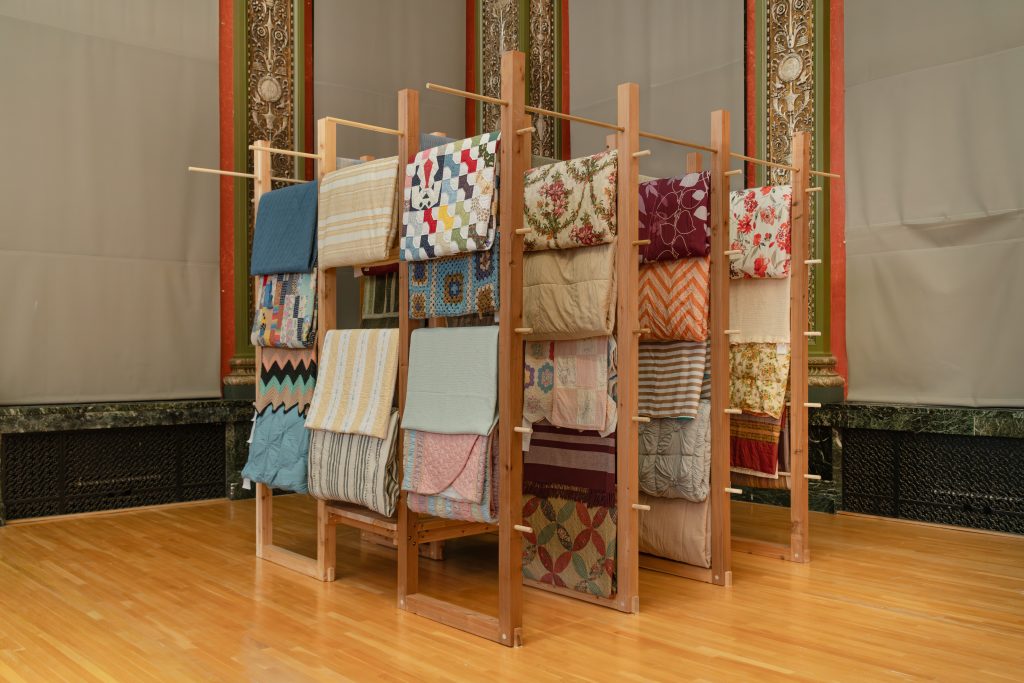
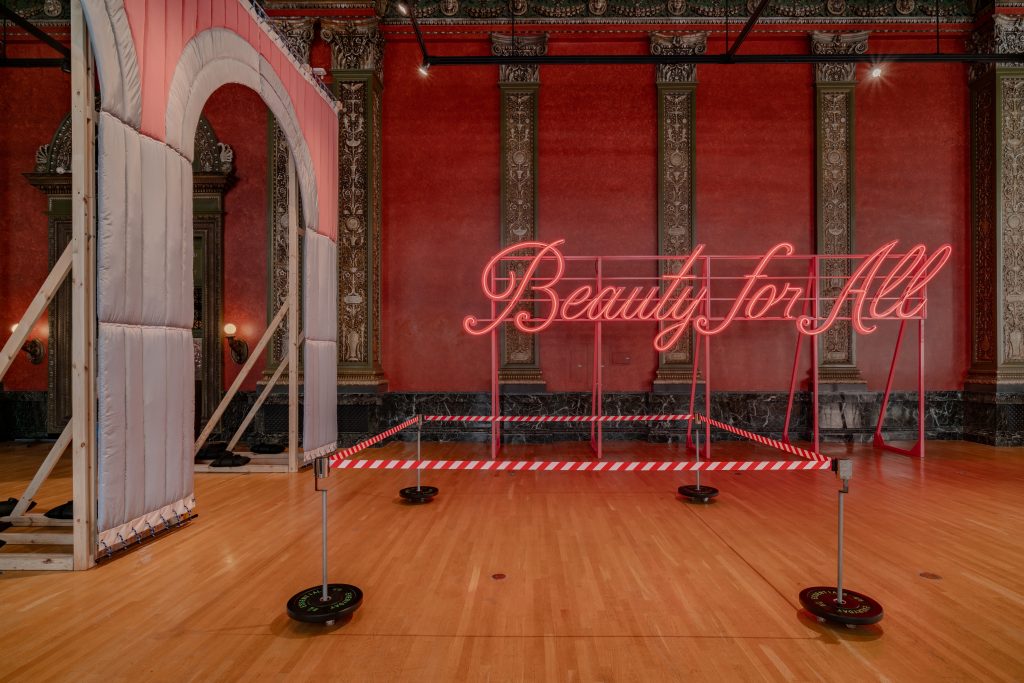
Minor Techtonics by BURR (Madrid-based firm) made an homage to the puffer jacket in streetwear, a staple in Chicago weather, into a large-scale arch. Mixing the Neo-Classical form with this everyday material imbues clothing and fashion with a type of importance. Linen Closet by Jason Campbell / ellProjects was a visible storage of blankets that allowed them to hang on wooden structures to form the walls of a space that you could sit inside. It hushed the exterior busy Chicago Cultural Center and provided a place to sit inside those walls. At the Hyde Park Art Center (not a site of the biennial), I saw a car hood, a reclaimed grocery cart, a radio playing, and other equipment together to bring attention to the mobile homes and transportation of unhoused people. Immediately, when I saw Minor Techtonics and Linen Closet, whether intended by the designers or not, it reminded me of the make-shift homes of unhoused people throughout Chicago. It brought up the question: Who is architecture for? How do power, reuse, and resistance come into play?
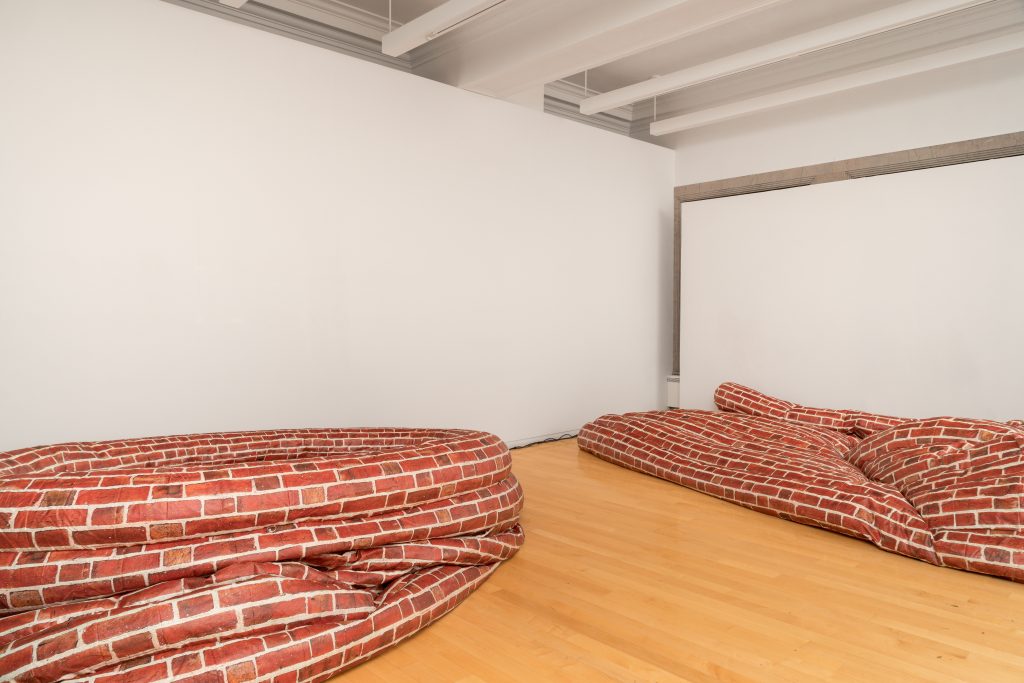
Traces by Balsa Crosetto Piazzi and Giorgis Ortiz (Córdoba, Argentina, Boston, and New York-based firm) turns its attention to history itself, encasing the footprint of the 1893 World’s Columbian Exposition in brick and inviting visitors to physically retrace the original site of the fair. That spectacular event positioned Chicago as a global architectural hub, exporting ideas of progress, order, and modernity to the world. In conversation, Sarah Hedda noted that the Exposition was a seismic moment that went on to inspire the Venice Biennale itself. Viewed through this lens, Traces functions as a reflective surface, asking viewers to reconsider the foundations on which biennials are built. By grounding an ephemeral exhibition in a historical trace, the project raises a critical question that reverberates throughout the biennial: what is a biennial, if not a space for examining and destabilizing its own epistemologies?
Taken as a whole, the Sixth Architecture Biennial presents Chicago as a city perpetually in flux, where architecture reflects both aspiration and instability. The projects on view expose how materials fail, systems erode, and spaces are continually repurposed by human need. Glass shatters, retail shells become speculative futures, environmental collaborations blur boundaries between the natural and the built, and gestures of comfort reveal the precarity of those they aim to serve. Looking through this architectural looking glass makes it clear that instability is not an exception, but a condition of the contemporary city. Yet reflection also holds the potential for reorientation. As a viewer, these are the shifts I would propose for the next biennial to increase its radicality: a less-is-more approach to the number of works on display, paired with a fuller commitment to place. While the Stony Island Art Bank site anchors part of the biennial on the South Side, imagining an entire biennial rooted there would further shift the lens toward communities historically marginalized by planning decisions. In a moment shaped by the planning of the CTA Red Line Extension, ongoing debates around public housing, and continued displacement, proximity matters. Ultimately, the biennial suggests that architecture’s power lies not in permanence, but in its ability to reveal, question, and respond to the changing ground beneath it.
…
The Sixth Chicago Architectural Biennial was on view from September 19, 2025-February 26, 2026.

About the author: Chenoa Baker (she/her) is a curator, wordsmith, and descendant of self-emancipators. She was the Associate Curator at ShowUp, an adjunct at Massachusetts College of Art and Design, and a consultant on Gio Swaby: Fresh Up at PEM and Touching Roots: Black Ancestral Legacies in the Americas at MFA/Boston. In 2023, she received the Association Internationale des Critiques d’Art (AICA) Young Art Critics Prize.
Currently, she teaches African American Craft History at the James Renwick Alliance, edits with Sixty Inches From Center, Pigment Magazine, The National Gallery of Art, Boston Public Art Triennial, and The Corning Museum of Glass, and writes for Hyperallergic, The Brooklyn Rail, Public Parking, Material Intelligence, and Studio Potter.