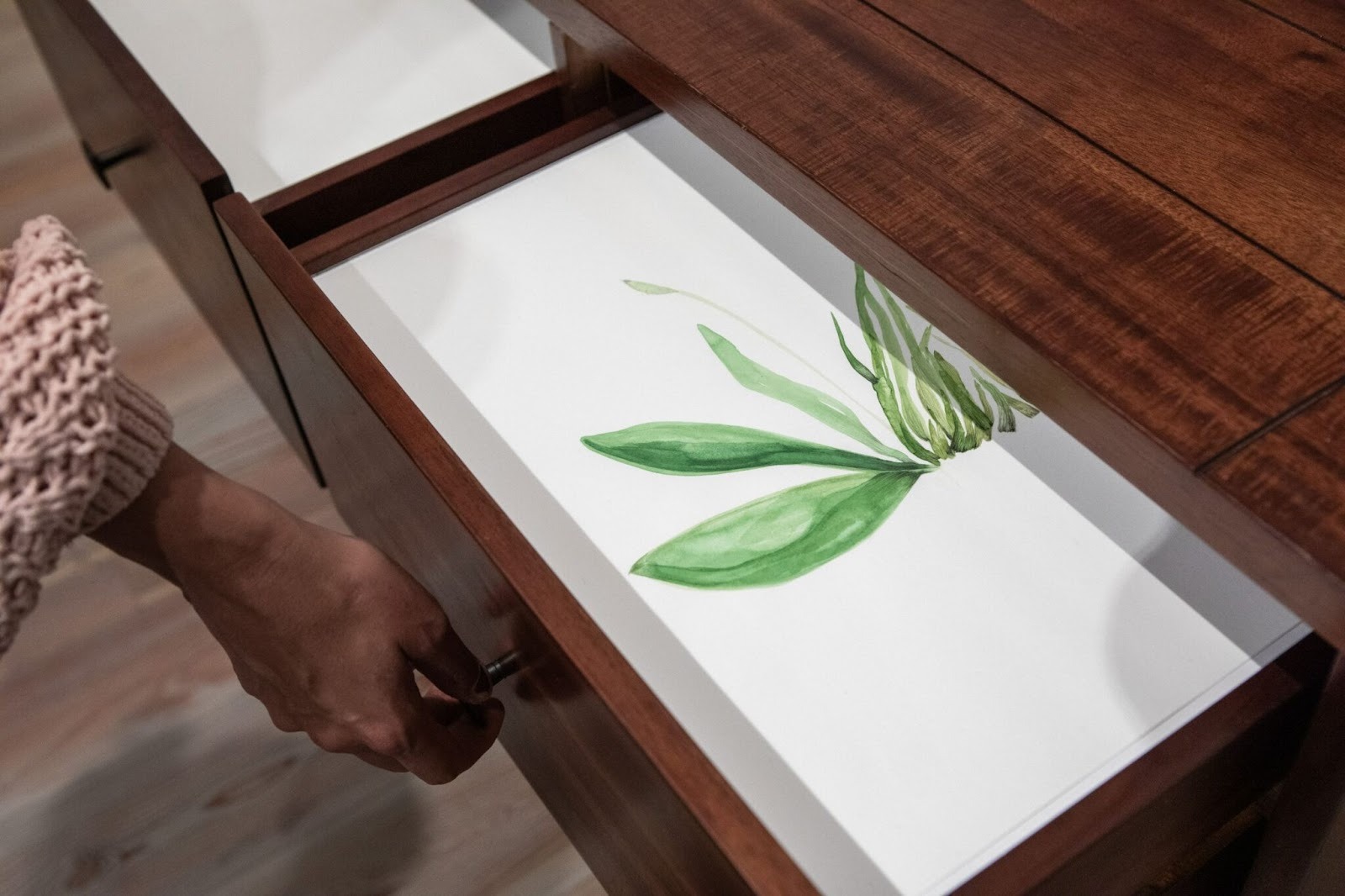
From intimate to worldly, Temitayo Ogunbiyi’s exhibition is a humanistic synthesis of botanical imagery, language, and abstraction through the mediums of sculpture, painting, and drawing. Gracefully drawn vignettes of flowers and plants, displayed in vintage furniture, recall a private journal, presented with discrete restraint. Recalling the vernacular speech of Nigerians, titles rhythmically state the phrase “You will….”, such as “You will find new framing in crafts of old.” Ogunbiyi’s poignant written messages prompt the viewer to reflect on the unnamed addressee. On herbarium paper, the artist draws abstracted images of roots, hair, caterpillars, and paw paw, among others, suggesting the borderless, regenerative qualities of the natural world. Placing the drawings in this furniture may be seen as an intentionally incomplete archive, also pointing to the traditional role women have played as family archivists. Historically, botanical illustration, as exemplified by early practitioner Maria Sibylla Merian and others, was an acceptable subject for women, affording them opportunities to experiment with artistic creation and scientific exploration.
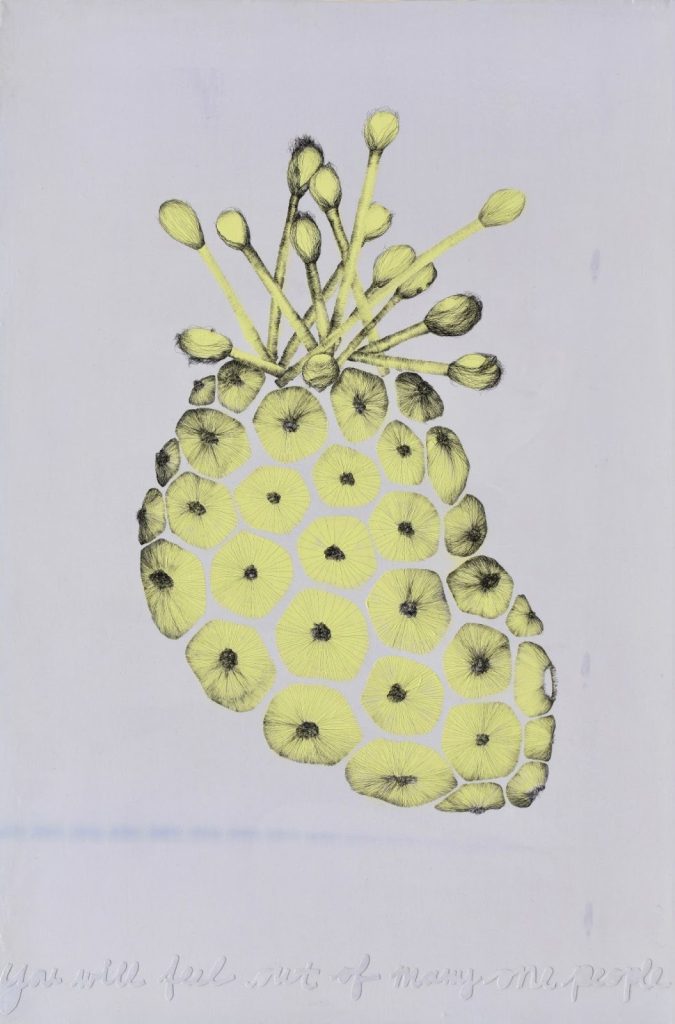
The specific imagery in the drawings shifts into paintings that abstract the botanical forms, increase the scale and employ a soft color palette of blues, greens, oranges and yellows with hints of thin black lines that suggest hair sprouting from the shapes. In contrast to the drawings in drawers, the paintings hanging on the wall provide a more traditional viewing experience. Here, the viewer can better observe the artist’s restrained brushwork. Keeping to her interest in botanical forms and natural symbolism, Ogunbiyi realizes this imagery with a centuries-old material deeply connected to the earth, layering her pieces with varnished Japanese ink. Displayed in the larger gallery, these pieces are given space and light as the viewer moves through the galleries, contemplating the fusion of native environments and materials.
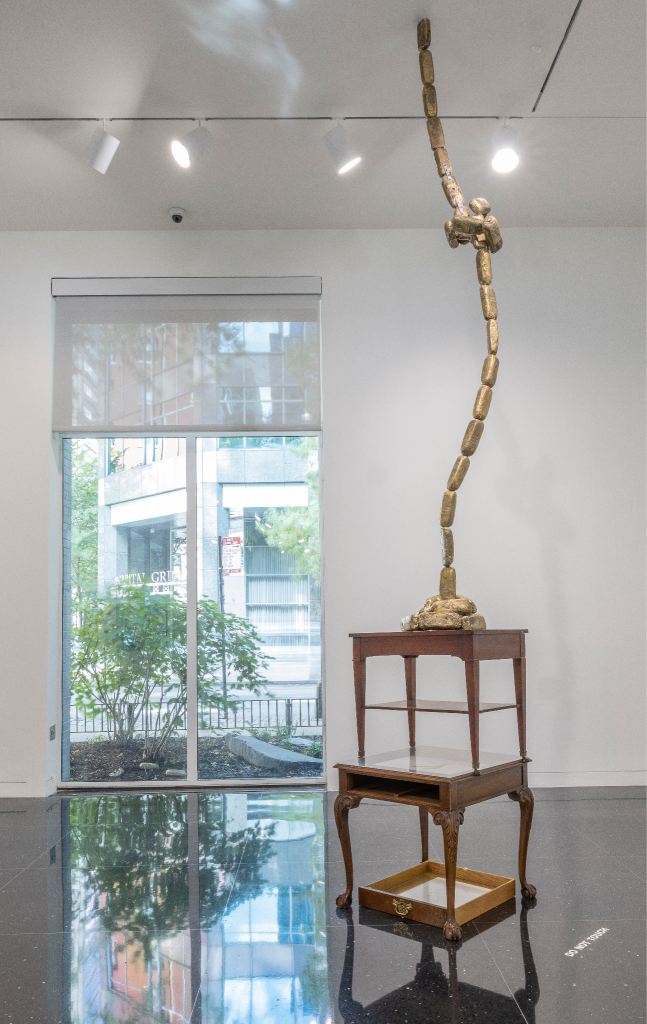
“You will have revelations along felled branches and longer roots/routes” is a sculptural installation that extends as a line, stem, or root from floor to ceiling, also displayed in the gallery’s main space and visualizes the artist’s ongoing repurposing of materials into natural forms. Building with copper alloy and carefully placing crystals on the surfaces of discarded plumbing materials, Ogunbiyi reshapes them into grinding or millstones, ochre for painting pigments, and plants for medicinal purposes, among other uses. The use of millstones has been dated from the Stone Age through the 19th century and remains in use in some indigenous communities. Speculating for a contemporary audience, we may see the presence of the millstone here as a symbolic reference to women’s labor as the “millstone represents pain through sacrifice of grain, death and the creation of new consciousness as a symbol of rebirth.” Copper, a natural earth metal also present in the human body, symbolizes the qualities that Aphrodite/Venus is known for: love, beauty, and female energy characterized by creativity and (“mother”) nature. Reading “sweet mother” engraved into the stones leads the viewer to consider questions about women’s labor, connections to making, and the materials used in these processes. Might the stone, no longer an essential tool, be used in its original purpose and also transformed into a tool to educate and build community?
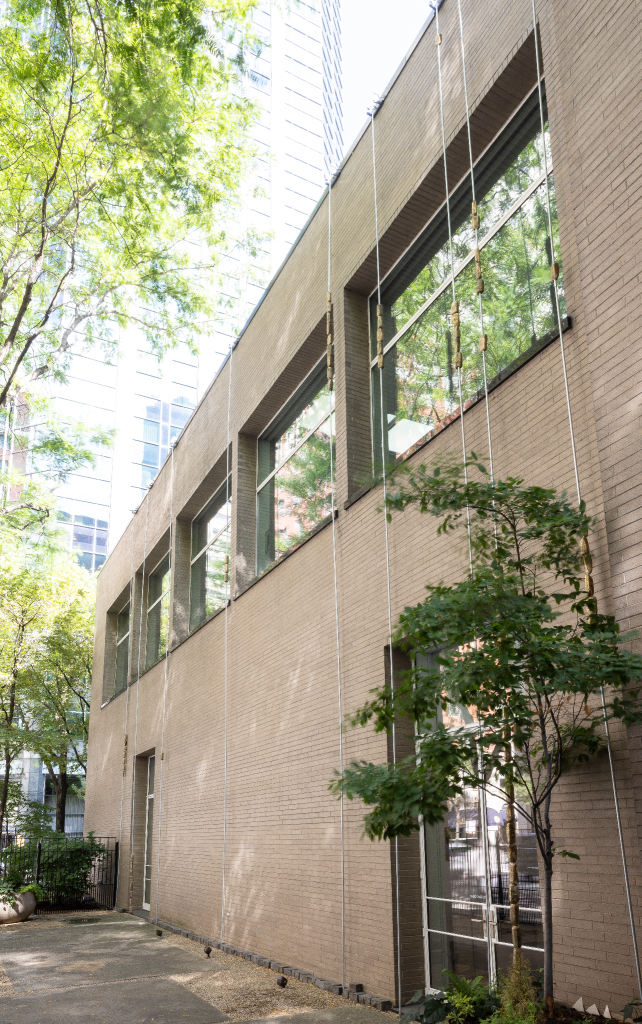
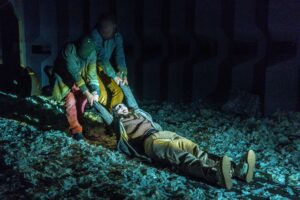
You will count those whose names you may never know (aba-cus) is an impressive sculptural installation in the garden area of The Arts Club, spanning the entire height of the building. The stones are mainly suspended toward the top of the poles and visible from the upper gallery windows, as if floating within the window frame, while several stones are scattered on the soil. The poles supporting the millstones are transformed into representations of abacus beads. The large-scale structure, with mostly unreachable beads suspended on a linear frame, recalls her use of line as a metaphor for a root, hair, route and stem. The word count contains multiple pertinent meanings for this piece. Are we counting on these “names you may never know” or counting, as represented by the form of the ancient calculator? Either way, it seems that the artist is reminding us to value these transitory, faceless beings, a particularly cogent idea in our current American climate of government-sanctioned kidnappings, inadequate access to medical care and food, among other social ills. The artist states her directive in the title, offering the viewer a moment to consider this behest.
Ogunbiyi’s work here demonstrates her ongoing investigation into envisioning, constructing and transmuting metaphor with her interests in cultural anthropology, geography, land-based materiality and symbolism.
Temitayo Ogunbiyi’s exhibition You will have revelations along felled branches and longer roots/routes is on view at The Arts Club of Chicago from September 17 – December 19, 2025.
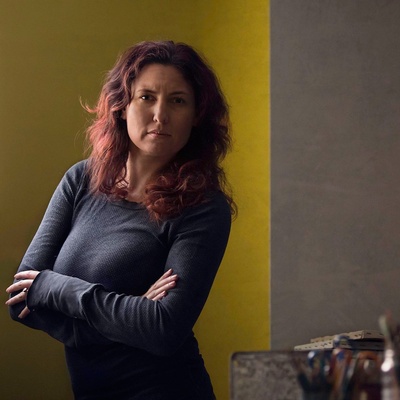
About the author: I am a Chicago-based artist, curator and writer who earned a MFA in Painting and Drawing from the School of the Art Institute of Chicago (2002) and a BA in Art History from the University of Illinois at Chicago (1995). My work has been exhibited at many Chicago-based spaces and I have been a recipient of grants from 3Arts, The City of Chicago Department of Cultural Affairs, The Hyde Park Art Center’s Artists Run Chicago fund and the Illinois Arts Council.
I am director of boundary, a contemporary visual arts project space founded in 2017, located in my renovated garage. boundary was included in the Hyde Park Art Center’s Artists Run Chicago 2.0 in 2020. In 2021, I was a member of The Center Program residency cohort at The Hyde Park Art Center. In summer of 2022, I was a visiting artist at Chautauqua Institute. I have taught at several colleges and universities in the Chicago area. A limited edition artist book entitled Invisible Labors, co-authored with Melissa H. Potter was released in Spring 2023. My future endeavors include a lecture at The Field Museum; A. Watson Armour Seminar series and preparing for an exhibition at Cultivator in Spring 2024 and planning exhibitions at boundary.