A dot. A dash. A droll squiggle. A drawn boundary delicately blurred. A dazzlingly meticulous magnet for the eyes.
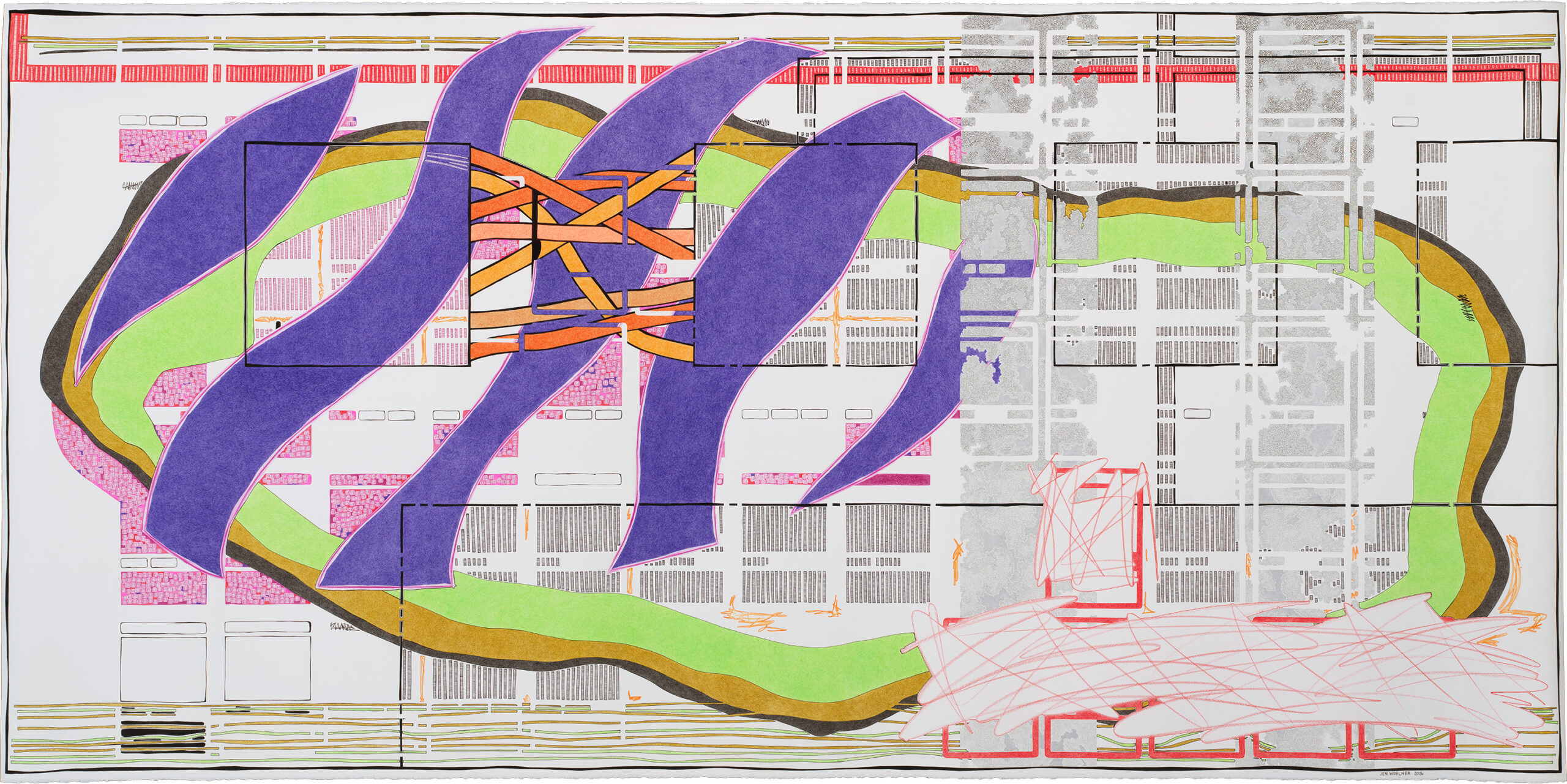
Unpuzzling the geometric planes of a Jen Wohlner piece is a feat sparked by curiosity and sustained by gradual astonishment. Spirals, semi-circles, and hatch marks march—or, at times, dance—across the canvas, some resembling dizzying motorways while others echo architectural blueprints. Parakeet green careens into lime; a grid of sky blue is gilded in saffron. Comprised primarily of fine-line ink and colored pencil marks, her drawings betray a keen attention to detail that both bewilders and beguiles. Unabashedly abstract, but unafraid to bat a lash at figuration, Wohlner’s image-scape is buoyant but brainy, as suddenly felicitous as it is fastidiously composed. What can visually approximate the incredible precision of large-scale data systems—informed by the artist’s previous experience as a software engineer—is never cold or antiseptic, but warm and alive, betraying the affectionate, yet steady, marks of a devoted human hand.
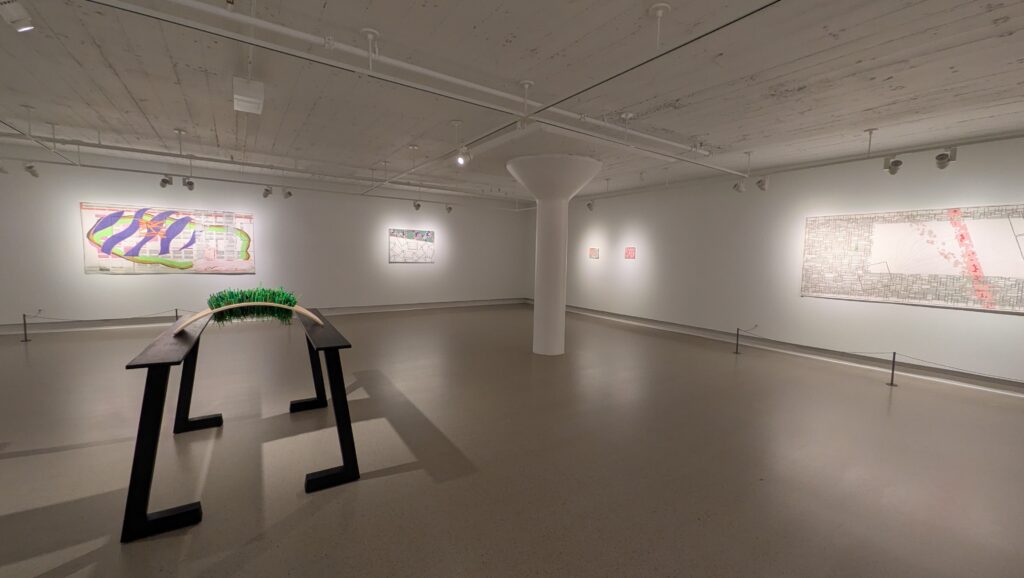
In BINGO!—Wohlner’s first major institutional solo exhibition since earning an MFA from the Art Institute of Chicago in 2024—what stands out most is the variation in scale; the smaller pieces, many of which appear in a series, are about the size of a kitchen cutting board, whereas the largest pieces are the size of hanging tapestries or a panoramic landscape painting. Navigating the gallery, these differences in scale contribute to a generative uncertainty about the artist’s process of making. The painstaking nature of Wohlner’s mark-making—which, from a distance, seems so seamless as to appear computer-generated—becomes even more stunning when viewed at a larger scale. What constitutes as figurative versus abstract might also change depending on one’s distance from a canvas. What looks like a tropical-hued flip-flop or bikini from a few yards away resembles a voluminous grid of squiggles close up; similarly, a map-like body of water looks more like cells dividing in a petri dish when the viewer draws near.
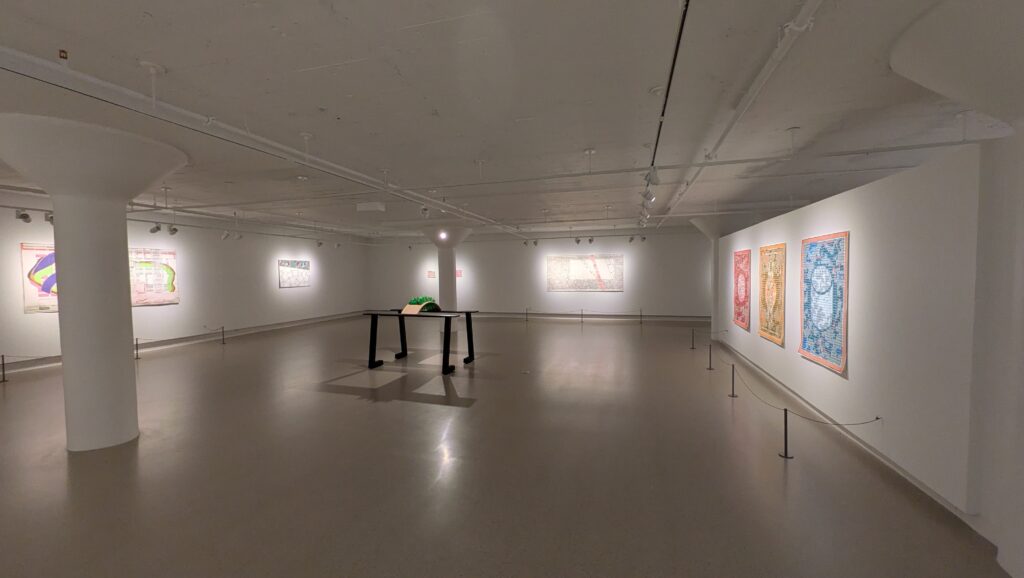
At the entrance of the gallery, Wohlner’s smaller, serial works cumulatively achieve new effects, as though training us to fully see, inspect, and speculate on the giant pieces to come. Arena 1 is a rectangle divided into four rectangles, divided into smaller rectangles and squares. From a ways off, the deft pointillism approximates digital pixels; up close, it’s clear that not all dots are actually the same size. The black specks resemble kiwi seeds; the green ones grains of sand. As a whole, the design is redolent of an Art Nouveau window or East Asian textile. A bit larger, Arena 2 toys with the rectangle again, above a field of amorphous concatenations, archipelagos of black and white with red, chestnut, and rust brown splotches. The uniformity of the pencil stroke that fills in each designated shape is so consistent, it fools the eyes, resembling laser printer ink. A lone circle hovers toward the center like a transparent eyeball or blank soccer ball.
The Must-win game series that follows features the circle again; in the first pen, ink, and colored pencil drawing, the circle’s dark green outline gives the impression of a fractal-like surface punched through to reveal a white background. The pink, red, and blue at the border lend a zest in keeping with the flags waved during a soccer match. Must-win 2 brings in a larger circle, as though we are zooming into a shaggy field. Sans outline, this circle looks more like a communion wafer or poker chip placed on top. Must-win 3 expands on the motif of shapes and forms that compete for our attention, the circle appearing moonlike against a kelly green sky.
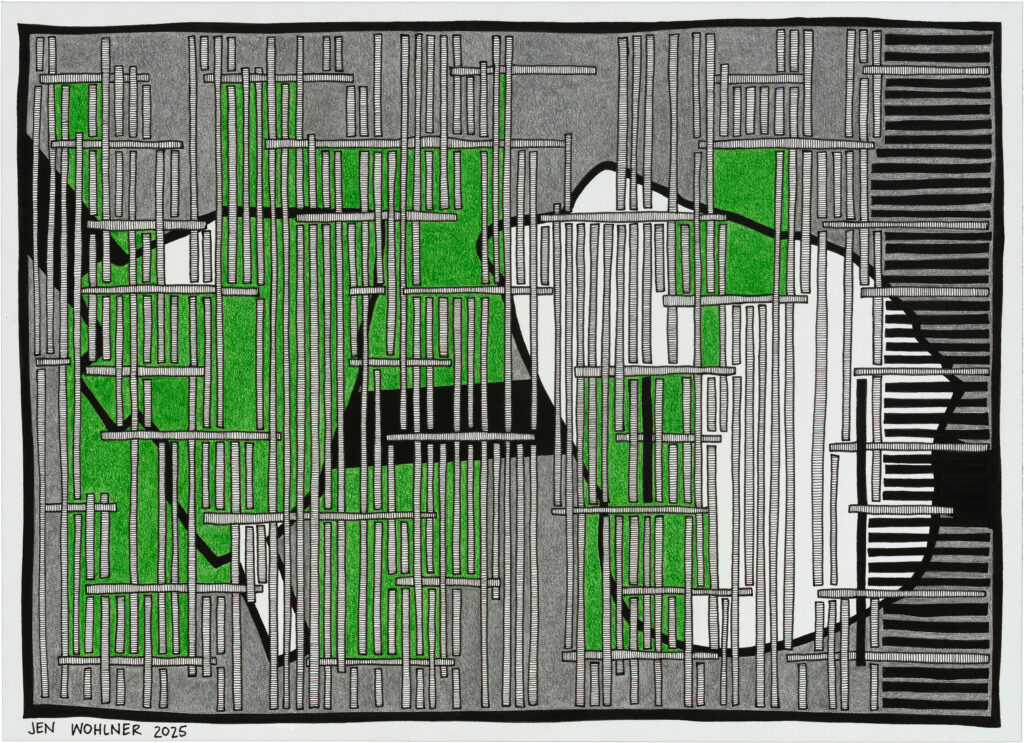
Another series of smaller works, Reflecting on my limits, foregrounds how personal or physical precarity might be organized and made sense of. Reflecting on my limits (in traffic) presents a grid of blocks layered with frenzied, warped rectangles of parallel lines, occasional red horizontal strips suggestive of anxiety—or even, in a figurative turn, sudden brake lights at night. Reflecting on my limits (in the suburbs) presents a more orderly mishmash of skinny rectangles over green and gray, the right edge darkening like the bars of a jail cell, hinting at a feeling of entrapment. Reflecting on my limits (outside) brings in lime green and sable brown; as white space peeks through, the field appears more open than the others, equanimity restored.
On the back center wall, one of the largest works Jill and my anticipation of what Mary Grace might achieve, stretches to over ninety inches and explodes with color. The claustrophobic lines of the smaller series give way to a more free-wheeling negative space; so, too, does the color palette shift from earth tones and reds to an array of pinks, purples, peaches, and yellows that Lisa Frank would appreciate. While from afar the canvas beckons with splashy femme ebullience—a tangled web of neon oranges resembling shoelaces or summer straws—up close Wohlner’s signature squiggly rectangles reappear like an aerial view of a massive parking lot. In the bottom right corner, thick loose pencil strokes burst from the regimented geometric field, as though liberated from the regimented grid. The most ambitious piece of the show, the piece feels both neurotic and joyful, layered in dimension in tension with its humble medium. “Mary Grace” (and the eagerness to know what she can accomplish) seems to propel the artist out of her common mark-making pattern.
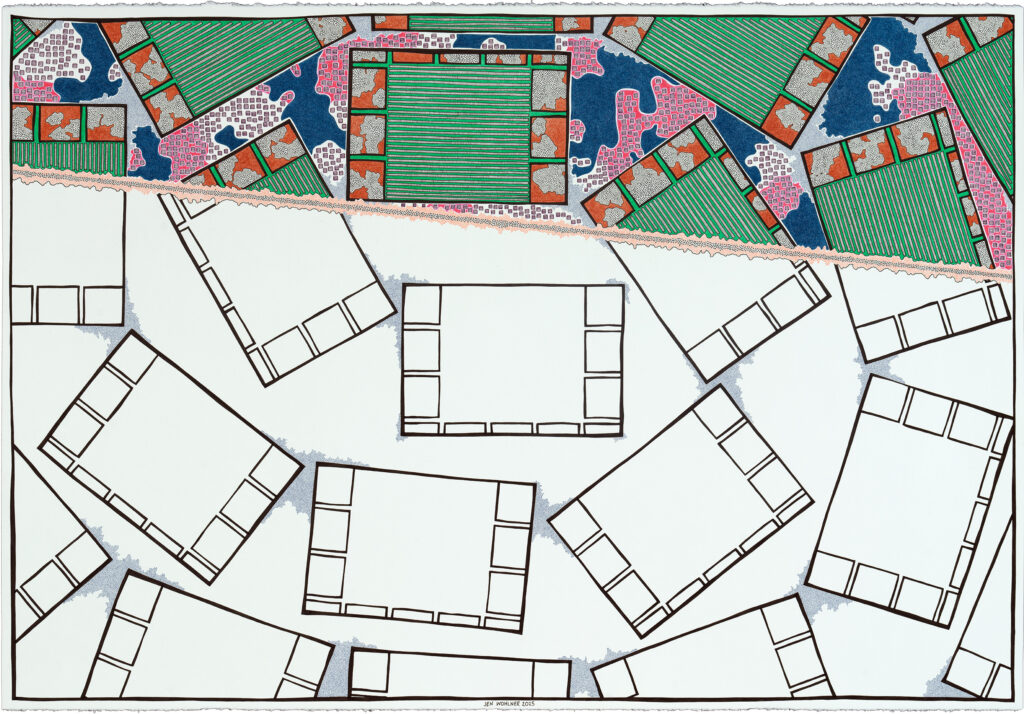
Feeling confident, but struggling all the same, another giant horizontal drawing, divides the canvas into two parts; the top third presents a handsome array of rectangles and lake-like blobs in an earthy seventies color palette, and the bottom two thirds presents the same rectangles in outline only on a daringly blank background. Between the two sides, a crenulated diagonal line with what appears to be an electric charge comprised of tiny stipple marks. To the right of Feeling confident, Becoming aware of my psychological limits through sports maximizes negative space with a blank rectangle off-center surrounded by hundreds of tiny triangles. Within the negative space, finger-link branches appear in the middle, marked by rough Xs and Os that look like a coach’s rapid scrawl upon an otherwise immaculately sorted plane. Here, as in Wohlner’s other large-scale works, the visual boundary between colors, lines, and shapes reflects the artist’s endeavor to acknowledge and control anxieties great and small but also push past them in a more effusive, freewheeling visual language.
“I employ drawing as a material strategy for ‘Queering memoir,’” reads the artist statement at the gallery entrance, inviting viewers to consider the extent to which conventional expectations of self-disclosure rely on a hetero script. Wohlner’s drawings may withhold scrutable people and objects, but they do not withdraw from human intimacy, and the presence of the artist’s hand—and painstaking labor—suggests a vulnerability in keeping with BINGO!’s ruminative, presumably autobiographical titles. If these titles—like Feeling confident, but struggling all the same or Becoming aware of my psychological limits through sports—seem in fruitful tension with the patent lack of figures depicted, it is only to prompt one to sleuth out visual clues—color, line, and shape—that might relate to the artist’s psychological experience and larger kinship network.
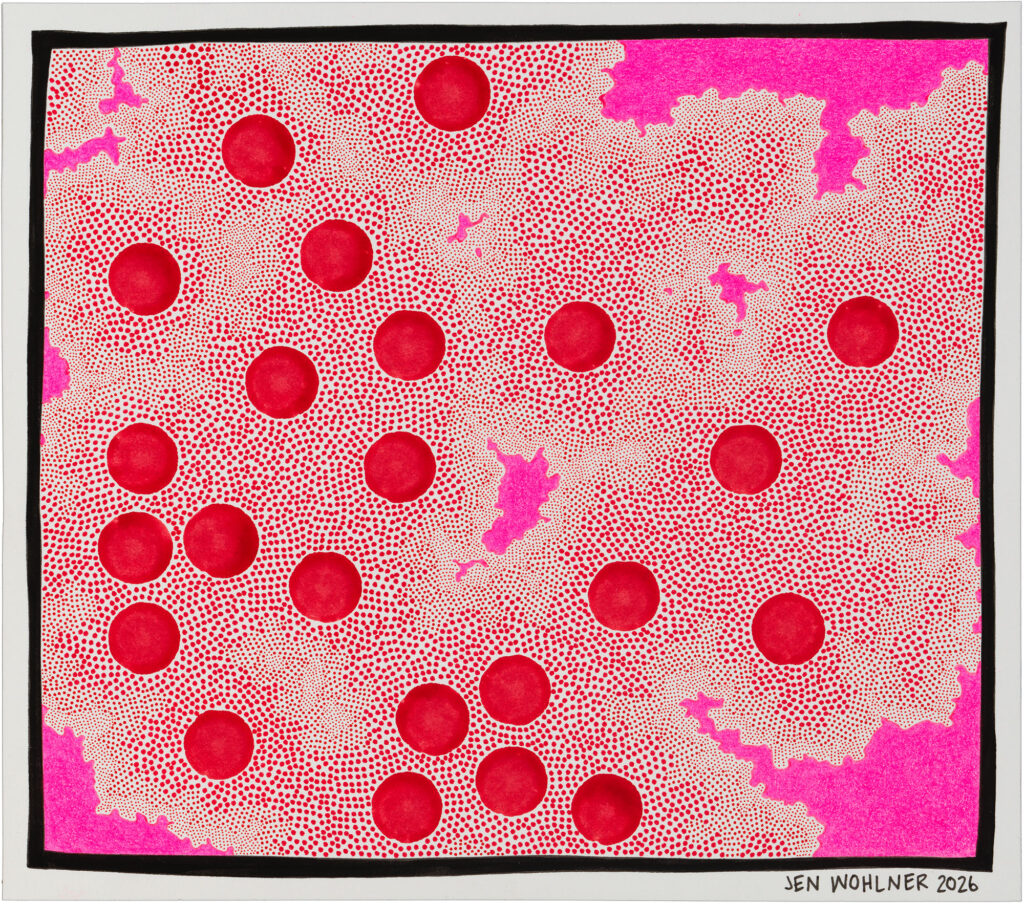
The title BINGO! literally gestures to the bingo-dauber marks that dot the surface in two works, but might also allude to a kind of kinship—or sudden win-win—with the artist herself as we move through the show and come to grasp the depths of her creative methods. On the opposite wall from the Arena and Must-win game series, the BINGO! series reverses the earlier empty-circle motif with bright orange and pink Dab King ink. The dauber dots are playful and not entirely uniform, a less predictable form of mark-making than Wohlner’s assiduously executed stipples. It is as though, after the experimental, looser process of creating the larger canvases on the center wall, the artist has allowed herself a rapid dauber gesture, excited to “fill the Bingo card,” so to speak.
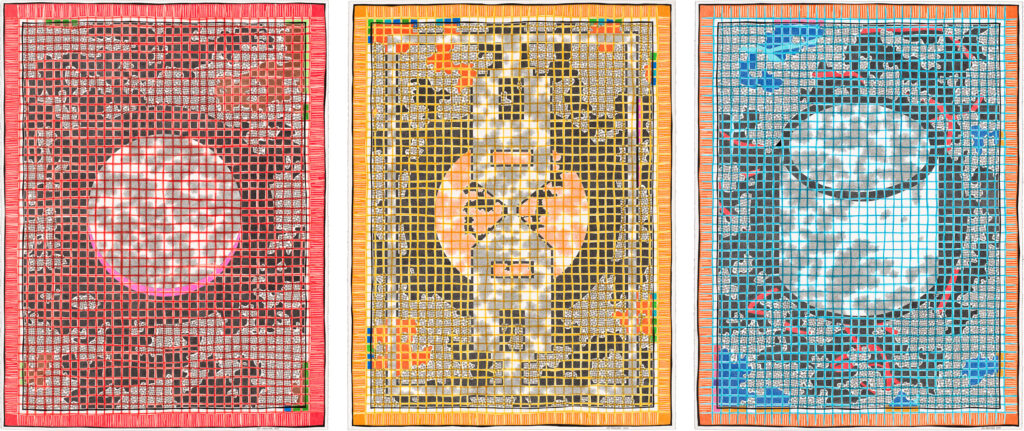
This sense of self-awareness culminates in the majestic triptych Me as hot, warm, and cold storage tiers, which dominates the final gallery wall. Red, orange, and powder blue, each piece hangs fifty by thirty-eight inches like a psychedelic quilt; the overall lineation softly accented with watercolor pencil, revealing grids upon grids upon closer inspection. Named after the ways that computer data is hierarchically stored based on its performance, cost, and frequency of access, the trio implies how the artist’s mind and body are taxed by various pressures and activities. Yet all three “tiers” are equal in size and visual complexity, as though Wohlner is negotiating which of these modes is in fact the most demanding. The final, “cold,” tier is further framed in orange and features slivers of red, as though the artist can never entirely “shut down” the mode most demanding.
Punctuating the space like a garden of glistening caterpillars or glossy cacti, Remember when the summers would not end (in 2026) is positioned at the center of the gallery, offsetting the two-dimensional works on the walls. This nostalgically named sculpture is crafted out of hundreds of plastic ties “planted” into a wooden arch. As with Wohlner’s drawings, from a distance it’s impossible to discern exactly how these shoots of lime and emerald were made. Up close, each blade of grass resembles a woven friendship bracelet, no two the same. The nod to childhood mirrors the innocence of the massive piece Jill and my anticipation of what Mary Grace can achieve, floating above from the nearest wall. Beckoning our fingers as well as our eyes, Remember when… insists that wonder can survive the existential pressures of adult life—and that the line between abstraction and figuration is never as straight as might be imagined.
BINGO! is on view at the Neidorff Family Gallery in the Sheldon Concert Hall from June 12, 2026 – August 8, 2026.

Writer: Eileen G’Sell is a poet and critic with contributions to Hyperallergic, The Baffler, The Conversation, Current Affairs, and The Hopkins Review, among other publications. She is a 2023 winner of the Rabkin Foundation Prize in arts journalism and teaches at Washington University in St. Louis. Her most recent book, Lipstick, joined Bloomsbury’s Object Lessons series early 2026.