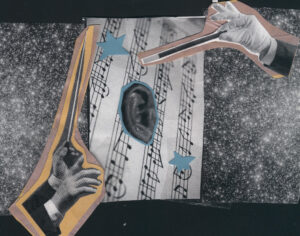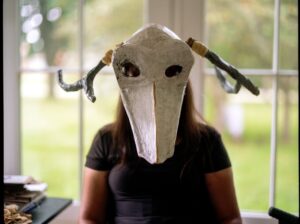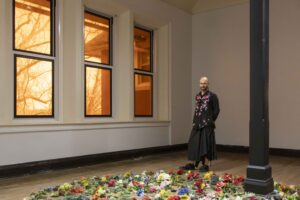
In the spring and early summer of 2025, Simon S. Belleau had a solo exhibition at Letters to Nora, titled Thousand Telephones. The space’s sophomore exhibition approached cinema, time, the performance and consumption of contemporary artistic spectacle with a blunt sensitivity that paid respect to Dadaist and Russian Constructivist cinema as much as modern film and movie-making. Belleau does a remarkable job of positioning all parts of the cinema industry on display, in a manner that is read as its individualized perception, in proximity to its global enterprise. All parts are present. All parts are performed in a manner that makes time sensitive and contemporary politics–and requests that the viewer play along.
I had the opportunity to discuss the exhibition with Simon S. Belleau on Friday, August 1st via Zoom.
Megan Bickel: I’m assuming the title comes from the Bob Dylan track “Highway 61 Revisited?”
Well, Mack the Finger said to Louie the King
“I got forty red-white-and-blue shoestrings
And a thousand telephones that don’t ring
Do you know where I can get rid of these things?”
And Louie the King said, “Let me think for a minute, son”
Then he said, “Yes, I think it can be easily done
Just take everything down to Highway 61″
Simon S. Belleau: I was surprised by the first question, because it’s actually not coming from Bob Dylan; but I was so happy that you found that. My work is so connected with popular politics and popular media. But, I didn’t know this was a lyric of Bob Dylan, which I love, actually. [It helps to start at the title because] the exhibition in some way is a variant of the exhibition, Répliques, that I did in Montreal at Fonderie Darling, in 2024. The title isn’t fully translatable to English. You can use the word “replica,” which works word for word, since it refers to a copy of something. [However], in French, it has this double meaning. It’s the copy of something – the replica – but it’s also the line that actors and actresses exchange.
In a conversation with Julian and Megan [of Letters to Nora] we felt it didn’t have the same aura in English. So we tried coming to a new title for the exhibition and we [landed on] the telephone game (in the main film presented in the gallery, the actors are directed through an earpiece by the director’s voice—that is, my own. The whispered lines make it difficult for the viewer to determine whether the repetition is accurate or not, hence the telephone game). Part of the reason we added the “thousand” is that I’ve always been drawn to A Thousand Plateaus as a title.1 The funny thing is, I’ve never actually read the book—it’s just not the type of reading I go for. Nevertheless, I love the title, and the subject works as a kind of link through the layers of time that is everywhere in the exhibition. [In] the layers of Self-portrait as a table (2025) you see the accumulation of time and the plateau, [which serves as] the stratification of time, the visualization of time that I really love.
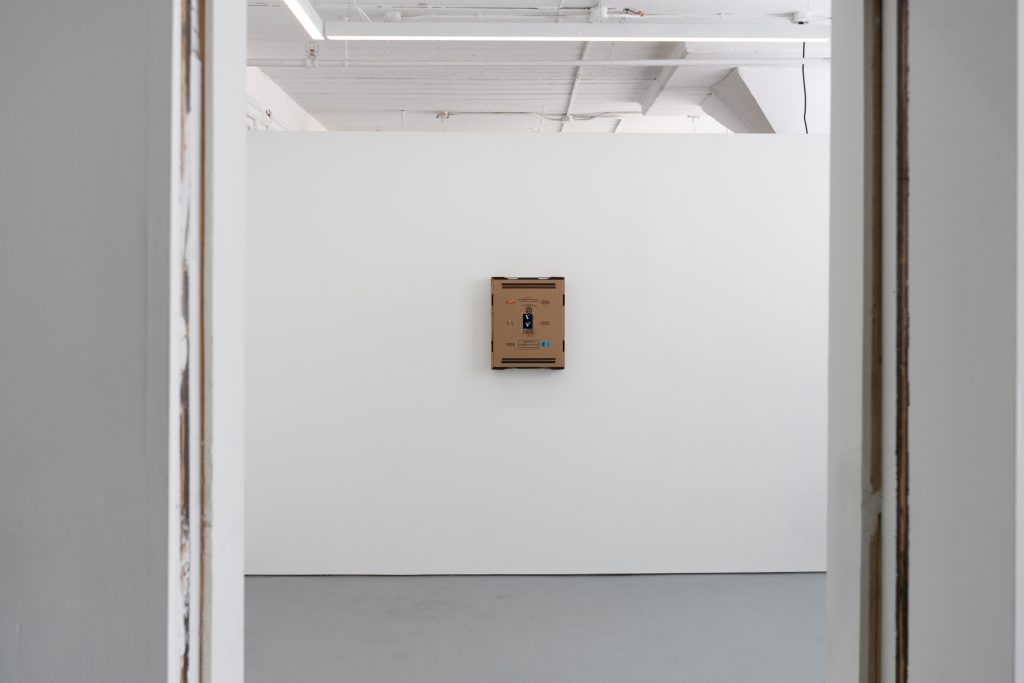
MB: At the end of the exhibition narrative, you mention a quote by Jean-Luc Godard,2 “Cinema is a box in which time is locked.” Craft here is presented in the same way that Godard prioritized: a materialist approach that announced the fiction and made-ness of the visual artifact, often exposed with plentiful jump cuts and nonlinear storytelling. It’s clear that the craft of the exhibition is critical in revealing the truth of itself. What value do you think the announcement of the truth of the work; the made-ness of it, brings to our current moment?
SB: I’m wondering what you mean by “exhibition craft” and if it’s just the material meaning, like, the actual material of the exhibition?
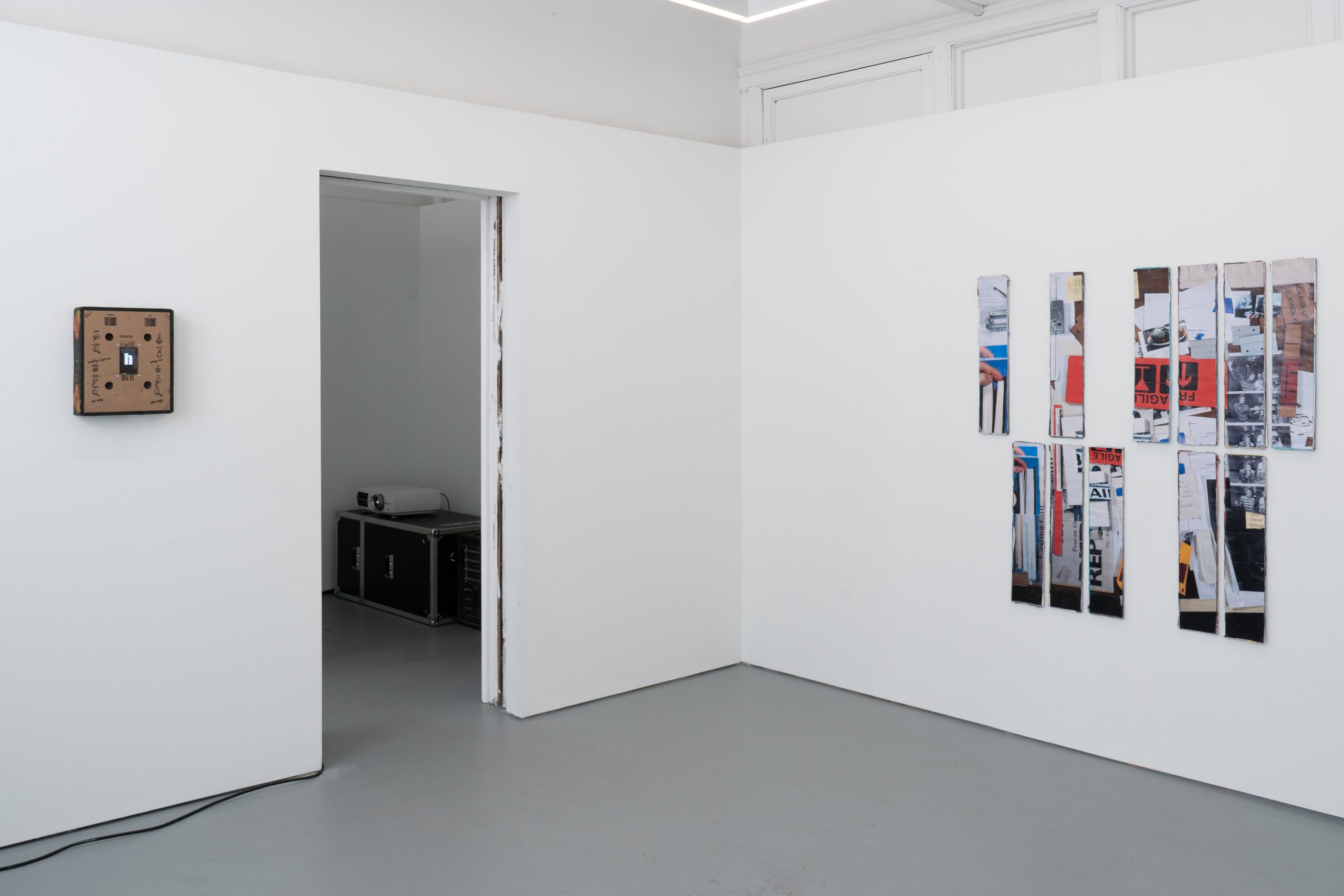
MB: Yeah, I think I was referring to the tactility of the exhibition– the visibility of the parts. Right? The use of cardboard, the use of the compressed prints that had been cut out and placed on top of one another. Right? The visibility of the projector, the visibility of the wires, the red lamp. I was thinking about early Surrealist cinema, where we have all of these cuts in the film, think Richter’s Ghosts Before Breakfast (1927). The material and actions taken to the physical film are as much of the story of the film.
SB: Yeah. Yeah. So that’s what I thought. However, you connected it with an idea of “truth” or “false” when you observe[d] the made-ness that you mentioned. It’s quite interesting because I’m never thinking about “truthiness” and “falseness,” in any way at any time in my practice. I’m not thinking about truth / false or even about fiction and reality. It is very super interesting, but not something that is in my psyche.
Though there is something in material truth, though. I love that you mentioned early cinema. The Dadaists and stuff like that. I’m thinking about [the] Russian Constructivists. You see the film and, of course, as you say, you feel the material of the film, but you also feel the set. You feel the costume and you feel at first glance that you’re looking at something. It’s entertainment. I think in the last decades we lost that because I think that in a weird way, we need the disbelief. [Perhaps] we think we want things to be perfect. In cinema [most] perfection [comes in the form of] CGI and all that. I think in a weird way, it’s doing the opposite effect, you know? [The false is becoming the true, and vice versa]
Coming back to Dadaism, there is something that always influences my work, I don’t know what to call it, but it’s like a [Bertolt] Brecht-kind-of-method where everything that is on stage is visible, right? Brecht was famous, of course, for not hiding the set and the apparatus and the mechanism. You could see the technician, you could see wires, you could see and everything else. I’ve always been really fond of that method because the question remains: “Why would you hide a wire?”—and honestly, in the end, I have no answer, you know.
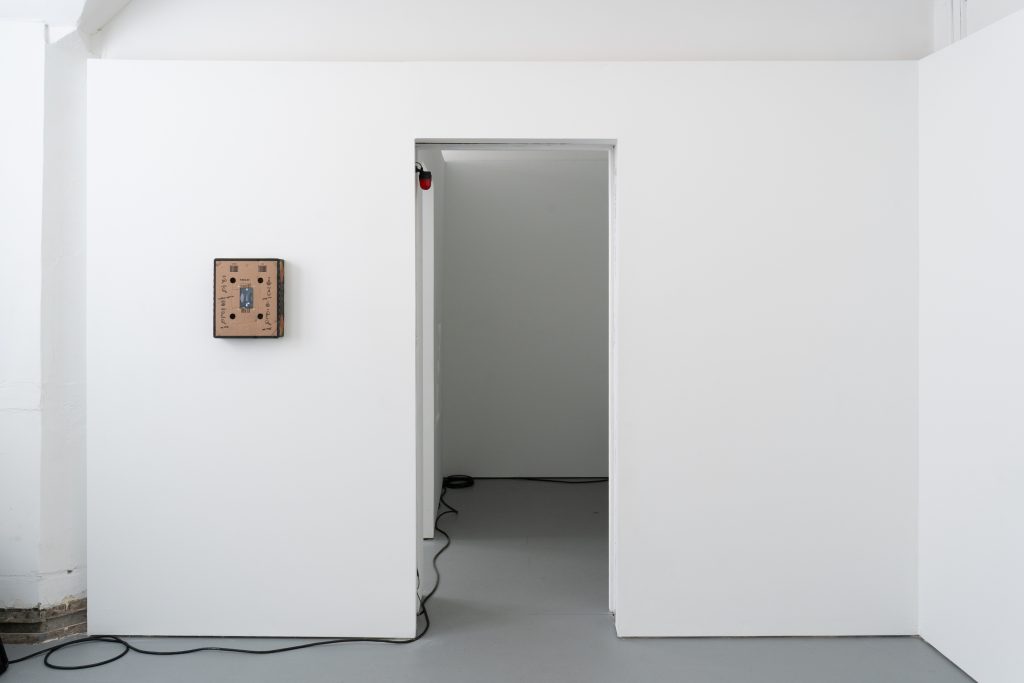
Why would you hide the projector? Actually, I have no real reason to hide it. So it naturally led me to enjoy letting people see the whole mechanism, and that comes through in both the video and the materials. You mentioned the “truthiness” of material—but the boxes and paperwork come from a time in my life when, honestly, I just had no money. I still wanted to make things, though. These grocery boxes and recycled posters were all around me.
MB: It can also be both of those things, you know. We can hold space for these theoretical and artistic literalisms, whilst being earnest about the space with which they were constructed. If I can be frank in where I was coming from: In my practice, I often consider illusions and allusions; and thus imagery that’s dependent on varying ideas of truthiness, fiction, and deception, and so I probably seek that out. As I was reading the exhibition narrative in preparation to see the show, I kept returning to propaganda–how power presents information–and where that’s made present in media and politics.
What’s interesting now, is that in reading the texts, it felt like it was sitting right on the surface, right? The consideration of consuming propaganda, dissolving or resolving it, and then releasing it, I guess. It felt like a performance of what it means for a person that’s existing in this world, with also friends and lovers and intimacy. Right? How do we consume all of those parts? I think that’s where I was coming from with this conception of truths.
SB: Media and politics are everywhere in my work. I’m interested in the mechanisms, the tropes that shape a speech, what makes this or that—it’s very entrenched in what I do. It’s definitely connected to a certain kind of illusion and disillusion. I might be bugged on the word truth and false, but there’s definitely some kind of illusion and artifice. I think the work [from the show] makes us aware that propaganda.
MB: I left feeling as if mediation and feigned intimacy in cinema work, here, as a liaison for a contemporary social posturing that always seems rather precarious. After seeing your exhibition and hearing whispered lines echoed by the actor presented to me, I couldn’t help but consider a parallel experience: Observing US citizens (myself included) become increasingly aware of the workings inside their government, due to their witnessing of its unraveling deeper into its specific fascism. In “Thousand Telephones,” pronouncing craft voids our capacity for belief, and there is something euphoric or refreshing about that.
SB: Yeah, I love it. I think it’s the anchor of much of my work and practice, and of that exhibition as well. Again I’m going back to something very Brechtian, [you decide to choose] a position, [and then] you decide to show all of the tropes.
MB: Absolutely.
SB: The spectator has a crucial role to play in all of this. I think it has to come from a sort of shared understanding, an agreed-upon arrangement that a spectacle is being made [there is no spectacle without spectators]. In the end, any form of spectacle is a trinity of mutual dependence: the spectators, the performers, the stage, the technicians, the producers, everyone. Ultimately, each person is simultaneously spectator and participant.
MB: You referred to the gallery as a set earlier, and now you’re referring to the stage. [If I could contribute], I’m also considering: is the dance floor also applicable? A space where all of the bodies together burst out in both performance and consumption of [the spectacle].
SB: Yeah. They are all simultaneously actors and spectators, performers and audience. It’s interesting too, the set and the stage are different, but they are the same things. I grew up on movie [sets]. I worked [approximately] fifteen years as a scenic painter on movie sets. I was very young, eighteen or nineteen, working in a place where the set transformed into a stage the moment the camera crew arrived. So I have this [unique] understanding of a plateau or a movie set where I was also a participant in the construction of that thing. So I have this [unique] understanding of a plateau or a movie set where I was also a participant in the construction of the image. So weirdly, I think my position is [not too dissimilar] to your dance floor analogy: simultaneously performer and spectator. I love that kind of parallel to dance [floors] actually, it’s a communal thing for sure.
MB: How then does the audience participate? Is the hope that they participate in this interior way that they make a narrative for themselves? Or is it more tangible?
SB: I would not put it in the tangible category. I don’t think I’m the kind of artist who does interactive, immersive work. Perhaps the [participation] comes from a viewer’s point of view where you understand that everything is fabricated. Going back to the Dadaits, the idea is that you realize you’re a spectator. the idea is that you realize you’re a spectator. When you truly grasp that something was made for you, or that it was deliberately constructed, I think that, metaphorically, is the audience’s participation.
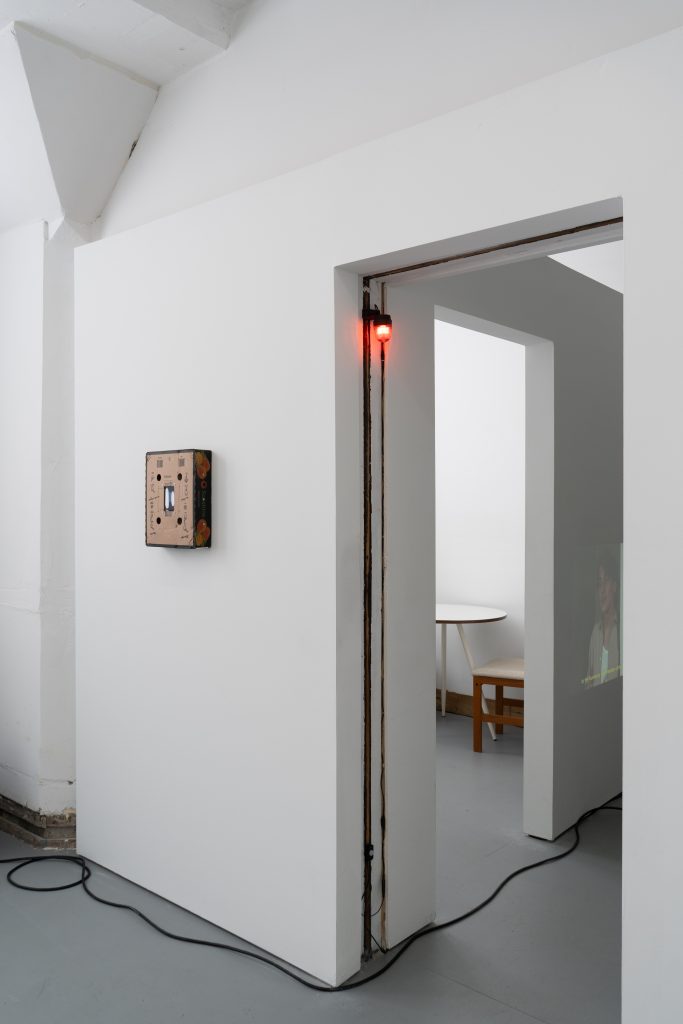
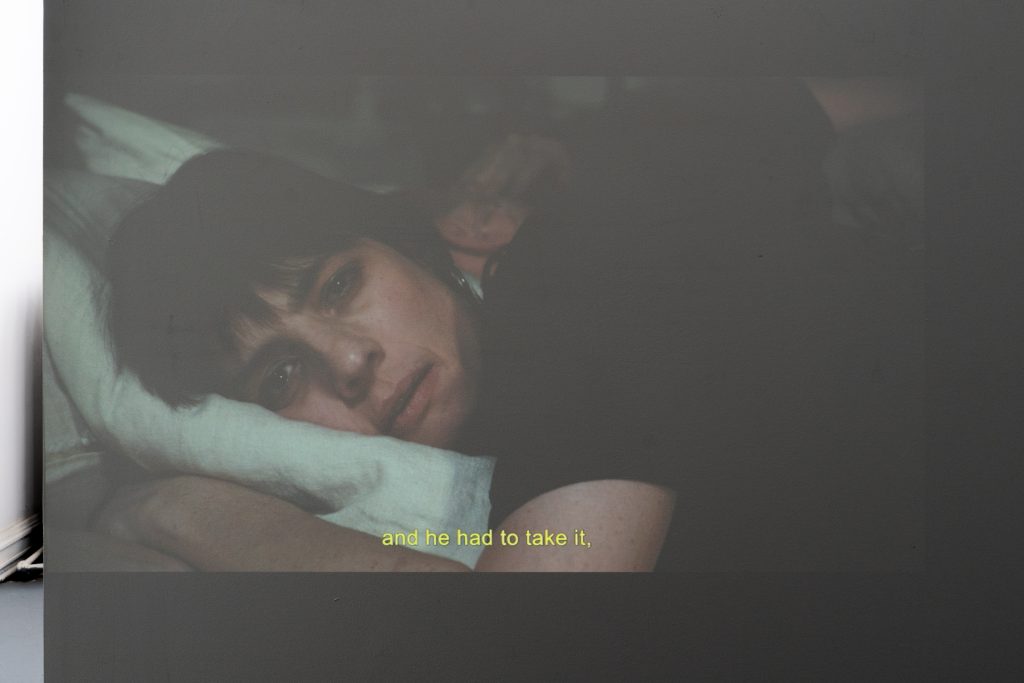
It’s that light [in the exhibition] when you enter that turns red, right? It’s the visible wire and where it’s connected. Right? It’s even in the video. There’s no convincing the viewer of the role or the act, or the [position] of the actor and actresses. They don’t know their lines. You know, I’m whispering the lines and you can see the earpiece, and then you hear them repeat the line. There’s no magic. So I think the participation is more theatrical in a way where we could all exchange roles, you know,
I could be the audience, and you the performer.
MB: Cultivating a space where the viewer is as much entrenched in the filmmaking as the person on the screen and the person inferred to be behind the camera.
SB: Yes.
MB: How is the construction or utilization of time important in this work?
SB: It’s everywhere. Yeah, I think it’s everywhere. Going back to the start of our conversation, I think this is evident in Self-Portrait as a Table (2025). You see a single image, a single window, but in fact, there are twenty more layered behind it, referring to the way the papers in the work are stacked in layers. So, time appears everywhere, playing out not just linearly but also vertically. Coming from a time-based practice over the past fifteen years or so, this has been my primary focus, it’s my main material. I’m interested in how images and words both attach to and drift away from time.
It’s also in the content of the images you see. Flies Dial I (2025) shows a flytrap, it’s a photograph from my studio taken in February, during winter. This is a specific period in time, very visible and tangible: insects trapped on something at a precise moment. That’s what you see right in front of you. But if you move slightly to the right or left, diagonally to the work, you notice a different layering of time in the paper itself. The same applies to Self-Portrait as a Table. It marks a position in time: my studio table with all its mess, papers, and so on, which in itself is already a pocket of time, it’s me, working in my studio. Then, if you shift a bit left or right again, you encounter yet another form of layering, outside the time captured by the framed photograph. I think I’m interested in [how] time transforms. There’s also the way that time can be accelerated or squished. Even the red light, [which] is probably the most direct way possible to experience time. You enter the gallery, it turns red. When you don’t move, it turns off.
When you move to the other gallery room, it comes back on. It’s a marker. I’m interested in these markers of time. It may also come down to a fascination with video editing, and annotation. I’m someone who annotates a lot, and these annotations become markers of time, giving me a kind of Joan Didion moment.3
And I love that because they are both markers of time and markers of thought. This is a marker of time and it’s also a place to forget. Yeah, so time is everywhere. [To return to the exhibition narrative], I wrote it without seeing the space. I wrote it [as a means of] imagining a scenario where you walk into space. There’s an element of script writing. Which is again connected with time-based workings. For me that is one of the most important things: how I manifest, [or] imagine a sequence of images to write. Julian wrote [“In the Cold Winter Night Somehow the Air is Thin”] without seeing the work. I loved this intertwining of writing about each other, writing about the space of each other without seeing it or living it.
MB: I thought the exhibition narrative was particularly interesting. [Especially] if we think back to the communal construction of the exhibition that we were thinking through earlier. The relationship of the viewer to the filmmaking, in the set, as it were; because obviously if this narrative is a script, then the assumption is that the viewer becomes the actor and is performing their lines. There’s this idea of having a director dictate where you go and what you consider while in the exhibition. Which of course, is what any curatorial statement does; but it felt like we were literally engaging with the context of that – as opposed to conceptually or semantically – which I thought was a specific moment. It again points to this materialist approach. We are performing the subject–acting out the acting.
SB: For most of the exhibitions I put together, I write an exhibition narrative. But that was actually the first time in my life that I presented the narrative publicly. It’s [usually] something that I keep to myself.
I usually write the exhibition narrative very early in the process. Sometimes even before having any material. Often it will start with like. . . I enter a room and a gallery space and the narrative is built from that. I was gently encouraged by Megan and Julian to share it because [they felt] it was a great way to present something without imposing anything. It’s more directional, I don’t think it gets very didactic.
MB: I was thinking back on it, and there is a moment when you’re explaining Speech Assistance Machine (Charlie Chaplin’s first monologue, 1940) (2025) piece where you theorize why Chaplin would choose The Great Dictator (1940) to be his first speaking film. The prose wasn’t necessary to the piece, it wasn’t directional, but it was poignant in a way that postured its importance in the exhibition.
SB: Yeah. I appreciate you saying that because I think I felt that this moment was really important, mainly because it’s a really important marker of time in the history of Cinema. The first time language was spoken [cohenrently] on camera was actually in that brief cinematic moment, a speech against fascism. I find it mesmerizing: how extraordinary it is to choose to speak for the first time [and with a new tool], to confront such a profound problem, and for it not to be censored.
I’m looping back to that Godard quote. It’s like that little video box of the whole Chaplin speech, letter by letter: It’s a box in which time is encapsulated.
“Likely unnoticed by the viewer amid the rapid succession of letters and occasional images, they
collectively form Charlie Chaplin’s final speech from The Great Dictator (1940). The video slot
machine runs for 1 hour and 28 minutes before looping back to the beginning :
“I’” “m” “s” “o” “r” “r” “y” “,”
“b” “u” “t” “I’” “d” “o” “n’” “t” “w” “a” “n” “t” “t” “o” “b” “e”
“a” “n” “e” “m” “p” “e” “r” “o” “r”
It’s striking to note that this was Charlie Chaplin’s first spoken film—though he had previously
performed a song with nonsensical lyrics in Modern Times (1936)—as if he had to gradually
adapt to the synchronization of his voice with his image.
Emerging from the silent era, he chose to speak—to bear vocal witness to the realities of his
time—as if the image alone was no longer sufficient.”
– Simon S. Belleau
FOOTNOTES
- A Thousand Plateaus continues the work Gilles Deleuze and Félix Guattari began in Anti-Oedipus and has now become established as one of the classic studies of the development of critical theory in the late twentieth century. It occupies an important place at the center of the debate, reassessing the works of Freud and Marx, advancing an approach that is neither Freudian nor Marxist but which learns from both to find an entirely new and radical path. It presents an attempt to pioneer a variety of social and psychological analyses free of the philosophical encumbrances criticized by postmodern writers. A Thousand Plateaus is an essential text for feminists, literary theorists, social scientists, philosophers, and others interested in the problems of contemporary Western culture. ↩︎
- Jean-Luc Godard was a prominent French New Wave filmmaker in the 1960’s, and a significant contributor to contemporary film theory. ↩︎
- In a section of this interview removed for space, Simon S. Belleau mentions Joan Didion’s “On Keeping a Notebook,” an essay of hers published in Slouching Towards Bethlehem: Essays (1968). A wonderful piece on keeping a notebook and taking notes. ↩︎

About the Author: Megan Bickel is an artist, writer, and educator working out of South Carolina. Their work utilizes various media to assess power, world-building, and the construction of ‘utopia’s. She was the founder of houseguest gallery (2018-2025) and they’ve had arts criticism, science fiction, images, and mentions published in Hyperallergic, Burnaway, Artforum, Anarchist Review of Books, Sixty Inches from Center, Ruckus, and others. She is an Assistant Professor of Painting at the University of South Carolina School of Visual Art, and Co-Director of Tiger Strikes Asteroid, Greenville.