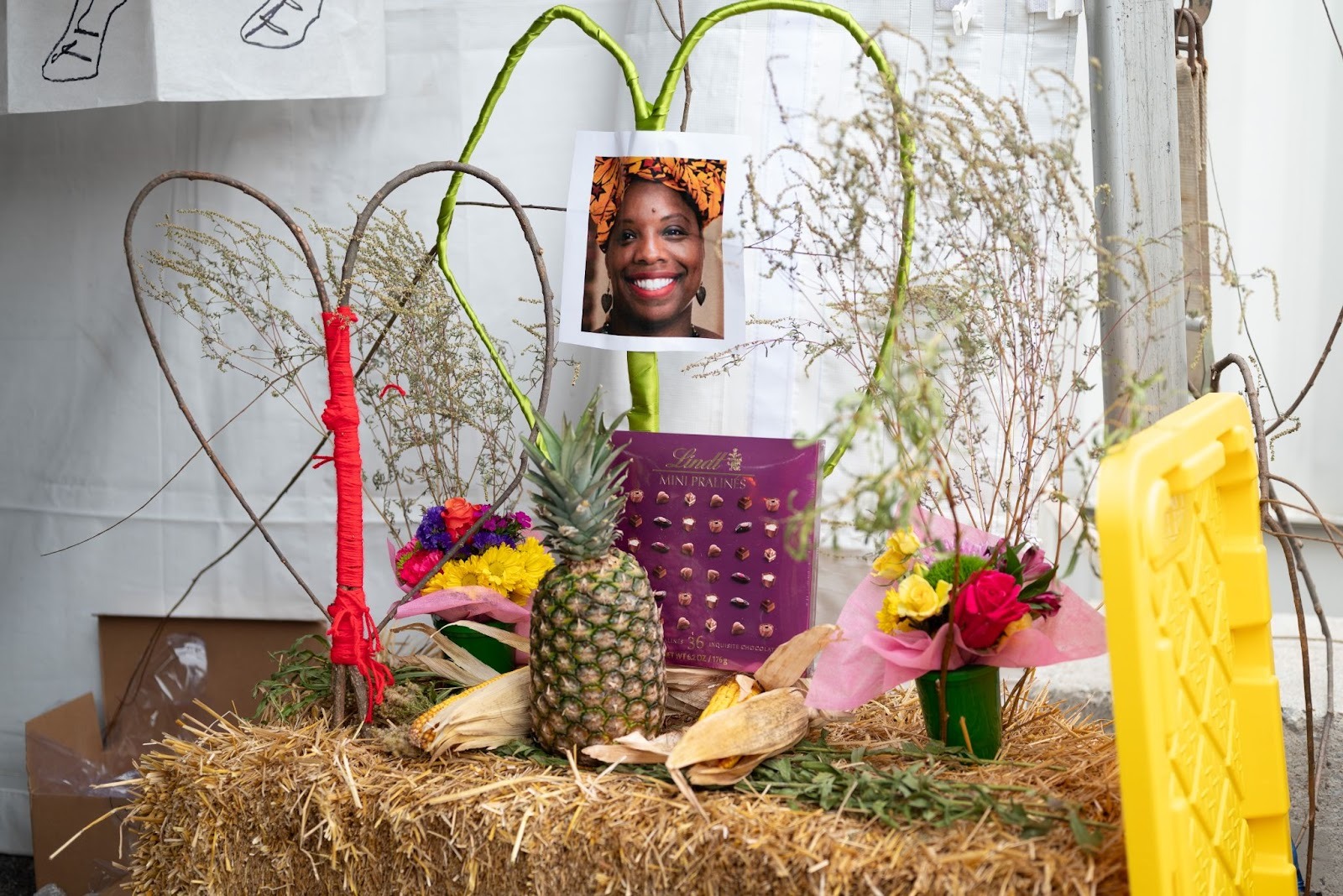
Opening night, downtown, under a large, red circus tent in a converted parking lot, the Circus of Life welcomed hundreds of guests. Spells and divinations made by attendees floated through the space on paper and in chants, calling in ancestors and honoring the bison, the beaver, and the Mississippi, all with the urgency to see the future as it is today. In collaboration with artists, the community, and non-profits, Counterpublic hosts the US’s largest public art exhibition in neighborhoods across St. Louis every three years.
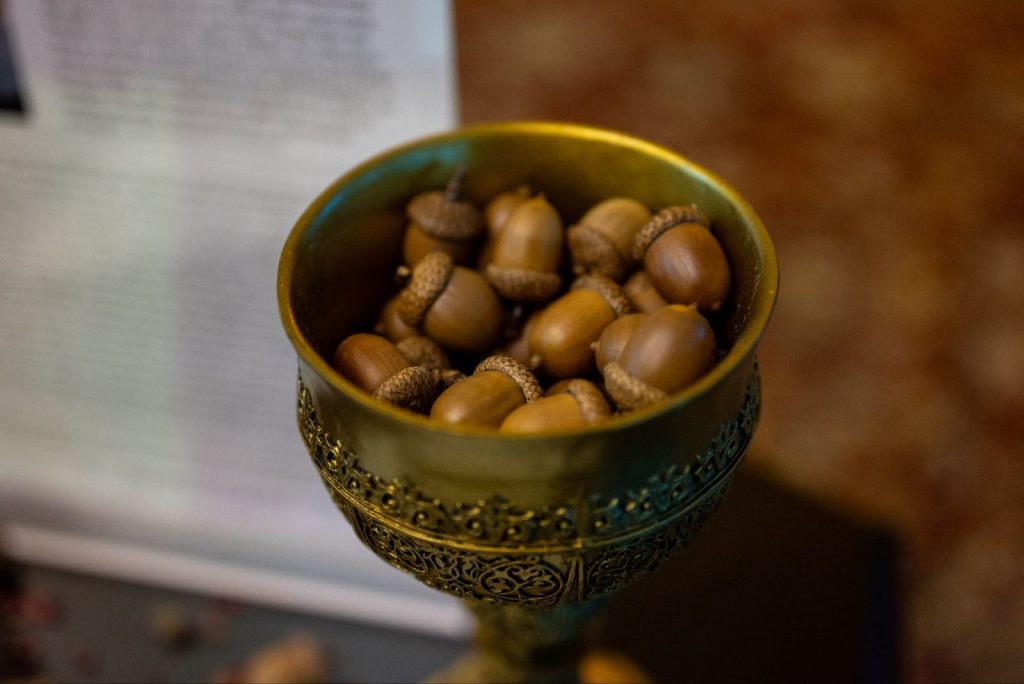
Unlike traditional triennials, they work between exhibition years to reflect an art scene that is not only co-created by the people but also anticipated and desired. By following their mission to foster public dialogue centered on restoration, their work seeks to support the reclamation of all parts of St. Louis and all Saint Louisans. These are not conversations that Counterpublic seeks to avoid, but rather to amplify and put on the public stage. This commitment can be witnessed in their inaugural Convening last October, dubbed the Circus of Life, featuring five acts in which guests could create their own experience, with some occurring synchronously.
Act I: Speaking Truth to Power
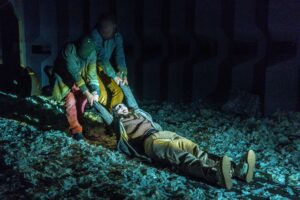
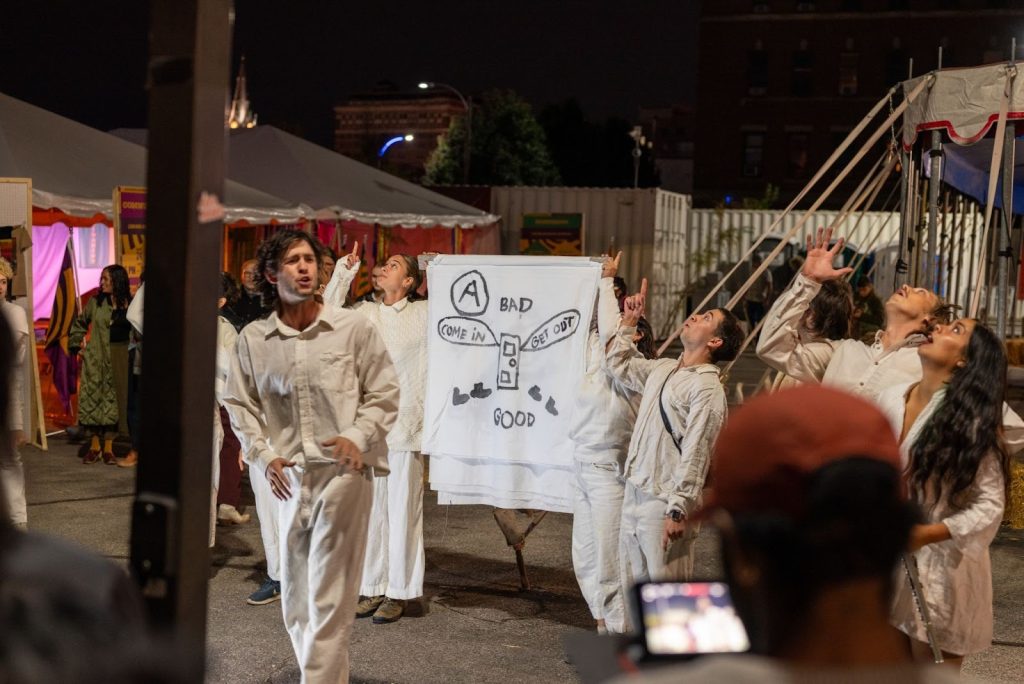
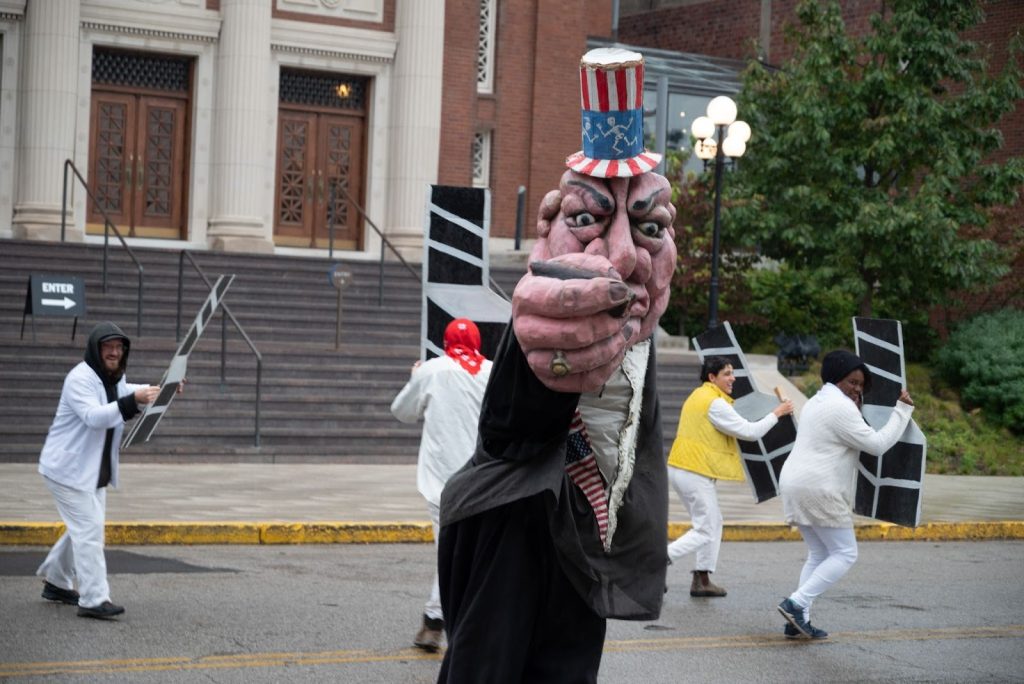
Early in the evening, as guests browsed outdoor booths, Bread & Puppet Theatre, the traveling political puppet show from Vermont, began its performance, setting the tone for the weekend. How to Turn Distress into Success—an allegory about life under a censored, authoritarian police state —was performed by a troupe of at least fifty participants out in front of the circus. The performers share a satirical A-to-D survival guide, drawing each “tip” on a white sheet presented before the crowd. Each step highlights a contradiction of living under a tyrannical state. For example, step A starts with the performers discussing police brutality, where they describe the horror and violence, whether they tell police they can “come in” or “get out.” Another example is their use of terrorist vs horrorist, and how a horrorist is a person who just watches the terror. Both figures are smiling.
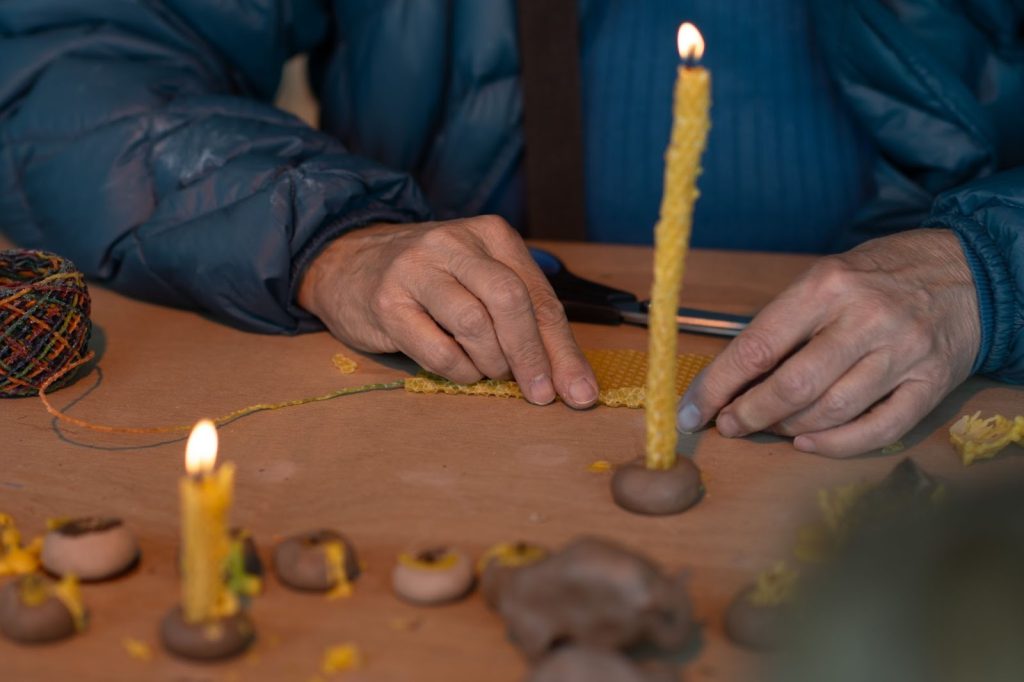
Beyond the big-tent performances, there was an array of booths lining the perimeter of the circus tent. On the right sat the booths designed by artists, and to the left were spaces for workshops dedicated to conversations for Act III: Resisting/Existing. At the corners of most booths sat small stacks of papers titled “Spell for Saint Louis.” This subtle prompt encouraged attendees to remember why this space, this convening, and why now. It called for honoring 400 years of displacement of Black and Brown people, the land and the Mississippi, marked by waste and structures, and the bison and beaver who persist despite overhunting.
If you place your head on the ground,
you may still hear the stampeding bison,
their rhythm carried through the groundwaters,
calling back to the original people of this land.
Keep listening there–
under the freeway,
under the stadium turf and the shopping mall,
beneath the national park–
there’s a buried story that whispers,
one that is hard to tell
In contrast to the performance, As Far as My Fingertips Take Me, by Lebanese artist Tania El Khoury, was designed to be an intimate experience between an unknown person with refugee status and the sitter. Separated by a large white gallery wall, which contrasted with the space. It was the only ‘closed’ booth. I sat down, eager for this experience in trust, one that I am learning as an artist, is central to not only making art but also understanding it. Once seated, I put on large black headphones, and as the music drowned out the crowd around us, I placed my forearm into a small circular opening.
The performance began with the music playing as the unknown sitter cleaned my hand and forearm, taking special care to stop at the middle finger. Starting in the same spot, I felt them draw a strong black line down the center of my palm. This eight-minute act included listening to a rap song by Syrian-born Palestinian Refugee Basel Zaraa, based on the journey of his sisters from Damascus to Sweden. The song’s translation was the only words on the white wall, which could be seen as a representation of the whitewashing of violent migration and immigration stories in the media.
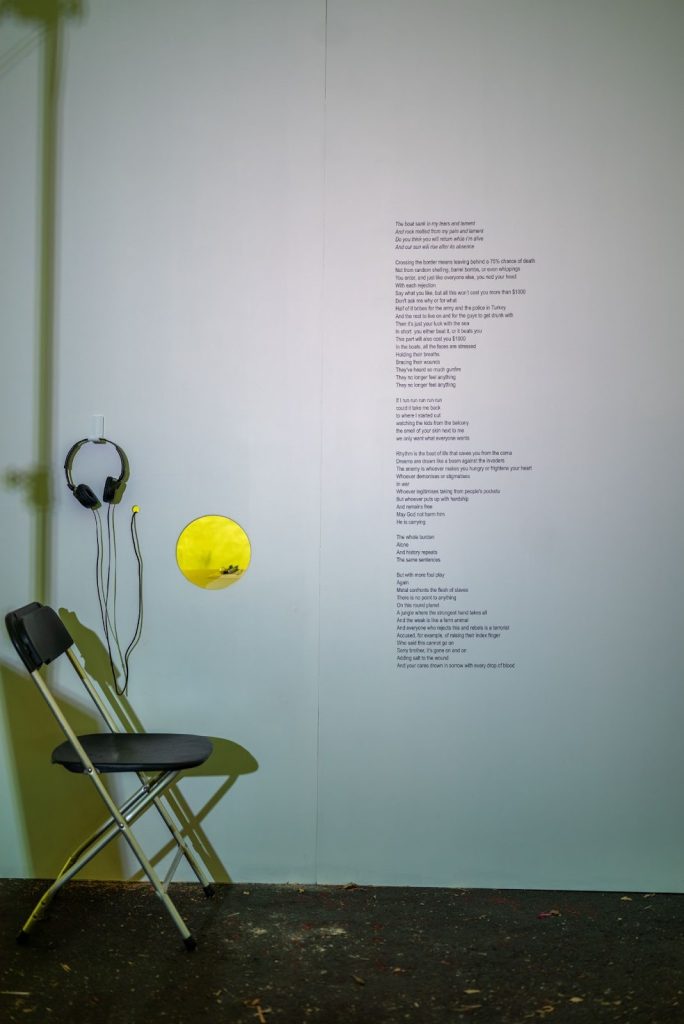
Who said this can’t go on
Sorry brother, it’s gone on and on
Adding salt to the wound
And your cares drown in the sorrow with every drop of blood
When the performance was completed, I finally saw the full image they created. At the base of my hand, they drew a boa to represent a story of people fleeing their homes due to the threat of violence. The scene continues up my forearm, where more drawn figures ‘walk’ towards the border, which was a line drawn just below my elbow. It reminded me of stories of the Great Migration and the Black people who fled the South for freedom. I thought of my Great Grandma Sylvia Mintee Jelks, who left Mississippi for a better life in St. Louis. She was only able to return home a handful of times.
The weight of this work not only explores the need to feel someone to grasp the impact of discrimination, as El Khour intended, but also begins to interrogate power structures that determine movement and belonging. This performance joins the discourse on surveillance and migration by demonstrating how systemic racism separates personhood from people of color, treating us as subjects to be controlled rather than as people with self-determination. These contradictions juxtapose the discourse of state surveillance and control against the stark reality of lived experiences.
Act II: Undoing & Redoing
The rain continued into the second day at the Circus of Life. I arrived early that morning for the first performance. It was 10 am, and the crowd was slowly teetering into this chilly circus tent. Waiting for the show to begin, my eyes were transfixed on a lonely wooden box, the color of packed earth, centered onstage.
As artist and DJ Soumir mixed lo-fi sounds that played gently in the background, the performance started when Emcee Dr. Treasure Shields Redmond stepped onto the stage. Briefly, I noticed the box catch her eye, and as she stepped in front of it, I was immediately reminded of an auction block. Maybe it wasn’t until a Black person stood next to it that the prop took meaning for me before the story even began.
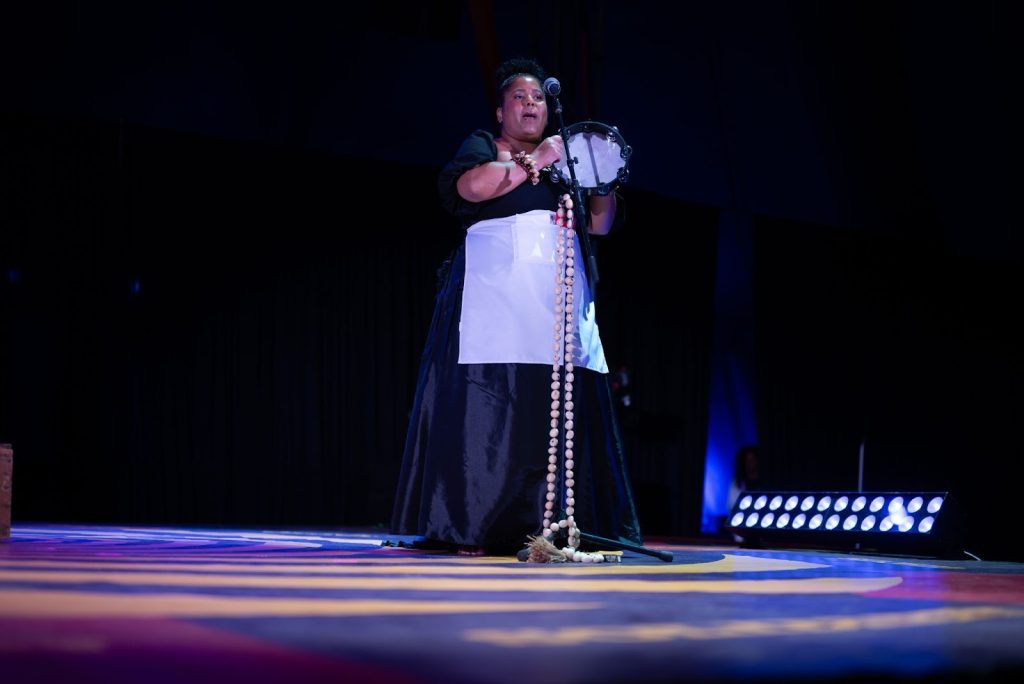
Shields Redmond urged the audience to call in their ancestors aloud. To speak their names. To remember who they were. A silent indifference filled the space until choreographer and performer Rashida Bumbray entered the stage singing “Oh Black Betty” by Ram Jam. In an all-black dress with a white apron, she moved about the stage, punctuating every corner with eight taps of her hand tambourine. Some among the crowd perk up in their seats. The chime of the tambourines and her voice filled the leftover space. The movement and sound felt spiritualistic, signaling that this was not just a performance — it was an invocation, a call in to Black people and ancestors across the Mississippi River, and beyond.
Before continuing, Bumbray shared the story of Sarah Baartman, a South African woman who was kidnapped and exploited across Europe as the “Hottentot Venus,” a hypersexualized, dehumanized parody of Black womanhood. Bumbray briefly noted that this work, or performance, was her thesis project titled A Blues for All the Nameless Women, and Sarah Baartman was one of the many stories that inspired the project. The atmosphere shifted again as Bumbary ended her story, and she began dancing atop the ‘auction’ block. With each three-quarter turn Bumbary made atop it — sometimes waving, sometimes clapping, sometimes silent — her body told a different part of the story. She closed each portion of the performance with her back to the audience.
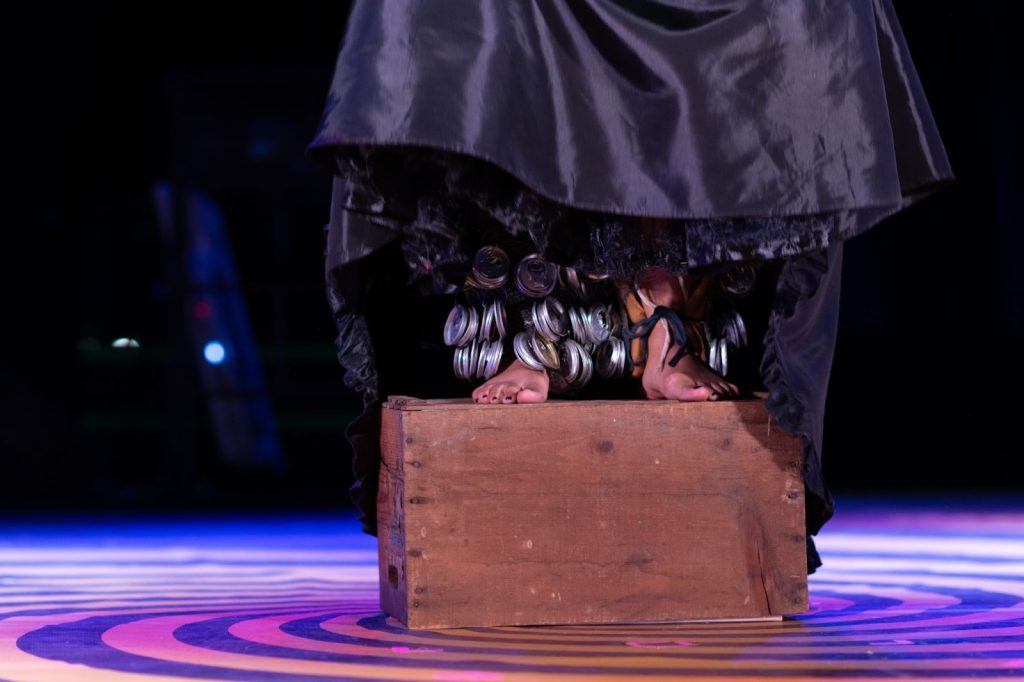
The performance peaked when, facing the crowd, Bumbray stepped off the box, untied her apron and scarf, and dropped them carelessly to the ground. Next, she undid the train of the dress, revealing a bustle made of plastic bananas tied to her waist, accentuating her butt. Fervently, she untied the string of bananas and attempted to toss it to the ground – instead, it intertwined with her ankle tambourines. She stomped and shook her ankle vigorously, like she was fighting for her freedom, for her right to not be this caricature of Black women.
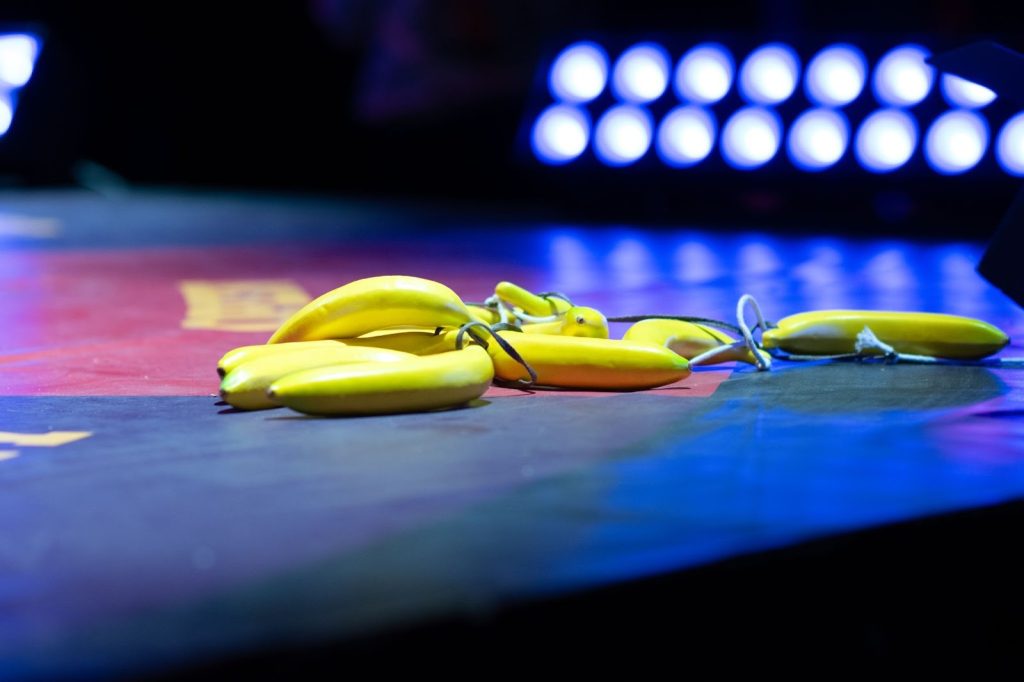
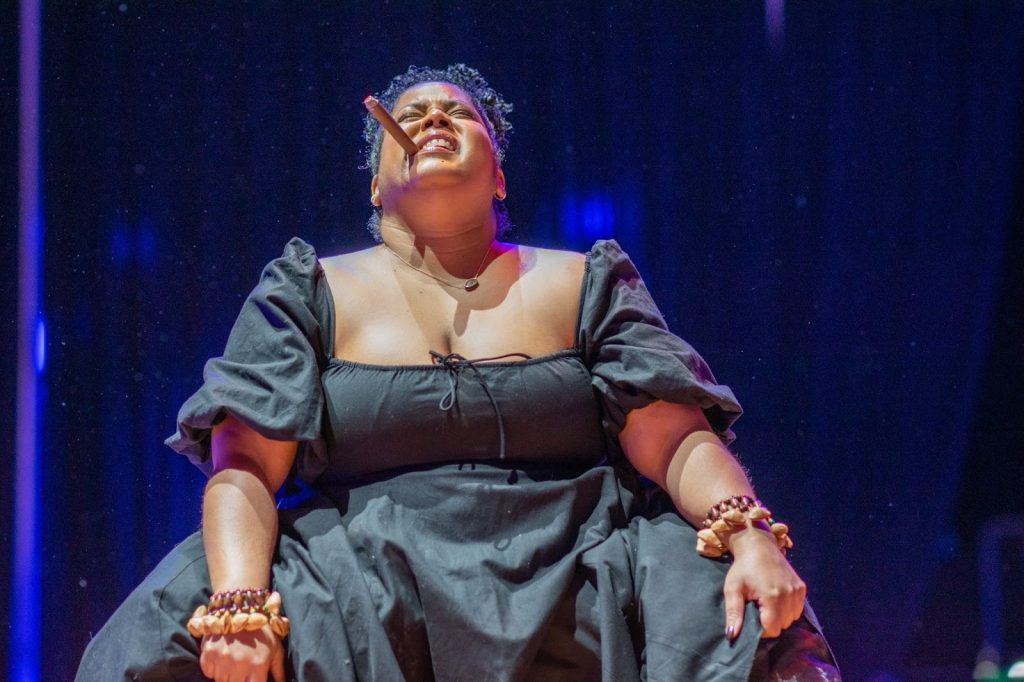
The room waited in anticipation. Once the bananas were finally cast aside, I heard my neighbors sigh. Bumbray closes with one final three-quarter turn. Except this time, there are no bananas, no aprons, no mammy. She sits on the box with a cigar, smoking and moving her feet as her ankle tambourines sing. Demonstrating that even when Black women choose themselves, they still have to finish their performance. The striking performance functioned as an embodied archive, using gestures to surface Black stories often flattened or forgotten.
Act IV: Cultivating Radical Love
Heading into the final evening, I reflected on an earlier conversation between the writer Roxane Gay and the poet and lecturer Chloë Bass about what it means to get free, how our freedom is tied to the freedoms of those around us. Or as curator for The Convening, Laura Raicovich would emphasize, “the unfreedoms coming at us.” We are losing access to public third spaces across the country, making Counterpublic and its missionto reimagine civic infrastructure critical to our fight for community. These are not easy conversations; they aren’t meant to be. Radical love is much more than a smile and niceties. It is meeting the moment with intention and care.
As journalist Nermeen Shaikh of Democracy Now!, said, “What would it mean to be in good humor, talking about starvation and death? What kind of smile could accompany speech without appearing as a monster?”
Act V: Reflections of the Future
The Circus closed out with a parade from The Big Top to the Counterpublic House led by Bread & Puppet Theatre. As co-conspirators in the performances, attendees, artists, and curators, we exchanged questions and reflections. One attendee noted that, “Every time we bear witness to one another, we make the future.”
Sitting on a lawn, huddled under a few small table tents in the pouring cold rain, this resonated deeply. I was reminded that the commitment to this work is difficult. Sometimes it is terribly uncomfortable to show up. Yet, if we look closely enough, certain patterns appear, like the Spell for Saint Louis and the water that remained constant.
Spirit of the beaver, hold the grief of the rivers.
Gather what’s been splintered.
Turn slit to refuge
For the dreams of those we’ve lost.
To ancestors displaced and enslaved,
The river remembers your names.
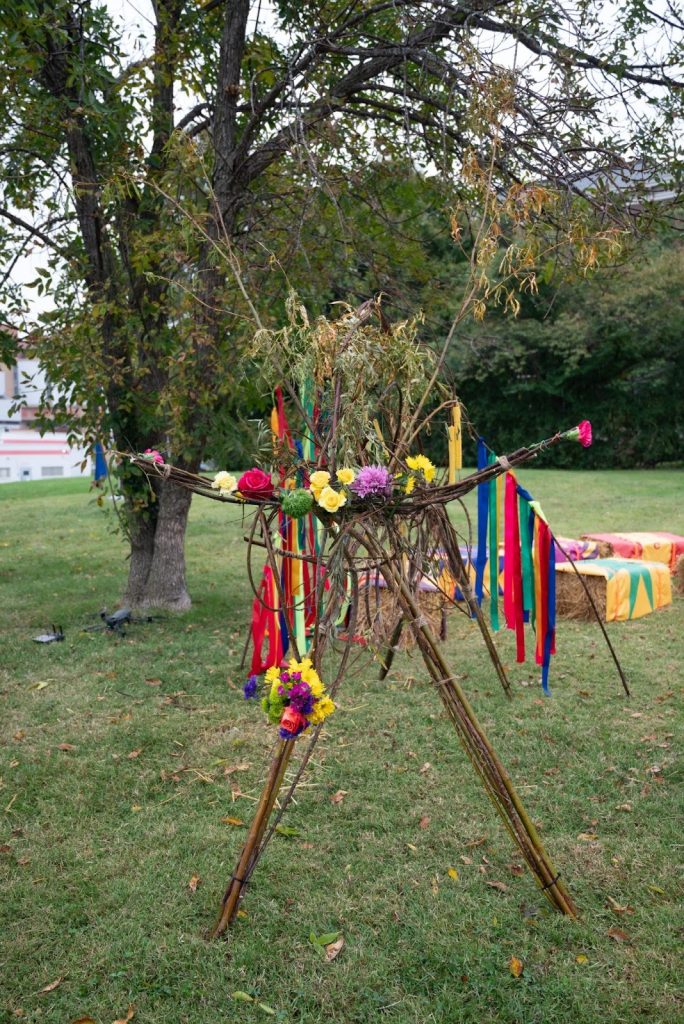
Throughout Counterpublic’s Convening weekend, a subtle yet persistent throughline emerged. Though the artists and speakers came from different practices, many works were in conversation. They discussed the weight of ancestral memory, the need to bear witness, and the confrontation with a fraught past and present. This synchronicity, whether planned or unplanned, undoubtedly was felt. Water echoed throughout this experience, signaling to me that the ancestors were pleased with our offerings, the counter-narratives, linking the past with the present.
The Circus of Life wasn’t a series of isolated acts; it was a communal insistence on truth-telling. It can remind us, if we choose to listen, that the past is not just something we inherit—it is something we can choose to re-articulate, honor, and transform.
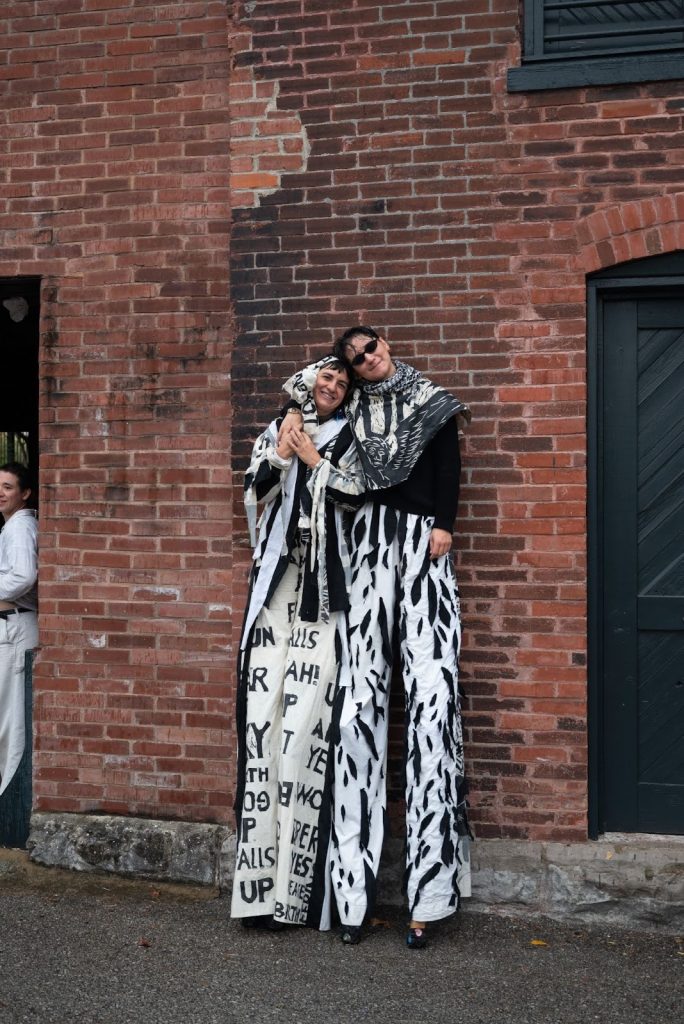
Counterpublic’s triennial group exhibition will be hosted September 12th – December 12th, 2026, at various public and business locations across The Ville neighborhood. In addition, installations will activate the International Institute of St. Louis, the National Building Arts Center, and Tower Grove Park, among others. Check out their website or Instagram for the latest information on monthly gatherings and their upcoming show.
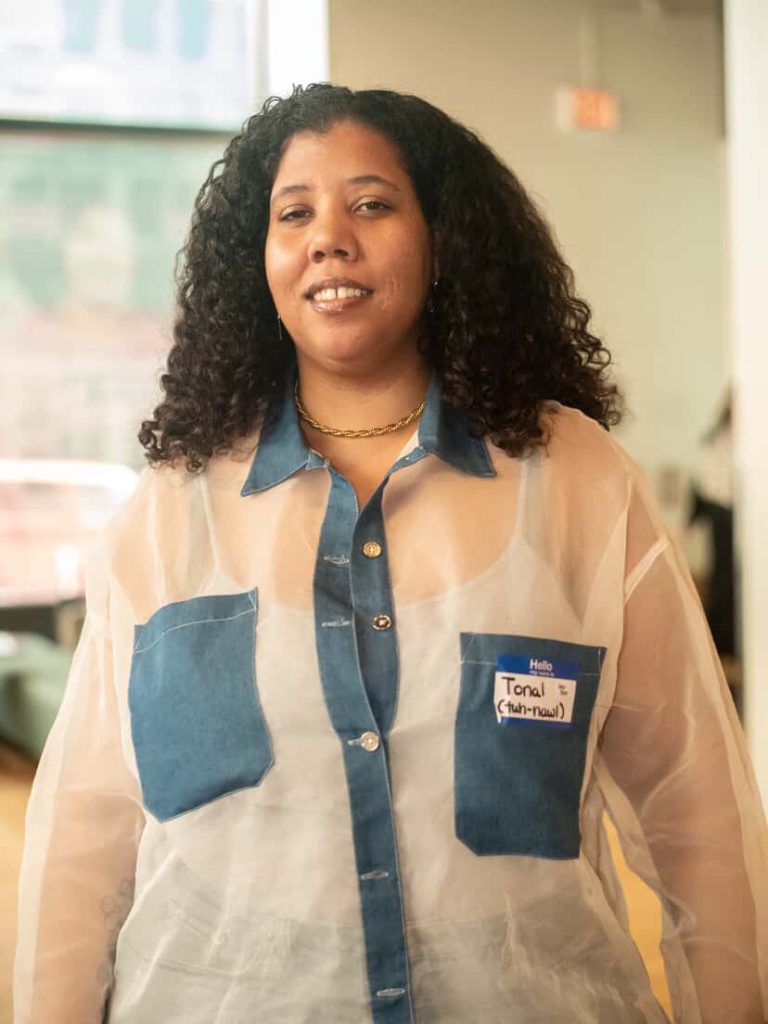
About the Author and Photographer: Tonal Mondae (they/them) is a documentary photographer and writer based in Chicago, IL. Their work creates visual narratives that celebrate personhood and seek to explore the relationship between belonging and environment. The use of collaborative portraiture is an act of resistance that promotes the right to self-authorship for Black, Brown, and queer people.