I keep losing things. Words, objects, thoughts.
Last month, in the backyard, I could not remember the word for a food I knew we all liked at our local shawarma stand; “I like the side of, oh what are they called, french—potatoes—?”
My neighbor looked at me, smiling. She supplied the word: “Fries?”
I nodded and laughed, marveling at how such a simple word felt so out of reach.
Weeks ago, my toddler wanted milk and I could swear I had just bought some at the store but when I looked in the fridge there wasn’t any. I pushed aside pickle jars and egg cartons, sleeves of cheese and glass bowls of washed blueberries. I rifled through the produce drawer. No milk, anywhere.
Finally, I found it in the cupboard, halfway to curdling. I couldn’t remember when I put it there, or how.
—
Mombrain: The word used to colloquially describe this sudden absentmindedness. I hear it in department meetings as women apologize for typos, on social media as momfluencers make humorous skits about forgetting their wedding anniversary, from my own mouth as I shuffle in my pockets, looking for a key I’ve misplaced. Nearly always, it is said in a sort of infantilizing sing-song tone, the same kind of voice one uses to pronounce baby-words like blankie or lovie.
“Oh, sorry, you know, I’ve got mom brain,” I trill, my cartoonish lilting a sonic way to apologize and minimize my experience at once. The brain fog, the jarring lapses in thought, the sudden absence of phrases just on the tip of your tongue; suitably gendered and therefore made inoffensive when given its cutesy, warbled name. I cringe at the way it sounds, even in my own voice. I feel shame at the thing it suggests: that to become a mother is to become forgetful, prone to loss, somehow made less intelligent by the act of mothering.
—
But the truth is more complex. Even as I lose things, I am finding things too.
In situations where I used to hesitate, I now find myself determined and action-oriented .
Indecision has vanished. In its place, there is a no-nonsense efficacy.
Fear still inhabits her hidey-hole in the base of my brain, but next to her cowering, I am surprised to find courage, nestled and ready.
And where there was once a milque-toast, touchy-feely, dare I say it, liberalism, there is something else entirely. Something ferocious. Something fast. Something much more adamant and useful.
Does mombrain extend to these newnesses too? Or does it simply describe the dullness?
—
My first daughter was born in August 2023.
Two months later, my social media feed is flooded with images of the genocide in Palestine. I learned the way a dead child flushes blue-gray in the arms of her wailing mother. I saw how a son might hold the parts that were once his father in a plastic bag.
In the tenderness of new motherhood—in the fog of mombrain—these visages lanced through me. My infant suckling at my breast suddenly made suffering so much more accessible. And I wept, of course I wept. I worried. I paced, ranted, raged.
But where I once might have stopped with a few expletive laden missives of support on social media, I found myself going further. Mobilizing; I crowdfunded money, fundraised on behalf of Palestinian families, taught Zoom creative writing classes in exchange for donations, the camera angled so you couldn’t see that I was bouncing my baby to sleep while I instructed. One hot summer’s day, I ran into a friend’s mother on the beach and she introduced me to the people she was walking with: This is Nina, she said, She’s a writer and an organizer, raising money for people in Palestine.
I flushed. I knew many real organizers. What I was doing is not so much organizing as it was a natural outgrowth of my newfound maternity. It seemed unconscionable to sit idly by when I loved my daughter so dearly, wanted her to be safe and well, and knew that halfway across the world Palestinian people wanted this of their children too.
Then, I got pregnant again. Unlike the first time through, the second pregnancy was brutal, nauseating, strength-sapping. I stopped doing anything that wasn’t the bare minimum required to keep everyone in my household alive. I thought back to my earlier urgency with a pang of guilt. I wondered, through my queasy fog, what that had all been about. Was it actually some kind of change in me, or was it simply the moment?
—
In reality, mom brain shouldn’t be an anecdotal phrase meant to describe absentmindedness. People undergo an actual physiological transformation in their brains when pregnant. Recent research shows that pregnancy dramatically reorganizes the brain. If a person becomes pregnant, their brain prunes parts of the brain associated with “processing and responding to social signals.” This might sound like it means pregnancy makes us less intelligent, literally deleting physical portions of our brain matter—creating empty space where neurons once lived. But that couldn’t be farther from the truth.
Mom-brain, or the striking overhaul a person’s brain encounters when pregnant, actually makes those parts of their brain more efficient. Elseine Hoekzema, a neuroscientist at Leiden University in the Netherlands who published this research (also a mother of a two year old herself) says “Gray matter volume loss can also represent a beneficial process of maturation or specialization.” Privately, I think of it as a Marie Kondo-ing of the brain. Mom-brain as gray-matter pruning seems to me to be a way of getting rid of excess and focusing on responsiveness, on attachment. Getting really good at identifying danger in an environment, seeing where the exits are, connecting the dots of who is crying and what it is they need.
—
A few months before my second daughter was born ICE came to Chicago. My beloved city was occupied by men in SWAT gear, riding trucks and vans, snatching mothers and fathers off of street corners. One day, we walked home from church and heard shouting in the alley behind our home. We went to stand and witness. Our neighbors blew their ICE watch whistles. The agents pulled guns. Our neighbors put their hands up. From above, people shouted from apartment windows, screaming at the agents to get out. Finally, the agents made unintelligible verbal threats and peeled off in their black SUV. It is only months later, when Alex Pretti is murdered in Minnesota, I understand just how close we all were to death.
Again, suddenly, that industriousness from the aftermath of my first daughter’s birth reawakens. I signed up for ICE watch and stood on a corner in the rain, feeding my toddler an apple while watching parents drop their kids off at my neighborhood elementary school. I waddled down the street, volunteering as shift captain, directing people to the western corner, the north west corner, letting them know if ICE vehicles were seen in the neighborhood. My neighbors throw a soup fundraiser to raise money for bail for those illegally detained at Broadview immigration detention center. I used our last child-free night before the arrival of the new baby to attend, eating as much green pozole as I could, looking at the amber-lit faces of our neighbors across the table, thinking about the small ways we try to carry each other into a new world, even as it feels that this old one is engulfed in flames around us. Bowls of soup, loaves of bread, dollars from crumpled and worn wallets trying to keep people safe. It is so small and so big at once.
When snow darkened the clouds and ice—actual frozen water and not the President’s conservative white supremacist militia—slicked the streets, I gave birth to my second daughter. My brain folded in on itself yet again. Pruning, refining, connecting.
—
I am far from alone in this experience of a newfound ferocity. At the soup fundraiser I talk to a woman with two children who works as a nurse and doula. She says that parenting has radically politicized her like nothing else has. A college friend texts me to commiserate about morning sickness and says that it was only in delivering her own children that she became adamant that abortion be accessible to all. No one should have to do that if they don’t want to, she says. My dear friend Amina learns about her pregnancy the same day an ICE officer assaults her, pulling her to the cold cement by her necklace when she forms a human barricade on Monroe Street to keep the officers from illegally disappearing people at immigration court.
Later, she wrote about the experience into a poem:
“I didn’t even think of you, sesame
seed in my open womb. I went
to my comrades, pinned, asked
them, “Who loves you? Who needs
to know?”
When Amina says “I didn’t even think of you,” it thrums in my gut. When I do ICE watch or fundraise for Palestine or advocate for restrictions on data centers, I don’t first think of my children. I do it because I have been transformed by their existence to see how we are all someone’s child, how we all deserve safety and nourishment. Amina’s poem points to that part of my brain that has folded in on itself, the part that has learned to underline the way we are all connected. When the poem ends ‘Who loves you? Who needs to know?’ I hear an echo of my new mental landscape, the way my gray matter has shrunk to identify relation and threat.
—
My daughter turned three and she requested to go to the library for her birthday. I packed a sliced plum, some cheese, a handful of cherry tomatoes, two diapers and a change of clothes for the little sister. We piled into the car, rain spattering over our heads. Before I started the car I looked down to see my friends texting each other, trying to schedule a dance practice for a friend’s upcoming wedding. I realized I had been operating the whole day thinking it was the wrong day of the week. I wrote a quick apology to my friends for my absentmindedness. We began our trek to the library.
The rain continued to spit. In the back seat I heard my three year old playing peekaboo with the baby. “BA!” she shouts and the baby responds in peals of astounding laughter. Their brains, I suspect, are changing too. They are making new connections, gray matter sparking, learning about how to love and trust each other. I try to join in and the laughter stops. “Mama, don’t!” the three year old insists. I refrain and they start up again, their tiny back and forth, a new knowing budding between them.
As I pulled into the library parking lot my phone shrieked. I parked and saw that we had been issued a sudden unexpected tornado warning. There are sirens now, wailing all around us. “Run!” I say to my daughter, trying to make a game of it, “Let’s see who can get to the library fastest!” We get into the building and follow the librarian into the storm shelter. It is a muggy, wet, weekday during summer break. The shelter is comprised mostly of toddlers.
Next to me, my three year old anxiously burrowed into my side. I pulled out the sliced plums, stroked her hair. The baby babbled to herself happily, playing with my keys. I started talking to a mother next to me. Should we start a story time? We half-joked. We could sing some songs! Should we gather people into a circle? My concern arced to all of the children in the room. My body felt itchy with a need to do something. My mombrain was firing, seeing the need for calm, the need for care. The librarian appeared with a bag full of puppets, an armload of books. She began a raucous, happy, story time. Soon, the tornado alert ended and we filed out, back to the library itself. I sat in a wooden chair and I watched my daughters play amidst the other children. I saw the other parents, the nannies, the care-givers checking in, asking after spouses at work, comforting a child particularly rattled by the experience. I saw it all, all of our minds, saying it at once;
Who loves you? Who needs to know?
—
I keep losing things, but I am also finding them. One of the things I am finding is you. Yes, you, reader. Whether you have children or not, I am beckoning to you, writing to you, gathering you up.
This essay has been an exploration in the brain-changes that accompany motherhood, yes. But it has also been an essay about living during an apocalypse. War, occupation, climate collapse; you recognize it too, don’t you? All of these snapshots are part of a larger picture of an increasingly harsh, urgent, dangerous political reality. It is not just my children who are imperiled, but you, as well.
Initially, the argument I wanted to make about this apocalypse was that in this urgent moment, we ought to turn to mothers and their mombrains more. (Who you gonna call? Moms! Was the actual refrain I kept singing to myself while writing.) That we should bite back the urge to denigrate and infantilize people who have had children—that earlier sing-song voice—and instead value and take seriously the magnificent, transcendent changes that occur in the brain after pregnancy. That we ought to notice, admire, and call upon it, especially in this new world that requires us to see danger and meet it so often.
But, now, I’m writing this last paragraph to you from a stretch of fantastical sleeplessness. Teething, travel, the beginning of the new school year—I am so incredibly tired and my absentmindedness is the worst it’s ever been. I find myself gulping the air at the front of the classroom, unable to find the words to put sentences together, speaking English in Japanese grammatical constructions. I misplaced a set of keys that would have cost $500 to replace, only to find them again in the pocket of a bathrobe I have no recollection of wearing. Someone asked me if I’d seen or read anything good recently, and despite being someone who writes cultural criticism, I could not think of a single cultural object.
What I’m trying to say is: it can’t just be me. It can’t just be the moms. We need you. I need you. I need you, reader, to adopt this kind of pruning, efficacious, connective, community-oriented thinking. I need you to simulate mom-brain (and good-news! The research shows that alloparents, that is people who take care of children they are not related to, show similar gray matter changes to the brain changes associated with pregnancy). I am writing to you from and through the haze, reaching out to you, asking you to carry the question with me: Who loves you? Who needs to know? Perhaps together we might keep each other safe, build something big enough, strong enough, to house all of us, nurturing together.
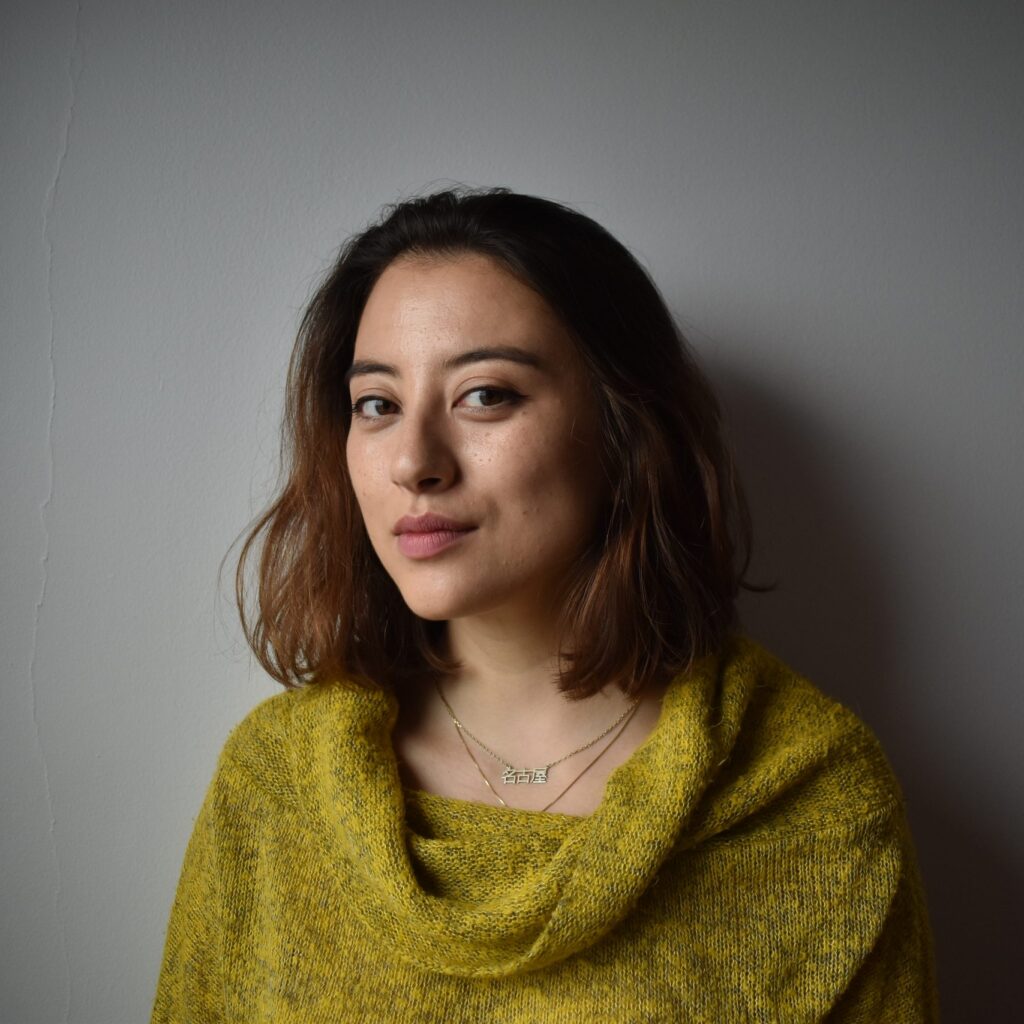
About the author: Nina Li Coomes is a Japanese and American writer living in Chicago. You can read more of her work at www.ninalicoomes.com.
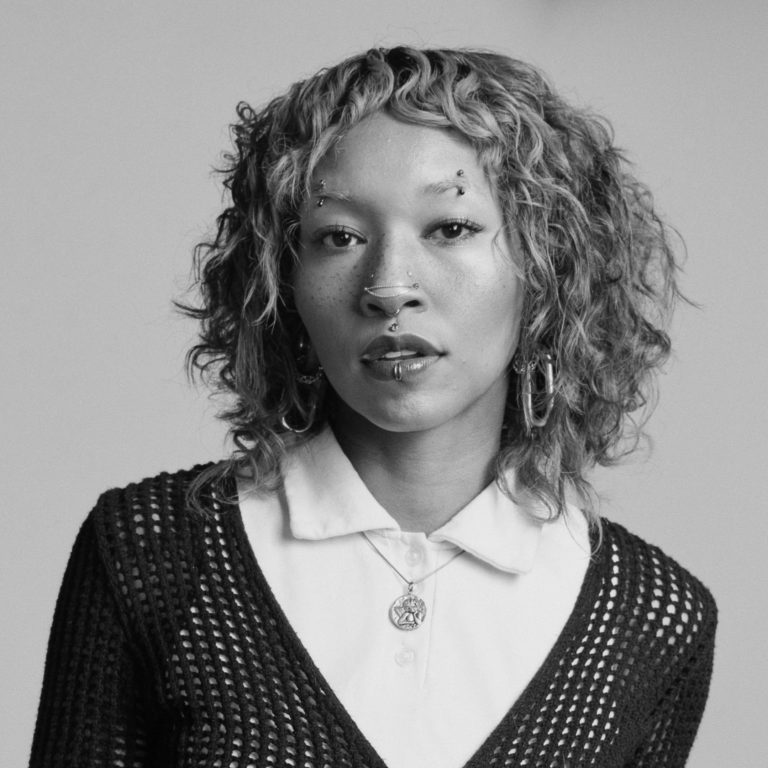
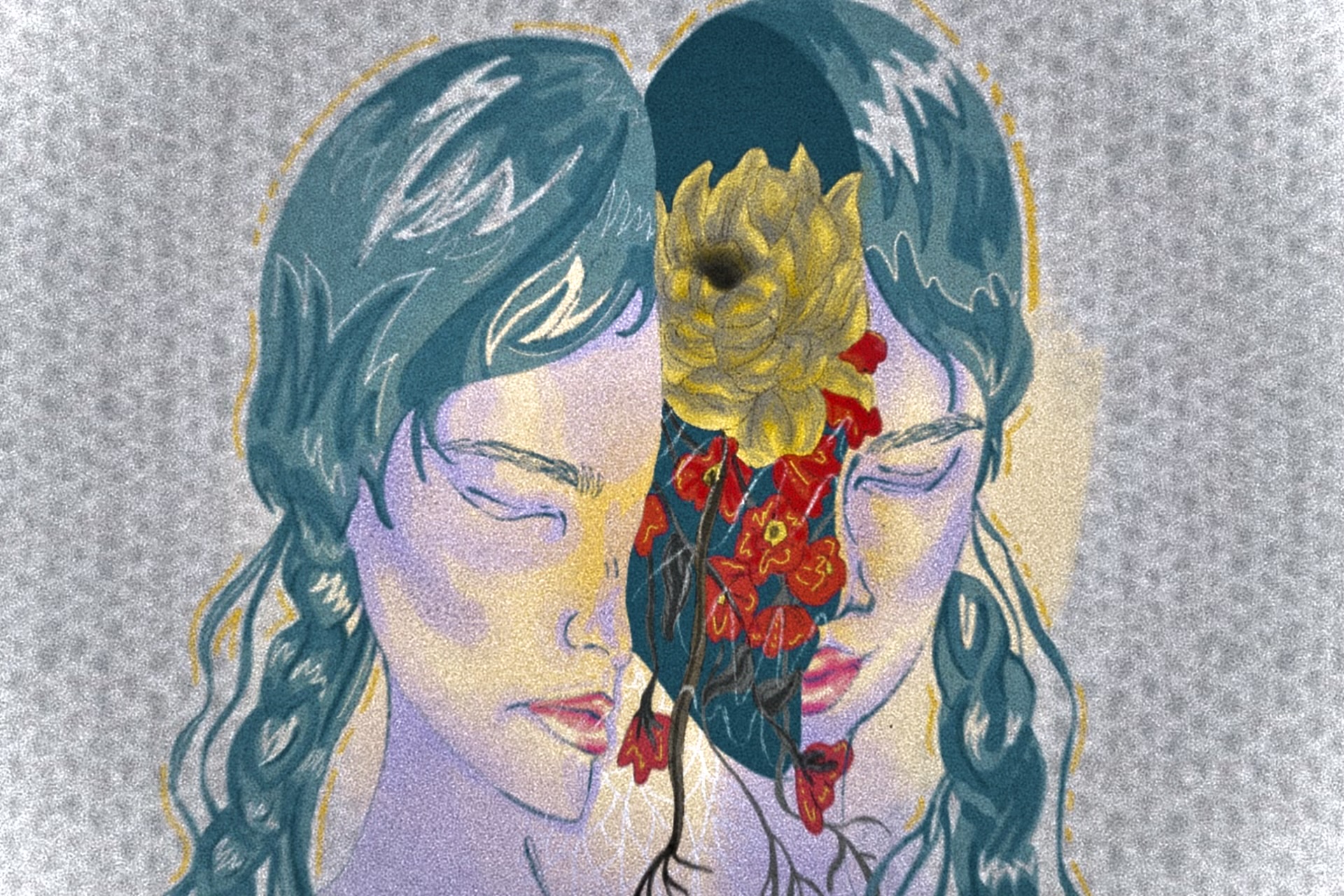
About the illustrator: Erika Sakata is a first-generation, non-binary multi-medium artist largely focused on traditional/digital illustration, poetry, zine-creating, and design. Their work revolves around themes of personal identity, race, and queer life. They typically explore bright color palettes and sharp imagery. As an individual of Black and Japanese descent, they typically infuse intermingled elements of both cultures into their pieces.