Tuning Away from Mechanized Listening features Midwest’s music ecosystems—listening cultures where thoughtful curation, collective engagement, and storytelling still shape what and how we hear. This series is meant to be a reminder: listening can be more than a passive, forgetful experience. You can read all of the articles in this series here.
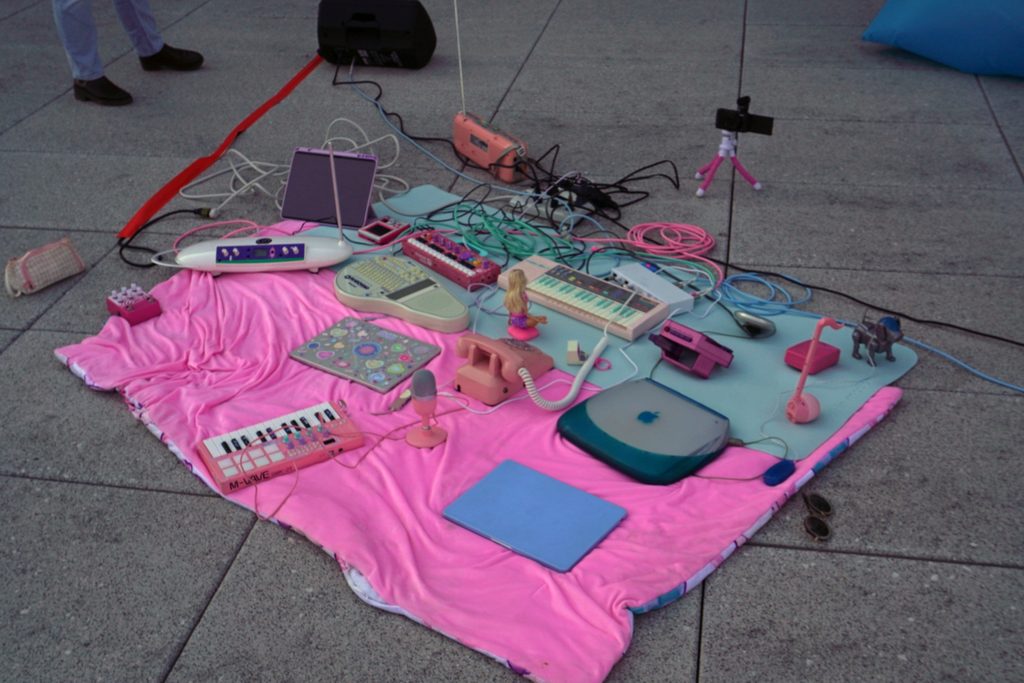
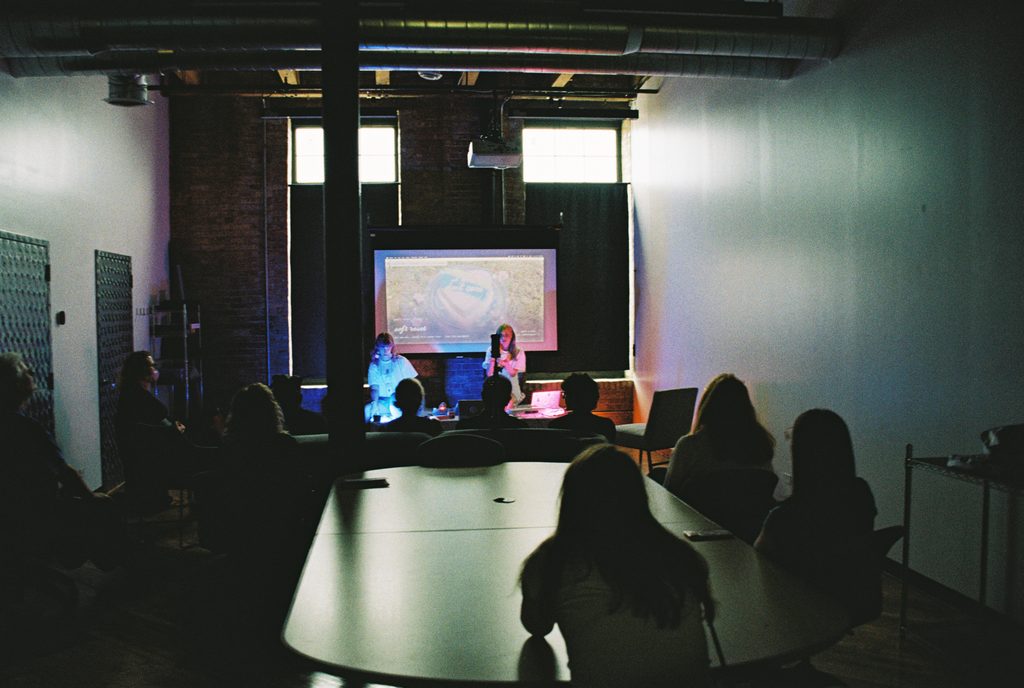
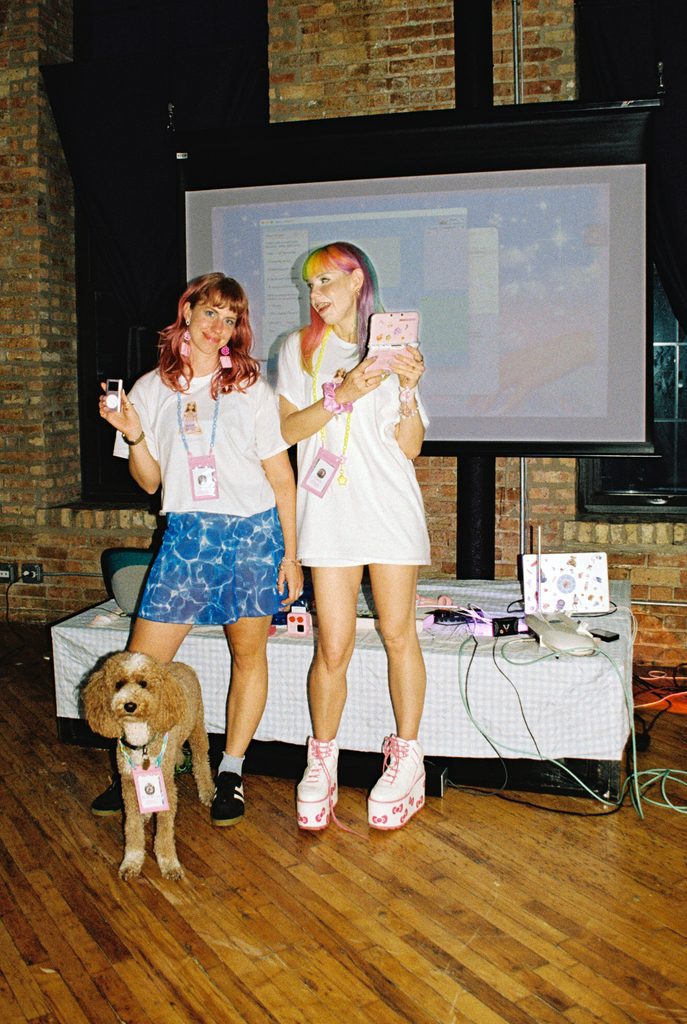
Close your eyes and envision yourself in your most relaxed state. Perhaps you’re sitting on a cozy couch with pretty pink lights and lush green walls; you hear a voice leading you peacefully into a villa in Fiji. Or maybe you’re comfortably lounging in a doggy day spa, watching pets getting pampered, with not a care in your world. If you listen even closer, you may notice you can find inner peace almost anywhere, just like I did at Emotional Tech Support, hosted by Soft Reset (duo Zsofi Valyi-Nagy and Clara Venice) at LATITUDE in Chicago. One Friday evening, I found myself sitting on a couch, next to a dog named Bob Ross. An oversized flat file cabinet had been transformed into a colorful makeshift stage covered with a spread of items: keyboards, a Y2K iBook laptop, a Barbie doll sitting cross-legged on an inflatable chair, a theremin, and even a Nintendo DS. What I didn’t know was that soon, I would be soothed by these items, all as sonic devices. At Emotional Tech Support, Soft Reset lulled viewers into their highest selves through a Love Island-themed soundbath and meditation, followed by a tech customization workshop.
Emotional Tech Support was a deeply imaginative opportunity to listen to sounds, but also to my body and spirit. There was a chance in this space to reflect, but also to envision what was possible when playfulness, performance, technology, and the sensory intersect.
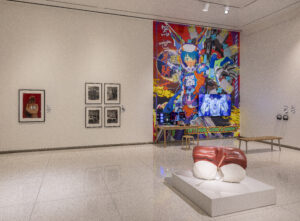
I had the chance to talk with Valyi-Nagy through Zoom about their performance and her solo exhibition, Intuitive Imaging Industries, at Latitude Gallery (July 15–August 15, 2026). This conversation has been condensed and edited for length and clarity.
Bri Robinson (BR): So I wanted to ask you a couple of questions. My personal practice is reflective of my own life and experiences with music, memory, and the Midwest. Typically, I’m writing blogs or chatting into cyberspace on Instagram or on WITHINDIGITAL.NET. In reality, I was enticed by your program called Emotional Tech Support hosted at Latitude so I jumped at the opportunity to talk with you about it. I’ve really been enjoying conversations with artists about the ways they listen. There’s been a series of writings and interviews through Sixty with artists called Tuning Away from Mechanized Listening that I’ve been doing illustrations for. The series looks at the ecosystems of the Midwest itself and the ways folks are curating spaces for listening, and how we literally hear one another through shifts in technology. So I wanted to talk to you about it.
Zsofi Valyi-Nagy (ZVN): That’s perfect, thank you so much for being there for that performance. It was maybe our fourth time performing for an audience as Soft Reset. My collaborator, Clara Venice, is very experienced with performing as a musician and has zero hang-ups about it, whereas I’m newer to it. So for me, it was a little scary. And it was my first time doing it in Chicago, which is the closest thing I have to a hometown,1 so that was intimidating. We’ve performed for very different audiences with all kinds of people, and I don’t know if anyone goes into it with expectations, but it’s interesting to see how different people respond to our performances. Clara reminded me afterwards, “You know that what we’re doing is, like, really weird? You have to remember, this isn’t normal.” I’m really grateful to Dæja Hansdottír, the executive director at Latitude, for welcoming such a weird event with open arms; she actually already had the Love Island text tone on her phone when I met her, so I knew we were kindred spirits.
It’s interesting because I’m half of this collaborative audiovisual project, but I have never considered myself a musician. I’ve never made music before. I played classical piano for ten years, but was never really passionate about it, or good at it. It just wasn’t for me.
Let me give some backstory about how Soft Reset came together. It was my first spring in LA and my friend Nina Wexelblatt invited me to this workshop at Heavy Manners Library called I Heart Files hosted by Molly Soda, and I was like hell yeah, I loved Molly Soda, she was my idol in college. This workshop led me to meet two of my closest friends in Los Angeles, Clara and my friend Ashley Hockney, because we all happened to sit at the same table and we all had matching laptop cases. It was just this really funny moment, very serendipitous; that’s how the i<3files collective was born. Clara is very striking, she has rainbow hair and her whole world is built out––we call it the Claraverse. She puts out this magical energy into the world, and I was like “who is this person” and we were talking after and she’s like “Oh yeah, I play the theremin.” and I was like “you play the theremin? I’ve never met anyone who plays the theremin” and she’s like “you know what the theremin is?” Clara actually did a certificate in sound healing, and she was really perplexed by this idea that there are certain frequencies or certain instruments that are supposed to speak to everyone, or to “heal” a particular chakra. She did all this research and found there’s no scientific evidence that there’s one frequency that soothes every single person in the same way. There’s no one-size-fits-all, so the whole algorithmic meditation music thing is a total scam. She’s thinking really critically and playfully about algorithmic audio.
BR: Oh wow!
ZVN: So she started thinking about what sounds resonate with individual people, and she developed these personalized frequency readings. It’s kind of like a color reading, where it’s like, “you’re a warm summer” but for sound. It’s called Find Your Sonic Aesthetic! There’s a quiz you can do, and she has a Substack called Frequi where she writes about all of this stuff. How to embrace main character syndrome, to kind of soundtrack your life according to what feels good to you. There might be songs that you like, but they don’t make you feel good. They make you feel sad. Or they make you feel longing or anxiety, and it’s being able to identify these feelings. Are there certain songs that make you feel grounded or present? For me, it’s a thumping bass. Like, I love a euro trash bass line. And Clara told me it’s because I’m a very embodied person, very aware of my body, but also I’m seeking grounding in the music. I think that comes from having a disability and having to tune in all the time and notice what’s off. I know I sound like Dr Fifi [Robinson, the fictional doctor from my project Intuitive Imaging Industries]. But there’s something about heavy bass paired with ethereal vocals. Cocteau Twins is a good example of what perfect music is for me. It makes me feel here.
BR: Oh, I see.
ZVN: But for Clara it’s completely different. And for you it’s probably completely different. So there are these little quizzes, and they tell you about your personalized Sonic Aesthetic. When Clara and I first met, we were talking a lot about wellness and our shared hobby of collecting vintage electronics––I collect computers and iPods and she collects vintage synthesizers. We were applying to the 2025 low-tech electronics fair at Temple University in Philly and we came up with this idea for a soundbath. Why don’t we use these nostalgic electronic sounds to comfort ourselves and embrace a different kind of sound healing? And that first performance was really special; it was called “Cache Me Outside”. It was a meditation on digital girlhood, and it was on a rooftop during golden hour in perfect weather. That was the day we named our project Soft Reset. We were in the Airbnb and were both like “oh my god, everything is a mess, we’re so frantic” and Clara said, “I need to soft reset this,” and I said “That’s it! That’s the name! We’re Soft Reset.” So we debuted that night and then we started making recordings, and now we have a whole album of guided meditations, Emotional Tech Support, that we will release soon. I’ve made music videos for two of the songs from our EP, Sound Pools, including the Love Island meditation and an ambient cover of Tate McRae’s “You Broke Me First.”
The guided meditations came from reflecting on the frustrations we have with traditional wellness spaces and the discourse around how technology is bad for you; we both love our tech but feel so alienated by this algorithmic generation of calming music and meditations. We’re both neurodivergent, and we just can’t meditate in traditional settings. We really judge ourselves when we’re unable to do it. I get into this spiral of “oh my god, everyone’s having a transcendent experience, and I’m not. What am I doing wrong?” So I thought, what I actually want is a meditation that’s about a doggy spa (my favorite YouTube channel is this Korean dog groomer), or Love Island, something that I can personally relate to. It’s not 100% serious, but it’s also meant to be healing. It’s not meant to be for everyone, but it is when it does resonate with someone, that’s really beautiful.
BR: Yeah, it was a really special time, and honestly, while you were speaking about it, I really enjoyed how you emphasized how the things we experience sonically can jolt you into a different time. As you spoke, I remembered the beauty of the soundscape of the Nintendo DS game Nintendogs.
ZVN: Yes! I loved how Clara incorporated live sounds from the Japanese Nintendo DS game Elektroplakton into our set.
BR: Yeah! I’d never played that game before, but it was so soothing and peaceful.
ZVN: Right?! I think we don’t do enough of using technology just to play. There’s so much about productivity, optimization, and even just now my planner app was telling me this meeting is in progress, and I know because I’m literally in it. I don’t need that reminder. Let’s calm down.
BR: I noticed something really interesting about language within your work. I was wondering if you could share if there are any ways that language specifically impacts the ways you listen? I know you’re also a writer and art historian; is there any enmeshment between those coordinates?
ZVN: That’s a good question. How does language impact the way I listen? I feel like I could go in so many different directions with this question. Can you say more about what you’re thinking about?
BR: Yeah, I find myself thinking about how I speak to people more, and I notice I say the most important thing last, and I’m wondering if there’s a relationship between how you experience sound, like in a sound bath where there are little to no lyrics?
ZVN: Wow, that’s so beautiful. I don’t think I’ve ever thought about that, but I think about language a lot because I studied linguistics in college. I think about sociolinguistics a lot, about how people use language in different ways, like accents or code-switching, and I’m super hyper-attuned to that thing, but it can be very personal for people and kind of triggering when you comment on it so I typically don’t. But after the soundbath it was interesting because someone asked me “where are you from” and I was like “here?” and he said “I thought so, because of your accent.” I thought that was interesting because I’ve been told that I’ve Californiafied my way of speaking, but I think as soon as I got to Chicago, I slipped back into my Midwestern voice. Or maybe I was code-switching seeing my middle school friend Hannah here. But I think the pacing of the meditation is something that made me think of how to get people to this space of visualization and enter different places. Taking people on a journey. I do write out the meditations and read them from the Stickies app on the iBook, but often I riff on them during the performance, depending on how the audience is responding.
I think listening is so interesting. I studied oral history methods in grad school to do my art historical research; I wrote my dissertation on the artist Vera Molnar, who was in her 90s when I was writing about her, which was really interesting and challenging in a stimulating way. I learned this oral history technique from Suzanne Snider, who runs the Oral History Summer School, called “seven seconds of silence” where, after you ask somebody a question and they answer, instead of immediately asking a follow-up question, you wait seven seconds in case they want to add to their answer. We’ve been socially conditioned to fill these gaps with chatter and these ideas that make you a “good conversationalist” actually makes you a bad oral history interviewer, so you have to unlearn these social norms but sometimes you have to let people know in advance because it can be uncomfortable. But it really works; I find it really interesting and I think that’s affected the way that I listen to people in general, even outside of interview contexts. Not feeling like I have to interject all the time. It’s interesting as a neurodivergent (ND) person to navigate that because I’ve spent my whole life trying to figure out how to be “normal” and talk to people in a socially acceptable way, and realizing that maybe actually the way that I operate without those rules is just fine. My partner and I talk a lot about this kind of ND conversation style where, instead of asking a question, I tell you about my day and speak for five minutes, and then it’s your turn. And back and forth. And I’ve gotten so used to that, so now when I’m around neurotypicals, I don’t know how to behave anymore. I think Clara and I maybe subconsciously consider a lot of that with Soft Reset. For the tracks and music videos, we have a version that’s just music or just voiceover, and one that has both, because some people get annoyed by talking or background music. We want to offer soundbaths that even misophoniacs will try out! In an ideal world, we would have three versions of every song that offers different ways of listening that aren’t prescribed but are more of a “choose your own adventure” thing.
BR: That’s pretty cool. The code-switching between neurotypical people and neurodivergent things is something I relate to. When I was younger, my mother would have me call my aunt and rehearse conversations, so I knew how to talk when it was time for school. But then I would go to school and not do that, but I think it all worked out.
ZVN: We’re creating a space for people who feel alienated in traditional meditation spaces and yoga studios. We make live soundbaths but also music for headphones––we’re equally thinking about listening as a collective practice and as a solo practice. Part of what we want to do, too, is to host more virtual soundbaths and workshops, partly because we live in different cities. A lot of this also goes back to disability and access, the problem of the post-COVID return to in-person events that abandons virtual and hybrid programming, which then excludes a lot of people who can’t leave their beds or their homes. Clara wrote a whole essay on her Substack about how the Justin Bieber Coachella set was not a cop out, not “lazy,” but was actually transcendent because it embraced the idea that the internet is a space where we create community around music. Clara and I have talked about how Bieber’s performance also implicitly acknowledged disabled and chronically ill folks who rely on online communities for social connection. So something we want to explore more of is how to not just replicate the experience of a live soundbath, but also translate it or transmit it into people’s headphones. Have them be able to shut their cameras off, lay down, fall asleep if they want to. So we started our Substack, Soft Reset Meditation Club, where we want to do these events where people can just gather and listen.
BR: I think it’s pretty sick. Throughout your residency at Latitude, did you have a particular listening routine? Can you talk more about that process?
ZVN: A lot of research went into developing Intuitive Imagining Industries, and a good part of that took place on eBay while listening to pre-AI New Age meditation music and Pure Moods (the infomercial for that compilation CD was also influential on my video Feeling is Believing, which is looping on my parents’ old CRT television set). I was collecting images of New Age print materials, and I was particularly fascinated by this genre of cassette tapes that were big in the 1980s called “subliminal tapes” that were for self-hypnosis and “subtle motivation.” They’d have music and voiceover (guided hypnosis, meditation, and affirmations) on a certain theme, from pain relief to quitting drinking to astral projection. The company names were really wild––Potentials Unlimited, Consciousness Tapes, Paraliminal Tapes, Institute of Human Development. I’ve only bought one tape and I’m totally obsessed with it; it was actually made by a pharmaceutical company to accompany the anxiety medication BuSpar called Tranquility Tapes: Calm Connection for BuSpar (1999); this doesn’t have a voiceover but the music is incredible and very relaxing. The pain management tapes are super interesting, too––I’ve only hit the tip of the iceberg and I’d love to do more with those in the future, as they are very Soft Reset coded.
BR: Even in your exhibition Intuitive Imagining Industries, you have these very different things––AI-generated images and video, camcorder footage, aura photography, x-ray imaging, the tactile experience of holding images in your hands––intersect, but then they come together in a very specific and intentional experience. I think that’s really beautiful in the wake of junk and slop.
ZVN: Yeah, that’s the goal; we’re trying to rediscover the magic in our devices, like the portal to magical places in our devices. They don’t just have to be slot (or slop) machines. This is the response we’ve had to people saying that the only way to be present is to put our devices away and to be offline, get a dumb phone. It doesn’t have to be that. There’s a way to be with technology that’s soothing; it doesn’t have to be either I’m doomscrolling or I’m meditating in the grass. There has to be a middle ground.
Zsofi Valyi-Nagy is a Los Angeles-based artist and art historian who teaches at Scripps College. Her work focuses on the history of art and technology and its intersections with gender and disability. As the July 2026 AIR at Latitude, she developed Intuitive Imaging Industries, an installation staging the office of Dr. Fifi Robinson, a fictional West Coast healer and inventor of the Intuitive Imaging Instrument, a pseudomedical imaging machine that can “see” any ailment. This project was originally developed with support from the Leonardo CripTech AI Lab (2025), a fellowship for disabled artists critiquing, reimagining, and (re)building AI models. Along with Clara Venice, Zsofi is one-half of Soft Reset, a collaborative audiovisual project offering a gentle, human-made alternative to algorithmic wellness audio.
***
1 Zsofi spent her teenage years in the western suburbs and lived in Hyde Park for eight years! Her soul dog, Buckets, was found as a stray in Little Village. Bob Ross is a California boy through and through.
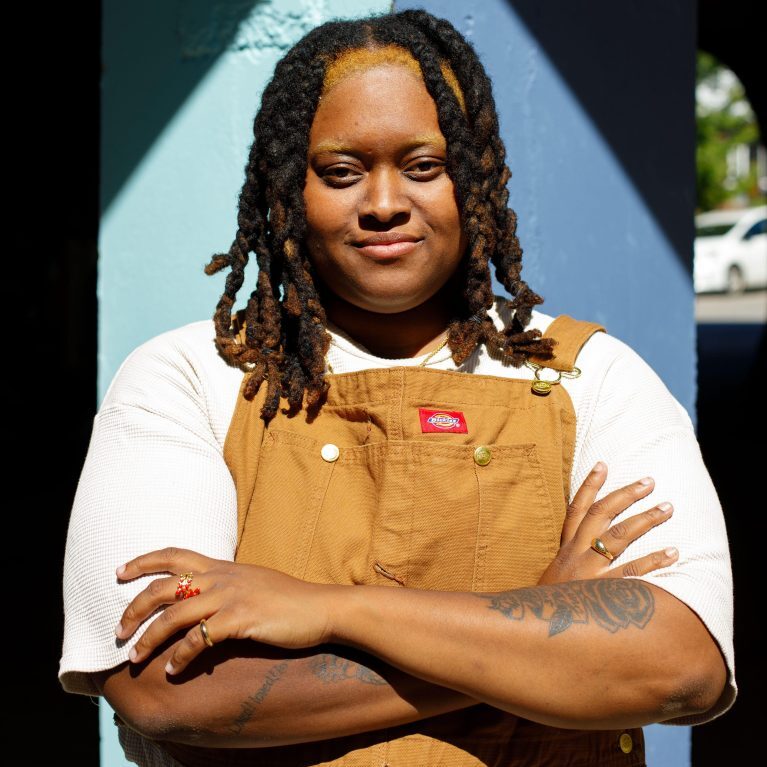
About the author and illustrator: Bri Robinson is a mixed media artist, analog collagist, sculpture artist, and historian who weaves intricate narratives of love, loss, and identity across the expansive Midwest. Through their unique process of cutting, pasting, and layering, Bri deepens the meaning of these found objects, transforming them into evocative works of art. Bri’s practice is deeply rooted in the exploration of identity, relationships, and the constant evolution of self. By merging archival materials with elements of popular culture, they create thought-provoking narratives that invite viewers to engage with the complexities of the queer experience. Through their work, Bri honors the past while also pushing the boundaries of contemporary art history, crafting pieces that are as introspective as they are expansive. Check out their work on instagram @niq.uor.