There is a gap. Amay Kataria has been thinking about it for years—a real distance, widening, between the pace at which technology changes and our capacity to understand what we are living inside of. It is the distance between the tool and the hand that holds it, between the system and the person it shapes. Most of us move through that gap every day without naming it. Kataria’s practice is built in it.
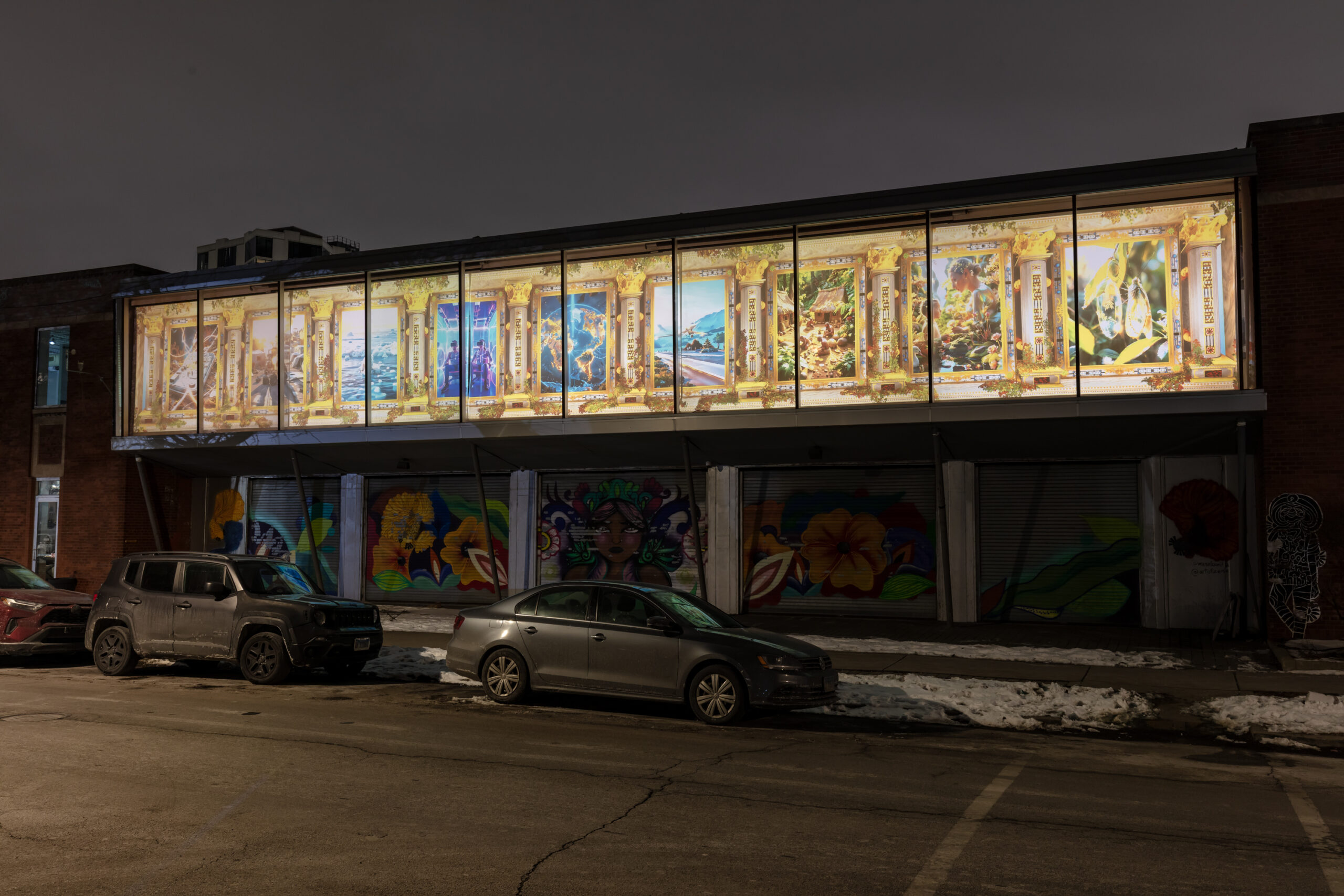
Saṃsāra, Kataria’s new forty-foot video installation on the exterior facade of Hyde Park Art Center, does not close that gap. It doesn’t try to. What it does is make the gap impossible to ignore—sprawling, luminous, and formally commanding in a way that resists passive consumption. Nine panels cycle through a story that begins with a lotus flower and ends with a circuit board going green. You cannot stand on 53rd Street and scroll past it.
The work was presented as part of Mutuality, an exhibition curated by Teresa Silva that brought together twenty artists from Hyde Park Art Center’s Center Program, a ten-month cohort residency for emerging Chicago artists. But Saṃsāra is more than an exhibition centerpiece. It is a provocation to its audience, to the field of new media art, and to anyone who has ever picked up a device without thinking about what they were agreeing to. Its themes are large enough to be unwieldy and specific enough to be urgent. What is undeniable is that the work demands excavation. It calls for interpretation at the level of its themes, its medium, and its moment. That kind of demand is itself a form of an argument.
New media art has always had to justify itself. Each evolution of the form: video art in the 1960s, net art in the 1990s, data-driven and AI-generated work now has arrived into a field that greeted it with suspicion before it arrived at understanding. Kataria is clear-eyed about this lineage. He invokes video artist Nam June Paik [1932-2006] and the early video artists who were largely dismissed before they were canonized, who worked in a medium the art world hadn’t yet decided to take seriously. “The pace of that thinking has increased a lot,” he notes during our interview. “People are already jumping on this because they know this is something that’s going to be relevant ten, twenty years from now.”
Saṃsāra participates in that longer history while also contending with the specific anxieties of this moment: the debates around AI authorship, the ethics of training data, the question of whether work made with generative tools carries the mark of the artist or the algorithm. Kataria built a custom workflow using open-source AI image and video generation models, all running locally on his own machine, deliberately avoiding commercial services that harvest prompts to train their systems. Each of the nine panels consists of four images animated into seamless thirty-second loops—over three hundred images generated, shortlisted, styled, upscaled, and refined across ten months of work. The process was neither simple nor automated. It was the slow, technical, and deeply intentional labor of an artist trying to find his own aesthetic inside a tool that has a tendency to flatten everything into the same visual register. He did not want to hide the AI nature of the images. Some artifacts stayed because, as he puts it, erasing them felt like tampering. The glitches are part of the argument: this is what it looks like to make something inside the systems you are critiquing. The medium is not incidental to the message. It is the message, folded back on itself.
The question isn’t whether Kataria’s hand is visible in the work; it is, in every compositional and conceptual decision, but what it means to make critical art from inside the infrastructure you are critiquing. “Perhaps critical use without complicity is an ideal dream,” he says. “But awareness, resistance, demanding to understand what’s hidden is valid. It’s conscious participation with our eyes wide open.” That position is not a resolution. It is a practice. And it is, arguably, the only honest position to have regarding the use of AI in art available to artists working in this moment.
The conceptual architecture of Saṃsāra borrows from two monuments separated by five centuries. The first is Michelangelo’s Sistine Chapel, which Kataria stood beneath for the first time in 2024 and experienced, he says, almost as a moving image, so compositionally alive that he came home to Chicago and spent months studying its structure, its narrative logic, and the number nine, which recurs across Eastern philosophical traditions in ways that eventually connected him to the Sanskrit concept of saṃsāra: the cycle of birth, death, and rebirth.
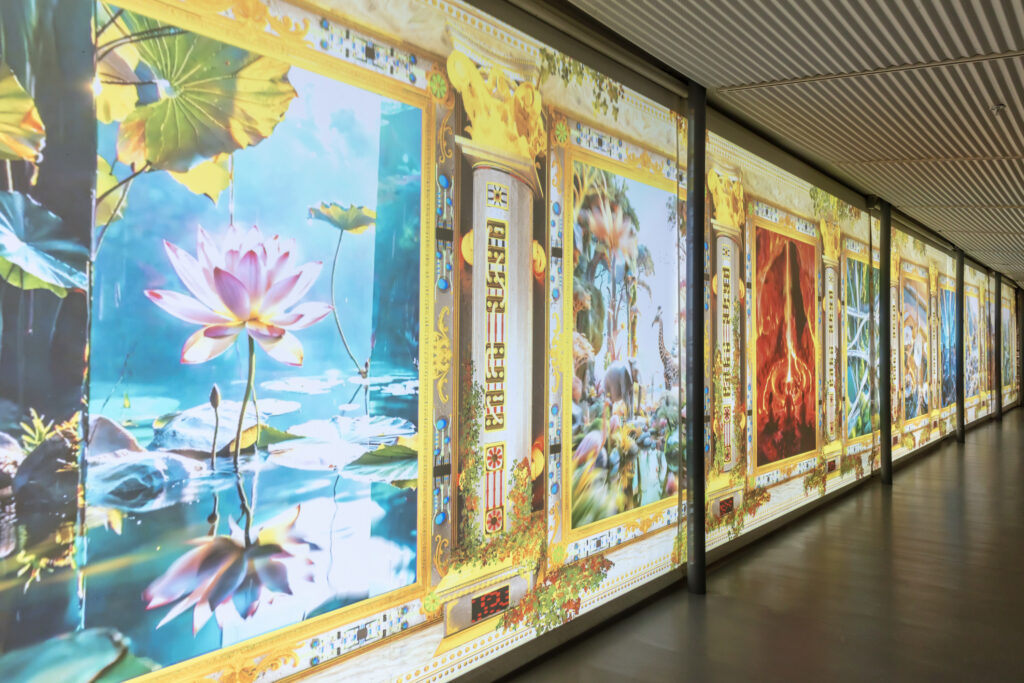
The second monument is the server rack. Flanking the nine video panels of Saṃsāra are structural columns that fuse Corinthian capitals with the vertical architecture of data infrastructure cables, LED indicators, fans, the hardware of the digital world rendered in the visual language of classical Roman authority. Kataria chose the Corinthian order for its acanthus leaf motif, a symbol of enduring life and circularity. The frames are not decorative. They are the hardware powering the video compositions, and they are the work’s central metaphor made physical: the server rack as the modern column, holding up a civilization most of us have never been invited to look at directly.
“Michelangelo used cutting-edge fresco technology to ensure permanence,” Kataria observed. “The Church used it as a tool of control, while depicting biblical morality to instill shame, guilt, and obedience. It was propaganda disguised as transcendence.” Saṃsāra doesn’t critique that history. It mirrors its structure, substituting one belief system for another. Where Michelangelo depicted divine creation and the human fall, Kataria depicts our technological genesis, the systems we are trapped inside, and what we are leaving behind.
The narrative unfolds across three acts, told from nature’s point of view. The first traces the symbiotic state through three panels titled, Emergence, Integration, and Awakening, and the first ruptures: tools, agriculture, the drawing of boundaries between the human world and the natural one. The second charts the acceleration through Expansion, Interconnection, and Immersion, arriving at what Kataria calls lives that have become “mundane, where we’re all alone together.” The third confronts consequences: Reckoning, with its lithium mines and forest fires and e-waste; Collapse, with its drone warfare and fragmented societies; and finally Renewal, which is not a return to innocence, but what Kataria describes as a point of arrival and a point of departure, a moment of choice, a possibility of conscious integration.
During critiques, the Center Program cohort kept calling it a temple. The data center as digital temple. The gold tones, the vertical columns, the decorative foliage—it read as sacred architecture before it read as computational infrastructure. Kataria found this productive rather than contrary. The data center’s server rack as the thing we worship, but never see. “I’m sort of elevating their importance in order to subvert their existence,” he says. The work makes visible what is foundational and hidden, and in doing so asks the viewer to reckon with their own participation in its upkeep.
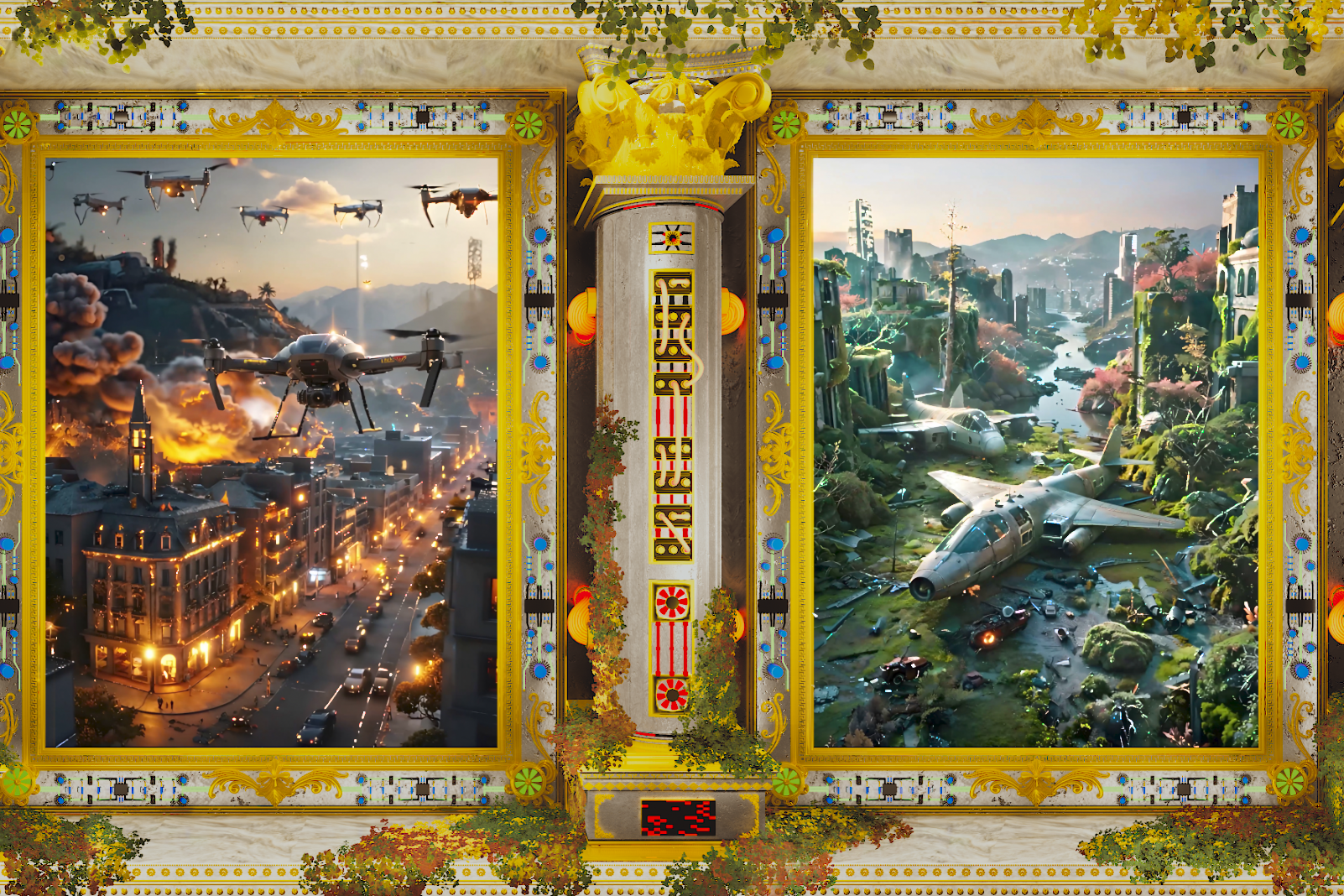
Saṃsāra was made inside a community, and the frictions, generosities, and sustained and sometimes difficult dialogue of that community are as much a part of the work’s story as the Sistine Chapel or the server rack.
Teresa Silva, who curated Mutuality and served as Program Curator for the Center Program cohort, came to the program in 2024 with the concept of mutuality already on her mind. She was thinking about the widening gap in society, a gap she describes as having festered for decades before accelerating sharply at the start of COVID, and about what the structure of a bridge across that gap might look like. “It reminded me that it’s a network of things [that makes bridging the gap] happen,” she writes. “Mutuality,” as she framed it for the cohort, meant showing up for each other’s work. Being genuinely invested. Contributing to the conversation. It was the organizing principle of the program before it became the title of the exhibition.
Kataria was the only new media computational artist in the cohort. That position made the feedback both more generative and refined the ideas. His peers—artists working in textiles, painting, sculpture, and other material practices—responded to his work from within their own disciplines, and those perspectives shaped decisions he might not have reached alone. Silva notes that she cannot point to a single exchange that changed the work, because that’s not how sustained dialogue operates. “Artists absorb all of that,” she writes. “They carry those exchanges with them and gradually synthesize them into their work.”
Kataria points to a question that artist Juan Molina Hernandez kept returning to during critiques: “it’s not what does the image look like, not what does it mean, but what does it do?” That question reframed everything. It made visible the function of the Genesis paintings, the way beauty and control are not separable in that work, and gave Kataria a lens through which to clarify what Saṃsāra needed to emphasize and what to leave out. “Those challenging conversations pulled me out of my technical obsession, making me reflect on why and what, forcing the how [of my work] to take a backseat,” he says. “That shift was everything.”
What Saṃsāra ultimately asks of its audience is not agreement. It does not need you to accept its claims about technological faith or extractive capitalism or the cycles of digital creation and consumption. What it commands, standing forty feet wide on the side of a building, is something simpler: engagement. Interpretation. The willingness to sit with its questions rather than scroll past them.
That is also what new media art at its best has always asked. Not passive reception but active excavation. The medium evolves, the tools change, the debates around authorship and labor and ethics shift with each new technology, but the demand remains. You have to operate in the gap. You have to be willing to look at what is foundational and hidden, to ask what the image does, to reckon with your own participation in the systems that shape your life.
This work is also a story about Chicago. Kataria arrived here in 2019, two years after a stint volunteering on an art installation at Burning Man, which cracked open his thinking about what his engineering skills could do outside of industry. He came from Microsoft, from Seattle, and he came to make art. He has spent the years since building a practice and a community, a studio at Mana Contemporary, relationships with galleries and curators and fellow artists across the city’s ecosystem. He speaks about Chicago with the particular gratitude of someone who found a place that received him. The funding, the grassroots gallery scene, the curators who care, the peer networks that hold. For these are not incidental to his practice; they are its infrastructure. Saṃsāra also could not have been made anywhere else, and not only because it is site-specific to a particular wall on 53rd Street. It required the conditions that Hyde Park Art Center and the Center Program created: ten months of sustained community, a curator who secured the facade before the work existed, a cohort willing to sit with difficult questions and push each other toward clarity. The mutuality Silva describes is not a soft concept. It is a structural one.
Kataria describes making Saṃsāra as itself an act of renewal: a year of confronting heavy material and producing something in response, something that stops being his the moment it leaves the studio. “The stories we tell, the expressions we create stop being ours the moment they leave the studio,” he says. “They become the world’s, and they stick with people in strange and odd ways.”
The work is site-specific to this wall, this city, this moment. It will not be shown here again, but the gap it points to isn’t going anywhere. And the conversation it demands—about new media, about technology, about what it means to make critical work from inside the systems you inhabit—is one the field will keep having, in new forms, with new tools, for as long as artists are willing to work inside the distance between where we are and what we understand.
That is the ongoing project. Saṃsāra is one chapter of it.
Saṃsāra was on view as part of Mutuality at Hyde Park Art Center December 13, 2025 through March 8, 2026. The exhibition brought together twenty artists from the Center Program, curated by Teresa Silva.
About the author: Mallory Shotwell (she/her) is a visual artist, independent curator, and studio manager for artists based in Grand Rapids, Michigan, with over 20 years of studio practice. Her participatory work examines care, maintenance, and the body, with key projects including Suspended Self: The Liminal Space of Breast Cancer and Maintenance Body. Her writing investigates contemporary art exhibitions alongside the systems, conditions, and practical realities shaping the art world. Mallory is the former Founder and Director of Cultivate, an artist-run organization that supported nearly 10,000 students and 1,000 artists. You can find her work at www.malloryshotwell.com.