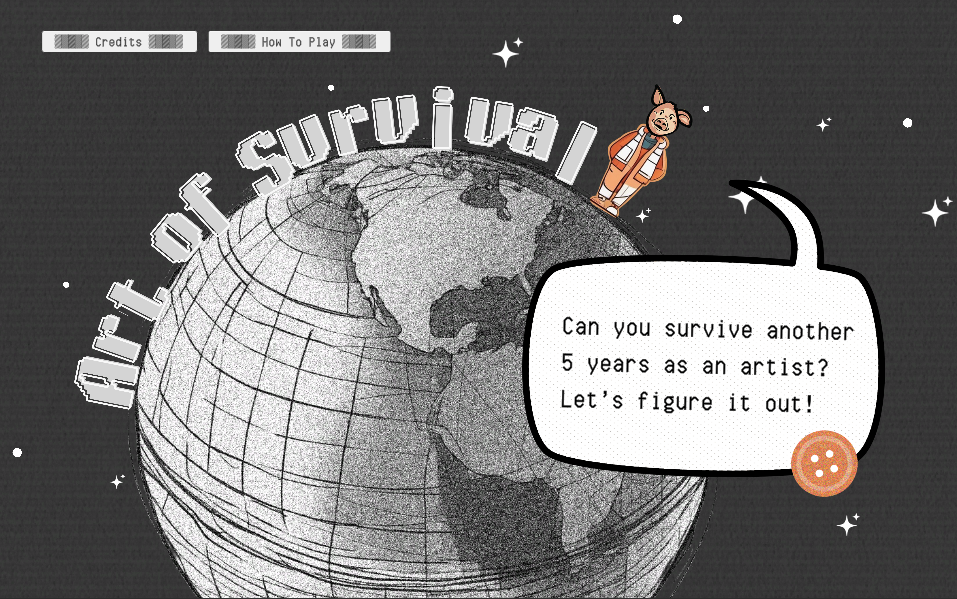
The artist Nayeon Yang and I originally met while collaborating on an essay for the Elbow Grease x Sixty project, which focused on femme and nonbinary labor in the arts. Much like this theme, Nayeon has been developing a game called Art of Survival. While its interface has some simplistic elements, it allows for deep conceptual engagement and serves as an outlet for the frustration that multifaceted creatives experience when expected to juggle multiple priorities, projects, and personalities under late-stage capitalism. According to Arts Midwest, creatives from the region earn $40,000 a year on average.1 This figure is lower than the $47,000 nationally; regardless of that $7,000 a year difference, both of these numbers are bleak. Nayeon’s outlook combined with the playful nature of a computer game has the potential to create dialogue around economics and creative decision-making in a way that is more approachable than reading a report.
Reviving my childhood love of PC games, playing Art of Survival brought back that muscle memory but then added the critical thinking behind my career. I realized that I make these decisions every day as a creative entrepreneur: how do I lower my grocery bill so I can save up to apply for a residency, and how can I not feel burnt out through pitching. As I maneuvered these decisions, the game operationalized it in a way that felt like I was advancing or even made visible the steps forward and back that being creative can feel like. It really made me question what hangs in the balance during a time where creativity is necessary and there’s intense economic precarity.
On May 31, 2026, Nayeon and I met via Zoom. This interview has been edited for length and clarity.
Chenoa Baker (CB): I’d like to start with what initially compelled you to explore artist survival through a game rather than working in another medium?
Nayeon Yang (NY): Prior to this game, I developed a research project titled “Inverse Proportion: Art as (Not) Labor,” which archived data from thirty-five Chicago-based artists, including their work hours, expenses, income, and work-in-progress videos, for a project or piece, to highlight the reality of unpaid artistic labor. [There is a difference between] saying unpaid labor versus showing the numbers like, let’s say 230 work hours and $3,000 expense with zero income, would hit people’s minds differently. [That is why] I would say this project makes a persuasive case for change.
I began to understand that this is actually a big subject to start with. So instead of presenting this information in a didactic way, I invite people to experience different situations and systems through their own decision-making process and its consequences. I brought this idea into a playful participatory form, a video game. Through role-play, the abstract word “struggle” becomes a [lived] reality that artists deal with. Once we identify them [those struggles], then we can start to talk about how [to tackle them] one by one.
Actually, I’m trying to transform Art of Survival, the video game, into a physical board game with a few more characters. The online video game was created to provide wider accessibility. You can play this game regardless of where you live: you can access [it] through itch.io, the online game platform. But I realized later that a player usually plays alone. If the game were played as a group, then players would discuss with one another before making a decision as learning others’ perspectives and situations. I think this way, a tabletop board game version could be a better platform for people to connect and talk.
CB: Yeah, I like that idea of collective decision-making because oftentimes when you’re a creative, especially a creative freelancer, you’re doing so much on your own. You don’t get to talk to people. And so I see your upcoming board game as being one of the solutions to the wild world of the arts, and trying to do it alone. That’s really great.
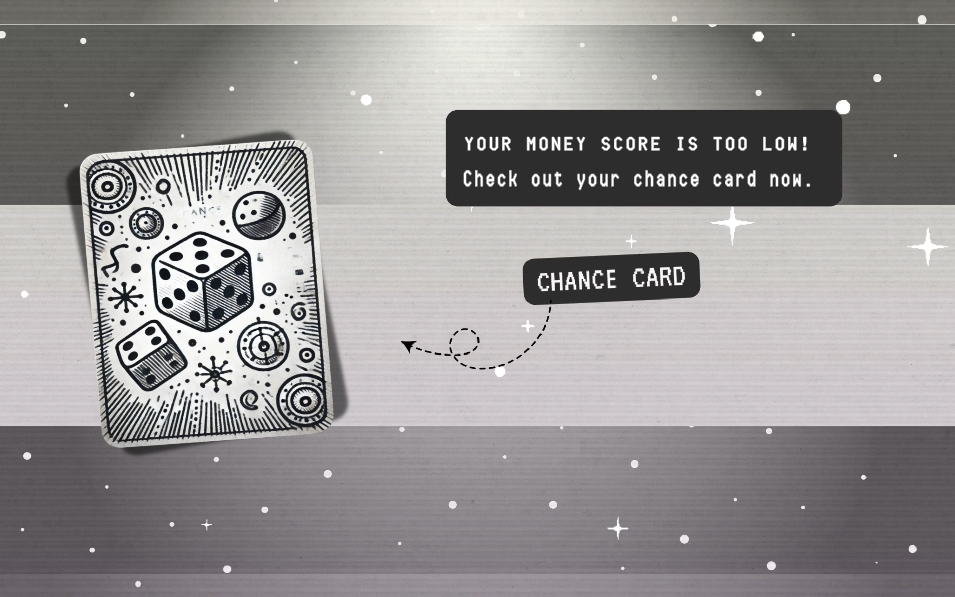
NY: Yeah. This is kind of a side topic. In the future, I plan to provide prompts that require consultation from another player’s character. For example, when you have a question related to a money topic and the following options, you have to discuss it with the other player who has the highest or the lowest money score before you make a decision.
So when you have this kind of group discussion, not only can players make better decisions to win, but it also helps them understand someone else’s situation through role-playing.
CB: Do you see this being an experience that you facilitate, like in front of a bunch of people and they play the board games and then you kind of like add in your perspective?
NY: I think, as a part of the development process, there should be a facilitator to guide the session and see what’s working and what’s not. But ultimately, I think this game is meant to provide a personal space for players to connect and have honest and deep conversations first. So then my next question would be how I’m going to distribute this physical board game. But that’s going to be another topic, I guess.
CB: Was there a specific moment in your own experience in the arts ecosystem that became the catalyst for Art of Survival?
NY: I think almost all the questions and options I have here are what I encountered and thought about, and also come from ideals. Like, what if I choose to do this instead of that? But, you know, I think things like burnout, gatekeeping, and a constant negotiation between making a living and maintaining an artistic identity are our shared experiences.
Artists try to build careers by working, volunteering, and using their limited resources fueled by passion. Then, when they constantly expose themselves to a malfunctioning, exploitative neoliberal system enough, you can’t even recall when your passion got shaped into a survival skill, or rather, your survival skill became framed as “passion” under market logic, while it is just a system of structural deficiencies burdened onto individual artists.
CB: How does your own experience relate to the game?
NY: If this is the game, what gives me “Game Over” these days is time and energy. The expense of my time and physical and mental energy is mostly untrackable and unmeasurable. I squeeze art into my “available time” after my nine-to-five job. And repeated small or big frictions and confrontations, like those depicted in the game, have unknowingly eroded my energy. Thinking through “what if” scenarios made me wonder what other artists juggle, how they do it, and whether they have somewhat higher or lower starting scores. But what’s really funny is how often artists are reduced to a single trait from a non-art perspective. Actually, “art” is what artists work on, and “artist” is a job title. Just like other fields, we are a group of different people with diverse backgrounds who happen to work in the same industry. Ironically, I think this reduction can be true because without a proper safety net and a system that can recognize artists’ labor as labor, work as work, there will be only a single trait remaining in this art world: those who can adapt to this neoliberal logic no matter what and who are already the cause of the malfunctioning system.
CB: Can you talk about your research process and then how you started designing it?
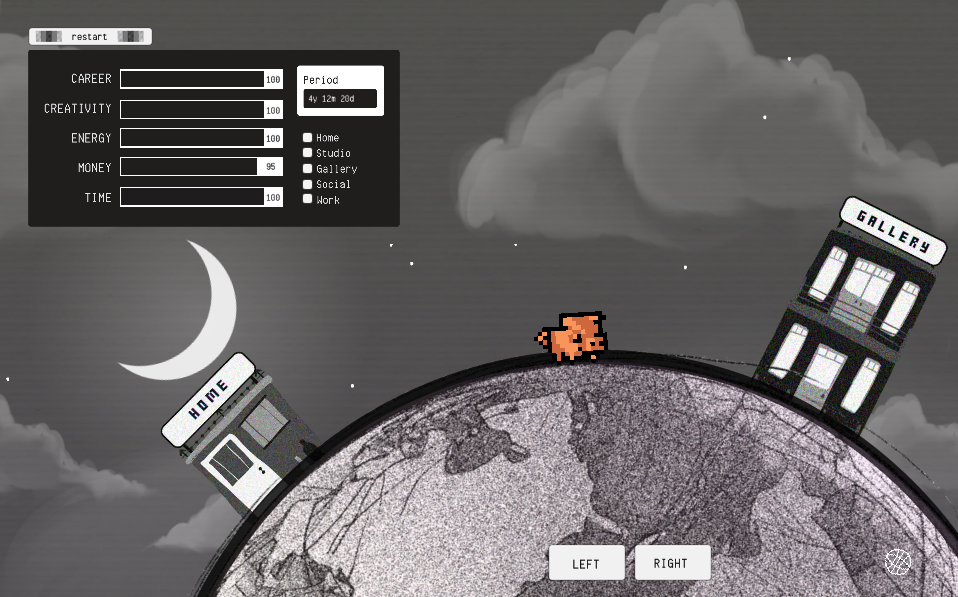
NY: Okay. In this game, I designed every domain, like home, studio, work, social, and gallery, to have its own dominant attribute that affects it the most. For instance, work, the gallery, and home are tied to your money score, while home and social sites heavily impact your energy. But your choice often leads you to an arbitrary outcome. For example, when you decide to apply for a grant, sometimes you get it, and other times you don’t.
Whatever the outcome you have, one rule stays the same. Each choice has a cost. So if you choose one value, the other goes down. For instance, when you have a conflict with someone, some players may focus on their careers and prioritize their professional relationships, while others might choose to protect their dignity, which can be energy-intensive. But you can’t score both energy and career from the option you choose. In this game, it reflects each player’s personal traits and their past experiences.
My research process started with the data from the Chicago Art Census, but, long story short, I ended up creating this game mainly based on my own experience as a foreign-born Asian female artist. So, for my next project, which I previously talked about, I’m expanding the narrative and adding a few more characters, referring back to data from the Chicago Art Census and Creatives Rebuild New York.
But since that data was collected during the pandemic, I think it is also important to gather artist testimonies to capture how the environment has shifted since then, especially considering the massive changes in AI use today.
And can I talk about the games that inspired me to make this game?
CB: Yes, please.
NY: Okay, so I was inspired by other games such as Lee Jihae Game: Surviving as a Woman in Korea, and Papers, Please. The creator, NolRaeMi, made Lee Jihae Game as a tool to promote feminism. This board game is designed to help people understand the destructive nature of patriarchal Korean society and how it leads to inequality. Also, Papers, Please, developed by Lucas Pope, is set in the fictional country of Arstotzka, where the player takes on the role of an immigration inspector working at a border checkpoint. The game’s objective is to process the paperwork of people trying to enter the country and decide whether to allow them to enter. At its core, it is a game about the human cost of bureaucracy and the moral dilemmas that arise when individuals are forced to choose between following orders and doing what they believe is right.
Inspired by those frameworks, I applied a similar mechanism in my game to question players’ roles and choices.
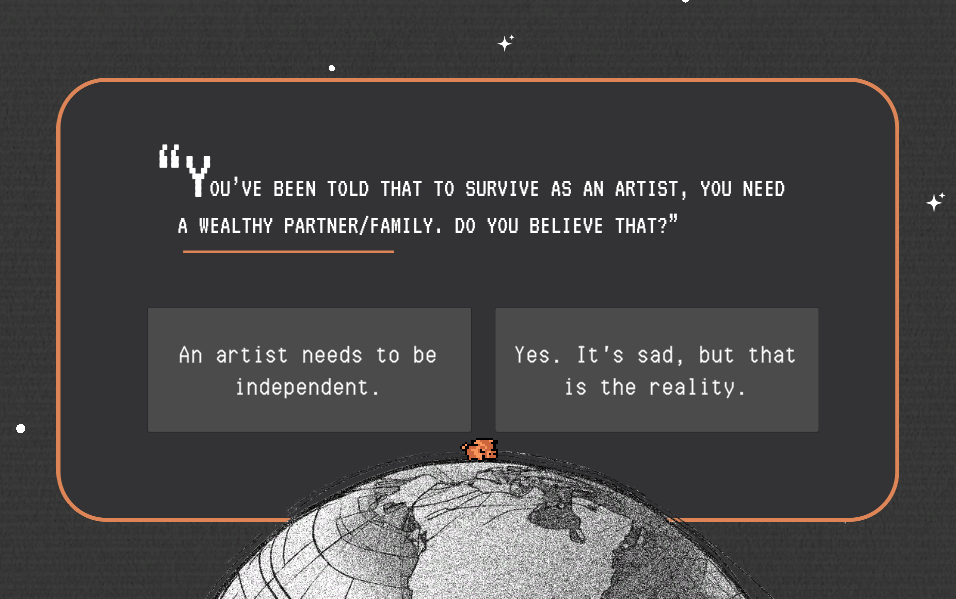
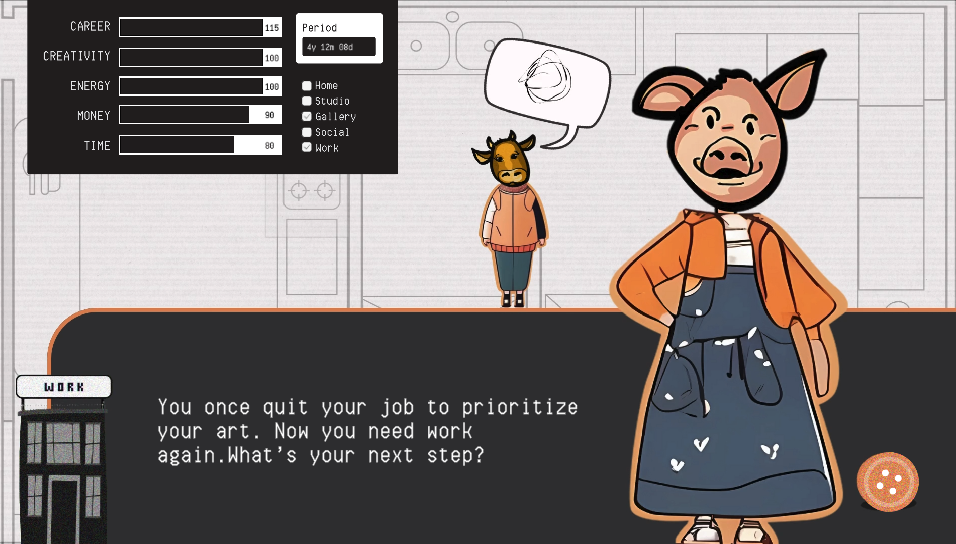
CB: Many artists survive through overlapping forms of labor, like freelance work. I really wanted to think about how you thought about that when designing the game.
NY: That question got me thinking for a very long time, actually.
Being a full-time artist these days is a privilege held by very few. In a way, being an artist who does more than art could be more appealing; it allows you to step outside the art world bubble and connect with others, broaden your perspective through different experiences, and bring all of those insights into your art.
But instead of focusing on artists’ double lives, the question I really want to ask is: where is their institutional safety net supposed to come from? It shouldn’t come from your day job. For far too long, the system has neglected artists’ welfare, treating them like high-risk investors, letting them burn out “to survive”?
CB: I’m curious, do you see just artists playing the game, or do you want people who could give that institutional safety net to play?
NY: Yeah, definitely all of them. Since my goal is to create a platform for discussion through this game, having artists play it alone is not going to work well. I think, to move forward, this subject needs to be shared with policymakers, artists, gallerists, artist-run galleries, nonprofit organizations, museums, entrepreneurs, and funders, all those sectors into the room together.
CB: Yeah, definitely. I mean I really think that the pace is realistic because I mean on one hand how you’ve designed it, while it seems elementary to certain people, it’s more accessible so more people can play it. But at the same time, like as a creative doing this full time, it’s very real that you’ll get a bunch of text and it’s like, deal with it through an email. It does force that same pace that the game has.
NY: Yeah. I think this game actually asks for your time. You know, it’s not fun to play even if it pretends to be. If I were to rename this game, it would be “Surprise: Life-never-goes-away-even-for-an-artist.” This game requires your time and focus. So, I think in terms of accessibility—or, like, having a broader audience—an easy and approachable design was necessary to encourage players to play a not-fun game at their own pace.
CB: Were there mechanics or scenarios you considered including but ultimately removed because I felt either too unrealistic or too real? Just want to understand, like the refining process for you and what that looked like.
NY: Actually, there are some stories and mechanisms that I had to leave out, either because they are too complex to build technically or because I wanted to keep the game accessible and simple. For example, in real life, things are entangled together like a spider web. For example, continuous residency activity can lead to substantial outcomes like unstable income, housing, and job situation, unless you have strong financial support. I wanted to map out all these messy and interconnected details and create different endings based on the various characters, but I couldn’t just make it happen.
CB: So can players truly win the game?
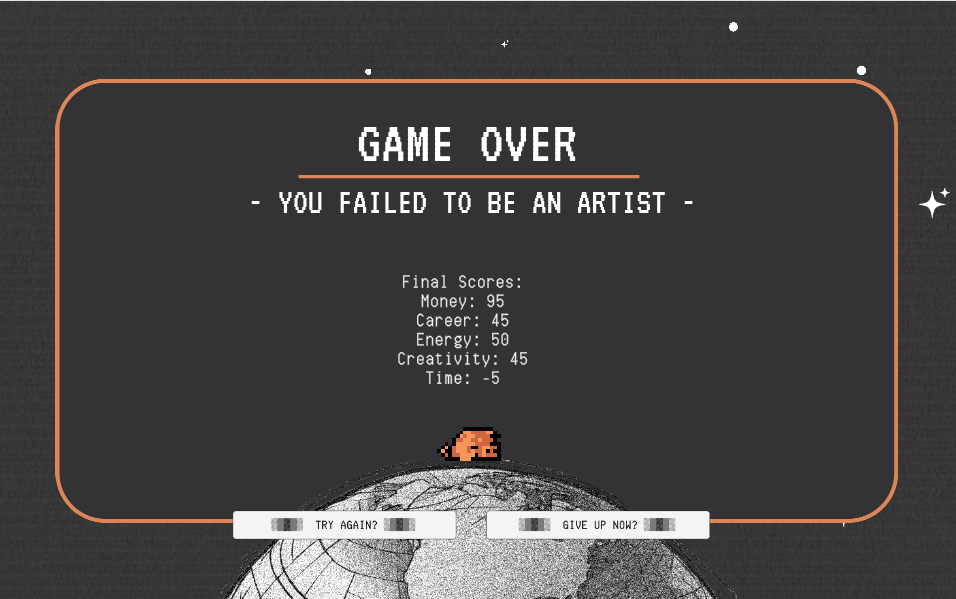
NY: No. The short answer is no. This game is actually designed to be unwinnable. Honestly, I have never seen anyone who claimed: “I won.” I’d really love to see if there’s anyone who won this game.
Players role-play as a visual artist navigating a series of stress-inducing scenarios, including power dynamics, financial instability, moral dilemmas, work-life balance struggles, and the physical and mental health challenges inherent to the art-world ecosystem. As you struggle to stay afloat, you are prompted to think about your choices. It forces you to ask, why do we romanticize the precarity of artistic labor? And what could an alternative system actually look like? So yeah, the tension between agency and inevitability in the game serves as a structure to drive the purpose of the game, which creates a space for reflection and dialogue.
Simply put, the goal of the game is to win by surviving, but the purpose is to talk and those are not my words. In C. Thi Nguyen’s Games: Agency as Art, he explains the distinction between a game’s goal and purpose.
CB: Yeah. Thank you so much. I’d love to know more about the software that you used off-script question as well, but did you kind of write up all the code or use a builder?
NY: I did have a developer collaborator, Jessica Ann Nguyen. She’s one of my friends who really knows how to leverage AI tools. She’s not a commercial game developer, but she built the game in Unity and was assisted by AI while coding.
CB: So you wrote all of the script?
NY: Yeah.
CB: And directing like the building.
NY: Yeah. I brought this project to Jess, the developer, with zero idea about how to develop a video game. I didn’t know what was doable or not for Jess or Unity. But no matter what I asked for, Jess was so wonderful that she brought it all to life. The way the time counts down, the globe spins between day and night, and the random results appear after the player’s choice. That’s all her work.
On my end, besides directing, I developed a decision tree narrative, but not in a conventional way, and designed most of the visual elements, from each scene’s layout down to the domestic animal characters. I also used AI to help generate some of the images, like the animals’ costumes, building facades, and the globe.
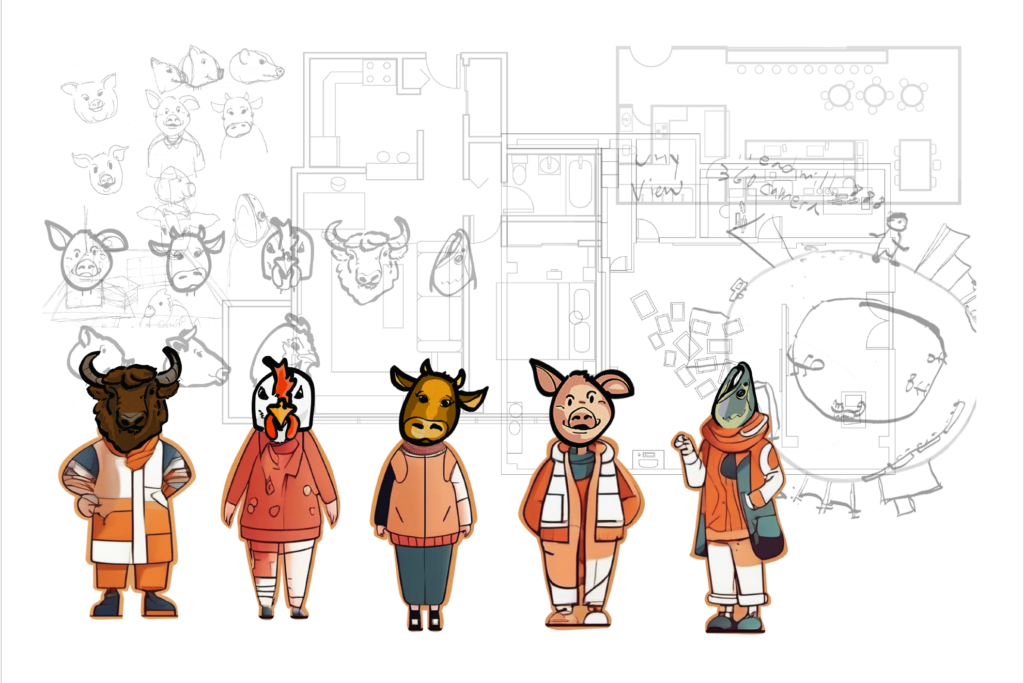
CB: Did you, like, lay it out like a storyboard? Is that how you thought through it?
NY: Yes. But not exactly a storyboard because the narrative is not linear in this game, even though the concept of time exists there. I just had to make sure that the game was impossible to win. Instead, I made all of the layout images and text in a spreadsheet for the narrative, categorized by domains, then questions, options, different or random results, impacts, question timing, and other details. Jess uploaded the images, then applied text to them through Unity.
CB: Thank you for clarifying that.
Is there anything else that you would like to add that I didn’t get to through a question?
NY: When I see my own spouse expecting me to make a living, do household work, spend time with family, and pursue my career as an artist, I think, “Oh, maybe in his eyes I’m a magician!” Here, I want to make it loud and clear: artists are not magicians; I really need to emphasize that they are just ordinary people working with very limited resources. In the game, I wanted to visually and intuitively show how these finite resources are drained and recharged, and to make players constantly see and feel the opportunity costs that come with every single choice.
CB: Definitely. I mean, I love that part of the game because I really wish there was a way to visually show people where my meter is at. Like, can I be social right now? What do I have on my plate? I feel like making that more visual is very helpful for other people to understand what we’re going through.
I did something, I mean, it’s a little different, but I made like a pie chart based on my income. And to describe what I do as a creative? And I had a breakdown of this percentage comes from writing, this percentage comes from editing, this percentage comes from making art, you know what I mean?
I feel like there needs to be more of that.
NY: Isn’t that heartbreaking?
CB: It really is. Yeah.
NY: Yeah, yeah, I actually did a pretty similar thing recently, like a budget book. Also, in the project I introduced earlier, I had to analyze how I spent my time and money. I knew that I invested a lot, but seeing the numbers coming out of my twenty-four hours and monthly paycheck is actually overwhelming.
CB: Definitely. Quantifying it is no joke, that’s for sure.
Well, thank you again for your time. I really appreciate it.
* * *
Footnotes
- Horton, Alana, and I/O Research. “What American Community Survey Data Says About Midwest Artists.” Arts Midwest. May 6, 2025. https://artsmidwest.org/resources/research-data/what-american-community-survey-data-says-about-midwest-artists/. This source was selected because it analyzes data specifically within the Midwestern United States and was published by Arts Midwest, an organization dedicated to the region’s arts and culture. Its findings are especially relevant for Sixty as a Midwest-focused publication. ↩︎
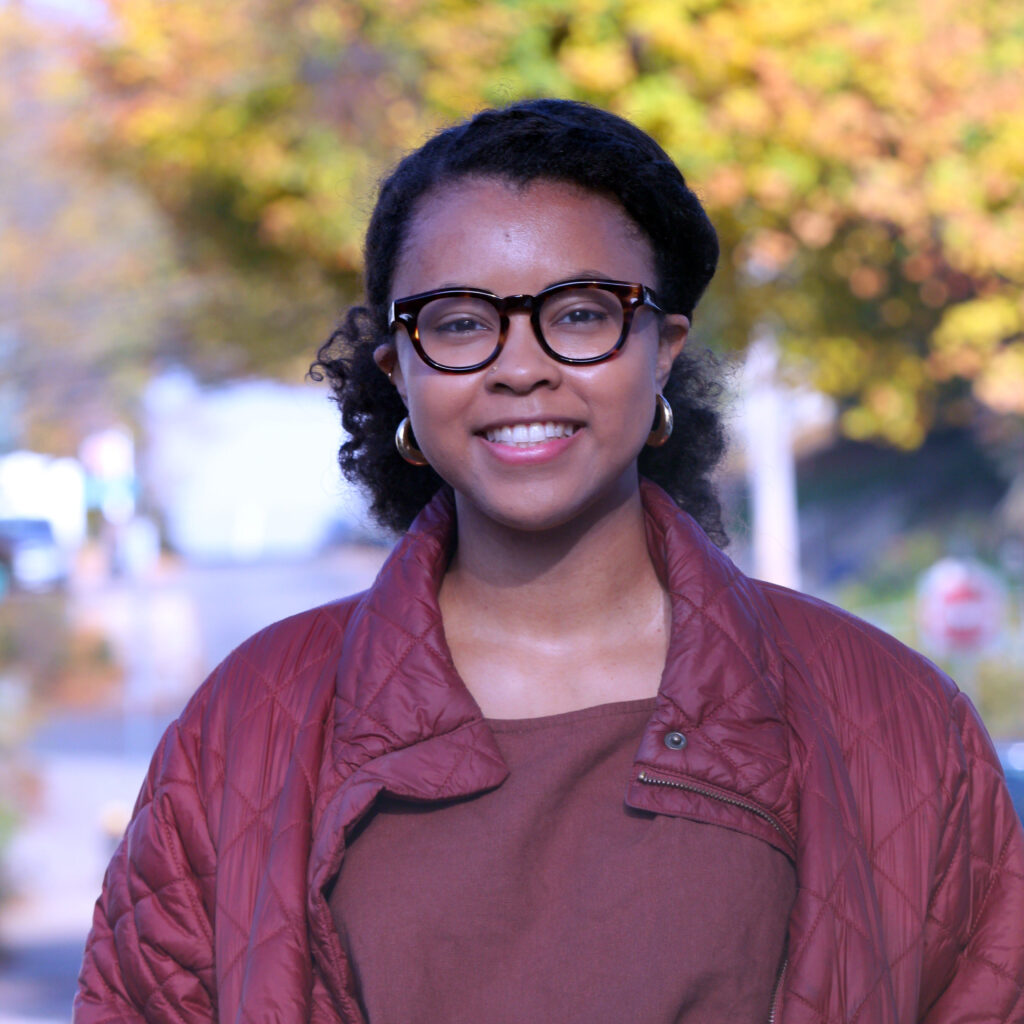
About the Author: Chenoa Baker (she/her) is a curator, writer, and museum consultant. Currently, Baker curates a temporary public art project (location to be announced) and Ifé Franklin: Orun/Portal at the Fuller Craft Museum. Both debut in 2027. Previously, Baker was granted the WBUR Maker Award in 2024 to honor her contributions to major exhibitions, such as Gio Swaby: Fresh Up at the Peabody Essex Museum; Touching Roots: Black Ancestral Legacies in the Americas at the MFA, Boston; and Simone Leigh at the ICA, Boston, and Venice Biennale. Through independent projects, she has worked with The Studio Museum, Boston Public Art Triennial, Denver Botanic Gardens, and Fallingwater. Her writing was awarded the AICA Young Art Critics Prize in 2023 and featured in Hyperallergic, The Observer, The Brooklyn Rail, Material Intelligence, and others.