Glacier Creek Preserve lies just 20 minutes and two turns from my front door on the edge of Omaha’s Country Club Historic District. The 525-acre preserve is managed by the University of Nebraska-Omaha and encompasses the entire Glacier Creek watershed, including 140 acres of restored tallgrass prairie. According to the United States’ National Park Service1, tallgrass prairies once covered 170 million acres of North America, but less than four percent of this native ecosystem remains today due primarily to large-scale agricultural development.
Growing up in Omaha, I don’t think I realized there was a difference between prairies and cultivated crops. As a city kid, I didn’t have much first-hand experience in fields of either kind outside of visiting my cousins who lived on the edge of a cornfield or the handful of times my family visited my mother’s ancestral cemetery in Kansas, a place where they homesteaded in the late 1800s. By the time I was in college at the University of Nebraska-Lincoln studying studio art, I idealized these fields—cultivated as they were—as I viewed them on my drives between Omaha and Lincoln, the state’s two largest cities, where over half of the population of Nebraska lives. Driving past the rows of corn flashing by at 60 miles an hour is almost like some kind of early video era projection, although the movement is coming from you rather than the thing you’re looking at. My younger self filled canvases with these scenes, painting swaths of golden wheat fields under bright blue skies, abstract and gestural.
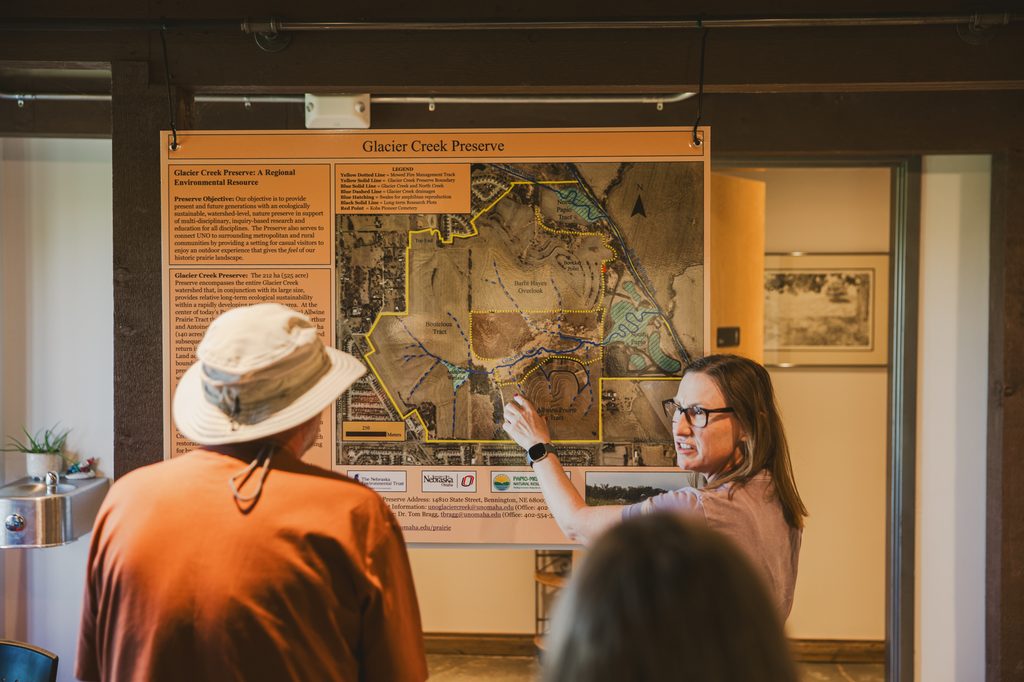
These same types of cultivated fields line the street approaching Glacier Creek Preserve, interspersed with suburban housing developments. Once you know what to look for, it becomes easy to spot the difference between cultivated fields and the tallgrass prairie at the preserve. From a distance, cornfields are a uniform dark green, whereas the grasses they frame vary from chartreuse to avocado to tan. The texture varies, as well: cornfields have almost no texture at all, other than the slight gradations of the land itself, whereas different sections of the prairie preserve appear as a feathery soft haze or leafy brambles, variations in texture that seem to result from areas having more grass compared to flowers or the other way around.
By mid-August, common milkweed grows as tall as my chin, heavy with seed pods that have yet to open, while big bluestem grass towers above my head. It evokes the scene in Little House on the Prairie in which Laura gets lost among the grasses that completely engulf her body and much of the landscape. Back in mid-June, the milkweed had yet to flower and the bright green grasses hadn’t yet reached my knees. This was the stage for tbd. dance collective’s traveling movement and sound experience “Passage,” which took place across five locations within Glacier Creek Preserve.
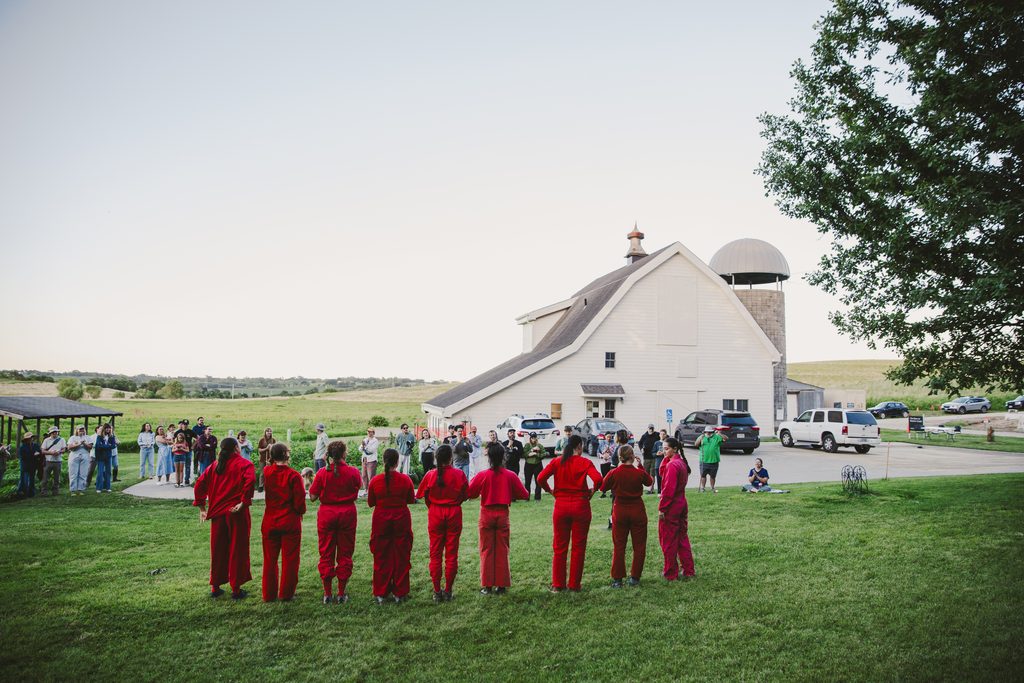
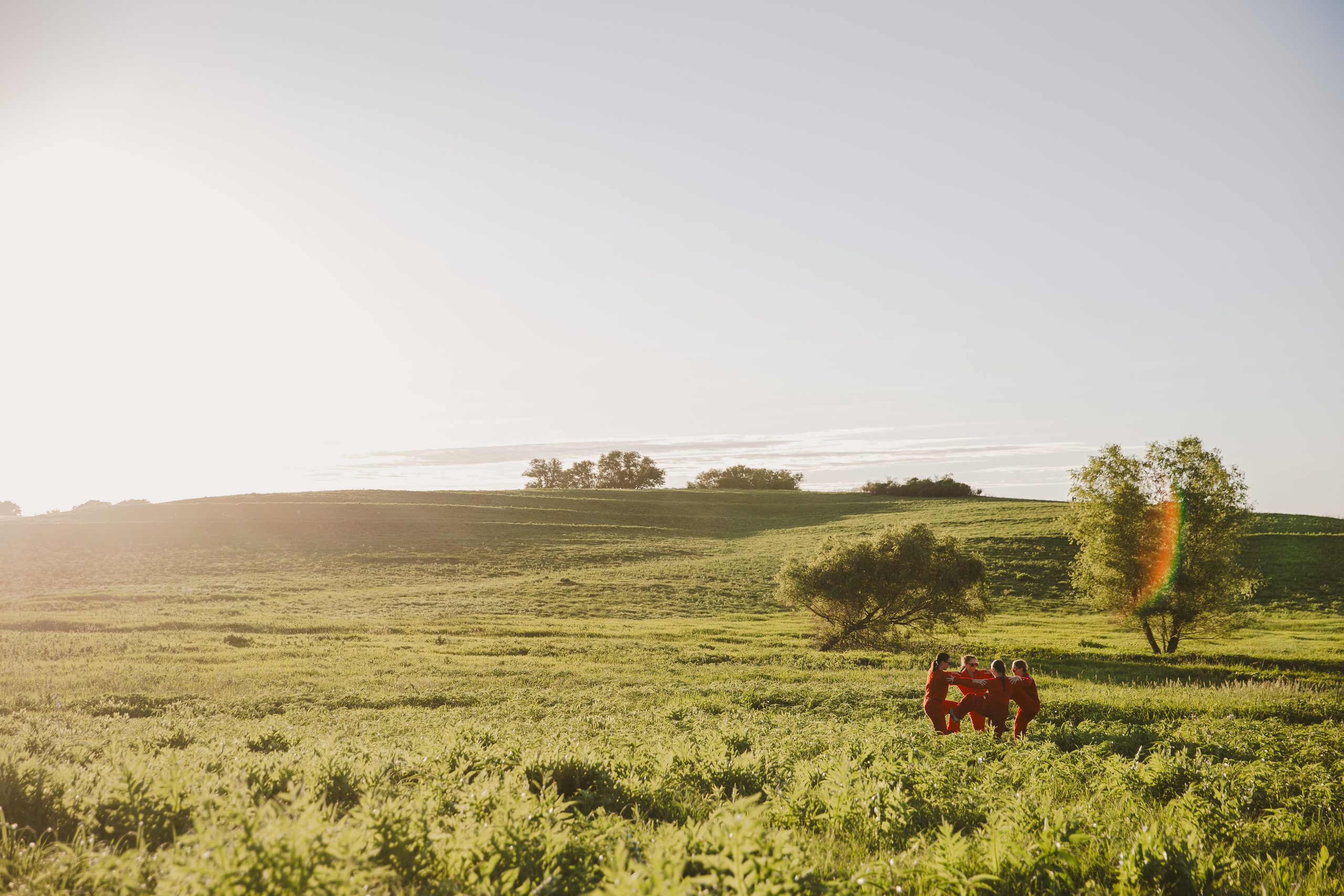
Each of the five pieces in the performance was choreographed by a different member of the collective and titled with the names of native plants. “Little Bluestem,” which is the official state grass of both Nebraska and Kansas, kicked off the evening behind a 1900s-era historic barn. There, two performers, both dressed from head to toe in bright red, danced in the sunlight shining beyond the shadow cast by the barn, their shadows grazing the prairie grasses at the edge of the mowed lawn. Haunting tones resonated from a vibraphone being played on the cement patio where the audience stood, a yearning that matched the mood of the setting sun. The contrast of the red costumes against green grass with all that blue sky overhead felt like something from a child’s imagination, playful and elementary.
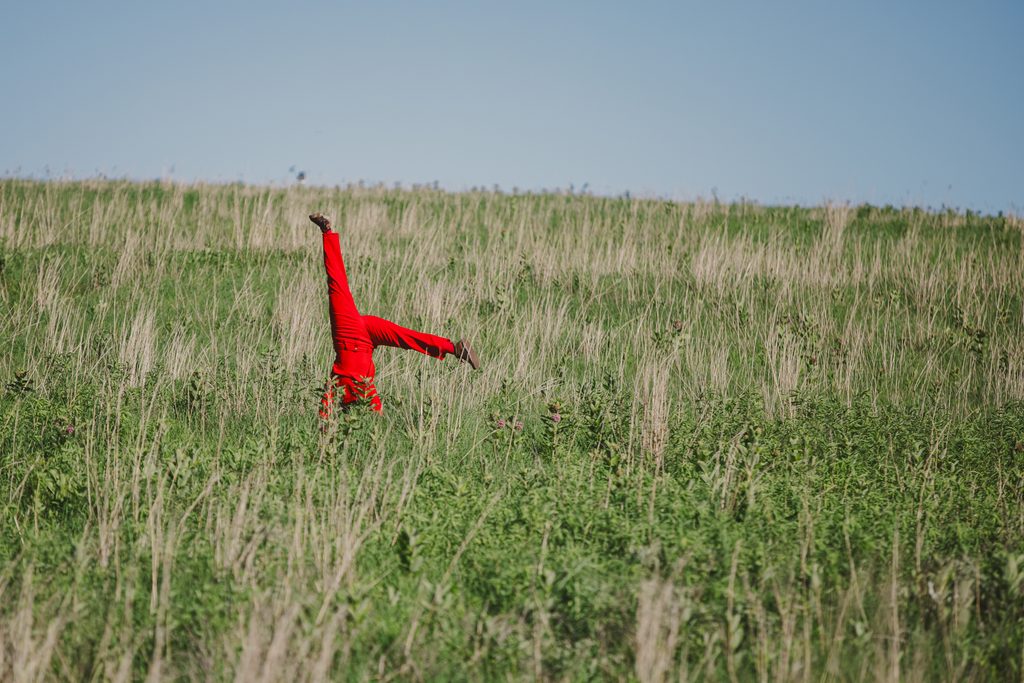
With birds and crickets chirping around us and a small plane buzzing overhead, the audience followed a mowed path from the barn into the prairie for “Prairie Violet,” the second installation. Red-clad torsos and cartwheeling red legs appeared at regular intervals among the rolling hillside before we had even arrived at the selected stopping point. Arms swept from left to right in big overhead gestures or were raised stiff into the air, hands clapping, before disappearing again down among the grasses. One performer ran uphill to a higher ridge where other performers, also dressed in red, popped up and down among the landscape like prairie dogs or their arcade-dwelling cousins, Whack-a-Moles. Their big, delightful movements, both individually and as a whole, were perhaps an attempt to make up for how small a body looks in such a landscape. Standing in a place with so much sky, scale becomes harder to distinguish.
“Prairie Violet” didn’t have any instrumental accompaniment, and so the sound of the performers’ labored breathing carried down the hillside to where the audience stood, along with the crunch of tall grasses underfoot and the slap of it against their legs as they ran between small plateaus. Some threw themselves downhill. They rolled not in the shape of a log, as a child might, but rather in the shape of a ball. The aggressive thud of their bodies as they somersaulted downhill, sometimes backwards, was only slightly quieter than the grunts escaping from their mouths. Their physicality within the landscape reminded me of how harsh it can be, sharp and abrasive, blades of grass aptly named for their ability to slice open your skin, even if they might appear to be soft.
The piece concluded with the performers disappearing over the hillside as the audience continued around it on a curving path. Following a performer to a small clearing, we stood in a semicircle, our shadows long and lengthening still; a curve of transparent heads creating a makeshift stage edge. One of the first things I learned as an art student about depicting groups of people in space is that the heads will always appear level, even if people are standing far apart from each other—it’s their legs that get shortened. It’s a principle of linear perspective, and on this gentle incline, the performers’ heads appear to touch the horizon line behind them when standing upright. Their bodies weave and bend, just as the grasses around them might in the wind.
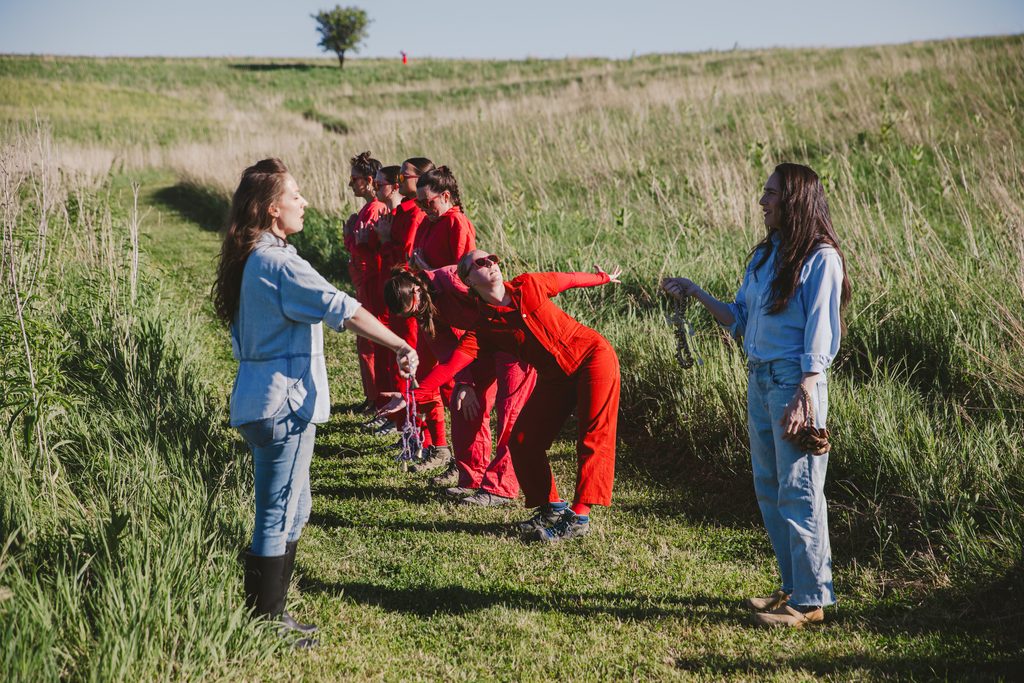
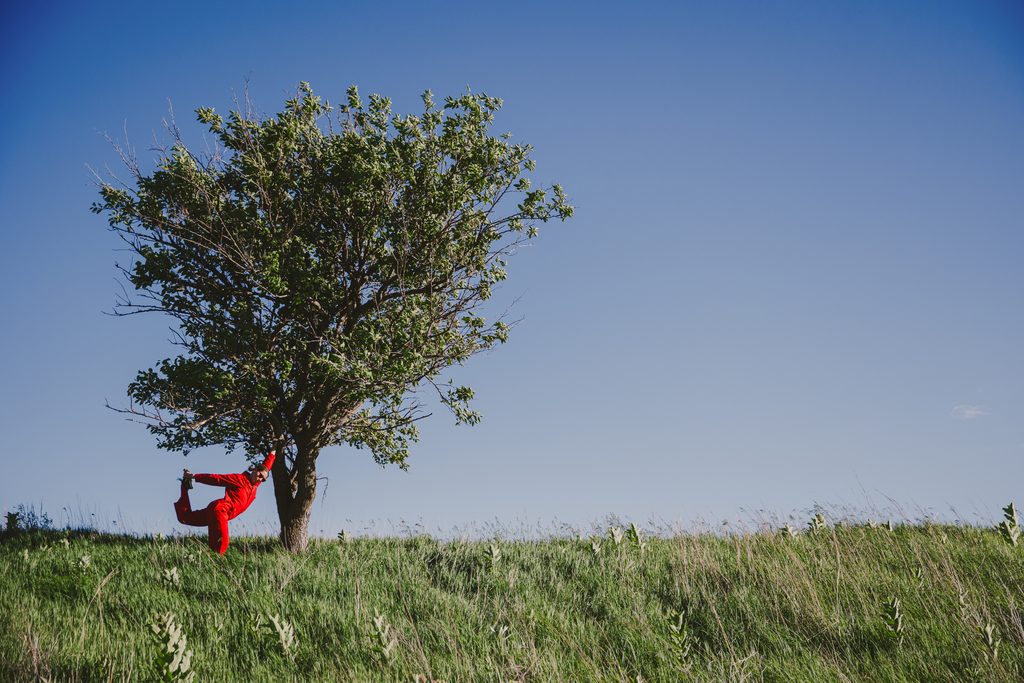
Gentle vocal harmonies direct your gaze back to the path, which continues uphill, where two singers are dressed in light blue denim, holding strings of bells and shells in their hands that tinkle and rattle alongside their voices. They frame the row of performers that have formed a line pointing toward a lone tree in the landscape near the high point on a hill, where the pinpoint of another performer in red emphasizes the distance. Arms outstretched, the line of dancers in the path bend and twist at the waist, their faces aimed over their shoulders toward the sky. They spin to stand and clap overhead, one after another, before bending to the ground and kneeling, all to the syncopated rhythm of lilting “ooohs,” sharp yelps, and staccato “ha ha has” of the two singers. The performers in red add to the soundtrack, a chorus of exaggerated exhalations and feet dragging in the grass, becoming dewy now.
On my return in August, I couldn’t help but walk up to that lonely tree, noticing the preference of the monarch butterflies for the spherical purple blooms of the tall thistle. As I crested the hill and the roofs of a suburban subdivision came into view, uniform in the same way that the cornfields are except in a muted palette of grays and tans, I felt a pit form in my stomach. These houses stand in opposition to what this performance is: orderly and planned compared to evocative and surprising. While Glacier Creek Preserve emphasizes that they give only the “feel” of a historic prairie, it’s easy to become consumed by the features it presents: the birds and the butterflies, the sun beating down overhead, the seemingly vast expanses all around. In contrast to the suburban areas of Nebraska, there is an openness to standing in that landscape that prompts feelings of possibility and limitlessness. Freedom.
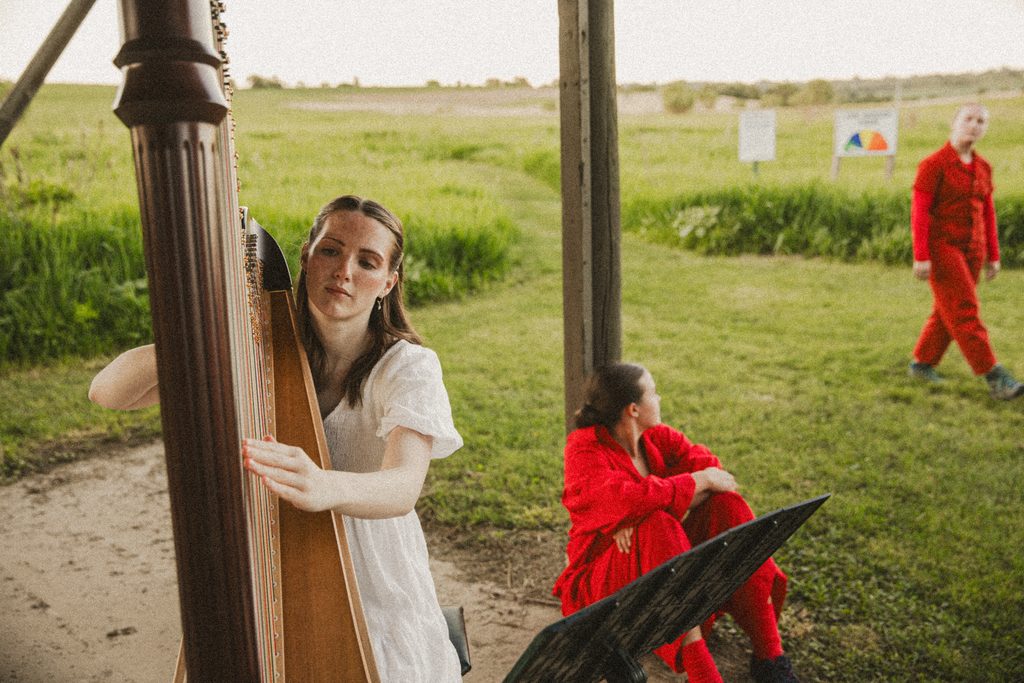
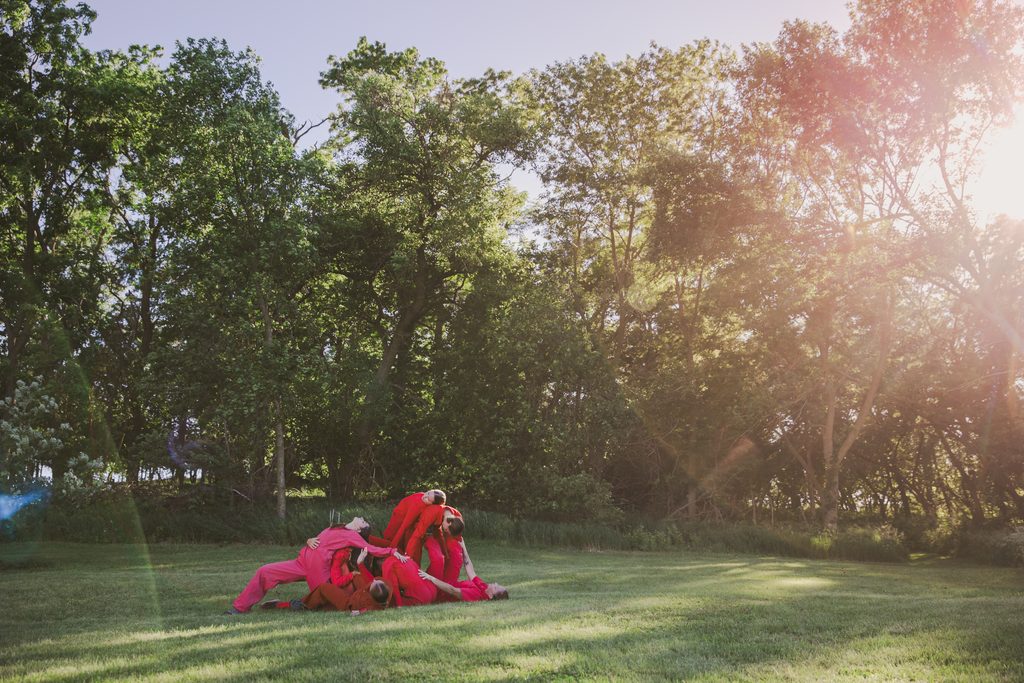
“Passage” underscores this corporeal experience; focusing on the figures in red gives you an excuse to stand in the periphery, a landscape that you might otherwise simply drive past or fly over. The performance was a gift of awareness, fully enveloping my senses in the physical world that surrounds me and requiring a presence of mind, as an hour of meditation might. The choreography not only draws our attention to the landscape, but it gives us a reason to pause within it. As we began our return to the barn via a fourth installation in the lower part of the prairie—where a map might show water running that we couldn’t see through the dense growth—I was filled with gratitude. Dancers ran ahead of the audience along our return path, stopping like signposts, waving their arms overhead. Arriving at a small pavilion, the resonant strings of a harpist accompanied a single performer, dancing now in the cool of dusk. The small plane still droned overhead, birds adding their perfectly-timed tweets. Titled “Big Bluestem,” its music and the movement was the most ballet-like of all, bringing with it romantic associations of the connection between nature and our emotions. The performers transitioned to our final stopping point on the opposite side of the barn from where we began by rolling, creeping, climbing, and spinning independently before forming a red group of bodies in front of a tall stand of trees. They stood in a circle and then paired off, hugging each other with their heads resting on each others’ shoulders, feet moving back and forth almost as if in a slow dance, as the harp and the birdsong continued. The final image of the group was almost like that of a pietá, bodies draped and bent over one another, perhaps acknowledging the loss of something precious, or at least honoring the preciousness of what remains.
According to the National Park Service2, one of the largest tracts of virgin tallgrass prairie in the United States–land that has never been plowed is Nine-Mile Prairie, so named for its position five miles west and four miles north of downtown Lincoln, NE. Spanning 230 acres, it is maintained by the University of Nebraska-Lincoln and abuts a facility with tall chain link fencing topped with barbed wire and signage warning would-be trespassers of prosecution. The nearby airport means that the atmosphere is always tinged with jet engines, although the cacophony of cicadas in August does its best to compete. It takes a bit of imagination to extract these aggressive human factors from the experience of virgin prairie, but walking even a short distance from the entrance makes you feel very small and somewhat abandoned. The fields are dominated by big bluestem grass, although I had the urge to pull familiar weeds at the edges of the paths that I recognized from my own backyard.
As trite as it might sound, this is where it begins: with awareness. Of the difference between cultivated fields and tallgrass prairies and the calls of various birds. Learning to recognize big bluestem grass as well as common weeds. Because these native ecosystems are not just for our human appreciation, but to support the many species that depend on them for their survival, and ultimately, us on them for ours. The University of Nebraska at Omaha3 has observed over 170 species of birds, amphibians, reptiles, and mammals as well as 56 species of butterflies and more than 200 species of moths at Glacier Creek Preserve. So as “Passage” reminds us: be present in nature. Stand in a field and watch a butterfly. Stretch out your arms and spin under the sky.
. . .
Works Cited
- U.S. National Park Service. “Tallgrass Prairie National Preserve .” National Parks Service. Accessed September 5, 2026. https://www.nps.gov/tapr/index.htm.
- University of Nebraska Foundation. “86002089_Text.PDF.” Lincoln: United States Department of the Interior National Park Service , June 1986.
Copy of National Register of Historic Place Inventory Nomination Form: Nine-Mine Prairie record - “Flora & Fauna.” College of Arts & Sciences, January 15, 2026. https://www.unomaha.edu/college-of-arts-and-sciences/nature-preserves/preserves/flora-fauna.php.

About the author: Amber Eve Anderson is a multidisciplinary artist, writer, and organizer based in Omaha, NE. She is interested in the ways identity and behavior are informed by one’s surroundings, both physical and virtual. She received a BFA from the University of Nebraska-Lincoln and an MFA from the Maryland Institute College of Art in Baltimore, where she served on the advisory board of the Institute of Contemporary Art and was a regularly contributing writer at BmoreArt. She is now one of the organizing artists at Project Project in Omaha. Her self-published book Free to a Good Home was purchased by the New York Public Library and is available at Printed Matter. You can find more of her work at ambereveanderson.com.