Read this essay in Mandarin here.
Being Chinese is cool now. That is the observation many have made as Chinamaxxing has become the latest trend. The term started with blind admiration of Chinese culture, misinterpretation of Chinese traditions and living styles, to a near infatuation with all things China, including Chinese economy and policies.
While Orientalism is nothing new, Chinamaxxing sends out concerning signals, especially as online influencers create an exaggerated and filtered view of what living in China looks and feels like. This distortion of reality often neglects existing and ongoing political and social issues within the nation and erases historic wrongdoings. Under the name of demystifying and debunking, the core narrative of Chinamaxxers is how China, as an economic and political body, is nothing what Westerners have been taught to believe. A narrative that has now attributed all negative comments and coverages on China as part of Western, especially US propaganda.
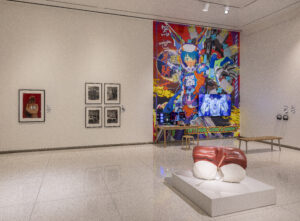
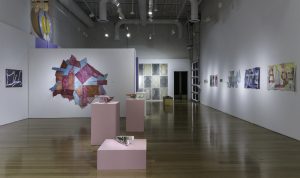
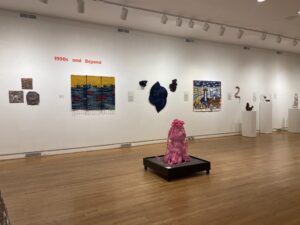
Amidst this sharp turn of opinions about China and, inevitably, the Chinese Communist Party, new challenges have risen for curators and scholars specializing in contemporary Chinese art. In this conversation, I invited Ellen Larson, Associate Director, Center for the Art of East Asia at the University of Chicago and Curator of Beyond Boundaries: Three Decades of Contemporary Chinese Art at the Smart Museum of Art to take a deep dive into how it feels curating contemporary Chinese art in the age of Chinamaxxing.
Xiao Faria daCunha: Hello, Ellen. Thank you so much for having this conversation today.
Ellen Larson: You’re welcome! Thank you for having me.
XFD: Let’s start with the “how” and “why” behind the exhibition. How did the idea for this exhibition come into place?
EL: I organized a symposium on behalf of Center for the Art of East Asia (hereinafter the Center) in honor of Professor Wu Hung in April 2025. Wu Hung has had a significant impact on several generations of students at Havard, the University of Chicago, and even those with whom he has worked in China. That symposium was titled Beyond Boundaries: a symposium in honor of Wu Hung.
XFD: So would you consider the current exhibition a survey of Chinese contemporary art?
EL: Not necessarily. It’s important to consider that Professor Wu was not only a scholar, but also an important curator. So, as a curator myself, when I worked on the current exhibition, my goal was to treat this as a curatorial collaboration between him and the Smart Museum.
XFD: I love this approach. Your website mentioned this exhibition is kind of in conversation with Transience, which was an exhibition Wu Hong curated in 1999–were there other curatorial projects from Professor Wu that influenced the current exhibition?
EL: Yes. That and a few more projects he’d curated, including Canceled (2000), which was the one focusing on experimental art, Past & Future (2004), which highlights new photography and video in China, Displacement: The Three Gorges Dam and Contemporary Chinese Art (2008), and finally, The Allure of Matter (2020).
XFD: It almost feels like you’re moving an existing conversation forward, or this exhibition is a continuation, or a new chapter, built on top of the professor’s existing practice.
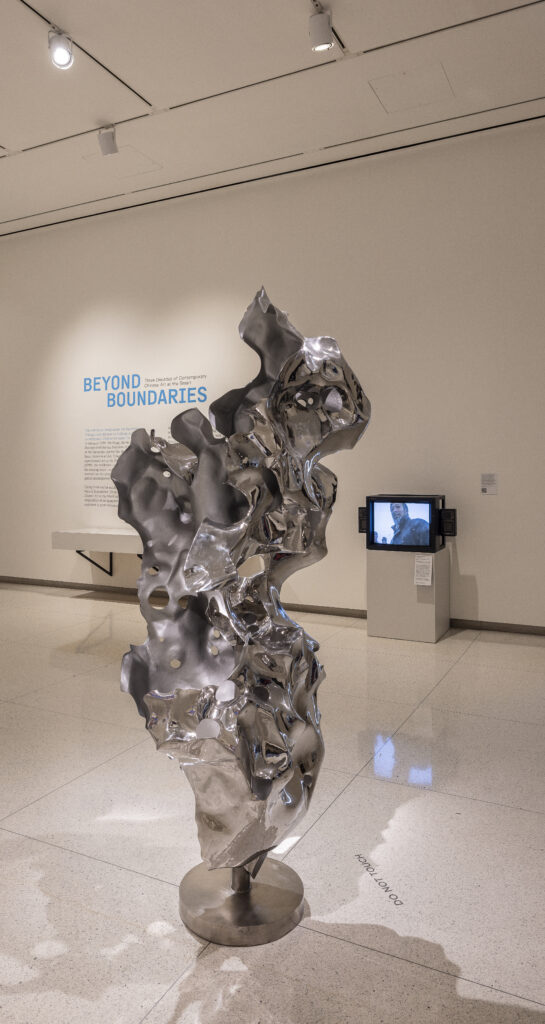
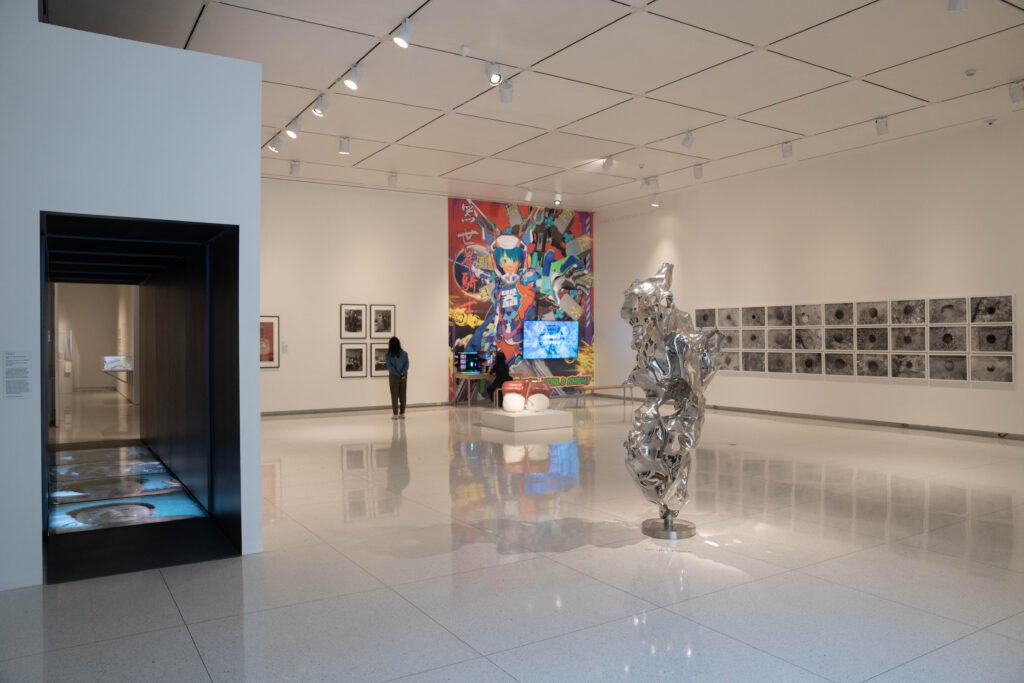
EL: Absolutely. Beyond Boundaries, actually selected artworks from all the aforementioned exhibitions. But we also chose to include Chinese contemporary artists belonging to younger generations, based both in and outside of China. Our goal is to examine how contemporary Chinese art has been understood, exhibited, but also collected and even taught over the past three decades at the University of Chicago. Ultimately, this is a hyper-local exhibition rooted in a specific Chicago context.
XFD: I really love that! Could you explain more about what principles guided you in choosing artists in this exhibition?
EL: In this exhibition, the term “boundary” stands for many things, including geographical boundaries of the nation-state and how artists are engaging their bodies as sites of expression, protest, or identity formation.
XFD: So it’s really beyond the boundaries of “bodies”; it can be political, physical, or metaphorical bodies?
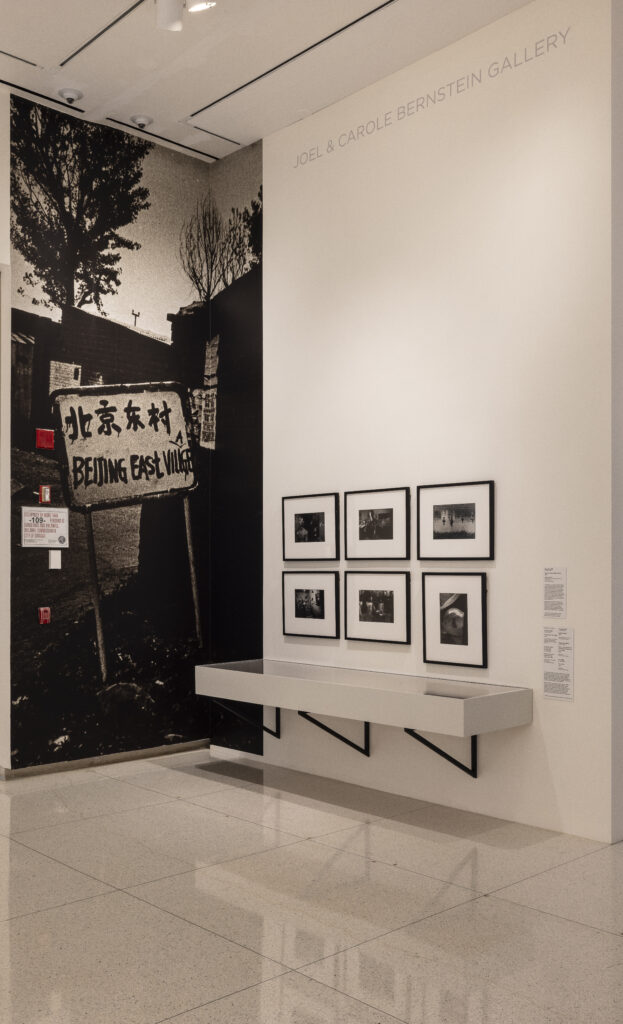
EL: Yes. For example, we included Rong Rong’s photography of performing artists in China. Rong was an important member of the Beijing East Village1, that was active roughly between 1993 and 1997. One of the artists in his lens was Zhang Huan, who was also one of the founding members of the village. Rong documents Zhang’s performance, where he treated his body as a site of memory. Here, often uses the naked bodies of himself and his co-performers as both embodiments of pain, struggle, and endurance, and building blocks of other structures that interact with the real, physical world.
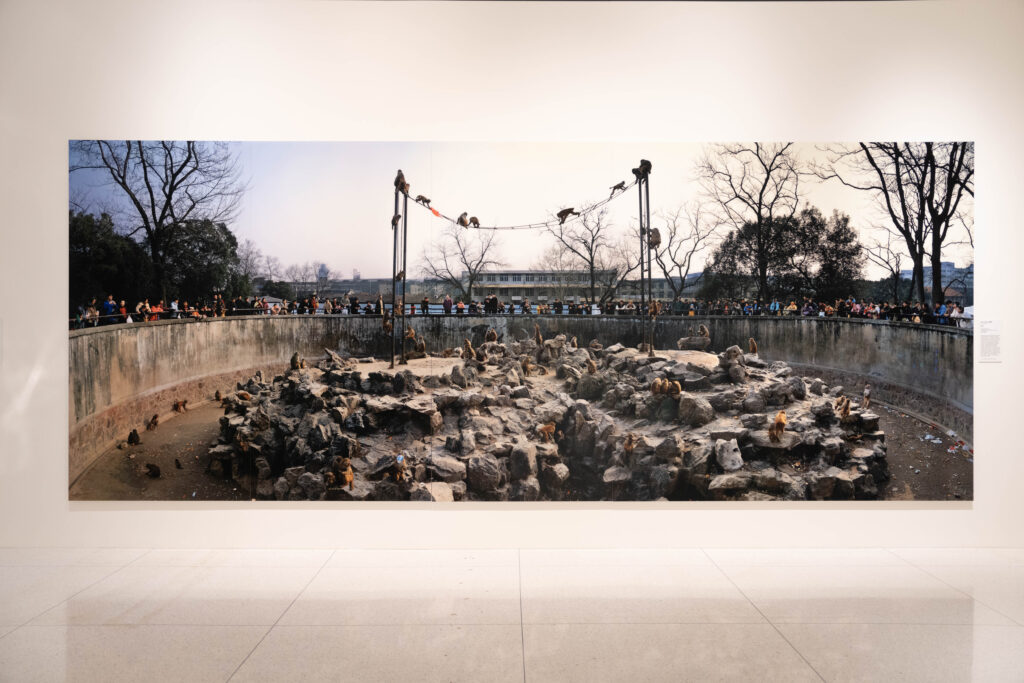
Another artist that was very important to me from a curatorial perspective for this exhibition was Zhuang Hui. The images he took carried a unique significance because it was done on the site that was soon flooded to make way for the Three Gorges Dam, the world’s largest hydroelectric project. He then asked a cameraperson to return over a decade later to document the magnificent reservoirs that stood in the original site’s place. So in his work, the viewers are taken beyond the boundaries of physical land, but also that of time and history.
XFD: I really like the way you talked about Zhuang’s work, because I think the idea of looking beyond what we perceive as the current carries unique significance in the political and social landscape we have today. Let’s talk about Chinamaxxing.
EL: Absolutely.
XFD: As you know, I’m from China. So for me, it’s surreal hearing people, mainly those living in “the West,” talk about wanting to move to China, especially with the increasing political and economic suppression of marginalized groups and dissent here in the US. Especially knowing so many contemporary artists left, or are still fleeing China due to those exact reasons. How has this turn of attitude in China as a nation, versus a culture, affected your curatorial experience?
EL: That’s such a good question. As far as Chinamaxxing goes, I definitely find this new wave of fascination interesting. From my perspective, the curiosity of “what life in China” really looks like is not the problem. A better question would be exactly what kind of curiosity is being encouraged?
XFD: Could you expand on that?
EL: As a contemporary Chinese art scholar, I often receive questions related to freedom of speech. For example, many inquiries about Ai Weiwei, because his experience really aligns with the American assumptions of what China is like2. Many are also interested in learning more about how Chinese artists dealt with issues related to freedom of speech.
XFD: I can definitely see that.
EL: Because of that, one of my goals with this exhibition is actually complicating those stereotypical impressions, rather than confirming them. For example, when someone thinks of going to an exhibition of Contemporary Chinese art, they might expect to see, at least for the most part, political art. But in reality, the work created by contemporary Chinese artists is so much more than that. As a curator, I wanted the viewer to see beyond the politics and discover what’s really in the work, such as humor or ways of experimentation.
XFD: What would you say is your ultimate intention?
EL: I’m hoping this approach can help expand people’s ideas of what contemporary Chinese art looks like, and also to challenge them to see beyond political stereotypes so they can walk out of the exhibition with new knowledge, understanding, and empathy of the artists shown.
XFD: I definitely agree with you on the importance of empathy and connecting beyond the political arguments. I also want to emphasize that a lot has changed in China these past few years, mainly, a significant tightening of certain policies. For example, Shanghai’s Pride Fest, the largest in the nation, was abruptly shut down in 2020 and has not resumed operations. Queerest, China’s primary queer culture platform, also canceled its Beijing and Guangdong festivals this year. The crackdown on queer literature and authors in China has also seen a resurgence.
So, focusing on the changing climate around queerness in China, how would you describe the relationship between your curatorial approach for this exhibition and the ongoing conversation about queerness and the threats to their safe existence? Especially since several of the younger Chicago-based Chinese artists in the exhibition are members of the queer community.
EL: While our first goal was to expand on Professor Wu’s existing curatorial projects, I recognized that most artists shown in his exhibitions were straight men. So, for me, it was important to ensure visibility of women and queer Chinese artists in this new exhibition, especially if we are addressing contemporary Chinese art in a Chicago context.
XFD: Chicago is very queer.
EL: Definitely. The artist salon, which was part of this exhibition’s programming, was specifically tailored to bring a diverse group of contemporary Chinese artists in Chicago to the table, including young queer artists. Furthermore, since I personally know all of the artists invited to the panel, I also wanted to emphasize that there is a history of contemporary Chinese artistic practice within Chicago that is centered around scholarship, experimentation, dialogue, and also friendship networks, which goes beyond the boundaries of the gallery space. This is also very similar to the relationship shared by Wu Hung and the artists he has worked with.
XFD: That’s a beautiful parallel, for sure. Since we’re now talking about the human and emotional aspects of this exhibition, could you share one or two of your favorite pieces from the show?
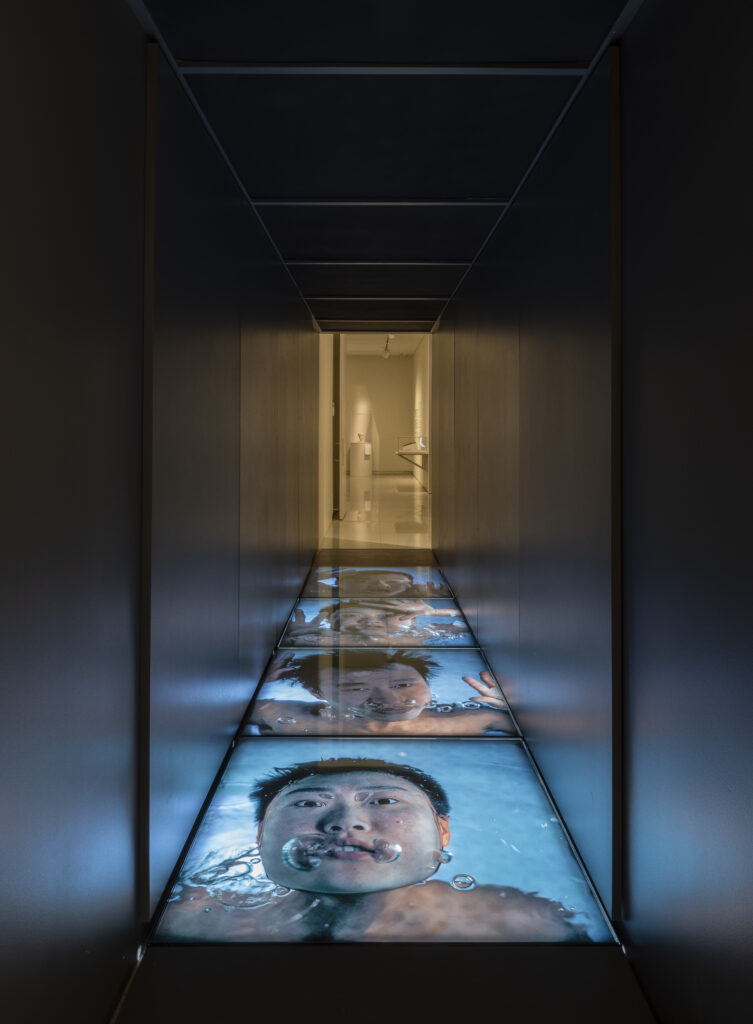
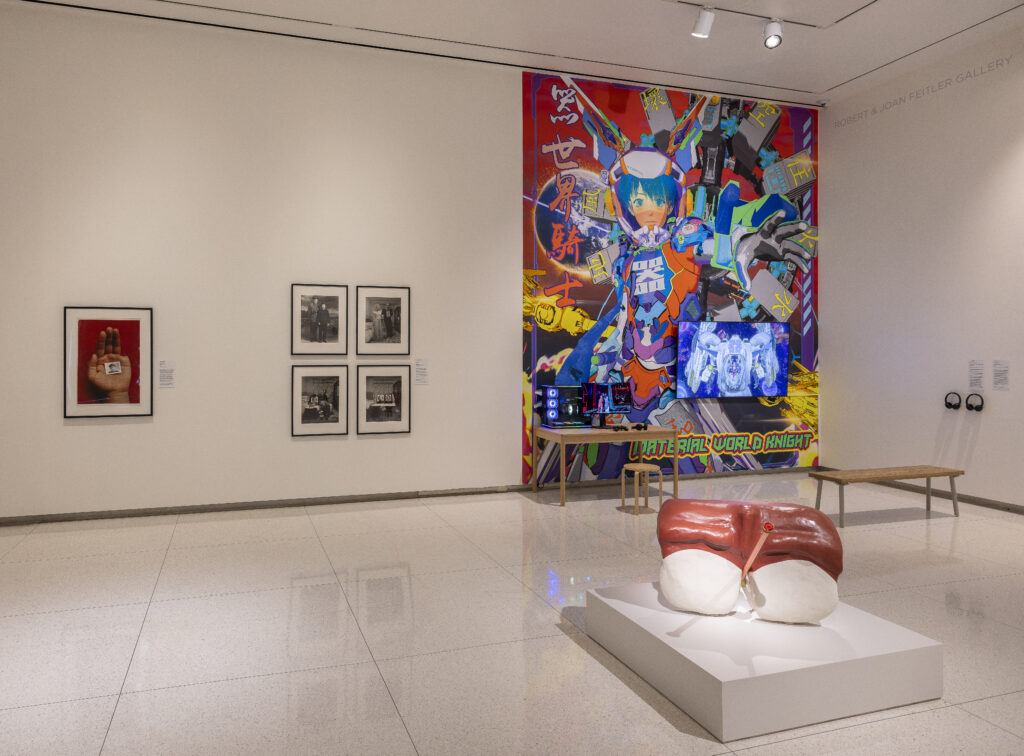
EL: That is always such a hard question to answer. I always love Magicfeifei’s work. The sculpture in the show has so many deep meanings tucked behind the initial cute impression. It takes a humorous approach to the very real struggles with physical appearance, and, therefore reposition what was originally seen as “flawed.” I also love Wu Wenguang’s “Diary,” it started as a documentation of the artist’s commune to the opening of an experimental art exhibition, not knowing it had been cancelled. So Wu recorded the canceled artists’ and curator’s response, followed by clips of public reaction. The video went from the artist’s private diary entry to a unique form of experimental documentary.
XFD: These are really good picks. How about a piece that didn’t really resonate with you initially, but eventually grew on you?
EL: Ohh… this is such a great question. I think… it was Sheng Qi’s photograph, “Memories (Me).” It shows the artist’s mutilated hand holding a photo of his younger self, and is part of his “My Left Hand” series. The back story is that Sheng severed his left pinky finger after the 1989 Tiananmen protest3 and the strict censorship that followed as a form of protest.
XFD: Why didn’t you take to the photo right away?
EL: My main concern was actually that this specific photo would be a work that would confirm existing assumptions about China, as a place where freedom of speech and expression is lacking, or where that freedom is stifled. This specific photograph validates the assumptions that many people in the US already have about China and contemporary Chinese art.
XFD: Which is?
EL: That all contemporary Chinese art is political art. Art is political, always. But that doesn’t make everything political art.
XFD: So you were concerned that this piece would take away the focus of the humanity within all these pieces, and basically enshroud everything with the political notion and context it carries.
EL: Exactly. But eventually, I still saw this piece as a witness of how an individual artist participates in historic events differently. Meanwhile, some events do leave a deep mark on an individual. One of the forms of those marks, of the distress, grief, sadness, and rebellion, is Sheng Qi’s photograph.
XFD: We’ve talked a lot about assumption vs. reality, which, again, is a boundary to cross. So, what do you hope visitors take away with them after visiting the exhibition?
EL: My hope is that Beyond Boundaries encourages viewers to recognize that contemporary Chinese art isn’t a single style or political position. It’s a field of incredibly diverse artistic practices shaped by a variety of social, economic, technological, and cultural conditions, and exist both within and beyond China’s geographic borders.
XFD: That is so well-said. Going deeper on what you just said, what would be one suggestion you’d give for those hoping to understand contemporary Chinese art but may be struggling with the mixed information about China that is floating around the Internet, whether it’s sinophobia or Chinamaxxing?
EL: I’d like us to all ask better questions. Rather than looking for works that confirm what they already think they know about China, I want viewers to see contemporary Chinese art as a space where artists grapple with universal questions, such as memory, identity, technology, migration, mortality, while remaining rooted in particular histories and places.
Endnotes:
- Beijing East Village was an avaunt-grade artistic community that primarily primarily active in the early 90s. The name came from its physical location, which was in the East Side of Beijing. ↩︎
- In a conversation with The Guardian reporter Lanre Bakare in early 2026, Ai Weiwei commented that he feels “the same kind of surveillance, same kind of censorship in the West.” He has openly criticized Western surveillance and censorship after his gallery cancellation in 2023, and made a trip back to Beijing in 2025. However, the artist remains firm on his stance, stating that his only connection to Chinese government is the fact he still has a Chinese passport and his mother is still Chineses as media outlets attempt to treat his critique of the tightening Western control of speech and ideology as proof of his softened attitude towards the Chinese government. ↩︎
- Also known as the “1989 Tiananmen Square Protest and Massacre,” or the “Six Four Movement,” the term refers to a pro-democracy, anti-authoritarian student protest at Tiananmen Square that started in mid-May of 1989 and ended with bloodshed on June 4. It is important to note that the massacre did not happen in the square and the majority of the casualty was not protesting students, as often painted by Western media. The military suppression primarily happened in alleys and roads around Tiananmen Square and most victims were neighbors simply hoping to hand water and food to the demonstrating students in the Square. The most reliable records from the Red Cross suggests a total casualty of over 2,000. The protest and the following bloodshed has always been strictly censored in China, with 2026 being the strictest marked by the cancellation of the annual memorial hosted by mothers of the victims, and a newly-hightened online censorship approach that removed any content containing flagged keywords, regardless of the actual content posted. ↩︎
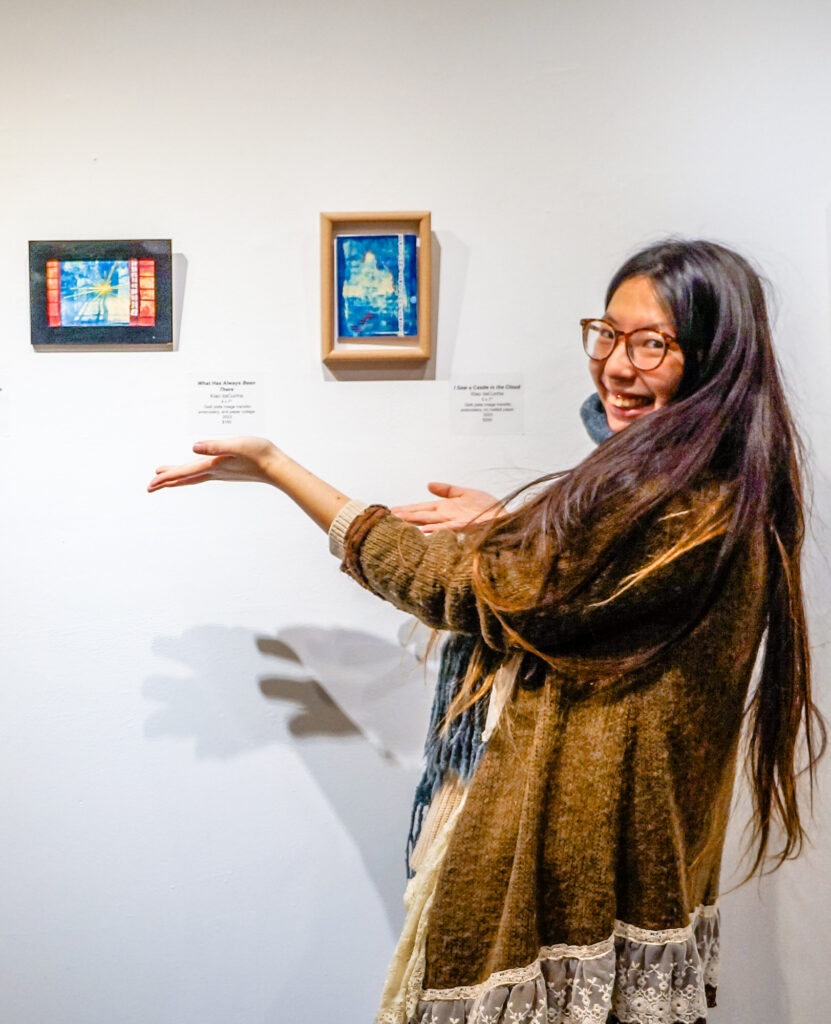
About the author: Xiao Faria daCunha is a practicing visual artist and an independent journalist covering what’s happening in the Midwest belt, focusing on lifestyle, art, and culture. Her visual art practice includes mixed-media illustration on paper, printmaking, and mixed-media collage. Xiao was the former Managing Editor for Urban Matter Chicago and her bylines have appeared in Chicago Reader, BlockClub, BRIDGE.CHICAGO, KCUR, The Pitch KC, and more. Xiao’s artistic and writing practice explores the intimate, vulnerable truth of the BIPOC, migrant, immigrant, and diaspora communities. She considers everything she does art journalism and aims to speak on behalf of those who haven’t been heard and shed light on what hasn’t been seen, whether it’s emotional, cultural, or societal. By weaving her personal experience with public narratives, Xiao creates emotional and engaging conversations to interrogate, challenge, and advance existing perceptions of women, Asian diasporas, and other immigration populations.