“Solidarity is likely sustainable only where one confronts institutions that promote schisms between ethnic groups and where one can challenge the perception that the dominant state is both invulnerable and the only viable vehicle for safety and success.”
– Joy James, Resisting State Violence
For familiar art-goers, SHANGHAI SEMINARY a quiet and driven gallery, has since 2024, been slowly setting roots on Morgan Street in Chicago’s Bridgeport neighborhood. Dubbed in 2017 by the City of Chicago as a ‘business corridor’, fueled by a $3.8 million streetscape project, and led by the Coalition for a Better Chinese American Community, Morgan St. from 31st to 35th has undergone a rapid transformation. Bookended by the Bridgeport Art Center and the Zhou B. Art Center, SHANGHAI SEMINARY rests strangely, and quietly, in the middle. Instead of aiming for a more explicit municipal outcome, SHANGHAI SEMINARY has seemingly adopted a more German kunsthalle approach to art, presenting contemporary visual and performance art often generated by individual artists in or around the proximity of the neighborhood itself.
Knowingly, the gallery also takes part in the changing economy of the Lower-West sides of Chicago, from Pilsen’s doubling–or tripling–of property taxes, to the throng of third-wave cafes, millennial cocktail bars, and boutique clothing stores overtaking family-owned businesses. To walk down Morgan with the smell of espresso wafting down the street, deciding impulsively to get a cocktail at a listening bar, or to catch a new installation at SHANGHAI SEMINARY is an excitement but one also tinged with the memory of my own mother’s eviction from the apartment I grew up in when a similar economic wave lead by the City of Los Angeles and various independent municipal groups gentrified the neighborhood of North Hollywood in the 2010s. It is with this strange balance of consciousness that I entered the darkened glass door of SHANGHAI SEMINARY in Peixuan Ouyang’s nánwàng de yī tiān, a 40-minute two-channel video with accompanying installation elements in and around the gallery.
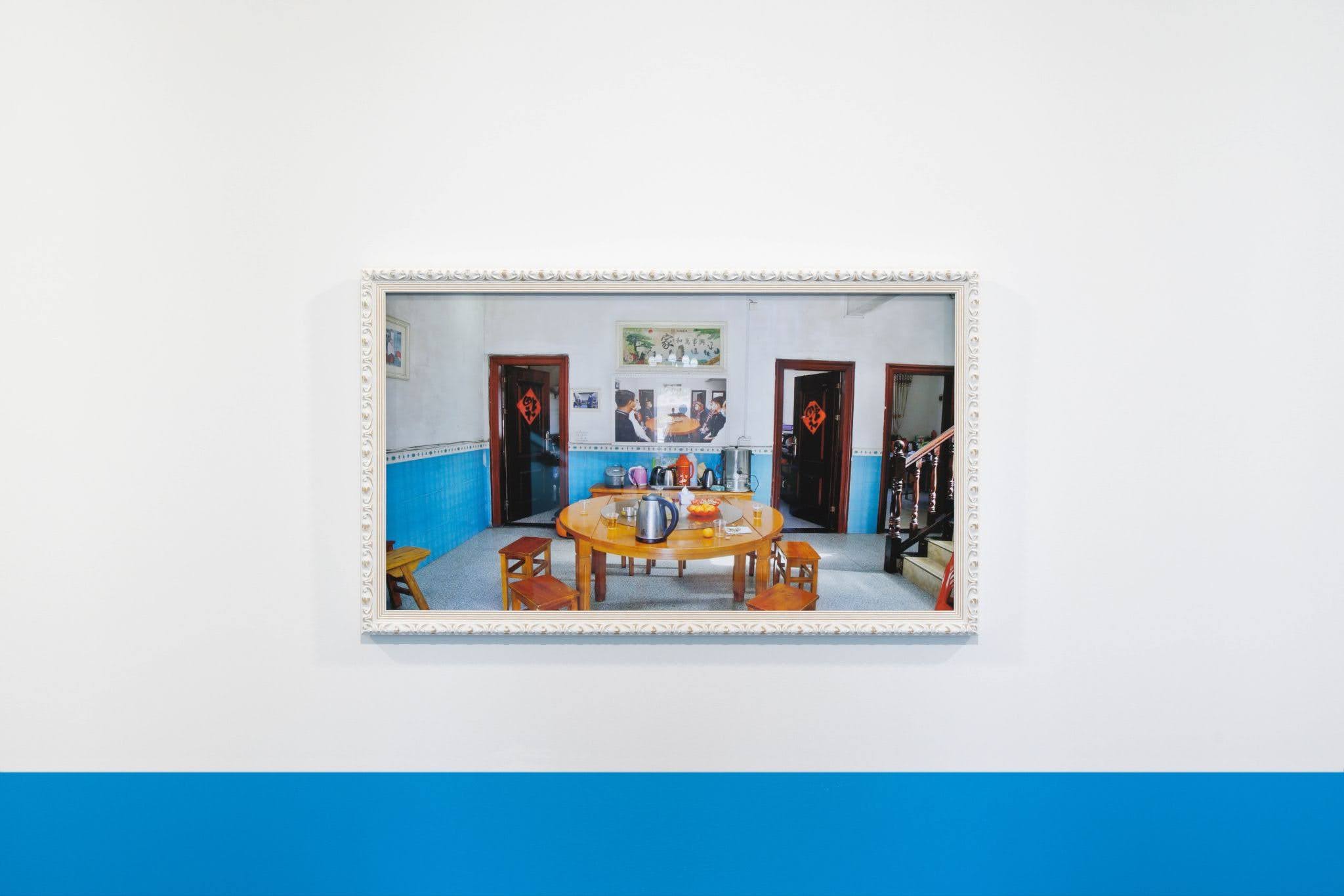
For better or for worse, part of the continued prominence of the white cube design of contemporary art galleries is to set the stage in a drama between the individual and the institution: the first physical condition of which is the architecture itself. It is that obstruction—a newly built white wall that greets you upon entering Ouyang’s solo outing, creating a disorienting preamble in the form of a small foyer. Centered on this initial wall is a panorama inkjet print of a living-room, entitled Domestic Affairs, rife with the evidence of the household—round wooden table, kettle, tea, a decorative swath of blue on the wall—but emptied of its occupants. Above the table centered in the image is another photo, of approximately the same size as the print, of the same room. In the photo within the photo, the table is full, at its head is a bloom of a light artifact, at once Xi Jinping, President of the People’s Republic of China (PRC), and Peixuan Ouyang themself, capturing the total image. In our real space of SHANGHAI SEMINARY, a blue horizon line, which mimics the decorative wall design surrounding the space of the table, spills into the gallery. Within the simultaneity of this dense gesture (photo: photo: author: viewer), the viewer encounters an initial doubling of subjectivity, a through-line of the web of time, acts of viewership, and subsumptive speech-acts that knot, unknot and re-knot themselves throughout the video installation of nánwàng de yī tiān.
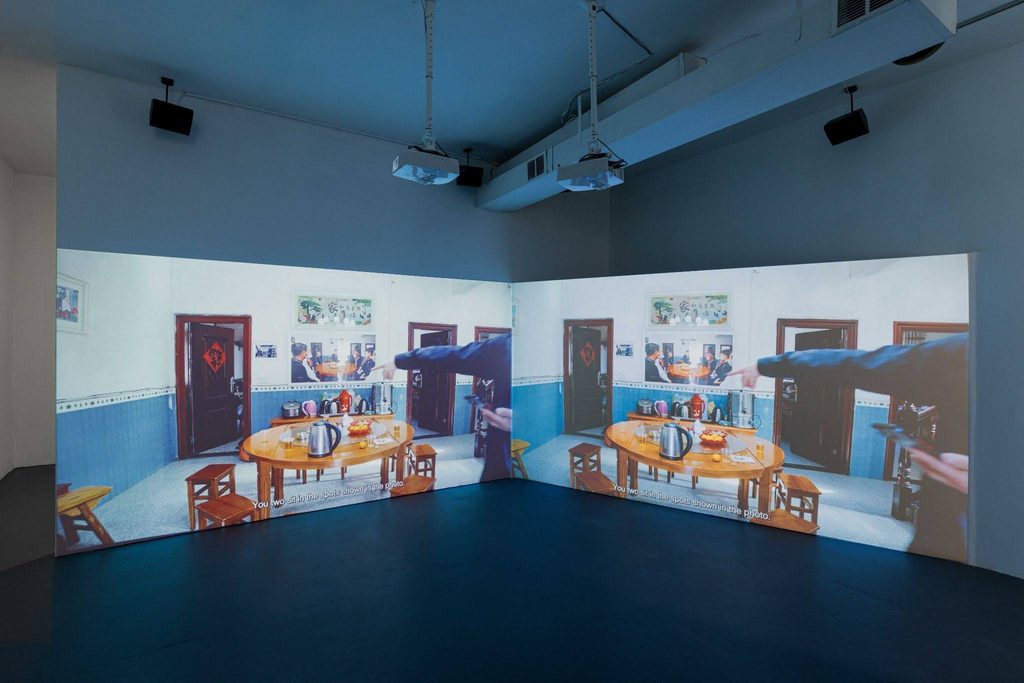
Entrance into the second room, the main space of the gallery, is met with another architectural intervention. Occupying the floor to standard viewing height on the primary wall is a video projection. Anchored into it, and angling out into the gallery floor is a second screen. It is on this primary wall and its secondary intrusion into the space that the full 40 minutes of nánwàng de yī tiān is viewed. Throughout, Peixuan Ouyang takes the role of documentary videographer who, through a walking tour and interviews with locals, retraces a visit by Xi Jinping to the Yao ethnic village of Shazhou in Rucheng County, Hunan, which took place over the course of one day in 2020. The fateful day referenced by all in the video (the title, translated to An Unforgettable Day, itself a reference to both the day in question and a song by Taiwanese pop-idol Teresa Teng) forms as a synecdoche for the years around 2020, in which the PRC ‘uplifted’ Shazhou by instituting a host of economic and political changes that transformed the lives of those in the region.
Via Ouyang’s point-of-view, we follow individuals in the Yao ethnic village through an elementary school, a Red Tourism site (a form of cultural museum dedicated to uplifting places of importance to the Chinese Communist Party), and the village square. While the tour takes place, subjects narrate the visit by Xi Jinping, expanding on a local, mythic interaction between Red Army soldiers retreating from Kuomintang military forces (of the same democratic party which later established the Republic of China government in Taiwan), where three female Red Army soldiers purportedly ripped their military issued blanket to help a young Yao woman, Xu Jiexiu, suffering from the cold.
Ouyang, as artist-cum-documentary videographer, utilizes their dual role to seemingly without reason pose their interview subjects in silence for three minutes exactly where they believed they were when Xi Jinping was present. It is in these three minutes that the screen splits, as if mirroring the mythic Red Army blanket being cut in two, one with the motionless subject performing themselves for the camera, the other as the interview continues on. Through the repetition of this structure, we come to see the intense comportment of the video’s subjects, their joy and excitement for sharing about the ‘unforgettable day’ soften into something else—a mysterious, unknown, unintelligible excess.
The appearance of the duplicating image acts as a visual opening, mirroring a flowering of privacy that occurs when the video’s subjects are allowed to fall silent. Instead of performing rote praises for the Chinese Communist Party, obviously tied to a material economic and social precarity in Shazhou, it appears that the silence allows something else to come forward. Whether it is read as discomfort, boredom, annoyance or something else mundane, those three minutes consistently allows disruption to spring forward. In one moment, two guides start editing each other’s memories and stories. In another, the guide stands almost motionless, except for wandering eyes and a wavering smile. In yet another, a fire-alarm at the Red Tourism site is mysteriously set off, showing tangible and intangible holes in the ideological perfection that the guides attempt to portray.
In a 2021 essay by Catherine Liu, “Virtue Hoarders: The Case against the Professional Managerial Class,” the scholar argues that the behaviors popularly known as ‘virtue signaling’ is a trope within the American managerial class which emerged after the countercultural political movements in the 1960s and ‘70s became subsumed into capitalism. Now an ideological necessity for individuals desiring upward mobility, revealing, as if in confession, how one’s trauma informs behavior acts as a tool to verify one’s own economic authenticity. For Liu, engaging in this mode of public confession is a deployment of prefabricated narratives adapted from working-class organizing in the ‘60s, which act to pose oneself as ‘honest’, ‘vulnerable’, and ‘having others in mind’, despite occupying a position of power and domination of the working class. For example, I demonstrate this at the start of the article, speaking about a traumatic experience of eviction in order to authenticate my authorial voice, gesturing towards my diligence to my own positionality, and therefore my ability to speak on economic issues and be platformed.
If a parallel can be drawn, as thin and fraught it may be, Liu’s argument could be re-drawn in the socioeconomic field that Ouyang points our attention toward. ‘Virtue signaling’ reappears in Shazhou through the video subjects’ confessional stance towards their own economic scarcity as an authentication device not of one’s capacity to manage others, but of an ethnic minority’s ability to receive the societal reorganization inherent in the PRC’s close governmental involvement, as well as wholeheartedly demonstrate its benefits. Likewise, in the example I draw of myself at the beginning of this article, I would quietly efface the $4,000 my mother was paid to move out of the apartment, a cooperative strategy of evictions that follow tenants-rights law, because this would complicate my story of trauma and its virtues. Pointing towards this discrepancy in the loose but known format of eviction narratives—one of many kinds of stories of racialized ‘resilience’ which have been commodified by popular media creating more questions than it answers. Perhaps the individuals in Ouyang’s film hide, in some inarticulable place, the more complicated and contradictory nature of what the PRC’s involvement in Yao ethnic life and culture has involved. Just as the PRC would trade economic stimulus for Shazhou’s positive self-representation of this thriving inter-societal partnership, I too would, and have repeatedly, traded my own complexity for economic stability through the American machine of sociocultural capital. This is the nature of subject formation that Louis Althusser, through Jacques Lacan, points to with his concept of méconnaissance, or ‘misrecognition’ that humans will choose to identify themselves with figures of authority, alienating aspects of themselves in exchange for a desired intimacy with the world.
In recent months, Catherine Liu’s argument against what is essentially the institutionalization of a public vulnerability of one’s most private experiences of violence and power through a system of political reward, has been conflated (somewhat by the scholar’s own doing) with socially conservative ideology of both the American right and left. But while Catherine Liu seems to argue against the neoliberal monetization of cultural narratives, nánwàng de yī tiān would have us complicate this framework by contributing a wariness of any state-promoted narrative. Gesturing, instead, towards the importance of listening to what we, as workers and artists should listen to—not enunciation that is rewarded, but acts that, beyond cultural narrative, beyond vocabulary even, escape our ability to articulate.
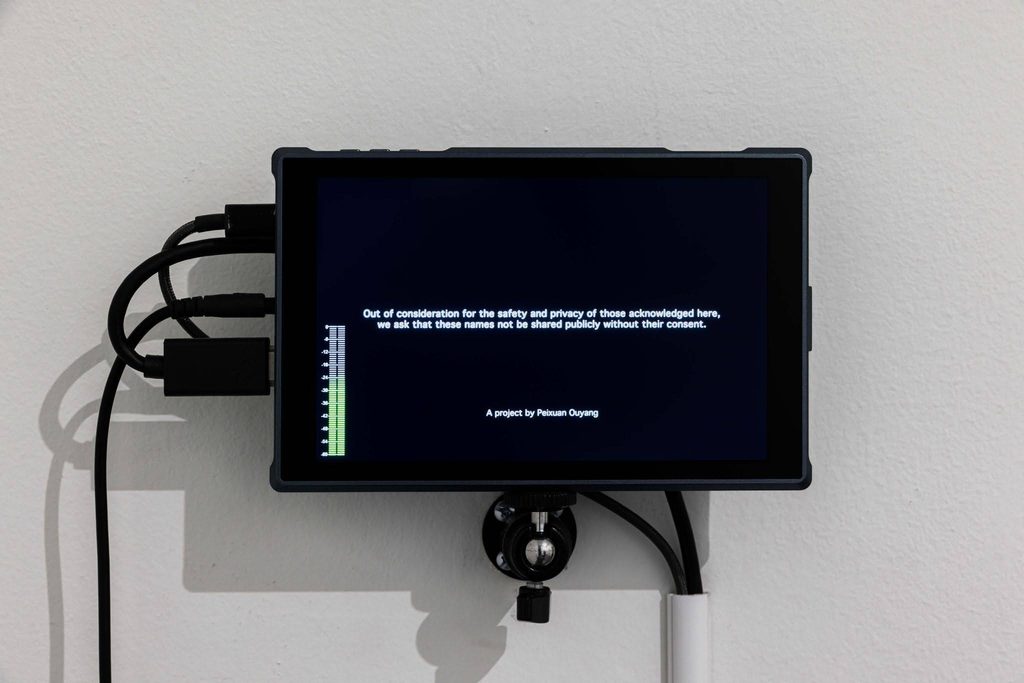
The third and final room in nánwàng de yī tiān forms an epilogue of sorts. Situated at the back of the gallery, a small IPad-size screen runs a loop of the real newscast footage of Xi JinPing’s visit to Shazhou, alongside an audio track of Teresa Teng’s popular song Nánwàng de Yī Tiān, and finally ending with a credit-roll of Ouyang’s collaborators. Simply titled Special Thanks, the video pulls in these references as a three-point gesture. First, Xi Jinping re-cast once again in the glorifying light of the authoritarian representation system of news broadcasting; second, a gesture of removal of the names of the authors of the prior video, which allows for a sense of nervousness towards the stakes of nánwàng de yī tiān (censorship? legal action by the PRC? visa restrictions?); and finally, all of this wrapped in Teresa Teng singing about forgetting and remembering, as if one’s own memory were a stranger to themselves.
For those with cultural memory of the past 70-or-so years of regional pop-idols, Teresa Teng is well known as an early icon of the post-war generation, who rose to fame through straddling traditional Cantonese opera vocal techniques with new regional, as well as western, pop ballads. There would be no Faye Wong, Leslie Cheung, or Shirley Kwan, stars more well known in my generation, without the cultural synthesis embodied by Teresa Teng. But likely of even more direct political importance, Teresa Teng’s cassettes were among the first recordings of popular music produced outside of Mainland China to be widely distributed internally, largely through informal markets. Teresa Teng, quite literally, was the foremost cultural representative of new forms of singing technique and music composition with an incontestable impact on how Chinese pop-music was, and still is, written and performed. This of course additionally means that Teresa Teng’s emotionality and bodily performance of voice allowed for the emergence of new constructions of womanhood and self-identity at large. So widespread was her impact that she was given the nickname 小鄧 (Xiǎo Dèng) after 鄧小平 (Dèng Xiǎopíng), the party leader of the PRC during that period, as a play on their shared surnames. As if offered by Ouyang as a provisional political construction, Teresa Teng as 小鄧 (Xiǎo Dèng) not only reflects a popular (if not transformed) centralization of values which inherits and productively contorts the legacy of state-controlled media, it asserts unnamed and unknown senses of feeling as inherent to the construction of personal being and desire.
“Please lady, please lady, don’t just walk away / ‘Cause I have this need to tell you why I’m all alone today / I can see so much of me still living in your eyes.”
In 1977, Teng performed the above lyrics on the Hong Kong public news station TVB from a cover of Randy Crawford’s I’ve Never Been To Me. In it, Teresa Teng interpreted the song by the Georgia born R&B and Jazz singer who started off performing in clubs with Cannonball Adderley, and throughout her career continued to perform with Funkadelic and Quincy Jones, among many others. Live on TVB, Teresa Teng poses in front of backdrops of Los Angeles palm trees. “I’ve been to Georgia and California, and anywhere I could run / Took the hand of a preacherman and made love in the sun,” sings Teng, as if disappearing into memory, “ …because I had to be free / I’ve been to paradise / but I’ve never been to me.” How is “me” figured here, if not as a creative wellspring, a site which must resist its own foreclosure by externally enforced narratives of life one desires?
Ouyang challenges us to look into each individual’s performance of subjectivity, witnessing it’s marbling and excesses in the face of ready-made narratives which could claim them as the very reason for the nation’s existence. The myth of the isolated working-class, hidden in the womb of the state and looked at as the stalwart for conservative policies may in fact have already been dissolved before its creation within political narratives. The upwardly mobile or otherwise—desiring subject has for decades formed their subjectivity based on how they see themselves mirrored back by dominant culture. Even after this process turns on them, they will continue to be its interlocutors, reinscribing, and interpellating these narratives into themselves because of how popular media figures the desire for a better life. Perhaps the challenge we must meet against is the force of absolute invisibilization of any narrative forged through the struggle of the working class, not only its ideals for fair and equitable treatment, but what emerges as new ways of occupying ourselves as identity-bearing subjects. As Hannah Arendt would say in her essay, “What is Freedom?,” what is freedom if not the capacity to begin something new, to spontaneously act and fully realize that action into being and memory?
In her day, Teresa Teng refused to perform in Mainland China despite her popularity amongst the people, until democratic values could be instituted into government. Before and after the Tiananmen Square massacre, Teng was outspoken, dedicating songs and performances to the students massacred by PRC’s military forces. One could extend Joy James’ quote at the top of this essay, that solidarity is likely only sustainable when one can challenge the perception that the dominant state is the only viable vehicle for our aesthetic production. Empathy, material action, and historicity as bedrocks of relationality will always be more transformative than what we can or cannot say through popular media. This is the true flashpoint of Audre Lorde’s Uses of the Erotic: that no one but ourselves can determine the imperative towards action.
The takeaway from the show, a postcard of the Domestic Affairs photo cut in two, invites the viewer to leave again with ‘the other half of the quilt’. Is this an ironic gesture from the artist, acknowledging her own role in recreating the PRC mythos? Or, an earnest plea to feel the sense of unease, that each move to articulate ourselves under the tidal wave of the political current named ‘the global rise in facism’ must simply, fearfully, and knowingly be just that: the possibility of its very allowance.
SHANGHAI SEMINARY presented nánwàng de yī tiān, a solo exhibition by Peixuan Ouyang from June 12th-August 1st, 2026.
About the Author: el n.k. lee is a visual artist, sometimes critic, whose work explores how form and subject are projected into bodily surface. Through a broad attention towards materials and structures, she mines the history of painting in order to confound the significance of how humans use power in their responses to one another. She holds an MFA from the University of Chicago, and is currently a Visual Arts Teaching Fellow in the Department of Visual Arts at UChicago, with the appointment of Lecturer. Her work has been shown at the Portland Institute of Contemporary Art, the San Francisco Museum of Modern Art, among others.