
Lee en Español aquí.
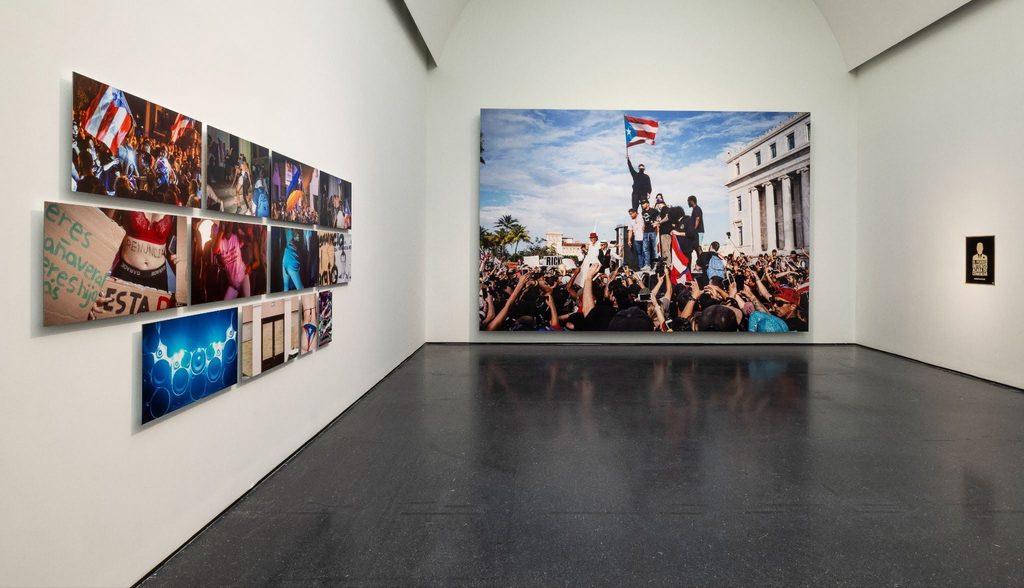
When thousands of Puerto Ricans filled the streets of San Juan during the summer of 2019 to demand Governor Ricardo Rosselló’s resignation, protest took many forms. Demonstrators marched and chanted but they also danced. On the steps of the San Juan Cathedral, queer and feminist activists gathered for perreo combativo—or “combative twerking”—transforming one of reggaetón’s most recognizable dance forms into a public act of political dissent. What had long been dismissed as provocative entertainment became a choreography of resistance, reclaiming public space and bodily autonomy in defiance of colonial power and state violence.
That moment serves as the historic and conceptual foundation of Dancing the Revolution: From Dancehall to Reggaetón at the Museum of Contemporary Art Chicago. But the exhibition does not begin in Puerto Rico, nor does it tell the story of reggaetón as a single national history. Instead, it asks visitors to follow the music backward and across borders—to Jamaica, Panama, Puerto Rico, New York, and the Caribbean diaspora—and to consider what happens when sounds, bodies, and political ideas travel together. Rather than presenting dancehall and reggaetón as popular musical genres, the exhibition argues that they are deeply political cultural practices.
Organized by MCA curator Carla Acevedo-Yates, the exhibition brings together more than 40 international artists working across installation, painting, sculpture, photography, sound, and video. Together, these works trace the intertwined genealogies of dancehall and reggaetón as diasporic musical cultures. In doing so, it asks visitors to reconsider familiar sounds known for their infectious entertainment as archives of resistance.
“This show was inspired by the summer of 2019,” curator Carla Acevedo-Yates says, “I’ve always been interested in the role that music and dance have played in revolutionary contexts and contexts of rebellion in the Caribbean.”
For Acevedo-Yates, who grew up in Puerto Rico during the emergence of reggaetón in the 1990s, the exhibition developed from scholarly research and her own memories. While organizing the exhibition over three years, she returned repeatedly to a question: How have dance and sound allowed Caribbean communities to imagine political futures when traditional avenues of power have failed?
That question reverberates throughout the exhibition, which consistently refuses the conventions of music exhibitions and traditional art historical surveys. As I walked through the exhibition, I couldn’t help but move—and be moved—by works whose exuberance and physicality seemed deliberately at odds with the conventions of museum viewing.
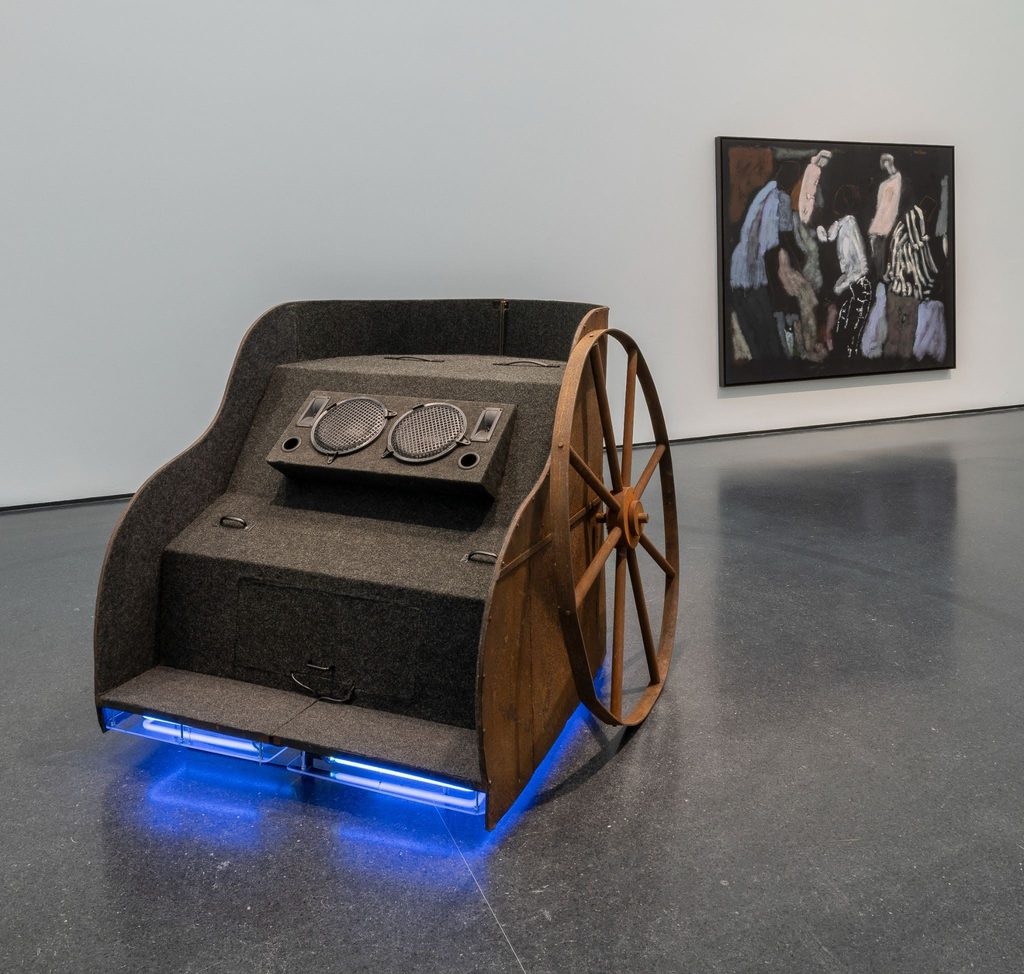
The galleries begin with the roots of Jamaican dancehall and the 1950s soundsystem culture that helped establish music as a communal, physical experience. Among the works that evoke this history is a sculptural soundsystem by Michael Richards, an elaborate construction of speakers with a lowrider-like sensibility, complete with neon and a sense of theatrical excess.
For Acevedo-Yates, the work carries an especially poignant history. “I wanted sound to function as a type of material,” she explains, “When you go to San Juan, there’s a cacophony of sounds coming from all over the place. Kingston is the same. That’s not how museums usually work. I wanted the sounds to intersect each other.”
Instead of isolating music as background or supplement, the exhibition embeds sound directly within contemporary artworks. Listening becomes inseparable from viewing. Music is an alarm, disrupting passive viewing. This distinction is central to the exhibition’s ambitions. Dancehall and reggaetón have frequently appeared in museums through album covers or historical ephemera. Dancing the Revolution instead asks how contemporary artists have translated these musical cultures into visual practice and cultivated a sense of place.
The exhibition’s title captures that approach, “Dancing the Revolution” references political revolution and the revolutions per minute of a vinyl record. The phrase links bodily movement with recorded sound while suggesting that history itself unfolds in recurring cycles of resistance.
“There are all these layered meanings,” Acevedo-Yates says, “Thinking about rhythm, thinking about circularity, thinking about records, and thinking about how history repeats itself.”
Those histories move across geographies rejecting the idea that reggaetón belongs to one single national narrative. While reggaetón is often associated primarily with Puerto Rico today, the exhibition foregrounds the importance of Jamaica’s dancehall traditions and Panama’s reggae en Español as foundational chapters in the genre’s development.
One of the exhibition’s central commissions reflects that commitment. Chicago-based artist and music historian Juan Rivera created a listening room featuring curated playlists that trace reggae en Español from the 1980s through the present. Conceived as an educational resource and a space for rest, the installation occupies a symbolic bridge within the exhibition itself, a red-carpeted hallway overlooking the museum’s terrace, connecting different historical narratives through sound.
Rivera’s playlists were commissioned specifically for the exhibition after Acevedo-Yates’ research trips to Panama, where Rivera introduced her to pioneering musicians including Nando Boom, Renato, and Kafu Banton. Although the museum had hoped to publish the mixes more broadly, funding limitations have kept them exclusive to the exhibition, to this writer’s disappointment.
The emphasis on listening reminds us: histories of migration often travel through music before they are recognized through institutions. The exhibition traces how Jamaican migrants carried records to Panama while working on the Panama Canal, how musical forms evolved into reggae en Español, and how those sounds eventually circulated into New York and Puerto Rico, where reggaetón emerged.
Although Chicago is rarely positioned within conversations about Caribbean music, Acevedo-Yates argues that its substantial Puerto Rican community and longstanding engagement with diasporic artistic practices make it a natural home for the exhibition.
“I’ve always been interested in thinking about the connection between Chicago and the Caribbean,” she says, noting both the city’s Puerto Rican communities and the often-overlooked history of Chicago founder Jean Baptiste Point du Sable’s Haitian ancestry. She also situates the exhibition within the MCA’s own history of exhibitions exploring relationships between contemporary art and music, including Tropicália and The Freedom Principle.
That interest in how Caribbean culture travels—and how it takes shape in new places becomes physical in Dutty Gyal, a commissioned work that takes the form of a fictional dancehall-themed morning show. Inspired by dancehall instructional videos circulating online, particularly those by renowned Jamaican dancer Latonya Style, the work turns choreography into performance and spectacle. Visitors can listen through headphones, while the dancers’ movements remain visible to everyone passing through the gallery.
The title refers to “dutty gyal,” a Jamaican patois term that translates roughly to “dirty girl.” Within dancehall culture, the phrase can be derogatory, but it can also be reclaimed as a term of celebration and sexual agency.
Dancehall and reggaetón have long generated criticism for misogyny and homophobia, tensions the exhibition confronts directly rather than attempting to resolve. Contemporary artists examine how women, queer, and trans communities have appropriated these same musical and visual languages to create new forms of empowerment.
“I don’t think the show is trying to present one side,” Acevedo-Yates says, “It’s trying to present these genres within all of their complexity.” Works by artists including Phil Collins and Awilda Rodriguez Lora examine how queer and trans communities have reclaimed and transformed the aesthetics of the music video while confronting the exclusions embedded within these forms. By appropriating figures such as the music-video vixen and reworking conventions of sexualized performance, these artists open up space to explore what it means to claim agency through sexuality.
Abu Lara Rodríguez’s Tortillera, for example, takes a derogatory term for lesbians in Puerto Rico and transforms the music-video form—traditionally a space for the display and sexualization of women’s bodies—toward lesbian desire and self-expression. Similarly, Cecilia Bengolea and Jeremy Deller’s work foregrounds dancehall as a space where masculinity and femininity are performed and continually negotiated.
Phil Collins’s Desire Lines is particularly important, bringing together multiple perspectives from Kingston’s queer dancehall communities through a series of conversations and encounters. The project acknowledges that these musical cultures cannot be understood through a single narrative: for some, their gender. Their meanings shift depending on who is dancing, who is watching, and who is allowed to participate.
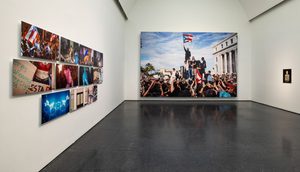
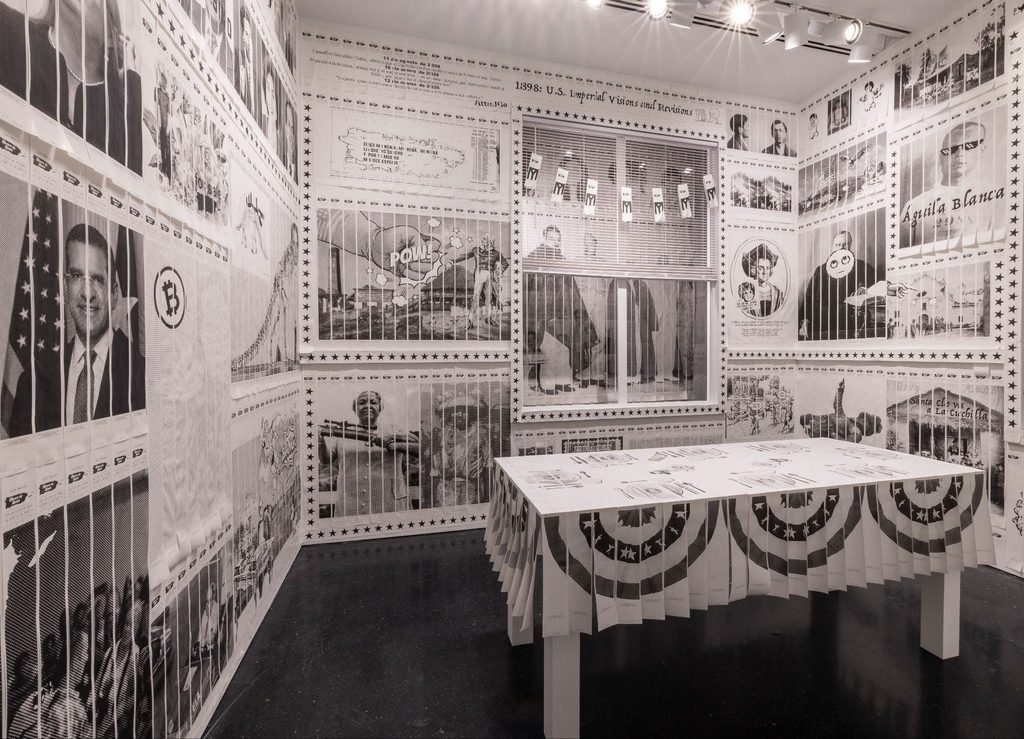
That question of participation becomes especially urgent when the exhibition returns to Puerto Rico’s political history. In Retratos de una deuda (2023), receipts documenting Puerto Rico’s $74 billion debt crisis are emblazoned with Rosselló’s face. The walls of the small room are covered with the documents, making the scale of the economic crisis difficult to ignore.
Across the way, video footage captures perreo combativo during the 2019 protests. Nearby, a monumental photograph of Bad Bunny dressed in black and holding the Puerto Rican flag among protesters turns the pop star into something closer to a political symbol. Together, the works make the exhibition’s argument explicit: reggaetón’s radical potential lies not simply in what it says, but in what bodies do with it.
The same dance that can be dismissed as sexually explicit entertainment can become a political tool. The same movement that is policed as vulgar can reclaim public space. The body becomes a site where colonial ideas about morality can be challenged.
Then the exhibition lets you dance.
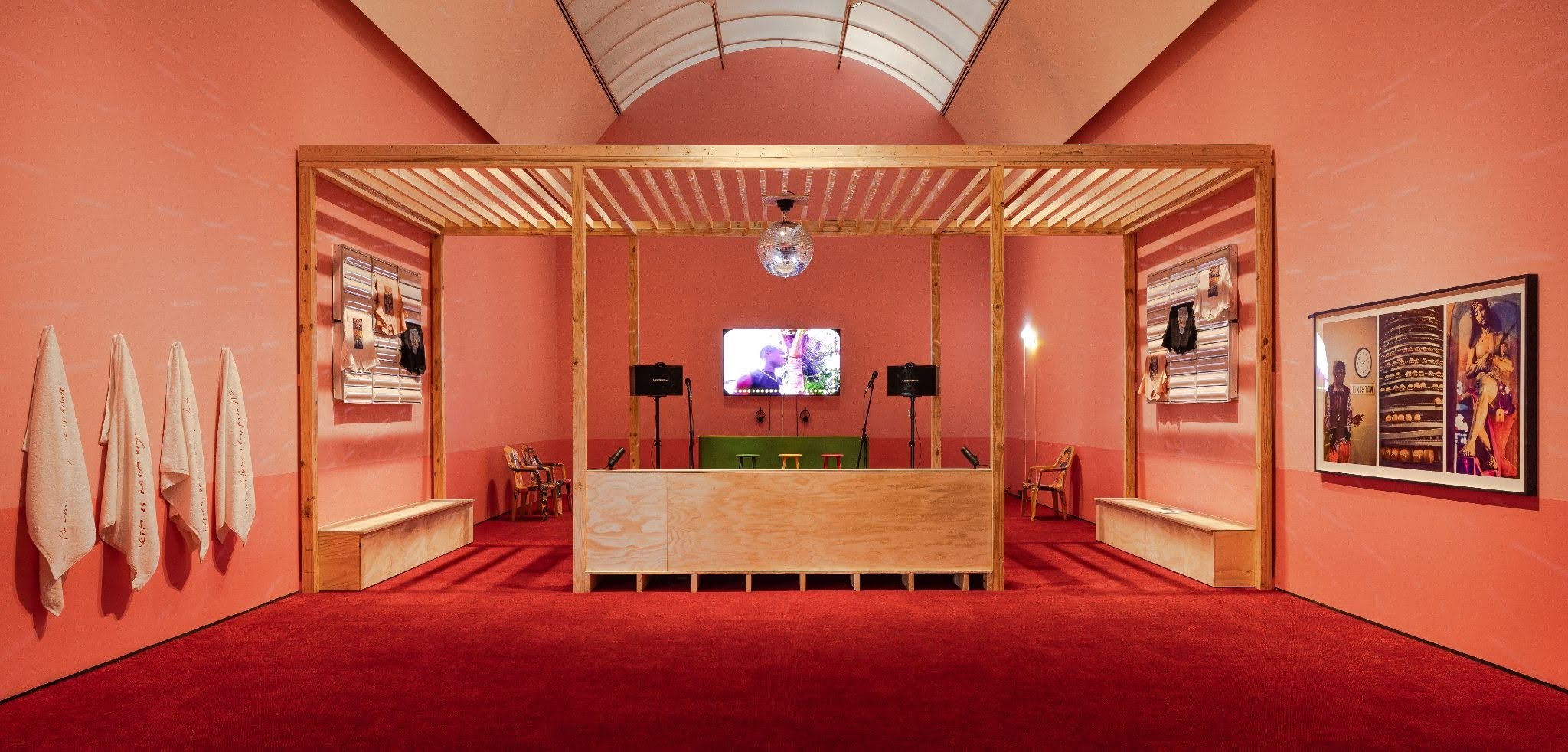
The next room is salmon-colored, bright, warm, and loud. There are no headphones here. Carolina Caycedo’s jukebox sits within the space alongside a karaoke installation, allowing music to spill freely through the gallery. I spent time perusing CD after CD in Caycedo’s jukebox, an extensive archive that ranges from Cubatón to familiar reggaetón classics by Don Omar and Daddy Yankee, as well as deeper-cut mixes and releases by Luny Tunes & Noriega.
The jukebox operates simultaneously as artwork, listening station, and historical archive. The CDs themselves form part of the artwork, transforming what might otherwise be overlooked as musical ephemera into an archive of underground reggaetón and its early circulation.
Every Tuesday, the MCA hosts free karaoke nights, inviting visitors to revel in the raunchy exuberance of live perreo. Even the room’s furniture contributes to the irreverence: one chair bears Bad Bunny’s face, allowing visitors to, quite literally, sit on him.
“I’ve been thinking lately about how to transform the museum experience,” she adds, “People stay for hours. They’ll sing a song, go through the show, and come back and sing another song.” Community is central to the exhibition’s political argument. Dancehall and reggaetón are collective practices in flirting, grieving, protesting, worshipping, and imagining a different future.
While Acevedo-Yates entered the project deeply familiar with reggaetón, her research into Jamaican dancehall transformed her understanding of the genre’s spiritual foundations. Encounters with Rastafarian communities and scholarship on dancehall as ritual practice reshaped the exhibition’s historical framework. The dancefloor after all, is already a church for many.
The exhibition traces those spiritual genealogies through works examining Rastafarian traditions including ceremonial instruments, and the religious foundations that informed reggae before dancehall emerged. Works by Rastafarian artist Errol Brown make those connections tangible. Brown, a member of the Coptic Orthodox Church, created instruments for use in his own religious gatherings and rituals.
The three drums used in Rastafarian groundations—ceremonial communal gatherings—became foundational to reggae. As Jamaican music developed, those traditions flowed into new musical forms, eventually contributing to the dancehall culture traced throughout the exhibition. In this final room, instruments sit alongside the tools of contemporary music production. A drum, a DJ’s laptop, a sound system: different technologies, but related functions. Each can create a space in which people gather and participate.
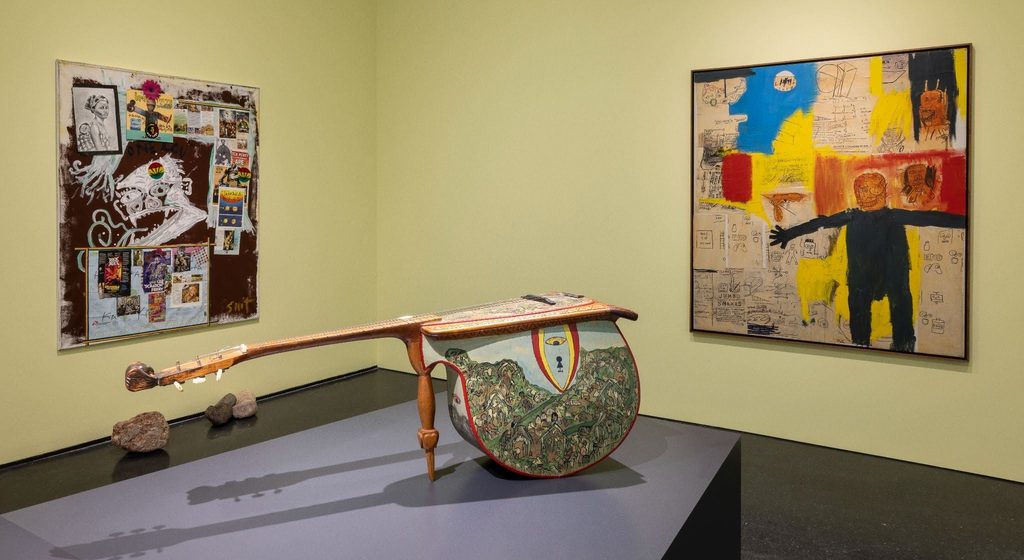
Acevedo-Yates points to Lee “Scratch” Perry’s Black Ark studio and his 1976 album Super Ape, a quintessential dub recording that circulated in New York during the years when Jean-Michel Basquiat was developing his artistic language. Basquiat himself spoke about the influence of Black Ark on his work. By the final gallery, the distinctions between entertainment and politics, dance and protest, party and church have become increasingly difficult to maintain.
Dancing the Revolution does not argue that dancehall and reggaetón should be taken seriously simply because they have entered a museum. It asks the museum to take seriously what these musical cultures have always known: that sound can create community, that movement can reclaim the body, and that pleasure itself can be political.
Reggaetón, in all its debaucherous language, can become a ritualistic act of freedom—a collective purging of colonial and imperial claims on the body and an insistence on autonomy. Dancehall and reggaetón are collective practices through which communities have remembered histories that official archives often ignored, reclaimed public space in moments of crisis, and forged new political identities through movement.
The exhibition argues that dance and movement becomes one of the ways revolution is made visible. Sometimes, in a museum that asks you to sit still, revolution means getting up and dancing.
Dancing the Revolution: From Dancehall to Reggaetón was on view at the Museum of Contemporary Art Chicago from April 14, 2026 – September 20, 2026.

About the Author: Alexandra Martinez is a Miami-based Cuban-American writer and filmmaker covering art, culture, and the politics of place. Her reporting spans immigration, housing justice, workers’ rights, and contemporary art, appearing in VICE, CNN, Prism, Hyperallergic, and other outlets. She is a recipient of an Andy Warhol Foundation Arts Writers Grant, and her debut short documentary, El Soldador, was acquired by PBS and is available to stream online. Her investigative reporting has been recognized by the Esserman-Knight Journalism Awards.