What should the forefather of contemporary Chicago look like? We know precious little about Jean-Baptiste Pointe DuSable’s appearance, other than he was Black and handsome. This detail comes to us from a literal historical footnote nestled beneath a 1779 speech in an 1813 book by a British Army officer:
“A handsome Negro, (well educated and settled at Eschecagou,) but much in the French interest.”
Known as the first outsider to reside long-term where the Chicago River meets Lake Michigan, at a time when the former still flowed into the latter, DuSable is largely a mystery. However, his likeness has been a fascinating site of cultural production for generations of the city’s artists and culture workers, despite (or maybe even because of) this blank canvas in the historical record.
Some of what we do know: DuSable was likely born in present-day Haiti, and possibly mixed race. Sometime around the 1770s, he established his homestead and a successful trading business with his wife and partner Kittihawa. Though she’s often left out of his story, it was she who facilitated his flourishing on the homelands of multiple tribal nations, including the Odawa, the Ojibwe, and, her own, the Potawatomi. They had children, were part of a community, but in 1800, he sold his property and left the area for the Missouri Territory, where he died 18 years later. And, according to the previously mentioned white man, DuSable may or may not have met; we know that his beauty preceded him.
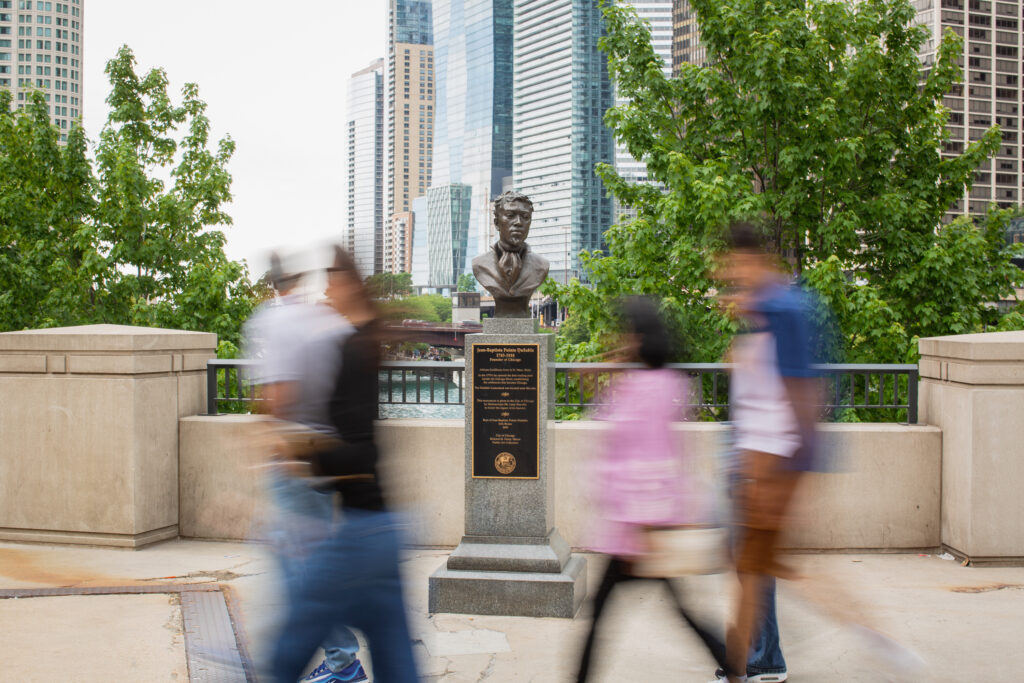
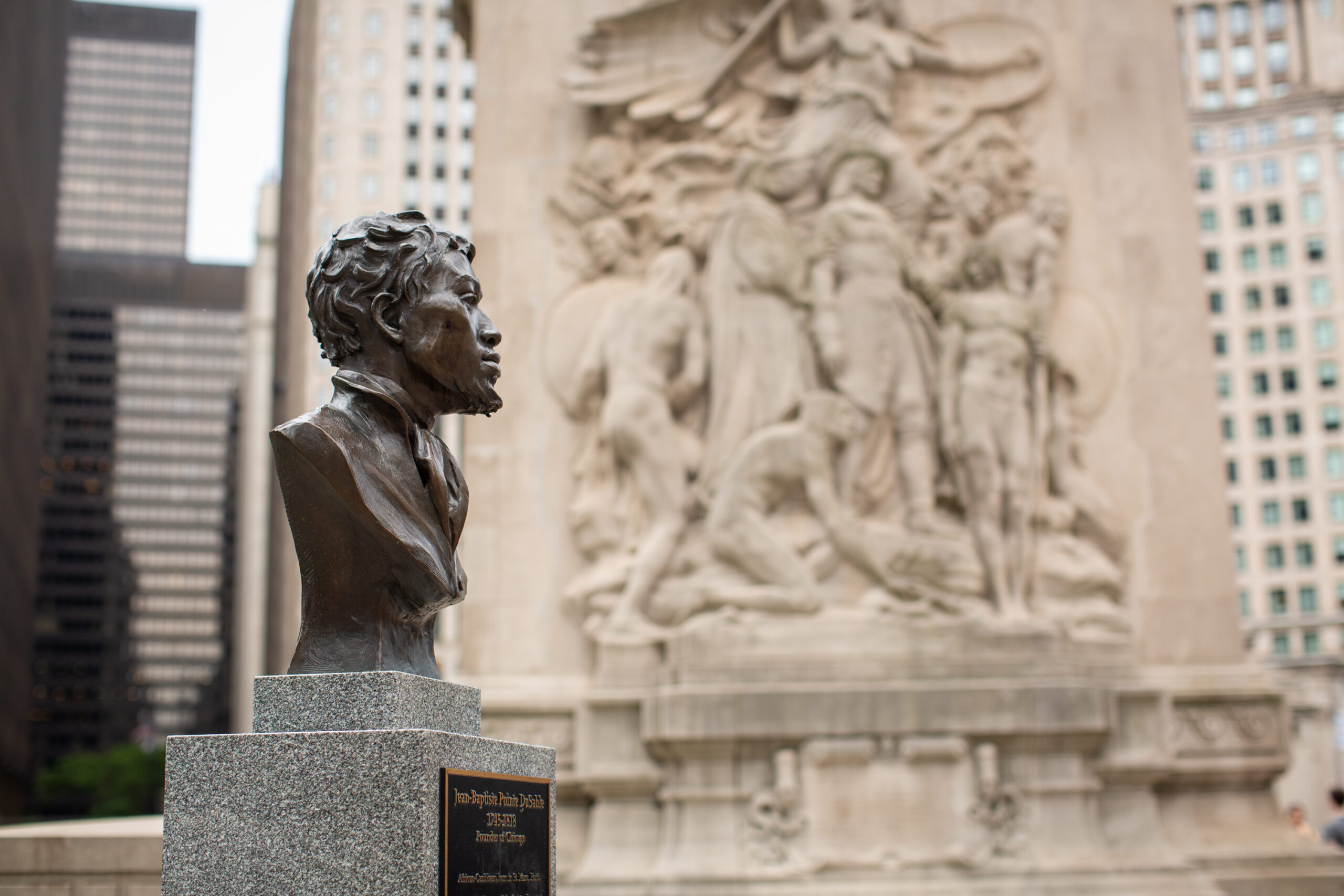
With that, it’s appropriate that the DuSable statue on the bridge named for him in downtown Chicago looks like the leading man in a Hollywood film about a rugged Black explorer who makes his mark on American history. Created by sculptor Erik Blome, it has an angular, goateed jaw, full lips, wide nose, pronounced cheekbones, and a gaze fixed up and out onto the metropolis where he once saw riverbank, dunes, and prairie. Plus, a head of confoundingly wavy, not coily or curly, hair.
The bust is a handsome representative of Chicago’s Black pride. We have no idea if this is what DuSable looked like. But when an authoritarian regime is tearing down historical markers that speak to the horrors of American history, while promising that Confederate monuments will rise again, why question the flattering depiction?
The stakes have always been high for artistic representations of African American historical figures. As W.E.B. DuBois once put it, Black art is important counter-propaganda to the anti-Black images and narratives that are so deeply ingrained in our visual culture they’re practically part of the air we breathe here in the US. Defying Black dehumanization is one major force behind the inspiration that has compelled, and the controversy that has often followed, DuSable’s shifting public image.
Tracing the iterations of DuSable’s appearance through time lets us reflect on the power of representation, and how future iterations—like the long-awaited monument to DuSable slated for creation later this year—could move public discussion past reclamation towards something less resolute, more reflective, and perhaps even more just. This, in spite of the rote anti-Black imagery Trump and his supplicants spew into the public sphere every day.
Notably, the decades-long rite of imagining and reimagining DuSable springs from what may be the first printed depiction of him in the 19th century, which was neither very Black nor very handsome. Appearing in the bottom right corner of the frontispiece of the 1884 tome History of Chicago by Alfred T. Andreas, this early portrait shows a gaunt DuSable, with a scruffy goatee surrounding thin lips. A sunken cheek flanks a long, sharp nose. Cat-like eyes confront the viewer from his three-quarter profile. Here is where we first see that wiry hair, neither coiling nor fully curling, but defying gravity nevertheless in sharp crescents.
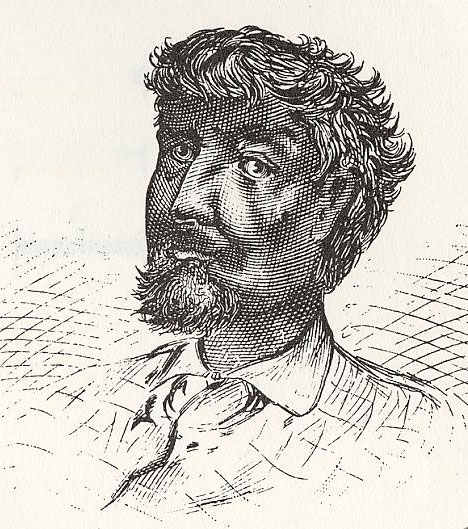
This DuSable’s race rests unconvincingly on tight cross-hatching complexion amid a complete absence of Black features. Created when popular entertainment and advertising were rife with racist caricatures of Black people, the portrait is for an audience unquestioningly unused to dignified depictions of African Americans.
Today, you can see the Andreas portrait featured prominently on DuSable’s Wikipedia page. But like that one army officer’s scant description, the Andreas portrait’s influence echoes to today, even as Chicago’s Black culture workers have succeeded in evolving DuSable’s image into a visually recognizable member of the African diaspora.
An early example is the National DuSable Memorial Society’s souvenir pamphlet for the 1933 Chicago World’s Fair. Founded just five years earlier by Annie E. Oliver, the Society promoted the widespread recognition of DuSable as a significant player in the history of Chicago. For the 1933 Fair, the organization constructed a life-size replica of DuSable’s cabin, making his legacy tangible for attendees who, at the same event, could visit the “Darkest Africa” exhibit or see the “Old Plantation Show.” Both were exactly what they sound like, spectacles featuring Black people cast as the caricatures created to degrade them.
As Cheryl Ganz writes in The 1933 Chicago World’s Fair: A Century of Progress, the DuSable pamphlet lent scholarly validation to the assertion that Black people “deserved recognition for [their] contributions to Chicago’s past and would undoubtedly share its march into the future.” Its cover, created by Chicago artist Charles C. Dawson, was likely a striking one for visitors, featuring an undeniably Black DuSable, decked out in the kind of buckskin clothes they were used to seeing on depictions of white frontier legends like Davy Crockett.
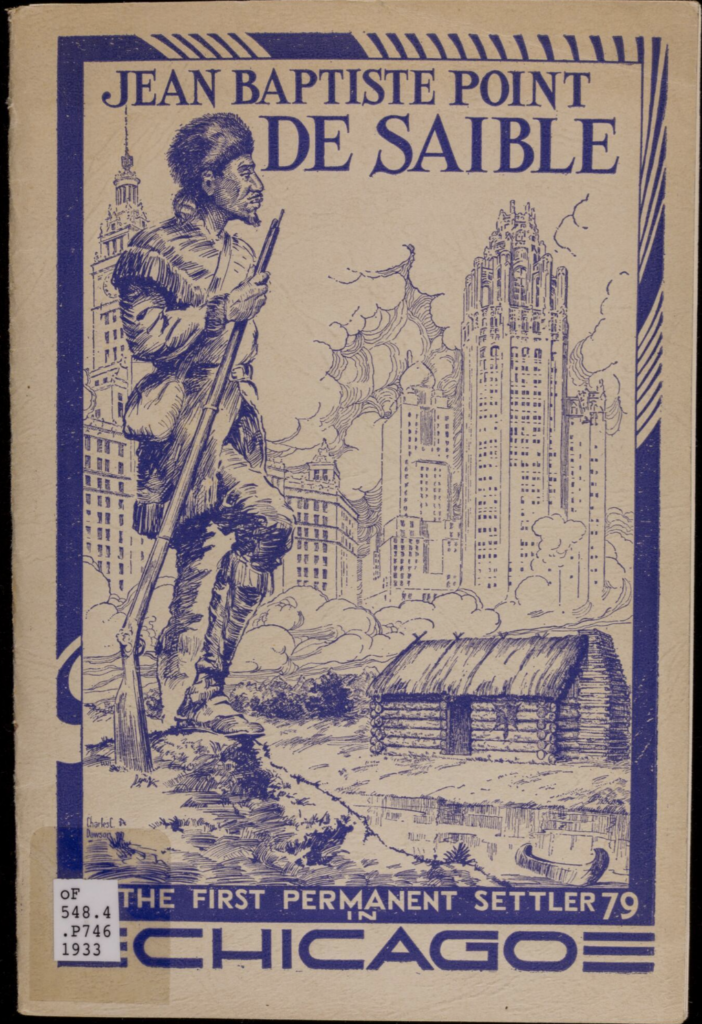
Alone, DuSable stands on a rock at the Chicago River’s edge as he looks to the distance, his face at full profile. His log cabin sits on the far riverbank, with the Wrigley Building and Tribune Tower rising from the clouds behind it. This depiction explicitly frames him as Chicago’s originator, gazing out at the rise of a mighty metropolis he’d never get to see.
Inside the pamphlet, we find a more familiar portrait of DuSable, a replica of the Andreas engraving but rendered visibly Black with a wider nose, fuller cheeks, and lips. The goatee, the face angle, the eye contact, and that wavy hair from the original depiction remain. Similarly, a portrait by Ethel M. Nolan, the Society’s president in the 1960s and 70s, springs from the same inspiration, recasting DuSable with darker skin and in a suit and tie. For years, the Nolan portrait was Jet’s go-to stock image for articles mentioning him.
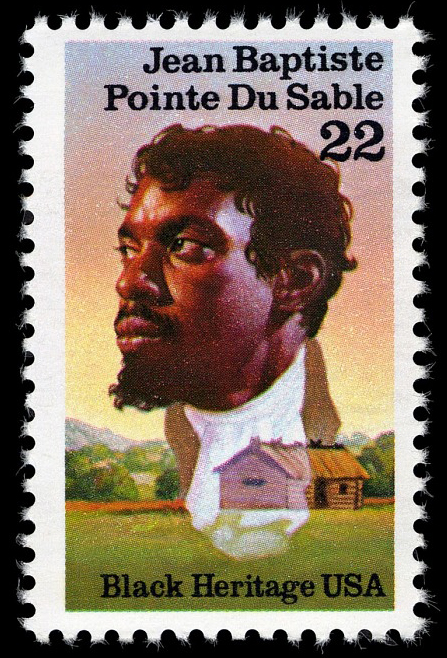
The postage stamp honoring DuSable, issued in 1987 as part of the USPS’s Black Heritage series, retains the Andreas influence while offering a new departure. The 22-cent stamp was created by African-American artist Thomas Blackshear more closely resembles the cinematic interpretation of the Blome bust that followed it years later. Paperwork accompanying the commemorative stamp set notes that Blackshear reviewed other artist conceptions provided by the DuSable Museum to inform his interpretation. The Andreas engraving was undoubtedly one of them. His DuSable doesn’t look at the viewer, instead gazing out of frame, his ruffled collar fading into a modest log cabin nestled on a green prairie. But that goatee, that positioning, and that hair all remain.
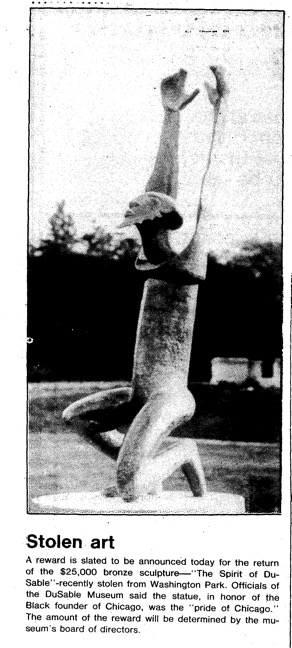
Though many depictions of DuSable over the years have been representational, not all have been. In the late 1970s, reclamation of his visual legacy took a radical turn for the abstract with the creation of the DuSable Museum’s “Spirit of DuSable” sculpture garden. Originally featuring five pieces set in the sunken lawn outside of the museum, today four remain, along with an empty pedestal where the fifth, a semi-abstract, figurative sculpture honoring DuSable, once knelt.
Created by then-DuSable Museum curator Ramon Price, it was a dramatic departure from the Andreas portrait. Though not explicitly a representation of DuSable, Price’s African-inspired sculpture depicted a figure on bended knee, with arms and chin raised to the sky. Instead of gazing out at the landscape at the progress of a place, he looks upward, implying the uplifting of a people. All renderings of DuSable are political, but this one makes its pro-Black aims clear. Or at least it did. In 1983, someone stole the statue not long after Harold Washington, Price’s half-brother, was inaugurated as Chicago’s first Black mayor. To this day, the piece has never been located.
Price’s choice to Blacken this figurative tribute to DuSable, not just in likeness but also in form, was a bold reclamation of the historical figure’s iconography. However, Price would go on to publicly oppose the city’s plan to install a similarly bold monument depicting DuSable in the park named for him, a park that remains unfinished to this day. For years, he and DuSable Museum founder (and then-Park District commissioner) Margaret Burroughs campaigned against the city and the Art Institute’s decision to commission a DuSable sculpture from famed abstract artist Martin Puryear. “It’s a shame that when we come to dealing with the memory of a black historical figure, we go to someone who does interpretive things,” Price told the Chicago Reader in 2000, pointing out that Chicago parks lacked any representational art of Black people.
The following year, the Reader shared details from Puryear’s proposal for the monument, which was set to include “a nine-foot figure of DuSable” and seemed to include appeasements for his opponents:
“On the flat face a relief of an imagined du [sic] Sable would be carved, oriented to greet the arriving visitor. Although representational and unmistakable as to ethnicity, this image would not pretend to be a likeness of du Sable, since to my knowledge no portraits from the life of du Sable are known to exist.”
The models weren’t enough to convince the Chicago DuSable League (formerly the National DuSable Memorial Society) or to push the project forward.
Today, the Blome bust on the DuSable Bridge delivers on the anti-abstract, pro-representational contingent’s demands. Commissioned by Haitian-Chicagoan businessman Lesly Benodin, who dedicated it to the city in 2009, the sculpture is highly visible, classical, representational, and unquestioningly Black. (Yes, even despite that hair.) What it isn’t, however, is a piece of Black art, not having been created by a Black artist. Nevertheless, it’s this DuSable that has become arguably the most popular and disseminated image of the historical figure in modern times.
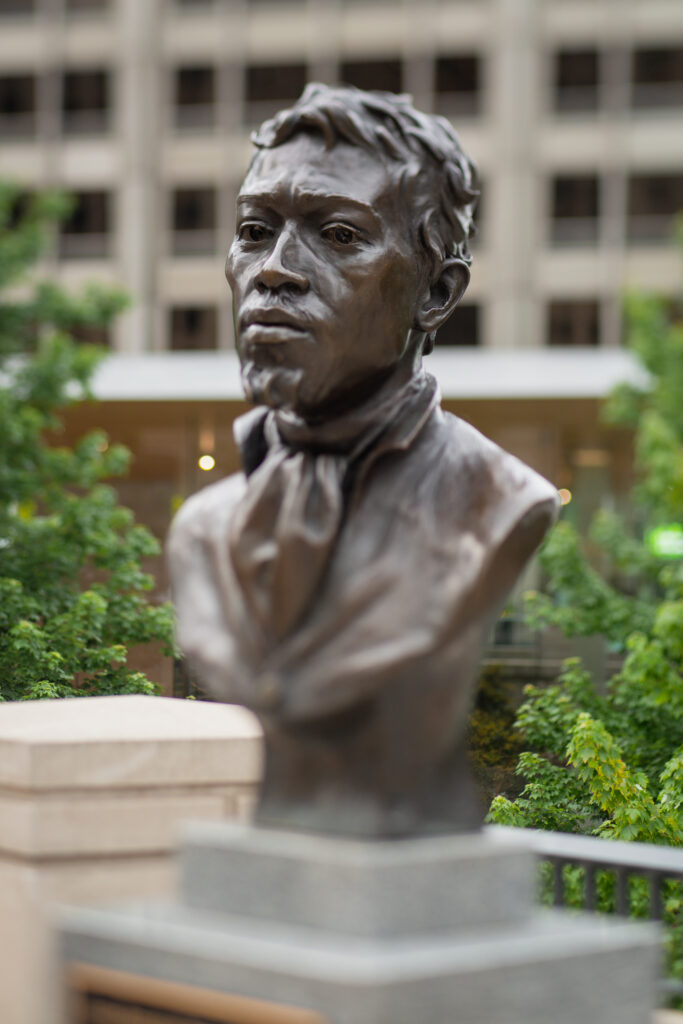
Photos of it are regularly used to illustrate news stories highlighting DuSable’s story and grace the DuSable Museum website. The statue itself is a tourist attraction and a natural gathering place for commemorations of the man it depicts and Chicago’s Black history in general. It’s a hard-won point of pride for Black Chicago, and it will undoubtedly be a point of comparison for whatever public imagery of DuSable we get next. The Park District’s DuSable is an opportunity to break fully from the Andreas portrait’s influence, along with the missed opportunities of too many subsequent depictions.
Visual representations celebrating DuSable’s being, presence, and accomplishments are important defiances of the denigration of Black people, but at what point do they boomerang into promotions of American individualism and expansionism? How can DuSable’s place within his and Kitihawa’s Potawatomi community, the reality of the genocidal force they faced, and their departure from the city they are hailed as founding, deepen our understanding of where we are today?
It took years of African-American culture workers’ and artists’ labor to finally get our clearly Black (and handsome) DuSable, and that work continues. The stakes are still high, the risks are still great, and the need remains for public art that questions the stories we accept about this country and how it came to be. That army officer’s scant words, Andreas’s futile portrait, those don’t have to rule DuSable’s public life anymore. Facsimiles of status quos past, let’s leave those behind, along with that confounding hair.
About the Author: Ann-Derrick Gaillot is a writer based in Chicago who likes to make zines. Check her work out at @adgzines.

About the Photographer: Kristie Kahns works in the photographic field as an educator, image-maker, writer, and independent researcher, based in Chicago. Her interests include contemporary and ecocritical approaches to photographic materiality, and the pedagogy of analogue and historical processes. Her writing has been published by Sixty Inches From Center, Lenscratch, and Bridge Chicago magazine. Most recently, she was awarded the 2025 Elaine Ling Research Fellowship from The Image Centre at Toronto Metropolitan University. She holds an MA from the School of the Art Institute of Chicago, and a BA in Photography from Columbia College Chicago.