You are here: Home // Artists, Editorial // Bibiana Suárez: Memoria(Memory) and the Latino Experience

Bibiana Suárez: Memoria(Memory) and the Latino Experience

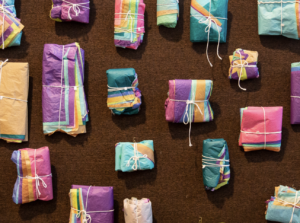
"Se Habla Ingles" and other pairs, 2011. (Image Credit: Ray Figlewski.)

When considering Bibiana Suárez’s exhibition Memoria(Memory), one must look past the distinction of Chicano, Cuban, or Puerto Rican art as separate entities and instead view the exhibition as a portrayal of the  Latino experience in the United States as a whole.  While a daunting task, Suárez narrowly escapes simplifications and allows for the playfulness of her work to strike a stimulating conversation on Hispanic/American cultural ties.

In the late 80’s early 90’s Suarez was part of a “Latino boom”—a fierce integration of Hispanic arts and culture within the United States. Born in Puerto Rico, Suárez came to Chicago in 1980 to finish her studies at the School of the Art Institute. “It was a place where East and West mentality meets” Suarez explained when asked why she chose the Windy City as a starting point to her artistic career. It was at the Art Institute museum where she began seeing her passion for history through an artistic lens.  Through this artistic Chicago landmark, she began a lifelong focus of interpreting national and generational identities through the arts.

It is also during this time that Suárez began to approach her art in what she calls a “game aesthetic.” “People were engaged,” said Suárez, “on the formal qualities of the work but not in the actual content, so I had to find a way to have people not dismiss that part of the work.” This desire for audience interaction drove the artist to create interactive exhibitions in the form of games and eventually Memoria (Memory, a spin on the classic children’s game Memory. Her painted ‘cards’ are speckled across three massive walls in the exhibition, as if laid on a table some facing up and some down. The result is a clash of seemingly innocuous images, and a dark, ominous history between the United States and the Latino experience. This collision is done by both the images she chose to incorporate and their placement in contrast to the other pictures. For example, by placing a matching pair of mangos next to a graphic picture of burnt migrant workers she is not commentating on how people take their fruit for granted, but instead that they are all part of the same story, the same cultural roots. The proximity of the images creates an interwoven piece urging the audience to view the exhibition as a whole, not simply interpreting each individual “card” alone.

"Jugo de mango" y "Campamento de trabajadores emigrantes despures del fuego"

"Jugo de mango" y "Campamento de trabajadores emigrantes despures del fuego", 2011. (Image Credit: Ray Figlewski.)

Using the images on her cards, Suarez is able to expose Latino identity in American culture and tear down some of the facades they carry.  With constant juxtapositions in the medium and content, Suarez acknowledges how American and Latino identity is both accepting and dismissive. “Images are very important on how we construct identity”, says Suárez, “we rarely stop and think how those images have messages and value”. With this exhibit, the Latino artist allows for the audience to interactively “question the relationship of the pairs in relation to the other pairs”, and to collectively give a Latino commentary on their integration into popular American culture.

In her exhibition, Suarez creates a muddled relationship between the United States and the Latino world. “Culture is never static, always changing, with an element of chance in history. [Society] cannot place people in a niche because they are constantly changing.” Memoria (Memory) imposes that all aspects of the “Latinization” of the United States are intricately connected to a collage of people, events, and objects. While some are positive and some horrifying, they are none the less part of the same river of colliding cultural currents.

To learn more about the subject and hear from the artist, a panel “Play, Concentrate, Remember: The Interwoven Histories of Latinos and Mainstream USA,”  will be held at the Hyde Park Art Center on Feb. 11th from 1-3 P.M with a reception following.

Tags: , , , , , , , , , , ,

2 Responses to " Bibiana Suárez: Memoria(Memory) and the Latino Experience "

  1. Benton says:

    Superb article, stylish site layout, continue the great work

  2. Alberto says:

    Outstanding information and facts! I have already been looking for something similar to this for some time now. Thanks!

Leave a Reply

Copyright © 2010 Sixty Inches From Center, All rights reserved.